An ingredient list is one of the most useful things printed on a skincare box, and one of the most misunderstood. It isn't a secret code and it isn't a warning label. It's a ranked list with a handful of simple rules, and once you know them, you can tell in about a minute whether a serum really leans on its star ingredient or just mentions it in passing.
This guide covers how to read skincare labels without a chemistry degree: the six rules behind every ingredient list, how to find the actives and roughly where they sit, what front-of-pack claims like "hypoallergenic" and "clean" actually mean, the little open-jar symbol, sunscreen labels, and why a long, scary-sounding name usually isn't scary at all. There's also a table you can screenshot for your next shopping trip.
My skin is combination and on the sensitive side, so I learned to read labels partly out of self-defense. The good news is that it gets fast. Really fast.
What an Ingredient List Can (and Can't) Tell You
The ingredient list on the back of a product is usually written in INCI names (International Nomenclature of Cosmetic Ingredients). It's a shared naming system, so the same ingredient carries the same name whether you buy the product in the US, Europe or Korea. That's why you'll see "Butyrospermum Parkii Butter" instead of "shea butter" and "Tocopherol" instead of "vitamin E."
I like to think of an ingredient list as the cast list of an Old Hollywood film. You can see who's in it and who has the lead role, but you can't see how good the performance is. Here's what the list can tell you:
- What's in the formula, including anything you already know your skin dislikes.
- Roughly what's a main ingredient and what's a supporting one, thanks to the order.
- Whether fragrance, essential oils or drying alcohol are included, and roughly how prominent they are.
- Whether the advertised star ingredient is actually there, and whether it's near the top or near the end.
And here's what it can't tell you:
- Exact percentages, unless the brand chooses to share them (or it's a sunscreen, more on that below).
- How well the formula is made: its pH, stability, texture and packaging all matter, and none of that is on the list.
- How your skin, specifically, will react. Two people can read the same list and have completely different experiences.
Keep those limits in mind and the list becomes a calm, useful tool instead of something to obsess over.
6 Rules for Reading an Ingredient List
These six rules cover almost every skincare label you'll pick up. Learn them once and you'll never look at the back of a bottle the same way.
1. Ingredients Are Listed in Order of Concentration
Ingredients are listed from the highest amount to the lowest, by weight. Whatever comes first makes up the biggest share of the formula, the second ingredient the next biggest, and so on.
In practice, the first five or so ingredients usually make up most of the product. That's where you'll find the base: water, humectants like glycerin, oils, emollients and the ingredients that create the texture. If glycerin is second on a moisturizer, it's a major player. If a lovely oil is printed in big letters on the front but sits twentieth on the back, it's a guest appearance.
A quick habit that helps: read the first five ingredients out loud (or in your head). They tell you what the product mostly is, before the marketing tells you what it wants to be.
2. After the 1% Line, Any Order Goes
Here's the rule most people never hear about. Once ingredients drop to 1% or less, brands can list them in any order. So the "descending order" rule only really applies to the top part of the list.
You can't see where that 1% line falls, but there are clues. Preservatives are a helpful landmark: phenoxyethanol, a very common one, is typically used at 1% or less (in the EU it's capped at 1%). So anything listed after phenoxyethanol is usually present at 1% or less too.
That doesn't make those ingredients useless. Plenty of ingredients work beautifully at tiny amounts: retinol, many peptides, antioxidants and soothing extracts are often used well under 1%. It simply means the order below that line doesn't tell you which of them is "more" in the formula.
3. Plant Extracts Go by Latin Names
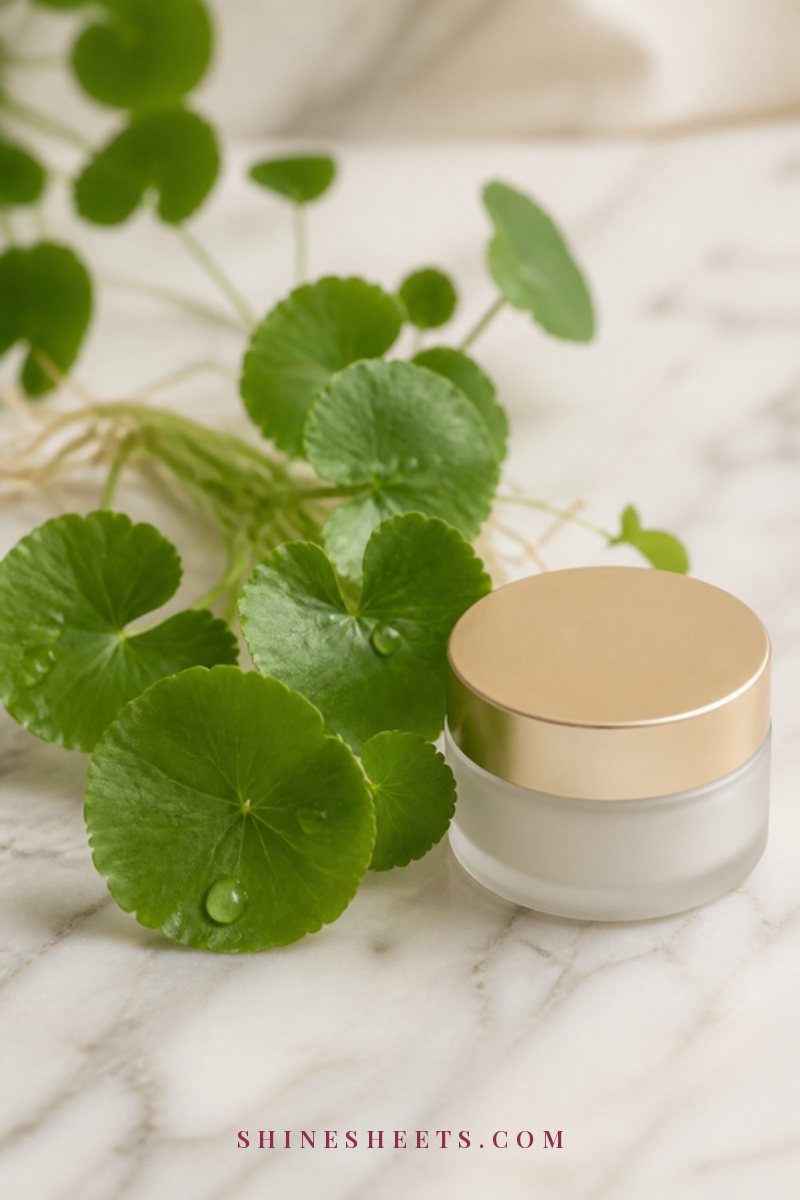
Botanical ingredients are listed by their Latin plant names, often with the common name in brackets. A few you'll see constantly:
- Camellia Sinensis Leaf Extract: green tea.
- Centella Asiatica Extract: centella, the "cica" in so many Korean soothing products.
- Butyrospermum Parkii Butter: shea butter.
- Simmondsia Chinensis Seed Oil: jojoba oil.
- Aloe Barbadensis Leaf Juice: aloe vera.
- Chamomilla Recutita Flower Extract: chamomile.
One gentle reminder: plant-based doesn't automatically mean gentle. Many plant extracts are lovely, and some can irritate reactive skin. A Latin name is just a name, not a promise in either direction.
4. Water (Aqua) Usually Comes First
In creams, lotions, gels, toners and most serums, the first ingredient is usually water, written as Aqua, Water or Aqua/Water/Eau. People sometimes call it filler, but it's really the base: it dissolves many ingredients, creates the texture and helps everything spread.
Sometimes a brand replaces water with something else, such as aloe leaf juice, a flower water or a tea infusion. That can be nice, but it isn't automatically better. And if you're reading an oil, a balm or a cleansing oil, there may be no water at all, which is completely normal.
5. "Fragrance" or "Parfum" Can Stand for Many Ingredients
This is the big one for sensitive skin. A single word, "Fragrance" or "Parfum," can represent a blend of many different scent components. In the US, brands can list that blend as one word. In the EU, certain well-known fragrance allergens have to be named individually once they're above small amounts, which is why you'll often see words like Limonene, Linalool or Geraniol near the end of a European list.
Fragrance isn't bad for everyone, but it's one of the most common reasons products bother reactive skin. If your skin is easily irritated, a gentle, fragrance-free cleanser is a smart place to start, because it's the product you use most often. I wrote a whole balanced guide to fragrance in skincare and who should avoid it if you want the full picture.
6. Colorants Sit at the End
Color additives are usually grouped at the very end of the list. In many countries they appear as CI numbers (Color Index): CI 77891 is titanium dioxide, and CI 77491, CI 77492 and CI 77499 are iron oxides. In the US you might see names like Iron Oxides, Mica or Red 40 instead.
In tinted products and makeup, you'll sometimes see "May Contain" or "+/-" before a group of colorants. That simply means one list covers several shades, and each shade uses a slightly different mix.
How To Spot the Actives (and Roughly Where They Sit)
"Actives" is an informal word for the ingredients that do the main job a product promises: brightening, exfoliating, hydrating, smoothing. Here are the INCI names to look for:
- Niacinamide: vitamin B3, used for oil balance, redness and an even-looking tone.
- Ascorbic Acid, Sodium Ascorbyl Phosphate, Ascorbyl Glucoside, 3-O-Ethyl Ascorbic Acid: different forms of vitamin C.
- Retinol, Retinal (Retinaldehyde), Retinyl Palmitate: vitamin A forms, from stronger to gentler.
- Glycolic Acid, Lactic Acid, Mandelic Acid: AHAs, the surface exfoliants.
- Salicylic Acid: BHA, the oil-loving exfoliant for pores.
- Sodium Hyaluronate, Hyaluronic Acid: hydrating humectants.
- Ceramide NP, Ceramide AP, Ceramide EOP: barrier-supporting lipids.
- Panthenol: provitamin B5, soothing and hydrating.
Now, roughly where should they sit? A loose guide:
- Top part of the list (first five to eight): ingredients the product is built on. If a product advertises "10% niacinamide," you'd expect niacinamide high up, often right after water and a humectant.
- Middle: supporting actives, emollients, thickeners.
- After the preservative: ingredients at 1% or less. Fine for low-dose actives like retinol or peptides, less convincing for an ingredient the front of the box shouts about as the main event.
Niacinamide is a good one to practice on. In a niacinamide serum, you'll usually find it within the first few ingredients. If you're curious about what it does and how much is enough, my guide to niacinamide goes into it gently.
Once you can spot actives, you can also spot doubling up. Two products with exfoliating acids, or a retinol serum plus a retinol night cream, can be a lot for sensitive skin. This guide to skincare ingredients you shouldn't mix is handy when you're layering.
What Common Label Claims Really Mean
The front of the box is marketing; the back is information. Many popular front-of-pack claims don't have a strict, shared legal definition, at least not in the US, so they mean whatever the brand has decided they mean. That doesn't make them lies. It just means they're a starting point, and the ingredient list is where you check.
Here's the table I'd keep in my phone. Screenshot it for your next drugstore trip.
| Label term | What it means | What it does not mean | When to care |
|---|---|---|---|
| Dermatologist tested | A dermatologist was involved in some testing, often a patch test on a group of volunteers | That dermatologists recommend it, or that it will suit your skin | Mildly reassuring for sensitive skin; still patch test |
| Hypoallergenic | The brand believes it's less likely to cause allergic reactions | That no one can react to it; there's no single required standard behind it | Read the list for your own known triggers |
| Non-comedogenic | Formulated or tested to be less likely to clog pores | A guarantee you won't break out | Acne-prone skin, mostly for leave-on face products |
| Fragrance-free | No fragrance added to give the product a scent | That nothing in it has a natural smell; some plant ingredients still smell | Sensitive, reactive or eczema-prone skin |
| Unscented | The product has no noticeable smell | No fragrance; a masking scent may be used to neutralize the base smell | Check the list for Fragrance or Parfum |
| Clean | The brand's own list of ingredients it chooses to leave out | Safer or better for skin; there's no shared definition | Rarely; read the actual ingredient list instead |
| Natural / Organic | Some ingredients come from plants, or from certified organic farming if a certification is shown | Gentler, purer or allergy-proof | If it matters to your values; look for a named certification |
| Clinically proven | The brand ran a study on a specific claim, sometimes small | That the result applies to everyone or is dramatic | Check what exactly was measured and for how long |
| Vegan | No animal-derived ingredients | Anything about skin benefits or how the product was tested | If it matters to your values |
| Broad spectrum | A sunscreen passed a test for both UVA and UVB protection (US labeling) | That a low SPF is enough for a long day outdoors | Always, for any daily sunscreen |
The pattern is simple: claims about what's left out ("free from," "clean") tell you less than they seem to, and the ingredient list tells you more than it seems to.
The Open-Jar Symbol and Expiry Dates
Look for a tiny drawing of an open jar with a number and the letter M, like "6M" or "12M." That's the period-after-opening symbol, and it tells you how many months the product is meant to be used for once you've opened it. In the EU, products that last longer than 30 months unopened use this symbol, while products with a shorter shelf life carry a "best before" date instead, sometimes shown with a small hourglass.
Sunscreens are a little different. In the US they're regulated as over-the-counter drugs, so they usually carry an expiration date. If a sunscreen doesn't, the FDA's general guidance is that it should stay stable for about three years, but I'd still toss one that has changed.
A few signs a product is past its best, whatever the label says:
- The smell has changed, turned sour, waxy or simply "off."
- The texture has separated, gone grainy or watery.
- The color has shifted, like a vitamin C serum turning dark orange or brown.
The easiest habit: write the opening month on the bottom of the bottle with a fine marker, or keep a little log in a cream skincare notebook with the product name, the date you opened it and how your skin felt in the first two weeks. It sounds fussy. It saves so much guesswork when something suddenly doesn't agree with you.
Reading a Sunscreen Label: SPF and Broad Spectrum
Sunscreen labels are the one place you'll often get exact percentages. In the US, sunscreens have a "Drug Facts" panel that lists the active ingredients with their percentages first, then the inactive ingredients separately. Mineral filters are zinc oxide and titanium dioxide; chemical filters include names like avobenzone, homosalate and octocrylene.
What the key terms mean:
- SPF measures protection mainly against UVB, the rays most responsible for sunburn.
- Broad spectrum means the sunscreen has also passed a test for UVA protection, the rays tied to long-term sun damage. For daily use, broad spectrum with SPF 30 or higher is a common, sensible starting point.
- Water resistant (40 or 80 minutes) tells you how long it holds up while swimming or sweating. US labels aren't allowed to say "waterproof" or "sweatproof."
- PA+ to PA++++ is a UVA rating you'll see on many Korean and Japanese sunscreens; more plus signs means more UVA protection. In Europe, a small "UVA" in a circle shows the product meets the EU's UVA standard.
If your skin is sensitive, a broad-spectrum mineral sunscreen with zinc oxide is often the gentlest pick. For a deeper look at filters, this guide on choosing the right active sunscreen ingredients lays them out side by side. And whatever the label says, the amount matters: roughly a quarter teaspoon for the face, reapplied when you're outdoors for longer stretches.
Why a Scary-Sounding Name Isn't Automatically Bad
Long chemical names can look alarming, especially next to a cute botanical one. But chemistry names describe structure, not danger. Some of the gentlest, most common skincare ingredients sound the most intimidating:
- Tocopherol: vitamin E, an antioxidant.
- Sodium Hyaluronate: a form of hyaluronic acid that holds on to water.
- Butylene Glycol: a lightweight humectant that helps hydrate and spread the formula.
- Cetearyl Alcohol: a fatty alcohol that makes creams soft and smooth. It's not the same as drying alcohol.
- Caprylic/Capric Triglyceride: a light, silky emollient usually derived from coconut oil.
- Ceramide NP: a lipid naturally found in your skin barrier.
Meanwhile, some things that sound friendly, like certain essential oils, can be the actual troublemakers for reactive skin. What matters is the ingredient, the amount and your own skin, not how the name sounds.
The ingredient worth a second look is "Alcohol Denat." (or "SD Alcohol") high up on the list. It gives a light, quick-drying feel and is common in sunscreens and toners for oily skin, but it can feel tight or stingy on dry or sensitive skin. If your skin likes simple and soothing, a simple ceramide moisturizer with a short list and those friendly fatty alcohols is usually a calmer choice.
A 5-Step Label Routine Before You Buy

Here's the little routine I run through in the store or before checking out online. It takes about a minute once you're used to it:
- Flip to the back first. Read the ingredient list before the front claims, so the marketing doesn't frame what you see.
- Read the first five ingredients. They tell you what the product mostly is: watery, rich, oily, gel-like.
- Find the star and the preservative. Locate the advertised active, then a preservative like phenoxyethanol. Is the star above it, or tucked in after it?
- Scan for your personal "no" list. Keep a short note on your phone of ingredients your skin has disliked before (fragrance, a specific essential oil, drying alcohol) and look for them.
- Check the symbols and claims last. The open-jar number, SPF and broad spectrum, then the front-of-pack claims, now that you know what's actually inside.
At home, keeping products in a clear acrylic skincare organizer with the labels facing out makes it easy to check opening dates and spot doubled-up actives. And if you're building a routine from scratch, start small: my skincare routine for beginners keeps it to the four steps that actually matter.
Patch Test First, and When To See a Dermatologist
Reading labels lowers the odds of a bad match, but it can't predict everything. Even a beautifully simple formula can disagree with your skin. That's why I always suggest patch testing anything new, especially leave-on face products. This step-by-step on how to patch test skincare walks you through it.
Introduce one new product at a time, give it a week or two before adding the next, and stop using anything that causes burning, itching, swelling or a rash. If a reaction is strong, keeps coming back or doesn't settle after you stop the product, please see a dermatologist. They can look at your skin properly and, if needed, run patch testing to pinpoint the exact ingredient behind it, which is so much more useful than guessing from a list.
Final Thoughts
Learning to read skincare labels isn't about becoming suspicious of everything on the shelf. It's about trading guesswork for a little confidence: knowing what a product mostly is, where its star ingredient sits and which promises on the front are worth a second look.
Start with the first five ingredients and the preservative landmark, and the rest will follow naturally. You don't need to memorize anything. A calm minute with the back of the box is all it takes to choose with your eyes open, and your skin will thank you for it.