Copper peptides are one of those skincare ingredients that sound far more dramatic than they really are. They aren't a miracle and they aren't dangerous. They're a gentle, supportive ingredient that does its best work when the rest of your routine is calm, simple and kind to your skin barrier.
The tricky part isn't the copper peptide itself. It's everything around it: which actives you already use, how often you apply it, and whether your skin is in a good place to try something new. Get those three things right and copper peptides tend to be an easy, low-drama addition.
This guide covers copper peptides from the ground up: what they are, what they're said to do (and what the evidence actually says), who they suit, exactly how to use them, the four things not to pair them with on the same night, a pairing table with safer timing, and the signs that it's time to pause. If you want the bigger picture of the whole peptide family first, my guide to peptides in skincare is a good warm-up. This one zooms in on copper only.
What Are Copper Peptides?
Peptides are short chains of amino acids, the building blocks of proteins. A copper peptide is a peptide bonded to a copper ion. The one you'll see most often in skincare is GHK-Cu, sometimes written on ingredient lists as "copper tripeptide-1."
GHK is a small peptide that occurs naturally in the human body, and it has a strong natural attraction to copper. Researchers first described it decades ago while studying human blood plasma, and since then it has been looked at in lab studies on skin cells and wound healing. Skincare brands took that interest and turned it into serums, creams and essences.
A few simple things to know before you shop:
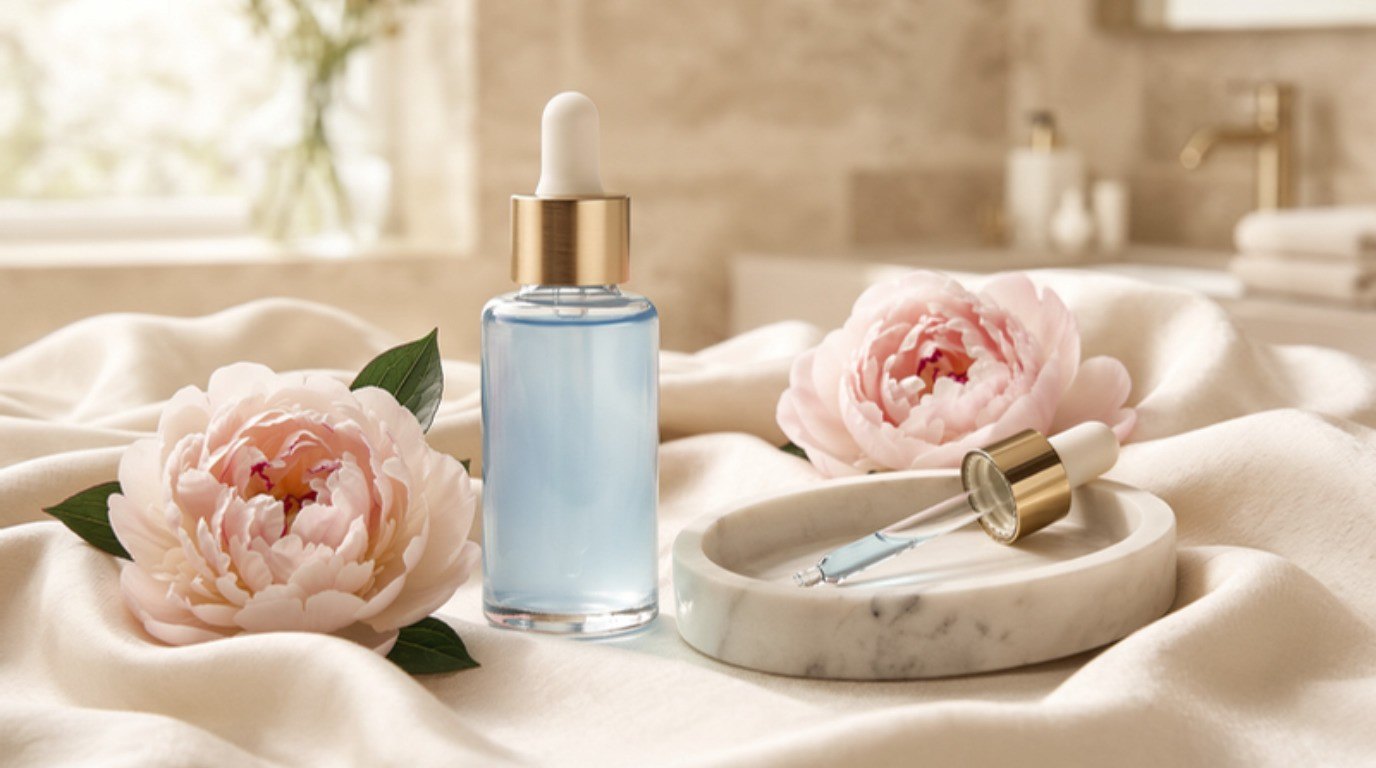
- Color is normal. Many copper peptide serums are a soft blue tint. That comes from the copper itself, not from added dye.
- Texture is usually light. Most are watery serums or thin lotions that sit early in your routine, right after cleansing.
- Concentration varies a lot. Some products list copper peptides near the top of the ingredient list, others include a tiny amount next to many other peptides. Neither is automatically better for a beginner.
- They're not an exfoliant. Copper peptides don't dissolve dead skin like acids do, so they shouldn't tingle or sting. If they do, something is off.
Think of copper peptides as a supportive ingredient rather than a corrective one. They sit in the same "care" category as ceramides and soothing ingredients, not in the "strong active" category with retinoids and acids.
What Copper Peptides Are Said To Do (and What the Evidence Says)
Here's where I want to be plain with you, because copper peptides are often marketed with very big words. The claims you'll see usually fall into three groups:
- Support for firmness. In lab studies, GHK-Cu has been shown to influence collagen and elastin activity in skin cells. That's where the "firming" and "plumping" language comes from.
- Support for the look of healing. Copper peptides have a long research history around wound healing, which is why brands describe them as "repairing" or "recovering." In skincare, this translates into helping skin look calmer and less stressed.
- Support for the skin barrier. Some formulas are positioned as barrier-friendly serums for skin that feels tight, dull or overworked.
And here's the honest part. Much of the strongest research on GHK-Cu comes from lab and cell studies, not from large, long clinical trials on real faces using real store-bought serums. The cosmetic studies that do exist tend to be small. That doesn't mean copper peptides don't work. It means the results are best described as subtle and gradual: skin that looks a little smoother, a little more even and a little more comfortable over a couple of months.
If a product promises to "erase wrinkles" or "replace Botox," please quietly put it back on the shelf. A good copper peptide serum is a nice supporting player. It won't replace sunscreen, a gentle cleanser and a moisturizer, and it won't do what a dermatologist's treatment does.
One more thing worth saying: skincare is not medicine. Copper peptides are not a treatment for any skin condition, scars or wounds. If you have a skin concern that worries you, a dermatologist is the right person to ask.
Who Copper Peptides Suit Best
Copper peptides are generally well tolerated, which makes them interesting for skin that doesn't love strong actives. They tend to suit:
- Dull skin that looks a little tired and flat, especially when you don't want to add another exfoliant.
- Mature skin that's starting to look less bouncy and wants gentle, supportive care alongside sunscreen.
- Recovering skin that has been through a phase of over-exfoliating, too many new products or a harsh season, and now just wants calm. (Wait until the stinging and redness have settled first; more on that below.)
- Sensitive or combination skin that wants something to look forward to in an evening routine without the drama of acids.
My own skin is combination and sensitive, with a T-zone that turns shiny by lunchtime, so I always pay attention to ingredients that promise results without irritation. Copper peptides sit in that gentle category, which is exactly why they're worth understanding properly.
Who should be more careful? Anyone with very reactive skin, a known sensitivity to metals, or an active skin condition should talk to a dermatologist before adding copper peptides. And if you're pregnant or breastfeeding, please ask your doctor before starting any new active ingredient, this one included.
How To Use Copper Peptides: Step by Step
The good news: using copper peptides is simple. The routine below is built for a beginner, with the barrier first and the new ingredient introduced slowly.
- Patch test first. Apply a small amount to the side of your neck or just behind your ear once a day for a few days. If there's no redness, itching or bumps, you're ready for your face. My step-by-step guide on how to patch test skincare walks you through it properly.
- Cleanse gently. Use a soft, non-stripping cleanser in the evening. A gentle cream cleanser is a pick for this step, because squeaky-clean skin is already a little stressed before the serum even goes on.
- Pat your skin mostly dry. A soft towel, a light press, no rubbing. Slightly damp is fine; dripping wet can make some serums feel more tingly.
- Apply 2–3 drops of copper peptide serum. Warm them between your fingertips and press over your face, avoiding the eye area and the corners of your nose and mouth at first. A copper peptide serum with a short, simple ingredient list is my preferred kind for a beginner.
- Wait about a minute. Let it sink in while you brush your teeth or light a candle.
- Follow with moisturizer. This is the step people skip and it matters. A ceramide moisturizer helps seal in hydration and keeps the barrier comfortable while your skin gets used to something new.
- Start every other evening. For the first two weeks, use copper peptides on alternate nights. If your skin stays calm, move to most evenings in weeks three and four.
- Wear sunscreen every morning. Copper peptides aren't known for making skin more sun-sensitive the way some actives do, but daily SPF is the single most useful thing you can do for firmness and even tone anyway. A lightweight broad-spectrum SPF 50 fluid layers easily under makeup.
Morning or evening? Either can work, but I'd choose evening for a beginner. It keeps copper peptides away from a morning vitamin C serum and gives your skin a quiet, product-light night to adjust.
4 Things Not To Pair With Copper Peptides on the Same Night
This is the part that causes the most confusion, so let's keep it very simple. Copper peptides are delicate. Very acidic ingredients can break peptides down, and copper can react with some antioxidants, which may leave you with two products working less well (and sometimes a more irritated face). These four are the ones to keep on separate nights:
- Strong AHA or BHA exfoliants. Glycolic, lactic and salicylic acid toners or serums have a low pH. On the same night, they can interfere with the peptide and pile irritation onto irritation. Use them on a different evening.
- Pure vitamin C (L-ascorbic acid). L-ascorbic acid is also very acidic, and copper and vitamin C are thought to react with each other. The easy fix: vitamin C in the morning, copper peptides in the evening. My vitamin C serum guide explains how to fit it into a morning routine.
- Retinol, at least at first. Retinol and copper peptides aren't a dangerous combination, but both are new-ish to your skin and retinol is known for dryness and flaking at the start. Layering them together while you're still adjusting makes it impossible to know which one is causing a reaction. Keep them on separate nights for the first couple of months. If you're new to retinol too, start with my retinol for beginners guide.
- Peels and at-home peel pads. Any strong peel, peel pad or "resurfacing" mask belongs on its own night, followed by a plain moisturizer. Copper peptides can come back a day or two later, once your skin feels completely calm.
If you'd like the wider view of what not to layer, my article on skincare ingredients not to mix has the full list.
Copper Peptides Pairing Table: What Goes Together and When
Screenshot this one and keep it with your skincare. It's the quick answer to "does this go with that?"
| Ingredient | With copper peptides? | Why | Safer timing |
|---|---|---|---|
| Glycolic, lactic or salicylic acid | Not on the same night | Low pH may break down the peptide and add irritation | Acids on one evening, copper peptides on another |
| Pure vitamin C (L-ascorbic acid) | Not in the same routine | Very acidic, and copper and vitamin C may react with each other | Vitamin C in the morning, copper peptides in the evening |
| Retinol | Not at first | Both are new; retinol can cause dryness that's hard to tell apart | Alternate nights for the first two months |
| Peels and peel pads | No | Too much stress on the barrier at once | Peel night alone; copper peptides 1–2 days later |
| Hyaluronic acid | Yes | Gentle hydration that supports comfort | Same routine, serum layers or a hydrating toner first |
| Ceramides | Yes | Supports the barrier while you add something new | Moisturizer right after the serum |
| Niacinamide | Usually fine | Most people tolerate both; go slowly if your skin is reactive | Same night once each is familiar to your skin |
| Sunscreen | Always | Protects the results you're working toward | Every morning, rain or shine |
A small note on niacinamide: you'll sometimes read that it shouldn't be combined with copper peptides. Most people are fine with both, but if your skin is easily irritated, introduce one at a time and give each a couple of weeks on its own first.
A Gentle Weekly Routine With Copper Peptides

Here's how a calm week can look once you're past the first two weeks of every-other-night use. Adjust it to your own actives, but keep the spacing.
- Monday evening: cleanse, copper peptide serum, moisturizer.
- Tuesday evening: cleanse, retinol (if you use it), moisturizer.
- Wednesday evening: cleanse, copper peptide serum, moisturizer.
- Thursday evening: cleanse, exfoliating acid (if you use one, once or twice a week is plenty), moisturizer.
- Friday evening: cleanse, copper peptide serum, moisturizer.
- Saturday evening: a rest night: cleanse and moisturizer only.
- Sunday evening: cleanse, copper peptide serum, moisturizer.
- Every morning: gentle rinse or cleanse, vitamin C if you use it, moisturizer, sunscreen.
The rest night is not a waste. Skin often looks its best when it gets a break, and it gives you a clean baseline to notice how things are going. A soft blush silk pillowcase is a sweet little extra for those evenings, because it feels smooth against freshly moisturized skin and doesn't tug.
Evening tea, a candle, a few slow minutes with your serum. That's my favorite way to think about a routine like this: a calm ritual, not a project.
How To Choose a Copper Peptide Serum
You don't need the most expensive bottle. You need a formula that's simple, stable and suited to your skin. Here's what I'd look for:
- "Copper tripeptide-1" or "GHK-Cu" on the ingredient list. That's the one with the most research behind it.
- A short, calm formula. Water, the peptide, a humectant like glycerin or hyaluronic acid, maybe a soothing ingredient. Fewer extras means fewer surprises for sensitive skin.
- No strong acids in the same bottle. If a "copper peptide" serum also contains glycolic acid or L-ascorbic acid, it defeats the point.
- Fragrance-free if you're sensitive. Fragrance is one of the most common reasons a new product stings.
- Opaque or tinted packaging. Peptides are happier away from light and air. A dropper bottle or pump that closes well is ideal.
- A realistic description. Words like "supports," "smoother-looking" and "comfortable" are a good sign. "Instant facelift" is not.
Store it in a cool, dark place (a bathroom cabinet away from the shower steam works) and close the cap firmly after each use.
Signs To Pause Copper Peptides

Copper peptides are gentle, but any new product can disagree with your skin. Pause and go back to a plain cleanser, moisturizer and sunscreen if you notice:
- Stinging or burning that lasts more than a few seconds after application.
- Redness that appears after you apply it and lingers, or gets worse over several nights.
- Flaking or peeling that wasn't there before you started.
- Itching or small bumps, especially in one area.
Give your skin at least a week of plain, gentle care before you try again, and when you do, go back to every third night with less product. If the same reaction comes back, copper peptides may simply not be your ingredient, and that's completely fine. There are plenty of other gentle options.
And please, if you have swelling, a rash that spreads, or a skin issue that sticks around for more than a couple of weeks, stop all new products and see a dermatologist. That's not a failure. It's just the kindest next step.
Common Copper Peptide Mistakes
Most problems with copper peptides come from the routine around them, not the ingredient. These are the ones I see most often:
- Starting on already irritated skin. If your barrier is red and tight from over-exfoliating, wait until it's calm. My guide on how to restore your skin barrier is a good first stop.
- Adding three new products at once. One new product at a time, two to four weeks each, so you always know what's helping and what isn't.
- Layering it with every active you own. Copper peptides prefer a quiet routine. Keep acids, pure vitamin C and peels on other days.
- Using too much. Two to three drops cover the face. More doesn't mean faster results.
- Skipping moisturizer. A serum on its own can leave sensitive skin feeling tight. Always follow up.
- Expecting results in a week. Give it eight to twelve weeks of consistent use before you decide whether it's worth keeping.
- Forgetting sunscreen. Without daily SPF, sun exposure undoes much of what any firming ingredient is trying to support.
Final Thoughts
Copper peptides are best enjoyed as a calm, supportive step in a routine that's already kind to your skin. Patch test, start slowly, keep strong acids and pure vitamin C on their own time, and always finish with moisturizer and sunscreen.
Your skin doesn't need to be pushed to look its best. Most of the time, it just needs steady, gentle care and a little patience, and you're already giving it that by reading up before you start.