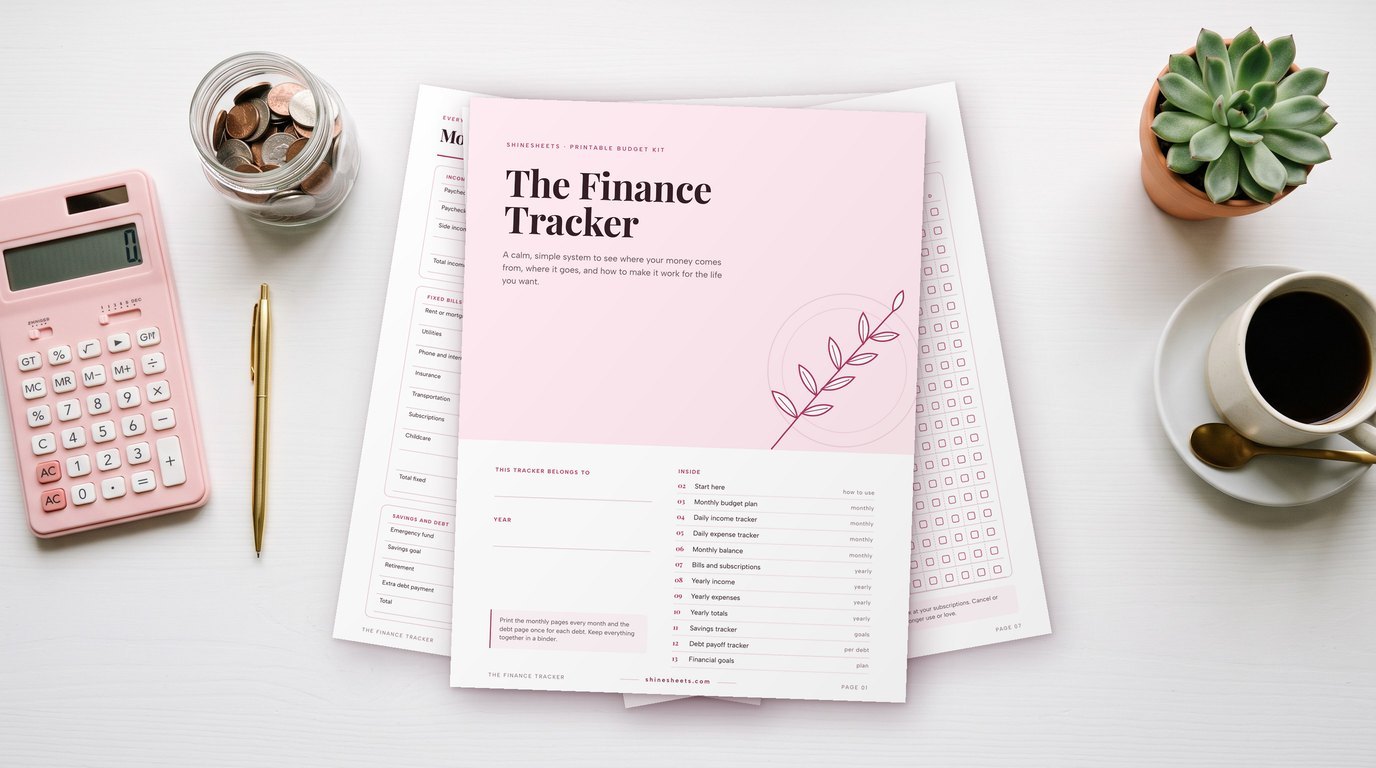
A low buy year isn't about saying no to everything you love. It's about deciding, ahead of time and with a clear head, what actually deserves your money – so you stop handing it over on autopilot to things you forget about a week later. Done gently, it feels less like a diet and more like finally noticing what makes you happy.
Most of us don't overspend on big, dramatic purchases. We overspend in tiny, forgettable pieces: the third neutral sweater, the lip gloss that was "only" a few dollars, the cute storage thing that now needs its own storage. A low buy gently closes those little leaks while leaving room for the things that genuinely light you up.
This guide walks you through how to do a low buy year step by step: how it differs from a no buy, how to look back at your spending without shame, how to write your three lists, set category caps and handle the urge when it shows up. You'll also find a low buy rules table you can copy into a pastel budget planner notebook (or just screenshot), plus ideas for birthdays, holidays and a mid-year check-in.
Pour yourself something warm. This is going to feel lighter than you think.
What Is a Low Buy Year?

A low buy year is a twelve-month commitment to buy less, on purpose, using rules you write yourself. You still buy what you need. You still buy some things you simply want. What changes is that every purchase has to fit a plan you made on a calm day, not a feeling you had at 10 p.m. with a shopping app open.
There's no official rulebook, which is the best part. Your low buy might focus on clothes and beauty only. Someone else's might target takeout and home decor. The point isn't to copy anyone's list, it's to look at your habits and set limits where they actually matter.
Low Buy vs. No Buy
A no buy is strict: you pick categories and buy nothing in them for a set time, apart from true necessities. It works beautifully for short sprints – a month like a no-spend January is a great way to reset your habits and see how much you really need.
A low buy is softer and longer. Instead of "nothing," it's "less, and only on purpose." Here's how they compare:
- Length: a no buy usually lasts a few weeks to three months; a low buy is often six months to a full year.
- Rules: a no buy says zero in chosen categories; a low buy uses caps, waiting periods and replacement rules.
- Feeling: a no buy can feel intense and exciting; a low buy feels calmer and more like a new normal.
- Best for: a no buy suits a quick reset; a low buy suits changing habits for good.
Why a Low Buy Works Better Long Term
Strict spending bans tend to end the way strict food rules do: a burst of discipline, then a rebound. When something you enjoy is completely off the table, the wanting gets louder, and the day the challenge ends often turns into a big catch-up haul.
A low buy avoids that swing for a few reasons:
- It leaves room for joy. You plan small treats in advance, so you never feel like you're being punished.
- It teaches you a skill, not just a rule. You learn to pause, compare and choose – and that stays with you after the year ends.
- It's realistic. Life still happens. Shoes wear out, friends get married, your favorite moisturizer runs out. A low buy expects that.
- It shows you your patterns. Twelve months is long enough to see seasonal triggers, like the post-holiday slump or the back-to-routine urge in early fall.
It took me a while to understand that my impulse purchases were rarely about the object. They were about wanting a small lift on a flat day (and as someone prone to anxiety, "add to cart" can feel weirdly soothing for about four minutes). A low buy gave me a pause long enough to ask what I actually needed instead.
How To Start a Low Buy Year: 10 Steps
You don't need to do all ten in one evening. Steps one to four are the setup – give yourself a weekend. The rest are habits you'll lean on all year.
1. Audit Your Last Three Months

Open your bank and card statements for the last three months and sort every non-essential purchase into rough categories: clothes, beauty, home, eating out, hobbies, subscriptions, "random." You don't need perfect numbers. You need a picture.
Use three highlighter colors as you go: one for things you're glad you bought, one for things you forgot about, and one for things you regret. That last color is where your low buy rules will come from.
Be kind to yourself here. This isn't a confession, it's research. If budgeting feels new and wobbly, my guide to budgeting for beginners walks you through a simple monthly plan you can pair with this.
2. Find Your Why
A low buy without a reason runs out of steam by March. Write one or two sentences about why you're doing it and what you'd like instead. Some examples:
- "I want to build a three-month emergency fund so money stops feeling scary."
- "I want a home that feels calm, not crowded."
- "I want to save for a trip I've been postponing for years."
- "I want to stop buying things to fix a bad mood."
Put this sentence on the first page of your notebook. You'll come back to it more often than you'd expect.
3. Write Your Three Lists
This is the heart of the whole year. Take a page and divide it into three columns:
- Needs list: things you'll replace without guilt when they run out or wear out – toiletries, basic groceries, work shoes, medication, cleaning supplies.
- Buy list: specific planned wants for the year. Be precise: "one good winter coat in camel," "a new duvet cover," "concert tickets in summer." If it's on the list, you can buy it guilt-free when the time comes.
- No list: the categories or items you're pausing. For example: no new candles until you've burned what you have, no new lipsticks, no decor "just because," no clothes from fast-fashion apps.
Keep the buy list short – five to ten items is plenty. A buy list with forty items is just a shopping list with better manners.
4. Set Category Caps
For the categories that aren't fully on your no list, choose a monthly cap. Look at your audit average and aim for about half. If you spent around $120 a month on beauty, try $50 to $60. If eating out was $250, try $150.
Caps work best when they're physical or visible. A cash envelope wallet with one envelope per category makes it very real – when the envelope is empty, that category is done for the month. If you prefer cards, a separate savings "pocket" per category does the same job.
Unused money in a category can roll over into the next month or go straight to your savings goal. Pick one and write it down, so you're not deciding in the moment.
5. Use the 30-Day Wait Rule
Anything that isn't on your needs list or buy list goes onto a waiting list for 30 days. Write down the item, the price and the date. If you still want it after 30 days, still have room in that category and can name where it will live, you may buy it.
Most of the time, you won't. The wanting fades quietly somewhere around day eight, and the item slips off the list on its own. The few things that survive 30 days are usually things you'll genuinely love.
6. Follow One In, One Out
For categories that tend to pile up – clothes, bags, mugs, throw pillows, books – every new item means one similar item leaves. Donate it, sell it, or give it to a friend.
This rule does something sneaky and helpful: it makes you choose. When you have to decide which sweater goes before a new one comes in, you often realize you don't need the new one at all. If clothes are your main category, building a capsule wardrobe pairs perfectly with this rule.
7. Shop Your Home First

Before you buy anything, go "shopping" in your own home. Most of us have half-used serums, unlit candles, notebooks with three pages filled and gifts we never opened.
Spend one afternoon gathering every backup and forgotten item by category and putting them in clear stackable storage bins so you can see exactly what you already own. Add a small label maker for the lids ("skincare backups," "candles," "stationery") and you've basically built your own little shop.
Rule of thumb: you can't buy something in a category until the matching bin is empty or nearly empty. Seeing a full bin is the fastest cure for "I need a new one."
8. Keep an Urge Log
When you want to buy something that's not on your lists, don't fight the feeling – write it down. Your urge log has four short columns:
- What I wanted (item and price)
- When and where (time, place, which app or store)
- How I felt (bored, stressed, sad, celebrating, tired)
- What I did instead
After a month, read it back. You'll probably spot a pattern: late evenings, Sunday afternoons, right after a hard day at work, after a social media session. Once you know your trigger times, you can plan something else for them.
9. Build In Allowances for Joy

This is what makes a low buy sustainable. Give yourself a small "joy budget" each month – $20 to $40 is enough for most people – that you can spend on anything at all, no questions, no waiting period.
Fresh flowers, a new paperback, a nice coffee out, a single glass candle – these little things make a low buy feel generous instead of strict. I'd much rather spend $15 on something that makes a whole evening feel special than $15 on something I'll forget I own.
And remember that plenty of joy is free. My list of things to do by yourself without spending money is full of ideas for the days your joy budget is already spent.
10. Make Shopping a Little Less Easy
Friction is your friend. The fewer prompts to buy you see, the fewer urges you'll have to manage. A few quick changes:
- Unsubscribe from store newsletters (it takes ten minutes and cuts dozens of "sale ends tonight" emails a week).
- Delete saved card details from shopping sites and apps.
- Move shopping apps off your home screen or delete them for the year.
- Mute or unfollow accounts that mostly make you want things.
- Turn off "buy now, pay later" options where you can.
For everyday errands, keep a foldable reusable tote bag in your handbag. It sounds small, but walking into a store with only one bag (and a list) makes "just browsing" feel a lot less tempting.
Your Low Buy Rules Table
Here's an example of what a finished set of rules can look like. Copy it into your notebook and change every line to fit your own audit – your caps and exceptions will be different, and that's exactly how it should be.
| Category | Rule | Monthly cap | Exceptions |
|---|---|---|---|
| Clothes & shoes | One in, one out; buy list items only | $40 (rolls over) | Replacing worn-out basics; one planned coat |
| Skincare & makeup | Use it up first; no duplicates | $30 | Sunscreen and prescribed products are needs |
| Home decor | No new decor unless something leaves | $0 | One seasonal refresh in fall |
| Candles & fragrance | Burn or use what you own first | $0 until bin is empty | Gifts received |
| Eating out & takeout | Planned meals out only | $120 | Birthdays and celebrations |
| Books & hobbies | Library first; 30-day wait for supplies | $25 | Supplies for a project already started |
| Subscriptions | Keep max three; review quarterly | $35 total | None |
| Joy budget | Anything, no waiting period | $30 | Cannot be borrowed from other categories |
A few tips for writing your own: keep it to one page, write rules as clear "if… then" statements where you can, and add a line at the bottom for the date you'll review it. Rules you can read in thirty seconds are rules you'll actually follow.
What To Do When the Urge Hits
Urges are normal, and they don't mean you're failing. They usually pass in 10 to 20 minutes if you give them something else to do. Here are seven things to try, in the moment:
- Close the tab and write it in your urge log. Writing it down feels like taking action, which often satisfies the itch.
- Ask the three questions: Is it on my lists? Where will it live? What will I do with the money instead?
- Do the cost-in-hours math. Divide the price by what you earn per hour after tax. A $60 top that costs four hours of work looks different.
- Go shop your bins. Spend five minutes with the matching storage bin – you might find exactly what you wanted.
- Change your state. Walk around the block, make tea, take a shower, call a friend. Often the urge was really "I need a break."
- Move the money. Transfer the item's price into your savings goal. Watching that number grow gives a similar little lift.
- Sleep on it. Nothing gets bought after 9 p.m. Evenings are when most of us are tired and least picky.
How To Handle Birthdays, Holidays and Social Plans

A low buy doesn't mean skipping celebrations or showing up empty-handed. It just means planning for them so they don't blow up your month.
- Make a gift calendar. In your first week, list every birthday, wedding and holiday you'll buy for this year, with a set amount next to each. Gifts come from a separate gift fund, not your personal categories.
- Give experiences or homemade gifts. A picnic, a handwritten letter, a homemade candle or a planned day together often means more than another object.
- Tell people kindly. A simple script: "I'm doing a low buy year, so I'm keeping gifts small and thoughtful. I'd love it if we did the same." Most friends feel relieved.
- Suggest cheaper plans. Swap a pricey dinner for a potluck, a movie night in or a walk and coffee. Nobody minds a good plan that costs less.
- Handle gifts you receive gracefully. Gifts don't break your low buy. Say thank you and enjoy them.
- Plan the big holidays early. Set your holiday budget by early fall so December doesn't undo eleven good months.
When the year is wrapping up, a year-end money reset is a lovely way to tidy your accounts before you decide whether to do it all again.
The Mid-Year Check-In
Around month six, set aside an hour – with tea and your notebook – to look back. This isn't about grading yourself. It's about adjusting rules so the second half feels even easier.
Work through these prompts and write a line or two for each:
- Which rules felt easy, and which did I break most often?
- What did I buy that I'm still glad about?
- What did my urge log show about my trigger times?
- Has my why changed? Do I need a new one?
- How much have I saved or moved toward my goal so far?
- Does any category cap need to go up, down or disappear?
Then update your rules table. If one rule keeps breaking, it's probably too strict for your real life – soften it rather than giving up on the whole year. A low buy that bends is a low buy that lasts.
Common Low Buy Mistakes
Most low buy years don't fall apart because of one big splurge. They fade because of small, fixable mistakes like these five:
- Making the rules too strict. If your rules leave zero room for joy, you'll quit by February. Start a little softer than you think you need to.
- A "last haul" before you start. Stocking up the week before your low buy just moves the spending earlier. Start where you are.
- Swapping one habit for another. If you stop buying clothes and suddenly start buying lots of home decor, the urge just moved. Your urge log will catch this.
- Not tracking anything. Without a quick monthly look at your numbers, it's easy to drift. Ten minutes on the first of each month is enough.
- Treating one slip as failure. Bought something off-plan? Write it in the log, notice what happened, and carry on tomorrow. One purchase doesn't cancel the year.
If you're looking for even more small daily habits to stack on top of your rules, these easy ways to save money every day fit beautifully into a low buy year.
One gentle note: if spending feels out of your control, if you're hiding purchases, or if debt is causing you real stress, you deserve more support than a set of rules. A nonprofit credit counselor can help with debt, and a therapist can help if shopping has become a way to cope with hard feelings. Reaching out is a strong, smart move.
Final Thoughts
A low buy year isn't about having less. It's about choosing more carefully, so the things you own and the money you keep both feel like yours again. Some months will be easy, some will be wobbly, and all of them count.
Start with your three lists this week. Fill one bin, write one rule, log one urge. By the end of the year, you'll have a calmer home, a kinder relationship with money and a few beautiful things you truly chose.