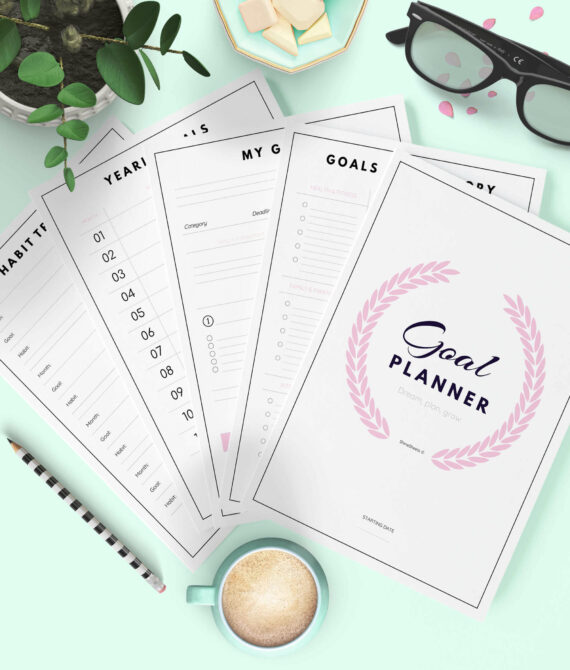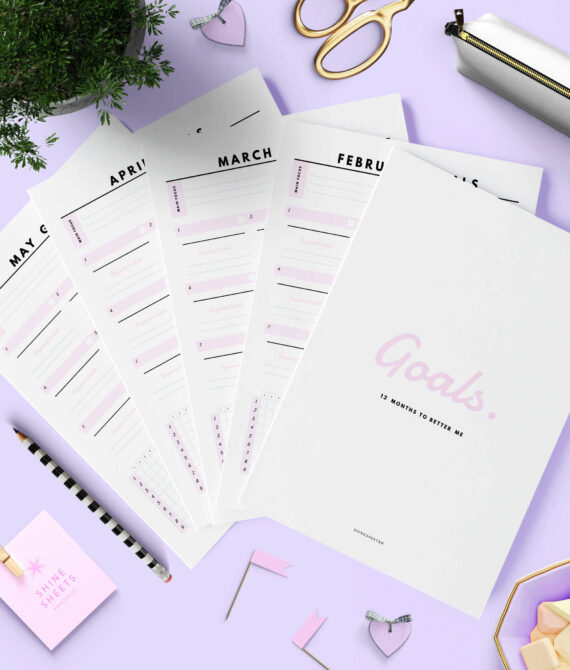
Every January I open a fresh notebook, write "Goals" at the top of the page and then… write fourteen of them. Run more, read more, save more, call my friends more, finally learn to bake bread, become a morning person. By mid-February the notebook is still beautiful and I'm quietly pretending that page doesn't exist.
What changed things for me wasn't more willpower. It was fewer goals. Three, to be exact – one from three different parts of my life, each with a tiny first step and a weekly minimum I could keep even on a bad week. I call it the Pick-3 Method, and it's the reason I now reach December with a few goals actually finished instead of a guilty list.
So here's what you'll find below: why most goals for the new year fade so fast, how the Pick-3 Method works, a worksheet table you can copy straight into your planner, and 100 goal ideas sorted by life area – health, mind, home, money, work, friends and family, self-love, creativity, fun and self-care. Read through, star the ones that make your heart lift a little, and then choose only three. That last part is the whole secret.
If you'd like to write it all out by hand (I always do), an undated goal planner with a soft linen cover is a lovely home for it, because you can start on any week without wasting pages.
Why Most New Year Goals Fizzle by February
It's not because you're lazy (you're not). Most goal lists are simply built in a way that almost guarantees burnout.
- Too many at once. Ten goals means ten new habits fighting for the same tired evenings.
- Too vague. "Be healthier" has no first step, so there's never a clear moment to start.
- All-or-nothing rules. "Work out every day" breaks the first time you catch a cold.
- No check-in. You don't look at them again until you feel bad about them.
- Someone else's goals. A goal picked because it looked good online won't survive a rainy Tuesday.
A small honest admission: as someone who's prone to anxiety, a long goal list used to make me feel behind before I'd even started. A short list feels like a plan. A long list feels like a verdict. If big goal-setting makes your chest tight, my guide on setting goals when goal-setting makes you anxious is a gentle companion to this one.
The Pick-3 Method: How It Works
The idea is simple: you choose three goals from three different life areas and give each one the same four supports. That's it. Three is enough to feel real change across your life, and few enough that you can hold all of them in your head on a busy day.
Step 1: Choose three different life areas
Pick the three areas below that need the most love right now. Spreading them out matters: three health goals compete for the same energy, while one health, one home and one friendship goal tend to support each other.
Step 2: Write one clear goal per area
Make it something you could clearly say "yes, I did that" about. Not "be more social" but "have a standing monthly date with a friend." Not "get fit" but "walk 20 minutes, five days a week."
Step 3: Give each goal a tiny first step
Something you can do this week in under 15 minutes. Buy the shoes. Text the friend. Clear one shelf. Almost silly-small is exactly right.
Step 4: Set a weekly minimum
This is the floor, not the ceiling: the smallest version that still counts on a hard week. Walking five days a week? The minimum might be two short walks. It keeps the habit alive when life gets loud.
Step 5: Put a check-in date in your planner
Once a month, sit down for 15 minutes with a cup of tea and look at your three goals. Keep, tweak or swap. Yes, you're allowed to swap a goal in March if it turns out it wasn't really yours. That's not quitting – that's learning.
Your Pick-3 Worksheet
Copy this table into your planner or journal (or onto a big sticky note on your fridge). I've filled in the first row as an example so you can see how specific each box should be. Use a set of pastel highlighters to color-code each life area – it sounds fussy, but it makes the page so much easier to scan at your monthly check-in.
| Goal | Life area | My goal | Why it matters to me | Tiny first step (this week) | Weekly minimum | Check-in date |
|---|---|---|---|---|---|---|
| Example | Health & Body | Walk 20 minutes, five days a week | I feel calmer and sleep better when I move | Put walking shoes by the door, plan a route | Two 10-minute walks | Last Sunday of every month |
| Goal 1 | ||||||
| Goal 2 | ||||||
| Goal 3 |
A few tips for filling it in:
- The "why" column is the most important one. When motivation dips, the why is what you'll come back to. Write it in your own words, not in goal-speak.
- Make the weekly minimum embarrassingly small. You're designing for your worst week, not your best one.
- Write the check-in date in pen. Treat it like an appointment with a friend you don't want to cancel on.
I like to stick a copy of the finished table somewhere I'll see it daily. A few pastel sticky notes on the bathroom mirror with just the three goals written on them (one per note) does more than any app ever has for me.
100 Goals for the New Year, Sorted by Life Area
Here are 100 ideas, ten for each area of life. Don't try to do them all – please don't. Read through with a pen, star anything that gives you a little spark, and then come back to the worksheet and choose just three. Each idea comes with a small note on how to make it doable.
Health & Body: Ideas 1–10
- 1. Walk 20 minutes a day, five days a week. Pick a fixed slot (after lunch works for a lot of people) so you're not deciding every day.
- 2. Drink a glass of water before your first coffee or tea. Keep the glass by the kettle the night before.
- 3. Get to bed 30 minutes earlier on weeknights. Set a phone alarm called "start winding down" an hour before your target time.
- 4. Stretch for 10 minutes every evening. Neck, hips, hamstrings – a short video on repeat is perfectly fine.
- 5. Book every checkup you've been putting off. Do it all in one sitting in January: doctor, dentist, eye exam.
- 6. Try one new kind of movement each season. Pilates in winter, swimming in summer – the point is curiosity, not a new identity.
- 7. Take the stairs whenever it's three floors or fewer. Tiny, boring and surprisingly easy to keep.
- 8. Eat lunch away from your screen three times a week. Even 15 minutes on a bench or by a window counts.
- 9. Build a strength routine you can do at home in 15 minutes. Two sessions a week with bodyweight or light dumbbells is a lovely start.
- 10. Track your sleep for one month just to learn your pattern. No fixing yet – simply notice what helps and what doesn't.
Mind & Calm: Ideas 11–20
- 11. Journal for five minutes after your evening tea. One prompt: "What felt good today, and what felt heavy?"
- 12. Keep one phone-free hour every evening. Phone goes in another room, not face-down next to you.
- 13. Read 12 books this year – one a month. Ten pages before bed gets you there without trying very hard.
- 14. Practice a 3-minute breathing pause when you feel rushed. Breathe in for 4, out for 6, ten rounds.
- 15. Write down three small good things every Sunday. A weekly gratitude list feels less forced than a daily one.
- 16. Unfollow 20 accounts that make you feel behind. Do it in one go, then check in again in June.
- 17. Spend one hour a month completely alone, on purpose. A café, a museum, a long walk – your company only.
- 18. Learn one calming tool you can use anywhere. A grounding exercise, a short meditation or a favorite song.
- 19. Do a monthly "brain dump" on paper. Write every worry and to-do on one page, then circle only three.
- 20. Talk to a professional if something has felt heavy for a long time. Booking the first appointment is a goal all on its own.
Home & Space: Ideas 21–30
- 21. Declutter one drawer or shelf every week. 52 small spots by December, no giant weekend purges needed.
- 22. Make your bed every morning for 30 days. Then decide if you want to keep going (you probably will).
- 23. Create one corner that's just for you. A chair, a lamp, a blanket and a book are enough.
- 24. Do a 10-minute reset every night before bed. Dishes in the sink, cushions back, bag by the door.
- 25. Finish one home project you started and abandoned. The half-painted shelf, the unhung frames – pick one.
- 26. Buy fresh flowers or greenery once a month. A single stem in a bottle still changes a room.
- 27. Set up a simple weekly cleaning rhythm. Example: Monday bathroom, Wednesday floors, Friday sheets.
- 28. Donate one bag of things every season. Keep an empty tote in your closet for anything that no longer fits your life.
- 29. Learn to fix three small things yourself. A wobbly handle, a running toilet, a loose hinge.
- 30. Host people at home at least four times this year. Tea and something store-bought is hosting. It really is.
Money (Habit Level): Ideas 31–40
- 31. Check your bank balance every Friday. Five minutes, no judgment, just awareness.
- 32. Save a small fixed amount automatically each payday. Even a little builds the habit before the amount matters.
- 33. Cancel every subscription you haven't opened in a month. Look through your last statement and be honest.
- 34. Try one no-spend weekend each month. Plan free things ahead so it feels like a treat, not a punishment.
- 35. Wait 48 hours before any non-essential purchase over a set amount. Leave it in the cart and see if you still want it.
- 36. Keep a simple monthly money check-in. Income, fixed bills, what's left – one page.
- 37. Build a small "oops" fund for surprise costs. Car repairs and birthday gifts stop feeling like emergencies.
- 38. Learn one money topic a month. Retirement accounts, credit scores, how interest works – one library book or article each.
- 39. Plan gifts and holidays ahead with a sinking fund. Divide the yearly amount by 12 and set it aside monthly.
- 40. Have one calm money conversation you've been avoiding. With a partner, a parent or yourself, on paper.
Work & Learning: Ideas 41–50
- 41. Learn one new skill with a clear finish line. "Finish a beginner course in…" beats "get better at…"
- 42. Update your résumé or portfolio every quarter. Add wins while you still remember the details.
- 43. Keep a "wins" note on your phone. Every time someone thanks you or something goes well, add a line.
- 44. Ask for feedback once per quarter. Script: "What's one thing I could do differently that would help you most?"
- 45. Take a real lunch break most workdays. Away from your desk, phone optional.
- 46. Set one boundary around after-hours messages. For example: no work email after 7 p.m.
- 47. Read one book in your field each season. Four a year adds up to real expertise.
- 48. Have coffee with one interesting person per month. Former colleagues count. So do friends of friends.
- 49. Try a language app for ten minutes a day. Pick a language connected to a trip you'd love to take.
- 50. Start the side project you keep talking about. Define the smallest possible version and give it a deadline.
Friends & Family: Ideas 51–60
- 51. Send one "thinking of you" message a week. No reason needed. That's the charm of it.
- 52. Schedule a standing monthly date with a friend. Same day each month, so nobody has to organize it from scratch.
- 53. Call a family member once a week instead of texting. Ten minutes on your walk home is plenty.
- 54. Write down every important birthday in one place. Then send cards – real paper ones – for the closest people.
- 55. Make one new friend this year. Join something that meets regularly: a class, a book club, a walking group.
- 56. Plan one small trip with someone you love. A day trip counts as much as a week away.
- 57. Start a little tradition with your people. A yearly picnic, a winter movie night, a birthday breakfast.
- 58. Reconnect with one old friend you miss. Script: "I saw something today that reminded me of you – how are you, really?"
- 59. Listen more than you talk in one conversation a day. Ask a second question before sharing your own story.
- 60. Let go of one relationship that only drains you. This can be quiet and kind – fewer invitations, gentler distance.

Love & Self-Love: Ideas 61–70
- 61. Take yourself on a solo date once a month. A matinee, a bookshop, a slow breakfast out.
- 62. Speak to yourself the way you'd speak to a friend. When you catch a harsh thought, rewrite it in a kinder voice.
- 63. Say no to one thing a week you don't want to do. Start with low-stakes invitations and build up.
- 64. Write yourself a letter to open next December. Seal it and put it somewhere you'll actually find it.
- 65. Plan one date night a month if you're partnered. Take turns choosing, keep phones away.
- 66. Stop apologizing for things that aren't your fault. Swap "sorry I'm late" for "thank you for waiting."
- 67. Celebrate one personal win every month. Flowers, a candle, a nice dinner – mark it.
- 68. Make a list of 20 things you like about yourself. Read it on bad days, add to it on good ones.
- 69. Keep one evening a week completely unscheduled. Rest is not a reward you have to earn.
- 70. Wear the "special occasion" things on ordinary days. The good perfume, the silk scarf, the pretty mug.
Creativity & Hobbies: Ideas 71–80
- 71. Pick up one hobby you loved as a kid. Drawing, roller skating, piano, collaging – whatever made time disappear.
- 72. Fill one sketchbook or notebook by the end of the year. Messy pages count. Doodles count.
- 73. Take one class in something hands-on. Pottery, candle making, flower arranging, sewing.
- 74. Make a photo album of the year as you go. Print your favorite five photos at the end of every month.
- 75. Write something every week. A poem, a story, a long letter, a few paragraphs in your journal.
- 76. Learn ten songs on an instrument. Ukulele is a famously forgiving place to start.
- 77. Start a small balcony or windowsill garden. Herbs and one easy houseplant are plenty.
- 78. Make one handmade gift for someone this year. Plan it in autumn so December feels calm.
- 79. Visit one museum or gallery each season. Bring a notebook and write down what moved you.
- 80. Finish one creative project from start to end. A finished small thing beats an unfinished big thing.
Fun & Adventure: Ideas 81–90
- 81. Visit one place within two hours of home that you've never seen. Small towns, hiking trails, a lake you keep driving past.
- 82. Try a new café or restaurant every month. Keep a little list of favorites in your notes app.
- 83. Watch the sunrise at least once each season. Bring something warm to drink and a blanket.
- 84. Say yes to one thing that makes you a bit nervous each quarter. A dance class, a solo trip, karaoke.
- 85. Go somewhere new on your birthday. Even a different neighborhood turns it into an occasion.
- 86. Plan one trip you've been dreaming about for years. Open a savings pot for it in January and name it.
- 87. Have a picnic in every season. A winter picnic with a flask of tea is underrated.
- 88. Go to one live show or concert. Book the tickets early so the excitement lasts for weeks.
- 89. Learn to play one new game with friends. Board game, card game, a lawn game for summer.
- 90. Make a "fun list" and do one thing on it every month. Write it in January and tick things off as you go.
Style & Self-Care: Ideas 91–100
- 91. Build a simple skincare routine you actually keep. Cleanser, moisturizer, sunscreen – morning and night.
- 92. Wear sunscreen every single day. Keep a bottle next to your toothbrush so you never forget.
- 93. Do a closet edit at the start of each season. Anything you haven't worn in a year gets a second look.
- 94. Create a 10-piece capsule wardrobe for workdays. Mix-and-match pieces in two or three colors.
- 95. Find your signature scent. Test one fragrance at a time on your skin, not on paper.
- 96. Book a monthly at-home spa evening. Bath, mask, hair oil, early bed.
- 97. Get a haircut every 8–10 weeks instead of "when I remember". Book the next one before you leave the salon.
- 98. Replace one worn-out basic each month. Socks, pajamas, a bra that actually fits.
- 99. Learn one new hairstyle you can do in five minutes. A low bun, a claw clip twist, a sleek ponytail.
- 100. Take a proper rest day after busy weeks. Put it in your planner like any other appointment.
How To Choose Your Final Three
If you've starred twenty ideas (very normal), here's how to narrow them down without overthinking. Ask yourself these four questions about each starred goal:
- Does this goal make me feel lighter or heavier when I imagine doing it? Choose lighter. Heavy goals usually belong to someone else's expectations.
- Would doing this one thing make other areas easier? Sleeping earlier helps your mood, your skin and your patience. Some goals are quietly doing three jobs at once.
- Can I start it this week? If it needs a perfect moment to begin, it's a goal for later in the year.
- Am I choosing it because I want it, or because I feel I should? Be honest here. "Should" goals rarely make it to spring.
Still torn? Write each finalist on a scrap of paper and sleep on it. The one you're secretly hoping to pick in the morning is your answer.
Want the longer, whole-life view too? My life goals examples show how this year's three can fit into the bigger picture.
Pair Your Goals With a Word or a Board
Goals tell you what to do. A word or a picture reminds you how you want to feel doing it.
- Add a word of the year – steady, brave, gentle – above your three goals like a headline. My word of the year guide has 150 ideas.
- Make a tiny vision board: three images, one per goal, on a single sheet. Easy layouts are in my vision board ideas.
- Reflect before you plan. The end-of-year reflection questions show you what drained you and what you want more of.
How To Keep Your Goals Going All Year
Setting goals is the fun part. Keeping them is mostly about rhythm, not motivation. Here's the simple system that keeps my three alive:
Weekly: a 5-minute Sunday glance
Ask, "Did I hit the weekly minimum?" Tick yes or no. If it's a no, name the reason ("sick", "busy week") and move on. Patterns show up on their own after a few weeks.
Monthly: a 15-minute check-in
On your check-in date, light a candle, make a cup of tea and look at the whole month. A soy candle in a simple glass jar has become my little signal that this is goal time, not phone time. Ask three questions:
- What went well with each goal?
- What got in the way?
- What's one small change for next month?
Quarterly: keep, tweak or swap
Every three months, keep each goal, tweak it or swap it for a new idea from the list. Finished one early? Wonderful – pick a new one from the 100.
When you fall off (because you will)
Missing a week isn't failing. Neither is missing a month. The weekly minimum is still small and still waiting. Restart on any ordinary Thursday – you don't need January to begin again.
One little extra: tie a physical object to a goal, like a pretty glass water bottle for your health goal. It makes the goal feel real every time you pick it up.
Final Thoughts
You don't need fourteen goals to have a good year. You need three that truly matter to you, a first step small enough to take this week and a kind check-in once a month. That's the whole Pick-3 Method.
So pour a cup of tea, read through the 100 ideas with a pen in hand and star the ones that make you feel something. Then choose your three, fill in the worksheet and put it somewhere you'll see it every day. Next December, you'll be so glad you kept it small.