A budget isn't a list of things you're not allowed to have. It's a plan that tells your money where to go before the month decides for you. Once you see it that way, budgeting stops feeling like a punishment and starts feeling like relief – the relief of knowing the rent is covered, the fun money is real and the surprise bill won't wreck your week.
This guide to budgeting for beginners walks you through one simple monthly budget plan: how to find your real numbers, a sample budget table with percentages you can adjust to your actual life, ten beginner steps in order, and a 30-minute "money date" you repeat once a month so the whole thing stays easy.
A quick, honest note before we start: I'm not a financial advisor. Everything here is about everyday habits, not investing or choosing financial products – for debt, tax or investment questions, a qualified professional is the right person to ask.

Why Most First Budgets Fail (and Why Yours Doesn't Have To)
Most people don't give up on budgeting because they're bad with money. They give up because their first budget was designed for a perfect person living a perfect month. Here are the usual culprits:
- It's too strict. Zero takeout, zero shopping, zero coffee out. It lasts about nine days.
- It forgets irregular costs. Car registration, birthday gifts, the annual subscription renewal – they "ruin" the budget, when really they were always coming.
- It tracks too much. Thirty categories sounds organized, but it turns every purchase into homework.
- It has no fun money. A budget with no room for joy feels like a diet, and you'll rebel the same way.
- One bad week ends it. You overspend once, feel guilty and quietly stop looking.
My small honest admission: because I'm prone to anxiety, I avoided my banking app for a long time. Not looking felt calmer in the moment, but the not-knowing was much worse than any number could be. A simple budget fixed that, not because it made me richer overnight, but because it replaced vague dread with a clear plan.
The plan below is built to survive real life: few categories, built-in fun, room for irregular costs and a monthly check-in that forgives mistakes instead of punishing them.
The Three Buckets: Needs, Wants and Savings
Every dollar you spend fits into one of three buckets. Keeping it this simple is what makes a beginner budget work.
Needs are the things you'd have to pay even in a quiet, no-frills month: housing, utilities, phone, groceries and household basics, transportation, insurance and the minimum payment on any debt.
Wants make life lovely but could shrink if needed: eating out, coffee runs, clothes beyond the basics, beauty extras, hobbies, streaming, gifts and weekend plans.
Savings is money for future you: an emergency fund, sinking funds for planned costs (holidays, car repairs, annual bills) and any extra debt payments above the minimum.
You've probably heard of the classic 50/30/20 split – 50% needs, 30% wants, 20% savings. It's a lovely starting point, but in many cities rent alone eats far more than half of a paycheck. Rather than feeling like you've failed before you begin, adjust the split to your real life and protect the savings bucket as much as you can, even if it starts small.
Sample Monthly Budget With Real-Life Percentages
Here's a sample budget for someone taking home $3,000 a month after taxes. The bold total rows compare the textbook 50/30/20 split with a more realistic version, where housing costs are higher and wants are trimmed to keep savings at 20%. Use the percentages, not the dollar amounts – multiply them by your own take-home pay.
| Category | Bucket | Real-life % | Example on $3,000 |
|---|---|---|---|
| Rent or mortgage | Needs | 35% | $1,050 |
| Utilities, internet and phone | Needs | 5% | $150 |
| Groceries and household basics | Needs | 10% | $300 |
| Transportation | Needs | 7% | $210 |
| Insurance and health costs | Needs | 3% | $90 |
| Minimum debt payments | Needs | 3% | $90 |
| Needs total | Classic 50% | 63% | $1,890 |
| Eating out and coffee | Wants | 5% | $150 |
| Fun, hobbies and plans | Wants | 4% | $120 |
| Clothes and personal care | Wants | 4% | $120 |
| Subscriptions | Wants | 2% | $60 |
| Gifts | Wants | 2% | $60 |
| Wants total | Classic 30% | 17% | $510 |
| Emergency fund | Savings | 10% | $300 |
| Sinking funds (planned costs) | Savings | 6% | $180 |
| Extra debt payoff | Savings | 4% | $120 |
| Savings total | Classic 20% | 20% | $600 |
How to adjust it to your life:
- If your needs are over 60%, trim wants first and look for one big need you can lower over time (a cheaper phone plan, a shared ride, a different insurance deductible after asking your provider).
- If savings at 20% feels impossible right now, start at 5% and raise it by 1–2% every time your income goes up or a bill disappears. A small habit beats a big intention.
- If you have no debt, move that 4% into your emergency fund until it's comfortable, then into sinking funds.
- If your income changes month to month, build your budget on your lowest typical month and treat anything extra as a bonus for savings.
10 Steps To Build Your First Monthly Budget
Set aside about an hour for the first round. After that, the monthly routine takes around 30 minutes.
1. Find Your Real Take-Home Pay
Budget with what actually lands in your account, not your salary on paper. Look at your last two or three paychecks and use the amount after taxes and deductions. If you're paid every two weeks, plan around two paychecks a month and treat the occasional third one as a gift to savings.
2. List Your Fixed Bills
Write down every bill that's the same (or nearly the same) each month: rent, utilities, phone, internet, insurance, loan minimums, subscriptions. Next to each, note the due date. This list alone often brings a wave of calm, because suddenly the big scary "money stuff" is a short, finite list.
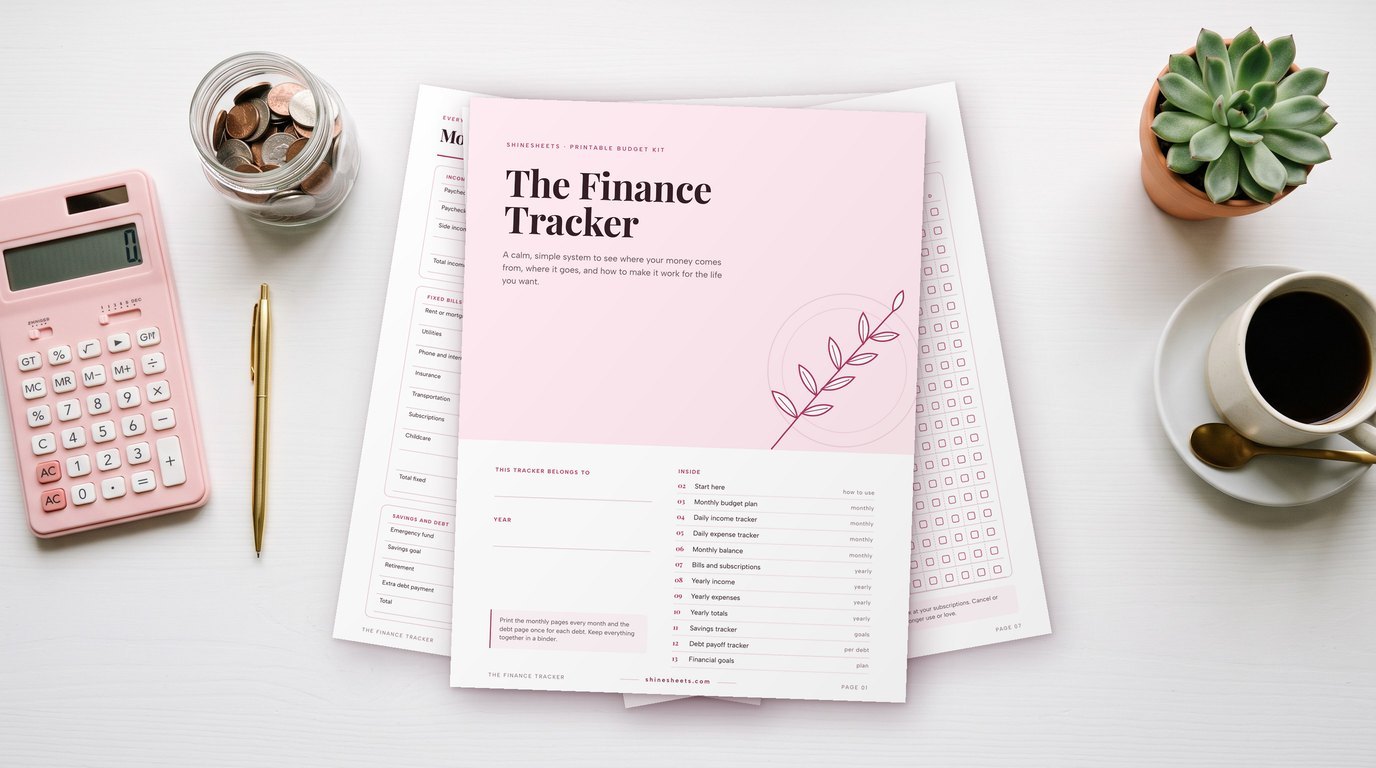
I'd keep this in a dedicated monthly budget planner rather than on random sticky notes. Look for one with a bill-tracker page, a monthly overview and space for notes – nothing more complicated than that.
3. Look Back at Last Month's Spending
Pull up your bank and card statements for the last 30 to 60 days. Go through each line with three pastel highlighters: one color for needs, one for wants and one for savings. Don't judge anything yet. You're simply gathering facts.
Most people find two or three surprises here – usually small, repeated purchases that add up. That's not a failure. It's exactly the information you need to build a budget that fits.
4. Sort Everything Into Three Buckets
Add up each color. Now you know your real split, which might look something like 70/25/5. Compare it to the sample table above and decide where you'd like to be in three months – not tomorrow. A gentle shift of a few percent is much easier to keep than a dramatic overhaul.
5. Give Every Dollar a Job
Take your monthly take-home pay and assign it to categories until there's nothing left unassigned. Leftover money doesn't stay leftover; it quietly disappears into "I'm not sure where that went." If you have $80 without a job at the end, send it to savings or a sinking fund.
Simple formula: take-home pay – needs – savings = what you can comfortably spend on wants.
6. Plan for Irregular Costs With Sinking Funds
A sinking fund is money you set aside monthly for a cost you know is coming. Make a quick list of everything that doesn't happen every month: holiday gifts, birthdays, car maintenance, annual subscriptions, vet visits, travel, a new winter coat. Estimate each yearly total, add them up and divide by 12. That's your monthly sinking-fund amount.
This one step turns most "budget emergencies" into planned expenses. December gifts stop being a crisis when you've put a little aside since spring.
7. Start a Small Emergency Fund
Your first emergency-fund goal doesn't need to be huge. Many beginners start with a mini goal of $500 or $1,000, then work toward a fuller cushion of a few months of essential expenses over time. Keep it in a separate savings account so it's easy to see and a little less easy to spend.
Name it something kind, like "Calm Fund." It sounds silly, but a name that reminds you why it exists makes it easier to leave alone.
8. Choose One Tracking Method
The best tracking method is the one you'll actually use. Pick one and stick with it for three months before switching:
- A budgeting app if you like automatic categories and checking on your phone.
- A simple spreadsheet if you like seeing everything on one screen.
- Paper if writing things down helps you remember them.
- Cash envelopes for one or two categories that tend to run away from you, like eating out or shopping.
For the envelope method, a cash envelope wallet with labeled tabs keeps it neat. You put the month's amount for a category inside, and when it's empty, that category is done until next month. It's surprisingly freeing – no math, no app, just a visible limit.
9. Build in Guilt-Free Fun Money
Give yourself a small personal allowance for anything you like, no explanation needed. Even $40 a month counts. Fun money is what makes a budget last, because it means a latte or a new lip balm is part of the plan rather than a "slip."
If you love small saving challenges to fund your treats, my list of easy ways to start saving money every day has gentle ideas that don't feel like sacrifice.
10. Check In Weekly for Five Minutes
Once a week, open your tracker and look at how much is left in your flexible categories. That's it. Five minutes on a Sunday stops small leaks before they become a month-end shock. I like to tie it to my weekly planning session – if you don't have one yet, here's how to plan your week in about 20 minutes, money check included.

Your First Month, Week by Week
If ten steps feel like a lot to start with, spread them over your first month. Nothing has to happen in one sitting.
- Week 1: Gather. Find your take-home pay, list your fixed bills with due dates and highlight last month's statements. No changes yet – this week is only about seeing clearly.
- Week 2: Build. Add up your three buckets, compare them with the sample table and give every dollar a job. List your irregular costs and work out your monthly sinking-fund amount.
- Week 3: Track. Choose your tracking method and use it every day for one week. Write down purchases the same evening, or check your app over your evening tea. It takes two minutes.
- Week 4: Review. Do your first 30-minute money date (below). Notice what felt easy, what felt tight and which category needs a more honest number.
By the end of the month you'll have a working budget, one week of real tracking and a routine to repeat. The second month is always easier than the first, because you're adjusting a plan rather than inventing one.
The 30-Minute Money Date
This is the monthly routine that keeps your budget alive. Think of it as a calm appointment with yourself, not an audit. Pick the same day every month – the first Sunday, or the day after payday – and follow this order:
| Minutes | What to do |
|---|---|
| 0–5 | Set the scene. Make a cup of tea, light a candle, open your planner and your banking app. Take three slow breaths before you look at anything. |
| 5–10 | Check the balances. Write down your checking, savings and any debt balances. Just the numbers, no judgment. |
| 10–15 | Compare to the plan. Look at each bucket. Where did you stay on track? Where did you go over or under? |
| 15–20 | Look ahead. Note bills, birthdays and irregular costs coming next month. Cancel any subscription you didn't use. |
| 20–25 | Set next month's budget. Adjust categories based on what you learned. Move savings first, on payday if possible. |
| 25–30 | One win, one tweak. Write one thing you did well and one small change for next month. Close the planner. |
A few things make the money date easier. A simple desktop calculator with big buttons is faster than switching between apps on your phone. A cream desk organizer keeps your planner, highlighters and envelopes in one place, so you're not hunting for a pen before you start. And a candle in a glass jar signals to your brain that this is a calm ritual, not a stressful chore.
The money date also fits neatly into a bigger monthly routine – I've put it right into my monthly reset checklist. And once a year, a slightly longer version helps you close the year well; my year-end money reset walks you through it in about an hour.
Beginner Budgeting Mistakes To Skip
- Budgeting on gross pay. Always use take-home pay.
- Forgetting small subscriptions. Five $8 subscriptions are a $40 category.
- Making the grocery line too tight. An unrealistic number leads to takeout. Base it on what you actually spent last month, then trim gently.
- Saving "whatever's left." There's rarely anything left. Move savings first, on payday.
- Comparing your budget to someone else's. Different city, different income, different life. Your numbers only need to work for you.
- Quitting after one bad month. A budget is a practice, not a test you pass or fail.
What To Do When You Overspend
You will overspend at some point. Everyone does. What matters is the next step, not the slip.
First, look at the number without judgment. Write it down: "Went $60 over on eating out." Then decide where those $60 will come from this month – usually another wants category. If wants are already empty, take it from next month's wants rather than from savings or bills.
Then ask one curious question in your planner: what was happening that week? Often overspending isn't about the money at all. It's tiredness, stress, a social plan you felt you couldn't skip or a hard day that wanted a treat. Noticing the pattern is far more useful than feeling guilty about it.
Finally, adjust the plan if the category was simply unrealistic. If you go over on the same line three months in a row, the budget is wrong, not you.
Little Ways To Make Budgeting Feel Good
A budget sticks when it feels like care rather than restriction. These small touches help:
- Celebrate milestones. When your emergency fund hits its first goal, mark it – a long bath, a walk somewhere pretty or a small treat from your fun money.
- Give savings goals a picture. A photo of the trip or the cozy armchair you're saving for makes it easier to skip the impulse buy.
- Use kind language. Swap "I blew it" for "I went over on eating out." Facts, not verdicts.
- Keep it pretty. A planner you like opening and a tidy desk corner make the money date something you look forward to.
- Track progress, not perfection. Each month, write down one number that improved, even by a few dollars.
Final Thoughts
Budgeting for beginners doesn't have to mean spreadsheets full of guilt. It's three buckets, a few honest numbers and a calm half hour each month with a cup of tea. Start with the sample table, adjust it to your real life and let the first month be messy.
Every month you sit down for your money date, you get a little clearer and a little calmer. That steady, quiet confidence is worth more than any perfect budget on paper.