
Scrolling before bed rarely has anything to do with willpower. It happens because your phone is the easiest, softest thing within reach at the exact moment your brain is tired, your day is finally quiet and you want a little time that belongs only to you. The phone isn't the villain here. It's just very, very good at filling that space.
Which means the fix isn't more discipline or a stern rule you'll break by Thursday. The fix is giving that evening space something else to land on, and making the phone a little less convenient than everything else.
In this guide on how to stop scrolling before bed, you'll find why the habit is so sticky, 12 gentle habits that make putting the phone down easier, a "phone bedtime" plan table you can follow hour by hour, and a three-step reset for the nights you catch yourself mid-feed anyway (because you will, and that's fine).
No shaming, no all-or-nothing rules. Just small changes that add up to calmer nights.

Why It's So Hard To Put the Phone Down at Night
If you've ever promised yourself "five more minutes" and looked up forty minutes later, you're in very good company. A few things are working against you at night:
- Your self-control is tired. After a full day of decisions, your brain naturally reaches for the easiest option. An endless feed asks nothing of you.
- There's no natural stopping point. A book has chapters and a show has episodes. A feed simply keeps going, so the decision to stop is always yours.
- It feels like "me time." If your days are full of other people's needs, late-night scrolling can be the only time that feels like yours. Many people stay up late for exactly that reason.
- It numbs a busy mind. When thoughts are loud at bedtime, a stream of small distractions can feel like relief, at least for a while.
That last one is my weak spot. I'm prone to anxiety, and on evenings when my head is busy, the phone feels like a quick way to switch it off. It works for a few minutes and then leaves me more wired than before. Knowing your own reason helps you pick the habits below that actually fit.
Bright screens and stimulating content close to bedtime can also make it harder to feel sleepy. You don't need to be perfect about it, but giving your mind a quieter last hour makes a real difference for most people.
12 Gentle Habits To Stop Scrolling Before Bed
Read through all twelve, then choose two or three to try this week. Small and consistent beats ambitious and abandoned.
1. Give Your Phone Its Own Bedtime
You probably have a rough bedtime for yourself. Give your phone one too, 30 to 60 minutes before yours. Set a recurring alarm labeled something kind, like "Phone goes to bed," so it doesn't feel like a punishment.
When it goes off, finish what you're reading, send any last message and put the phone in its spot. The alarm takes the decision off your plate, and that's the whole point.
2. Charge It Outside the Bedroom
This is the single habit that does the most work. If the phone isn't within arm's reach, you can't pick it up without thinking. Even a few steps of distance gives you a moment to choose.
Make the new spot pleasant so it sticks: a white wooden charging stand on a hallway shelf or kitchen counter turns "putting the phone away" into a small evening ritual instead of an exile.
3. Use a Real Alarm Clock
"But I need it as an alarm" is the most common reason phones end up on the nightstand. A simple alarm clock solves it. Look for a quiet, non-ticking cream analog alarm clock with a gentle backlight, so you can check the time at 3 a.m. without opening a single app.
4. Replace the Habit Instead of Just Removing It
An empty half hour is hard to protect. A planned one is much easier. Choose a "landing activity" for the time your phone would normally fill, something calm, low-effort and genuinely enjoyable:
- a few pages of a book
- a skincare routine done slowly
- tea and a playlist
- a short stretch on the floor
- tidying the room for tomorrow morning
The key is that it should feel like a treat, not a chore. If your replacement feels like homework, the phone will win.
5. Keep a Book on Your Pillow
Put the book where your phone used to be, literally. When you get into bed, it's the first thing you see. Pick something easy and absorbing, nothing you feel you should read.
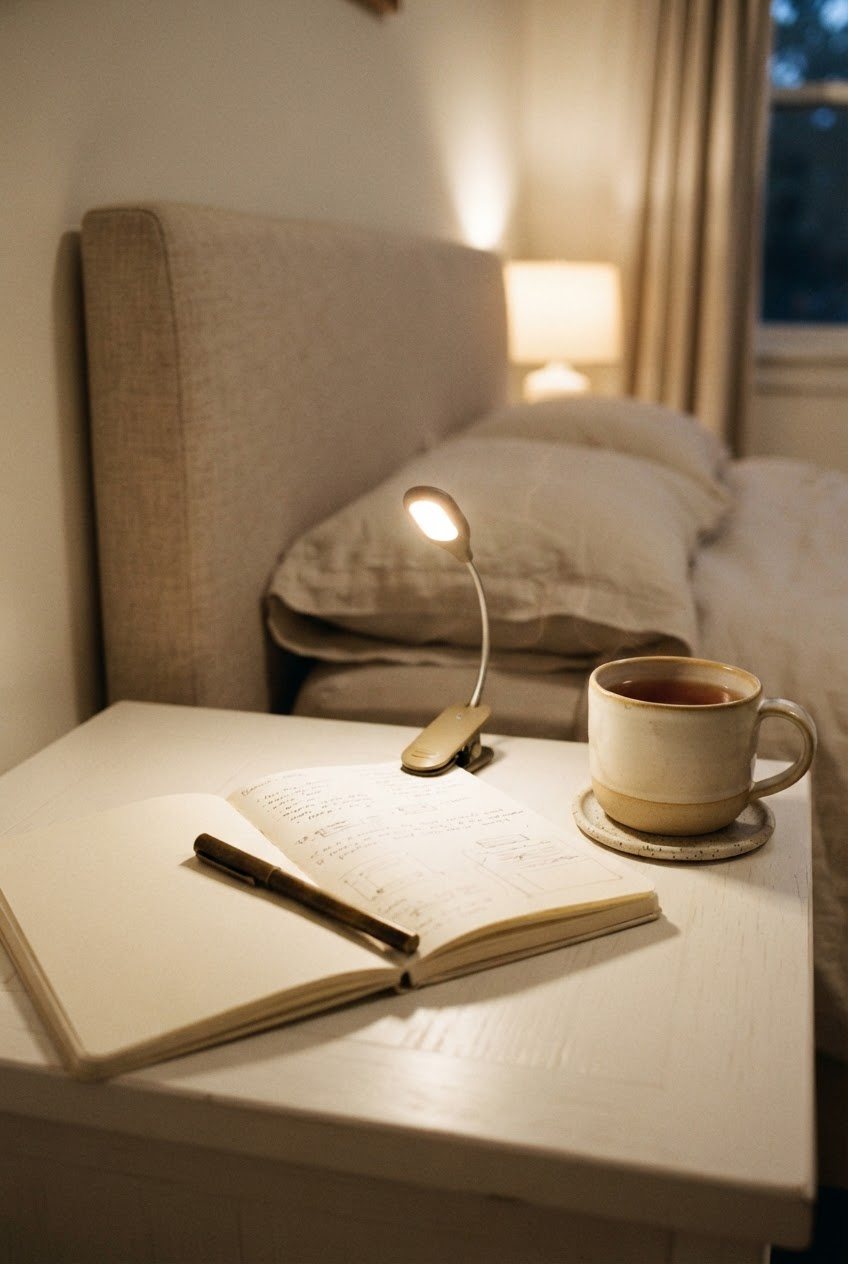
A small rechargeable clip-on book light lets you read without bright overhead light, which keeps the room sleepy. If reading has slipped out of your life, my tips on how to read more books make it easier to start again.
6. Do a Two-Minute Brain Dump
A lot of late-night scrolling is really avoidance of your own thoughts: tomorrow's to-dos, a conversation you're replaying, the worry that pops up the moment it's quiet. Writing it down gives those thoughts somewhere to go.
Keep a cream linen journal and a pen by the bed. Set a two-minute limit and write everything on your mind, in any order. End with one line: "The first thing I'll do tomorrow is…" Then close it. Your thoughts are safe on paper until morning.
7. Make the Screen Less Interesting
Most phones let you schedule a grayscale mode, a wind-down mode or app limits that start automatically in the evening. Grayscale is surprisingly effective: a colorless feed is simply less fun to keep watching.
Set it to begin at the same time as your phone's bedtime alarm, so the two work together.
8. Add a Little Friction
Every extra tap is a moment to change your mind. Move the apps you lose time on off your home screen and into a folder on the last page. Log out of one app in the evening, so getting back in takes a password. Turn off notifications from anything that isn't a real person.
You're not banning anything. You're just making the easiest option slightly less easy.
9. Create a "Last Check" Ritual
Part of what keeps the phone in your hand is the fear of missing something. Give yourself one intentional last check: messages, tomorrow's calendar, maybe the weather. Then say goodnight to the phone, out loud if it helps.
Having a clear ending is much easier than trying to stop in the middle of a feed.
10. Make Your Bed the Nicer Option
When your bed feels inviting, lying there with your eyes closed becomes more appealing than another round of videos. Fresh pillowcases, a soft throw, dim lamplight and a comfortable pink silk sleep mask all signal "this is where we rest."
A light mist of a lavender linen pillow spray can become a scent cue for sleep if you use it every night. My winter sleep routine has more ideas for making evenings feel restful when it's dark early.
11. Move Your Body Gently for Five Minutes
If you scroll because you're restless rather than tired, a few slow stretches can release that energy. Child's pose, legs up the wall and a gentle twist are enough. My bedtime yoga flow takes about ten minutes and needs nothing but a soft surface.
12. Have a Plan for Anxious Nights
On nights when your mind is racing, the phone feels like the fastest way to quiet it. Decide ahead of time what you'll do instead: slow breathing with a longer exhale, a few lines in your journal, or naming five things you can hear in the room.
My guide on how to calm anxiety fast has simple techniques that work well lying in bed with the lights off.
Your Phone Bedtime Plan
Here's the whole evening on one table. Adjust the times to your own bedtime, and remember that you don't need to follow every row on day one. Start with the 60-minute and 30-minute rows, and add the rest when they feel natural.
| Time before bed | What to do instead of scrolling | Why it helps |
|---|---|---|
| 90 minutes | Dim the main lights and switch to lamps | Softer light is a gentle signal that the day is winding down. |
| 75 minutes | Do your "last check": messages, calendar, weather | Ends the fear of missing something before it starts. |
| 60 minutes | Phone bedtime alarm; phone goes to its charging spot | Distance does more than willpower ever could. |
| 50 minutes | Make tea and tidy one small area | A calm, useful task that keeps your hands busy. |
| 40 minutes | Slow skincare or a warm shower | Turns the transition into self-care instead of "giving something up." |
| 25 minutes | Two-minute brain dump in your journal | Gives busy thoughts a place to land outside your head. |
| 20 minutes | Read in bed with a book light | An engaging activity with natural stopping points. |
| 5 minutes | Lights out, sleep mask on, slow breathing | A predictable ending your body starts to recognize. |
Screenshot it and keep it as your phone wallpaper for a week, a small irony that works surprisingly well, since it's the last thing you'll see before putting the phone down.
When You Catch Yourself Scrolling: The 3-Step Reset
Some nights you'll look up and realize you've been scrolling for twenty minutes. That isn't a failure. It's simply the moment to use this short reset instead of a long inner lecture.
- Notice without judgment. Say to yourself, "Okay, I'm scrolling." That's it. No "I always do this," no "I have no self-control." Noticing is the win.
- Ask one question. "What do I actually need right now?" Usually it's one of four things: rest, comfort, distraction from worry or a bit of time for myself. Naming it tells you what to do next.
- Do one small physical thing. Put the phone face down on the floor, out of reach. Then do the smallest version of what you need: three slow breaths, one page of your book, one line in your journal. Your hands need a new task, not just an empty space.
The reset takes less than a minute. Even if you only manage step one for the first few nights, you're building the awareness that makes the other steps possible.
Match the Swap to Your Reason for Scrolling
Not everyone scrolls for the same reason, and the best replacement depends on what the phone is giving you. Find yourself below and start there.
If You Scroll Because You Want Time for Yourself
The phone is standing in for "me time." Give yourself a protected 20 to 30 minutes earlier in the evening that's just for you: a bath, a hobby, a show you actually chose. When you've already had your time, it's much easier to let the night end.
If You Scroll Because Your Mind Won't Switch Off
The brain dump is your best friend. Pair it with slow breathing in bed: in for four counts, out for six, for a few minutes. A longer exhale is a simple, gentle way to help your body settle.
If You Scroll Because You're Bored but Not Sleepy
Your body might simply not be ready for sleep yet. Choose an activity that's interesting but low-stimulation: a novel, a puzzle book, a calm podcast with the screen off and the phone across the room. Get into bed when your eyes start to feel heavy, not before.
If You Scroll Out of Habit, Without Even Noticing
You need friction and distance more than anything else. Habits 2, 3 and 8 do most of the work here. When the phone isn't next to you, the automatic reach has nowhere to go.
What About Audiobooks, Sleep Sounds or Meditation Apps?
They can be wonderful. The trick is to start them, lock the screen and put the phone face down out of reach before you get into bed. Use a sleep timer so audio stops on its own, and you'll get the benefit without the temptation of one quick check.
What To Do When You Slip Back Into Old Habits
You'll have weeks when every habit holds and weeks when the phone ends up in bed with you again. Stressful periods, travel, illness and long workdays all make that more likely. Here's how to get back on track without starting from zero:
- Restart with just one habit. Charging the phone outside the bedroom is usually the easiest one to return to.
- Look for the pattern, not the fault. Do slips happen on the same nights? Sunday evenings, days you skipped dinner, nights after hard conversations? That tells you where to add support.
- Protect "me time" earlier in the evening. If late scrolling is your only time alone, carve out twenty minutes for yourself before the phone's bedtime. You'll feel less need to steal it from sleep.
- Treat it like an experiment. Try a habit for seven nights, notice how you feel in the mornings and keep what works.
If you want to reset your phone habits during the day too, my gentle 7-day digital detox works beautifully alongside these evening habits. Calmer days usually lead to calmer nights.
What You Might Notice After a Week or Two
Changing a nightly habit takes a little patience. Many people notice small things first, long before any big shift:
- Falling asleep a little sooner, because the last thing in your mind isn't a stream of news and videos.
- Waking up less groggy, especially if you also stopped checking the phone first thing in the morning.
- More time for the things you keep saying you'll get to: reading, journaling, stretching.
- A quieter mind at bedtime, since the brain dump catches what used to keep you up.
Everyone is different, so don't measure yourself against anyone else. If the evenings simply feel calmer, that's already a good result.
If you'd like to look at the rest of your sleep habits too, my sleep hygiene checklist covers the bedroom, light and routine basics in one place.
A Gentle Note on Sleep
These habits can help you wind down, but they aren't a treatment for sleep problems. If you regularly struggle to fall or stay asleep, wake up exhausted even after a full night or feel that anxiety or low mood is keeping you up, please talk to your doctor. Ongoing sleep trouble deserves real support, and asking for it is a kind thing to do for yourself.
Final Thoughts
Learning how to stop scrolling before bed isn't about becoming someone who never touches her phone at night. It's about making the calmer choice the easier one: a phone that sleeps in another room, a book on your pillow and a few minutes that belong to you without a screen.
Pick two habits, give them a week and be patient with the nights that don't go to plan. Every evening you put the phone down a little earlier is a small gift to tomorrow's you.