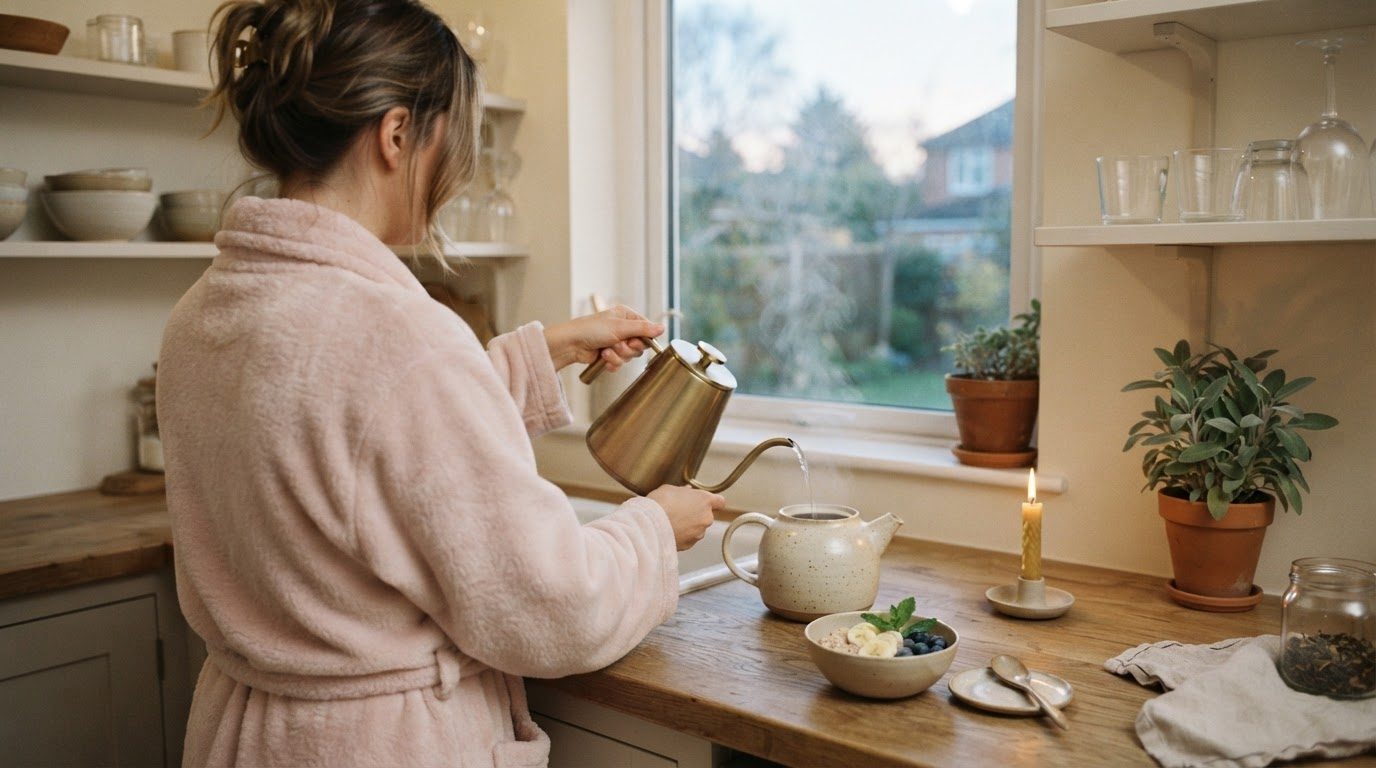
For years, my mornings started the same way: the alarm went off, I grabbed my phone before my eyes were fully open, and within two minutes I had read three emails, one bad news headline and a group chat I wasn't ready for. I'd be standing in the kitchen with my heart already racing, wondering why I felt behind before the day had even started.
The funny thing is, I didn't need more time. I needed a different first half hour. Once I stopped treating the morning like a race and started treating it like a soft landing, everything after it felt a little lighter. Not perfect (some mornings still fall apart, and that's fine), just calmer.
That's what a slow morning routine is about. It isn't waking up at dawn or filling an hour with fifteen wellness habits. It's giving yourself a gentle, unhurried start, whether you have fifteen minutes or a whole hour.
In this guide, you'll find three versions of a slow morning (15, 30 and 60 minutes) laid out as a simple timeline, a seven-step night-before setup that makes the whole thing possible, eight small rituals to mix and match and a few honest tips for the mornings when nothing goes to plan. Make yourself a warm drink and let's start.

What a Slow Morning Really Is (and Isn't)
A slow morning isn't about doing less forever. It's about doing the first part of your day on purpose instead of on autopilot. You still go to work, answer the emails and get things done. You just don't let the outside world into your head before you've had a chance to arrive in your own day.
Here's what a slow morning is:
- A few minutes of quiet before input (no news, no inbox, no social feeds).
- Moving at a pace that matches how your body feels when you wake up.
- One or two small rituals that feel good, done without rushing.
- A morning that's planned the night before, so you aren't making decisions half asleep.
And here's what it isn't:
- A 5 a.m. alarm (unless you genuinely love that).
- A twelve-step checklist you feel guilty about skipping.
- Something only people with free time and a sunny kitchen get to have.
If you've ever read a "perfect morning routine" and felt tired just looking at it, this is your permission to make it much smaller.
Why a Slower Start Makes Such a Difference
The first hour of the day sets a tone. When you wake up and immediately react to messages, your brain gets the signal that today is about putting out fires. When you wake up and spend ten quiet minutes with a cup of tea, the signal is gentler: there's time, you're okay, you can handle what comes.
I'm prone to anxiety, and I've noticed that rushed mornings make it so much louder. The racing heart, the tight shoulders, the feeling that I've already forgotten something. A slow morning doesn't make that disappear, but it gives my nervous system a softer starting point. If anxiety tends to show up early for you too, my post on a positive morning routine for mental health pairs nicely with this one.
There are practical benefits as well. Fewer decisions in the morning means fewer forgotten keys, fewer mismatched outfits and fewer "I'll just grab something on the way" breakfasts. Slowness, oddly enough, often makes you less late.
The 7-Step Night-Before Setup
This is the secret nobody mentions: a slow morning starts the evening before. If you wake up to a messy kitchen, no clean mug and no idea what to wear, there's nothing slow about it. These seven steps take about ten minutes, and I like to do them right after my evening tea.
- Pick tomorrow's outfit. Lay it out completely, including shoes and earrings. One less decision before 8 a.m. is a gift.
- Set up your drink station. Put your mug, tea bag or coffee and spoon next to the kettle. Fill the kettle so it's ready to switch on. A glass teapot with an infuser is a lovely pick here, because you can set it out with the leaves already inside.
- Clear one surface. Just one: the kitchen counter, your bedside table or the spot where you'll sit in the morning. Waking up to a clear space makes the morning feel calmer instantly.
- Pack your bag. Keys, wallet, charger, lip balm, anything you need to bring. Put it by the door.
- Write tomorrow's top three. On a sticky note or in your planner, write the three things that matter most tomorrow. Your brain can stop rehearsing them at night.
- Charge your phone outside the bedroom. Or at least across the room. This one step protects the first minutes of your morning better than any app.
- Decide your morning version. Look at tomorrow and choose: is it a 15, 30 or 60-minute morning? Set your alarm to match, and go to sleep knowing exactly how the day will begin.
If falling asleep is the hard part for you, my winter sleep routine guide has gentle ideas for the darker months, when getting to bed on time feels especially tricky.
Your Slow Morning Timeline: 15, 30 or 60 Minutes
This is the heart of the whole idea. You don't need the same slow morning every day. You need three versions you can switch between depending on how much time you have. Screenshot this table and keep it on your phone (to look at the night before, not first thing in the morning).
| Time | 15-minute morning | 30-minute morning | 60-minute morning |
|---|---|---|---|
| 0–5 min | Wake, open the curtains, drink a glass of water | Wake, open the curtains, drink a glass of water | Wake slowly, stretch in bed, open the curtains, drink a glass of water |
| 5–10 min | Make tea or coffee, sip it by the window | Make tea or coffee, sip it somewhere you love | Make tea or coffee, light a candle, sit down |
| 10–15 min | Three slow breaths, glance at your top three, get ready | Five minutes of gentle stretching | Gentle stretching or a short yoga flow |
| 15–20 min | – | Write three lines in a journal | Continue stretching, then wash your face slowly |
| 20–30 min | – | Get dressed and ready at an unhurried pace | Journal for ten minutes, then read a few pages of a book |
| 30–45 min | – | – | A short walk outside or simple breakfast at the table |
| 45–60 min | – | – | Get dressed, review your top three, then open your phone |
Notice what all three versions have in common: water, a warm drink, a moment of stillness and no phone until the end. Those are the non-negotiables. Everything else stretches or shrinks.
The 15-Minute Slow Morning
This is the version for busy weekdays, early shifts and any morning when you hit snooze one too many times. It sounds tiny, but fifteen calm minutes feel completely different from fifteen frantic ones. The trick is simply to sit down with your drink, even for five minutes, instead of drinking it while you run around looking for your keys.
A small detail that helps: a sunrise alarm light that slowly brightens before your alarm. Look for one with a warm, gradual glow setting and a soft sound option, so waking up doesn't start with a jolt.
The 30-Minute Slow Morning
This is my everyday sweet spot. Thirty minutes gives you time for a drink, a little movement and a few words on paper, which is honestly all most of us need to feel like we started the day on our own terms.
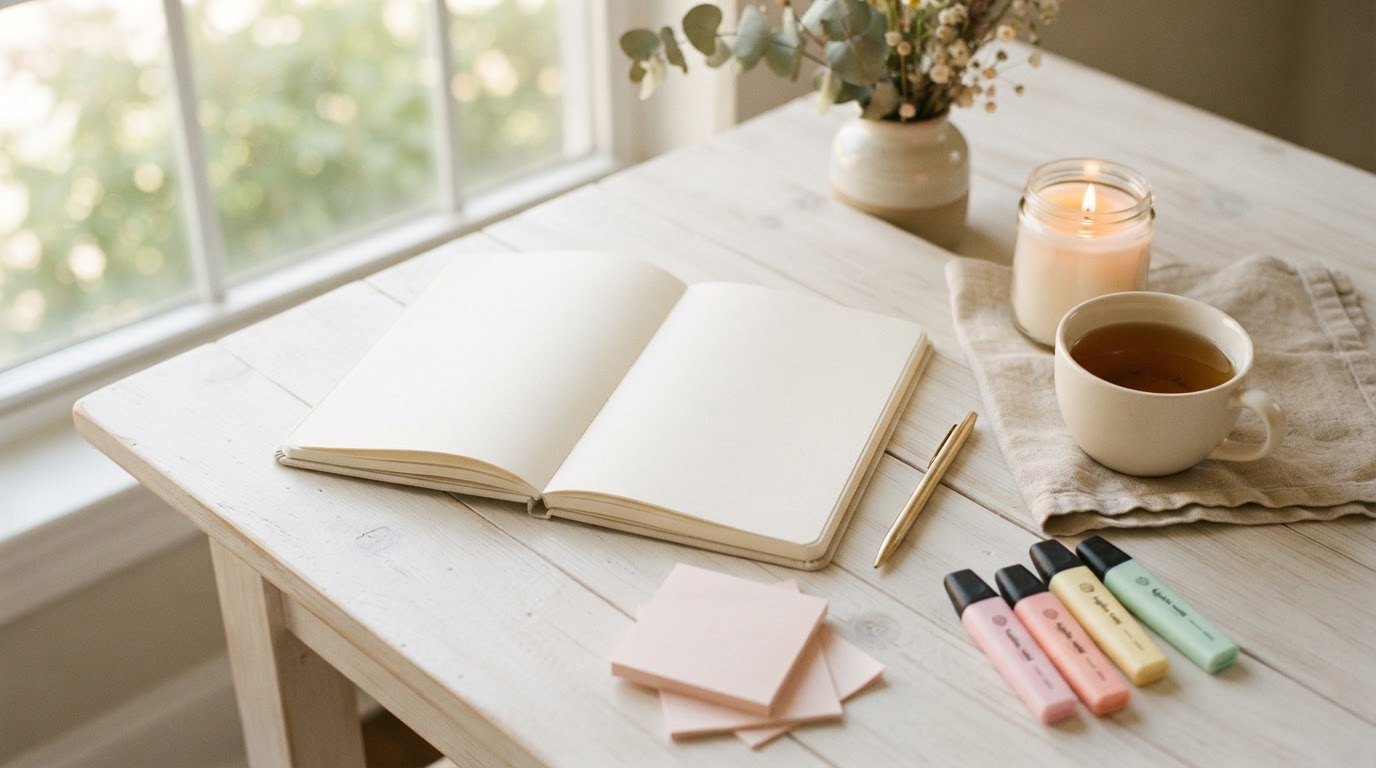
If you'd like to try the three-line journal, keep it simple: one line about how you feel, one line about what you're looking forward to and one line about what you need today. That's it. A cream linen journal that stays on your morning chair makes the habit easier to remember. And if you get stuck, my list of journaling ideas has plenty of gentle prompts.
The 60-Minute Slow Morning
This is the weekend version, the day-off version or the "I woke up early and I'm going to enjoy it" version. An hour lets you add the things that usually get squeezed out: a walk, a real breakfast, a few chapters of a book.
Please don't feel you need this every day. Even one 60-minute morning a week can become something you look forward to all week long.
8 Slow Morning Rituals To Mix and Match
Once you have the basic timeline, you can swap rituals in and out depending on your mood and the season. Pick one or two, not all eight.
1. Open the Curtains First
Before anything else, let the daylight in. Morning light helps your body feel more awake, and on gray days even a bright lamp by the window can make the room feel friendlier. Stand there for thirty seconds and just look outside.
2. Drink a Full Glass of Water
Keep a glass or a carafe on your bedside table and drink it before your tea or coffee. It's the easiest win of the day, and it gives your hands something to do instead of reaching for your phone.
3. Make Your Drink a Little Ceremony
Use your favorite mug, warm it with hot water first and watch the tea steep instead of checking your phone while you wait. A cream ceramic mug with a saucer sounds like a small thing, but having a "morning mug" turns an ordinary drink into a ritual.
4. Stretch for Five Minutes
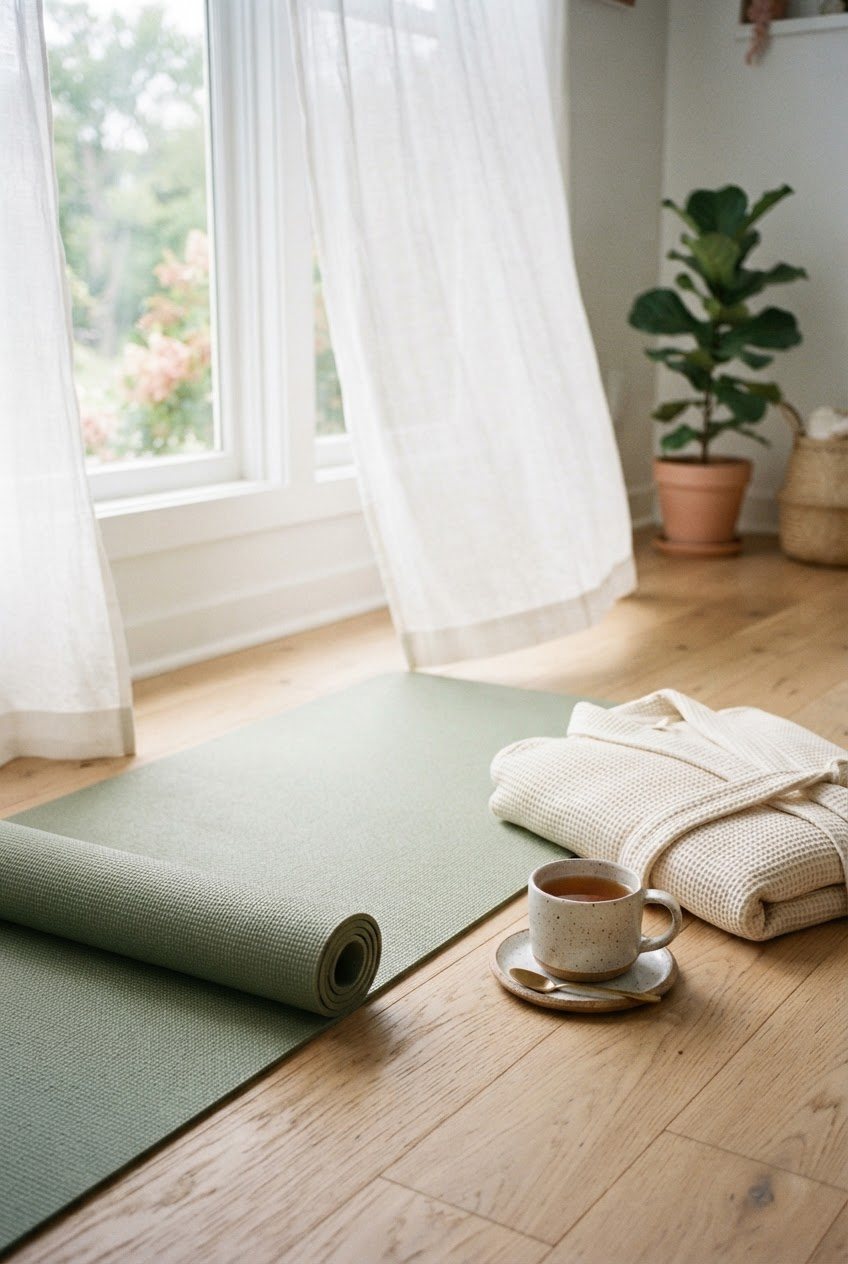
Nothing intense. Roll your shoulders, reach your arms overhead, fold forward gently and let your head hang. If you'd like a dedicated spot, look for a soft sage yoga mat with a bit of cushioning that you can leave rolled out by the bed or the window.
5. Light a Morning Candle
I love glass candles, and a lit candle on the table makes even a dark winter morning feel softer. Choose a light, fresh scent for mornings (think linen, citrus or white tea) and save the heavier vanilla scents for evening. Always blow it out before you leave the room.
6. Write Three Lines
Not morning pages, not a gratitude essay. Three lines. How you feel, what you're looking forward to, what you need. It takes two minutes and quietly tells your brain what matters today.
7. Read Something Real
Keep a paperback by your morning spot and read five pages before you check anything on a screen. It fills the "I want something to look at" urge with words that don't ask anything of you.
8. Get Dressed Slowly
Wrap yourself in something soft while you sip your drink, then get dressed without rushing. A cream waffle robe that hangs right by the bed is a lovely nudge to slow down. Look for a lightweight cotton waffle that feels comfortable year-round.
Coffee, Tea and a Calmer First Sip
I have a complicated relationship with coffee. Some mornings it perks me up beautifully. Other mornings, especially when I'm already a little anxious, it sends my heart racing and makes everything feel more urgent than it is.
So here's what I'd suggest if you notice the same thing:
- Drink water first. Coffee on an empty stomach and no water can make the jittery feeling stronger.
- Have something small with it. Even a piece of toast or a handful of nuts can make the caffeine feel gentler.
- Try a "half-and-half" week. Alternate coffee mornings with tea mornings and notice how you feel by lunchtime.
- Sit down to drink it. Coffee gulped while rushing feels completely different from coffee sipped slowly.
And if you'd like to turn your drink station into a little ritual spot, my guide to coffee corner ideas has lots of simple ways to make it feel special, even in a tiny kitchen.
5 Things To Skip in the First Hour
A slow morning is as much about what you leave out as what you put in. Try skipping these for the first part of your day:
- Checking email. It will still be there in thirty minutes, and you'll read it with a calmer head.
- The news. Stay informed, absolutely. Just not before you've brushed your teeth.
- Social feeds. Other people's highlights are a lot to take in before breakfast.
- Making big decisions. Save them for later in the morning, when you're fully awake.
- Multitasking. Drink your tea or read your book. Not both while also answering a text.
If skipping your phone feels impossible, start with just the first ten minutes. Then fifteen. It gets easier faster than you'd think.
Create a Little Morning Spot
A slow morning is so much easier when it has a home. It doesn't need to be a whole room or a styled corner from a magazine. A chair by the window, the end of your sofa or even one side of the kitchen table can become the place where your morning happens.
Here's how to make that spot feel inviting without spending much:
- Choose the brightest seat you have. Natural light makes waking up easier, and a window gives your eyes something soft to rest on.
- Keep only morning things there. Your journal, a book, a pen and a coaster. No bills, no laptop, no to-do pile.
- Add one textile. A folded throw or a small cushion instantly signals "slow down here."
- Give it a scent. A glass candle or a small vase of fresh greenery makes the spot feel like a little ritual rather than just a chair.
- Reset it every evening. Take away the empty mug and put the journal back in place, so it's waiting for you, tidy and calm.
Once you have a spot like this, your body starts to recognize it. Sitting down there becomes a cue in itself: this is the slow part of the day.
How To Make a Slow Morning Routine Stick
The biggest reason morning routines fail is that they start too big. Here's what helps them last:
- Start with the 15-minute version. Do it for a week. Only add more when it feels easy.
- Attach it to something you already do. "When the kettle clicks off, I sit down" is easier to remember than "I'll be more mindful."
- Move your alarm by ten minutes, not an hour. Small shifts are kinder to your sleep and much easier to keep.
- Protect your bedtime. A slow morning depends on enough sleep. You can't borrow calm from a night you didn't have.
- Plan the week, not just the day. Knowing which mornings will be 15 minutes and which can be 60 makes it feel realistic. My guide on how to plan your week walks you through a gentle Sunday routine for exactly this.
- Let it change with the seasons. In summer, your slow morning might be a walk. In winter, a candle and a blanket. Both count.
When Your Morning Goes Sideways
Some mornings you'll oversleep, spill your tea, discover there's no milk or wake up with a headache. The slow morning won't happen, and that's okay. Here's a one-minute rescue version:
- Stop wherever you are and take three slow breaths, longer on the exhale.
- Drink a glass of water.
- Say to yourself: "I'm starting late, not starting badly."
- Pick one tiny slow moment for later, like a calm cup of tea at 10 a.m. or a quiet lunch away from your desk.
A slow morning is a practice, not a test. Missing one doesn't erase the others. You simply begin again tomorrow, with the night-before setup already waiting for you.
Final Thoughts
You don't need a perfect kitchen, a 5 a.m. alarm or a long list of habits to start the day calmly. You need a little preparation the night before, a warm drink you actually sit down with and a few minutes that belong only to you.
Choose your version tonight, whether it's 15, 30 or 60 minutes, set out your mug and let tomorrow begin a little softer. Your whole day will feel the difference.