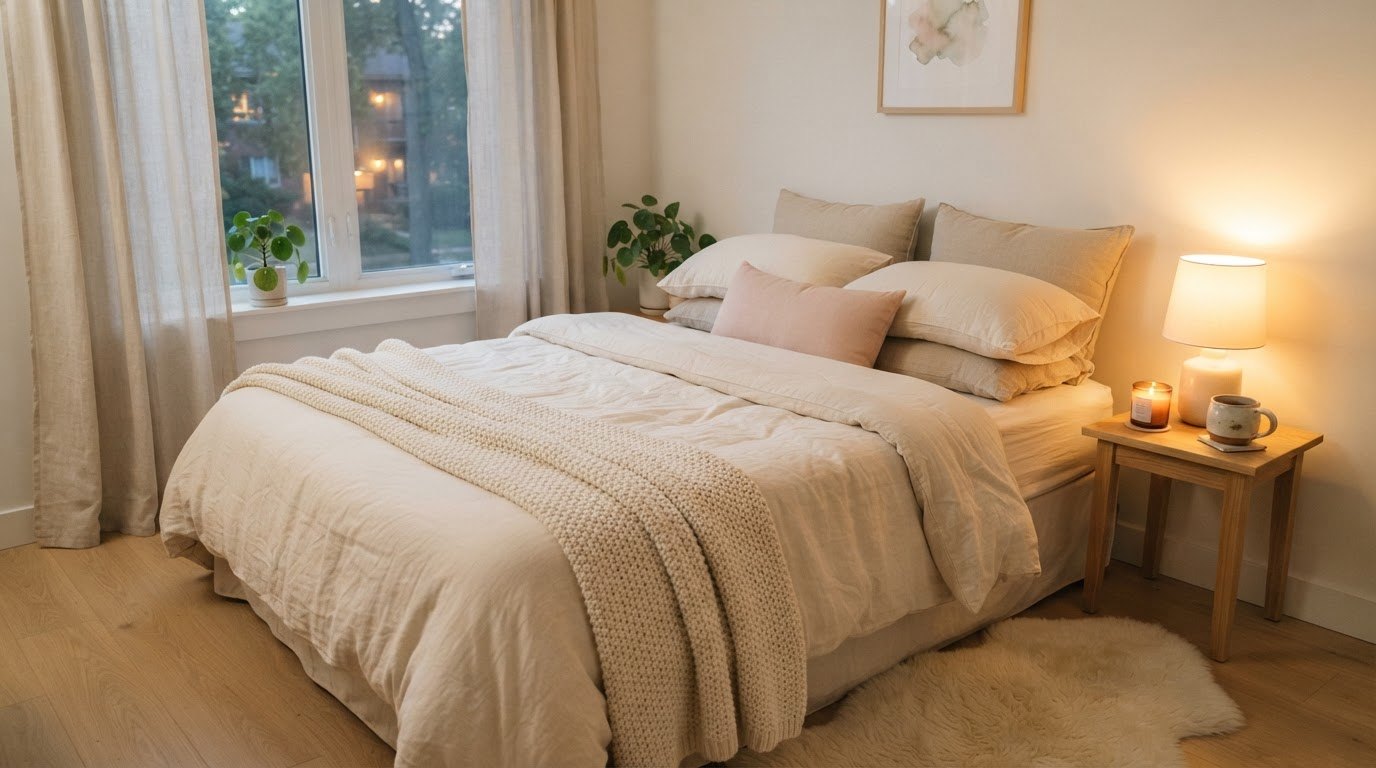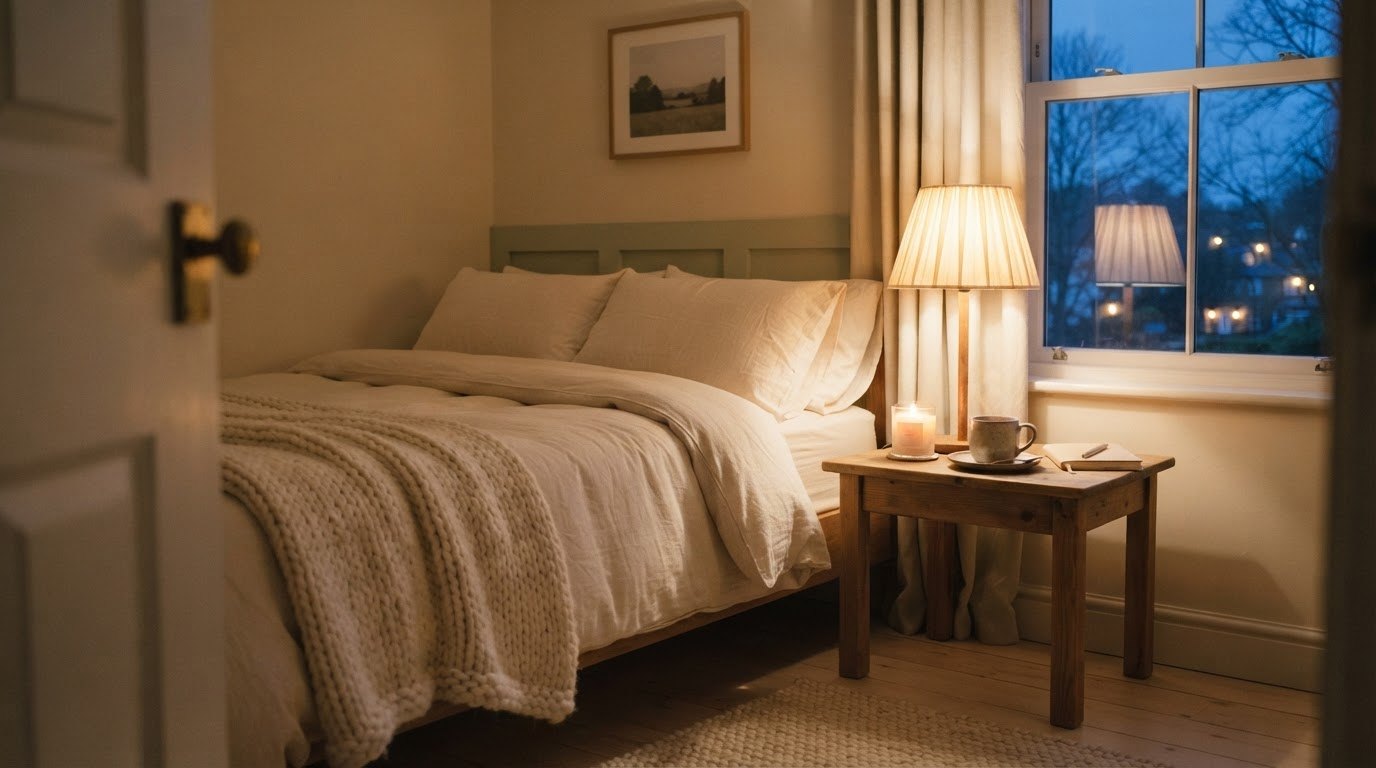
It's 4:58 PM, I've just closed my laptop, and the window behind it is already the color of ink. My body is convinced it's bedtime. Then, of course, at 11:40 PM I'm lying wide awake, thinking about an email I sent in October.
If winter turns your sleep into a strange little seesaw – sleepy at dinner, wired at midnight, groggy until lunch – you're not imagining it. Short days send your body clock mixed signals, and most of us respond by doing exactly the things that make it worse: staying under the big overhead light all evening, sleeping in on dark mornings, and reaching for one more coffee at 3 PM.
So this isn't a list of 25 hacks you'll forget by Thursday. It's a winter sleep routine built on five simple rules, plus a light and wind-down timeline you can copy straight onto a sticky note. Morning light, a steady wake-up time, dim evenings, a gentle wind-down and a cool, dark bedroom. That's the whole system. Everything else is decoration.
A quick, kind note before we start: this is general lifestyle advice, not medical care. If your sleep has been rough for weeks, there's a section near the end about when it's worth talking to a doctor.
Why Winter Messes With Your Sleep
Your body runs on an internal clock that takes most of its cues from light. Bright light in the morning tells it "the day has started," and darkness in the evening tells it "start winding down." In summer, the sun does most of that work for you. In winter, it barely shows up.
Here's what tends to happen when it's dark at 5 PM:
- Your mornings are too dim. You wake up in the dark, commute in the dark-ish, and sit under indoor lighting that's far weaker than daylight – even a cloudy day outside is usually much brighter than a well-lit room. Your clock never gets a clear "good morning."
- Your evenings are too bright. Ironically, because it gets dark so early, we flip on every overhead light and spend five or six hours under them, plus screens. That's a long, bright evening for a body that's trying to wind down.
- Your schedule drifts. Dark mornings make snoozing tempting, holidays shuffle plans around, and weekends turn into a sleep-in marathon. A wobbly wake-up time makes falling asleep at night harder.
- Your bedroom changes. The heating comes on, the air gets drier and warmer, and suddenly you're kicking off the duvet at 2 AM.
None of this means something is wrong with you. It means your routine needs a seasonal update, the same way your skincare and your wardrobe do.
The 5 Winter Sleep Rules (Not 25 Hacks)
For years I treated bad sleep like a puzzle with a hundred missing pieces – a new tea here, a new app there. What actually helped was going back to a few basics and doing them consistently. These five rules cover light, timing, evenings, your wind-down and your bedroom. If you only have the energy for one this week, start with Rule 1.
Rule 1: Get Light Into Your Eyes Within an Hour of Waking
This is the rule that does the most quiet work. Morning light helps anchor your body clock, which makes it easier to feel sleepy at a sensible hour later on.
- Best version: 10–20 minutes outside within an hour of waking. A short walk around the block, coffee on the balcony in your coat, walking the long way to the bus stop. It counts on cloudy days too.
- Good version: sit right next to your brightest window for breakfast, curtains fully open, not across the room.
- Dark-morning version: if you wake before sunrise, turn on bright lights as soon as you're up instead of shuffling around in the dark, then get outside as soon as there's daylight.
If dark mornings make getting up feel impossible, a gentle sunrise-style wake-up light can make the first few minutes feel less brutal – look for one that brightens gradually over 20–30 minutes and lets you choose a soft sound instead of a beep. It won't replace daylight, but it makes 6:45 AM feel less like a punishment.
Mini formula: Wake → open curtains → outside (or window seat) within 60 minutes → 10–20 minutes of light.
Rule 2: Keep Your Wake-Up Time Steady (Yes, on Weekends)
I know. Nobody wants to hear this one in December. But a steady wake-up time is the anchor for everything else – your body learns when to get sleepy based on when it got up.
- Pick a realistic wake-up time you can keep seven days a week, give or take an hour. If you need to be up at 7 on weekdays, aim for no later than 8 on Saturday.
- Move your bedtime, not your alarm. If you were up late, keep the alarm and take a short rest later in the day instead of sleeping until noon.
- Keep naps short and early. If you need one, 15–20 minutes before mid-afternoon is the sweet spot. A two-hour nap at 5 PM (so tempting when it's already dark) usually means a long night staring at the ceiling.
The holidays will bend this rule sometimes, and that's fine. The goal is to come back to it, not to never break it.
Rule 3: Dim the House After Dark
If Rule 1 is "bright mornings," Rule 3 is its mirror: soft evenings. Once the sun is down, start lowering the light in stages instead of keeping the whole home lit like an office until the moment you climb into bed.
- At sunset: switch from overhead lights to lamps where you can. Warm white bulbs feel much calmer than bright cool white.
- About 2 hours before bed: turn off the big light completely. Lamps, candles in glass jars (safely, and blown out before bed) and maybe fairy lights only.
- About 1 hour before bed: one lamp in the room you're in, set as low as it goes.
A small dimmable bedside lamp with a warm, cream shade is a lovely helper here: look for a touch or step dimmer so you can go from "reading" to "candlelight" without getting up. I'm a sucker for anything that feels a little Old Hollywood, so I'd choose a pleated shade – it makes this part of the evening feel like a scene from a black-and-white movie.
Screens are part of this too. You don't have to be perfect. Turning down the brightness, switching on night mode and keeping your phone at arm's length for the last half hour already makes a difference.
Rule 4: Build a 45-Minute Wind-Down
Your brain doesn't have an off switch, but it does respond to signals. A repeated wind-down routine becomes one of those signals: same steps, same order, most nights. Forty-five minutes is enough without feeling like a second job.
Here's the simple shape I follow:
- Close the day (5 minutes). Write tomorrow's top three tasks on paper, put your bag by the door, set out tomorrow's clothes. This keeps "don't forget…" thoughts out of the bedroom.
- Park the phone (1 minute). Plug it in somewhere you can't reach from bed. If it's your alarm, it can still charge across the room.
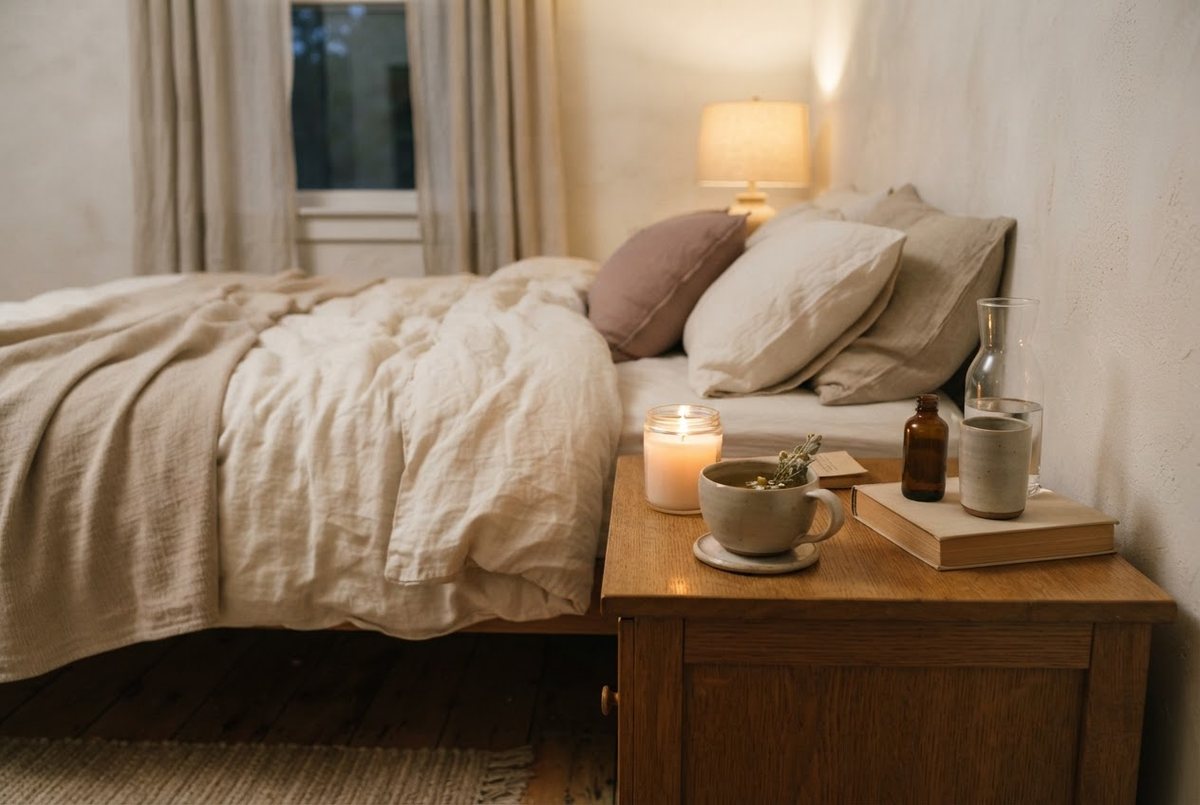
- Warm drink (10 minutes). Something caffeine-free and warm. My evening tea is non-negotiable. If you love loose-leaf, a small glass teapot with a removable infuser is a sweet pick – look for heat-resistant glass and an infuser you can lift out so the tea doesn't turn bitter (and watching the color change is weirdly calming). If you want ideas, my list of caffeine-free bedtime drinks has plenty.
- Journal after tea (10 minutes). Three lines: one thing that happened, one thing I'm worried about, one thing I'm looking forward to. Writing the worry down gives it somewhere to live that isn't my head at 1 AM.
- Skincare and pajamas (10 minutes). Slow, warm-water, no rushing. In winter, this is also when you add an extra layer of moisturizer for dry, heated air.
- Something quiet in bed (10 minutes). A paper book, a gentle stretch, slow breathing. Lights out when your eyes start to feel heavy.
If you want more ideas to swap in and out, my night routine for a better tomorrow has a whole list. Just keep the order roughly the same – repetition is the point.
Rule 5: Make Your Bedroom Cool, Dark and Quiet
Heating season can turn a bedroom into a warm, stuffy box. Most people sleep better in a room that's on the cooler side – many sleep guides suggest somewhere in the mid-60s Fahrenheit – with a warm duvet rather than a hot room.
- Cool: turn the radiator down in the bedroom an hour before bed, or crack the door so air moves. Layer blankets you can kick off instead of one heavy one.
- Dark: streetlights, a neighbor's porch light or a blinking charger can all sneak in. Blackout curtains help a lot, and a soft blush silk sleep mask is the low-effort version – look for one with an adjustable strap that doesn't press on your eyes.
- Quiet: a fan or a white noise sound can cover the hiss of radiators and late-night traffic.
- Not too dry: if you wake with a dry throat or tight skin, a quiet cool-mist humidifier on the dresser can make the air more comfortable. Choose one that's easy to clean, and empty and dry it often so it stays fresh.
Want the room to feel softer too? These renter-friendly bedroom ideas are all about warm light, texture and calm.

Your Winter Light & Wind-Down Timeline
This is the part to copy. It assumes a 7:00 AM wake-up and roughly a 10:30 PM bedtime – if your schedule is different, just shift every row by the same amount. The last column is for low-energy days, because some days you only have the minimum in you, and the minimum still counts.
| Time | What to do | Why it helps | Low-energy version |
|---|---|---|---|
| 7:00 AM | Wake up, open every curtain, turn on bright lights | Tells your body clock the day has started | Curtains open, lights on, nothing else |
| 7:15–8:00 AM | 10–20 minutes outside or by your brightest window | Morning light anchors your rhythm for tonight | Drink your coffee standing at the window |
| Late morning | Work near a window if you can | More daylight during the hours you're awake | Move your chair closer to the light |
| 12:00–2:00 PM | A short walk while the sun is highest | Your best daylight dose of the winter day | Step outside for 5 minutes, even on the doorstep |
| 2:00 PM | Last caffeinated drink of the day | Caffeine can linger for hours and keep you wired later | Switch to decaf or herbal tea from here |
| Sunset (around 4:30–5:00 PM) | Swap overhead lights for lamps | Starts a gentle "evening" signal without making you sleepy at dinner | Turn on one lamp, turn off one ceiling light |
| 5:00–7:00 PM | Stay up and active: tidy, call a friend, a short stretch | Avoids the early-evening crash and a long late nap | If you must rest, 20 minutes max, sitting up |
| 8:30 PM | Big lights off, screens dimmed, night mode on | A long, dim evening helps your body get ready for sleep | Lower screen brightness, that's it |
| 9:45 PM | Start your 45-minute wind-down (close the day, phone away) | Same steps every night become a sleep cue | Phone across the room + skincare |
| 10:00 PM | Warm caffeine-free drink, journal three lines | Moves worries out of your head and onto paper | One line in the journal |
| 10:15 PM | Bedroom cool and dark, quiet book or stretch in bed | A cool, dark room makes falling asleep easier | Sleep mask on, lights off |
| 10:30 PM | Lights out | Consistent timing, night after night | Lights out when you feel sleepy, not before |
You don't need to hit every row. If you only do the morning light and the 8:30 dimming, you've already handled the two biggest winter problems.
What I'd Skip in Winter
Part of a good routine is knowing what to leave out. These are the habits I've quietly dropped because they made my winter nights worse, not better:
- The "it's dark, so I'll nap" trap. A long nap at 5 PM feels amazing for 20 minutes and then costs you an hour of sleep later. Get up, put on a lamp and do something gentle with your hands instead.
- Weekend sleep marathons. Sleeping three hours later on Saturday is basically giving yourself jet lag. Sleep in by an hour if you need it, then get outside.
- Afternoon coffee "just to get through." Coffee sometimes perks me up and sometimes just makes me jittery and anxious, and on dark afternoons it's usually the second one. A walk often does more for that 3 PM slump.
- A nightcap. Alcohol can make you feel drowsy at first, but it tends to make sleep lighter and more broken in the second half of the night. If you enjoy a glass with dinner, keep it earlier in the evening.
- Lying in bed trying really hard. Sleep comes when you stop chasing it. More on that below.
- Buying every sleep gadget. A mask, a lamp and a steady routine beat a drawer full of devices. Start simple and only add what solves a real problem.
When You Wake Up at 3 AM
Ah, the classic. Waking up in the middle of the night is normal – most people do it briefly several times and never remember. It only becomes a problem when we start negotiating with the clock.
- Don't check the time. Knowing it's 3:12 AM starts the math ("if I fall asleep now I'll get four hours…") and the math wakes you up more.
- Breathe slowly for a few minutes. In for four, out for six, hands on your belly. Longer exhales feel calming for a lot of people.
- Do a body scan. Notice your toes, feet, calves, all the way up to your forehead, letting each part feel heavy.
- If you're still awake after what feels like 20 minutes, get up. Go to another room, keep the light very low, and do something boring – fold laundry, read a dull book. Go back to bed when you feel sleepy. This keeps your bed linked with sleep, not with tossing and turning.
- Keep a notepad by the bed. If a thought won't let go, write it down in two words and tell yourself you'll deal with it at a decent hour.
If anxious thoughts are usually what wakes you, my gentle guide on how to sleep with anxiety walks through what helps me on those nights. I'm prone to anxiety (mostly managed, but winter tests it), and having a plan for 3 AM makes the whole night feel less scary.
A Gentle Plan for Your First Week
Trying all five rules on day one is a recipe for giving up on day three. Add one layer at a time instead:
| Day | Add this |
|---|---|
| Day 1 | Choose your wake-up time and set one alarm (no snooze) |
| Day 2 | Morning light: 10 minutes outside or at the window |
| Day 3 | Lamps on at sunset, big light off by 8:30 PM |
| Day 4 | Phone charging outside arm's reach |
| Day 5 | Add the warm drink + three-line journal |
| Day 6 | Bedroom check: cooler, darker, quieter |
| Day 7 | Keep your weekday wake-up time (within an hour) and notice how you feel |
Give it two to three weeks before you judge it. Body clocks shift slowly, and the first few days can feel no different at all.
Winter Sleep and Your Mood
Sleep and mood are tangled together, and winter pulls on both. Better sleep can make dark days feel lighter, and gentle daytime habits – daylight, movement, seeing people – tend to make sleep easier in return. If the short days are weighing on you, my winter blues toolkit has 30 small things that help on gray days, many of which double as good sleep habits.
When To Talk to a Doctor
Routines help a lot, but they're not a fix for everything. Please reach out to a doctor or another healthcare professional if:
- You've had trouble falling or staying asleep most nights for several weeks, and it's affecting your days.
- Someone has noticed you snoring loudly, gasping or pausing your breathing during sleep.
- You feel very sleepy during the day even after a full night in bed, especially while driving.
- Your mood drops every winter and makes it hard to get through normal days, or you're feeling hopeless.
- You're thinking about trying a sleep supplement or medication – check with a doctor or pharmacist first, especially if you take anything else.
Asking for help isn't a failure of your routine. It's part of looking after yourself.
Final Thoughts
Winter sleep doesn't need a perfect routine – it needs a few steady signals. Light in the morning, the same wake-up time, soft lamps after dark, a short wind-down and a cool, dark bedroom. Five rules. That's all.
Tonight, just turn off the big light a little earlier and put your phone across the room. Tomorrow, open the curtains first thing. Small, kind changes, repeated, are what get you through to the longer days.