Gentle yoga isn't the "easy version" of real yoga. For a lot of bodies, it's the version that actually sticks, because it asks for fifteen calm minutes instead of an hour of sweat and a perfect split. Slow poses, long exhales and a few soft props can loosen tight hips, wake up a stiff back and quiet a busy mind in a way that feels like a reward rather than a workout.
This guide is your complete starting point for gentle yoga for beginners. You'll find a 15-minute flow of 12 poses in a set order, a minute-by-minute table you can follow on your mat, how to breathe, how to set up your space, what to wear, how often to practice and how to know when gentle is enough or when you're ready for a little more.
No flexibility required. If you can sit on the floor and breathe, you can do every pose here, and each one comes with an easier option.
What Makes Yoga "Gentle"?
Gentle yoga is less about which poses you do and more about how you do them. A few things set it apart from a faster class:
- Slow pace. You stay in each pose for 5–10 breaths (roughly 30–90 seconds) instead of flowing through on one breath.
- Low to the ground. Most poses are seated, on hands and knees or lying down, so there's little balancing and very little strain on wrists and knees.
- Props are normal, not a crutch. Blocks, cushions and straps bring the floor closer to you, so you never have to force a stretch.
- Effort stays around 4 out of 10. You should feel a stretch, never a sharp pull. If you're gritting your teeth, you've gone too far.
- The breath leads. You move on the inhale and the exhale, which is what makes it feel calming instead of like exercise you have to get through.
Think of it as stretching with attention. That attention is the part that makes it yoga, and it's also why it can help on anxious days. I'm prone to anxiety that I mostly manage, and a slow exhale on the mat does more for me than any amount of "just relax."
Before You Start: Mat, Props and What To Wear
You don't need much, but a few basics make gentle yoga far more comfortable, especially if your knees or lower back complain on hard floors.
Your Mat and Space
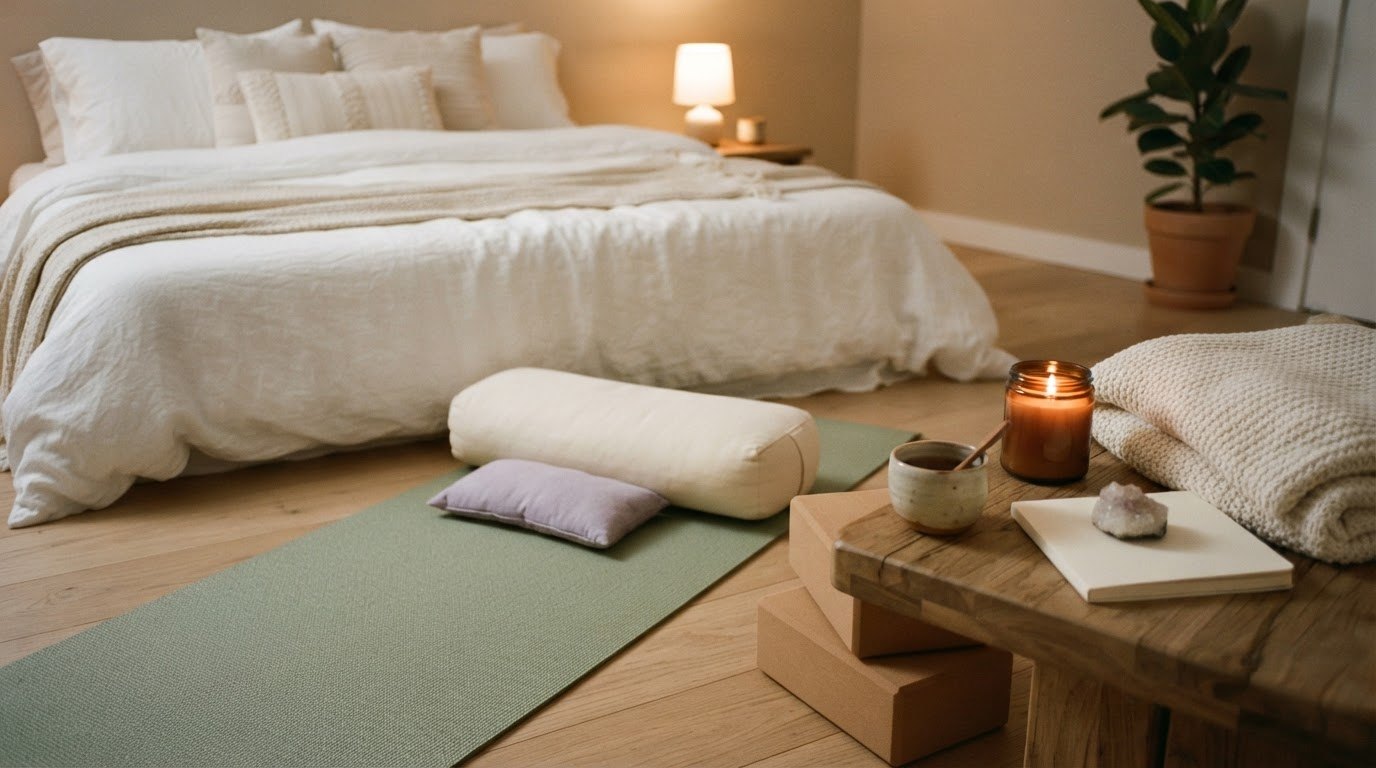
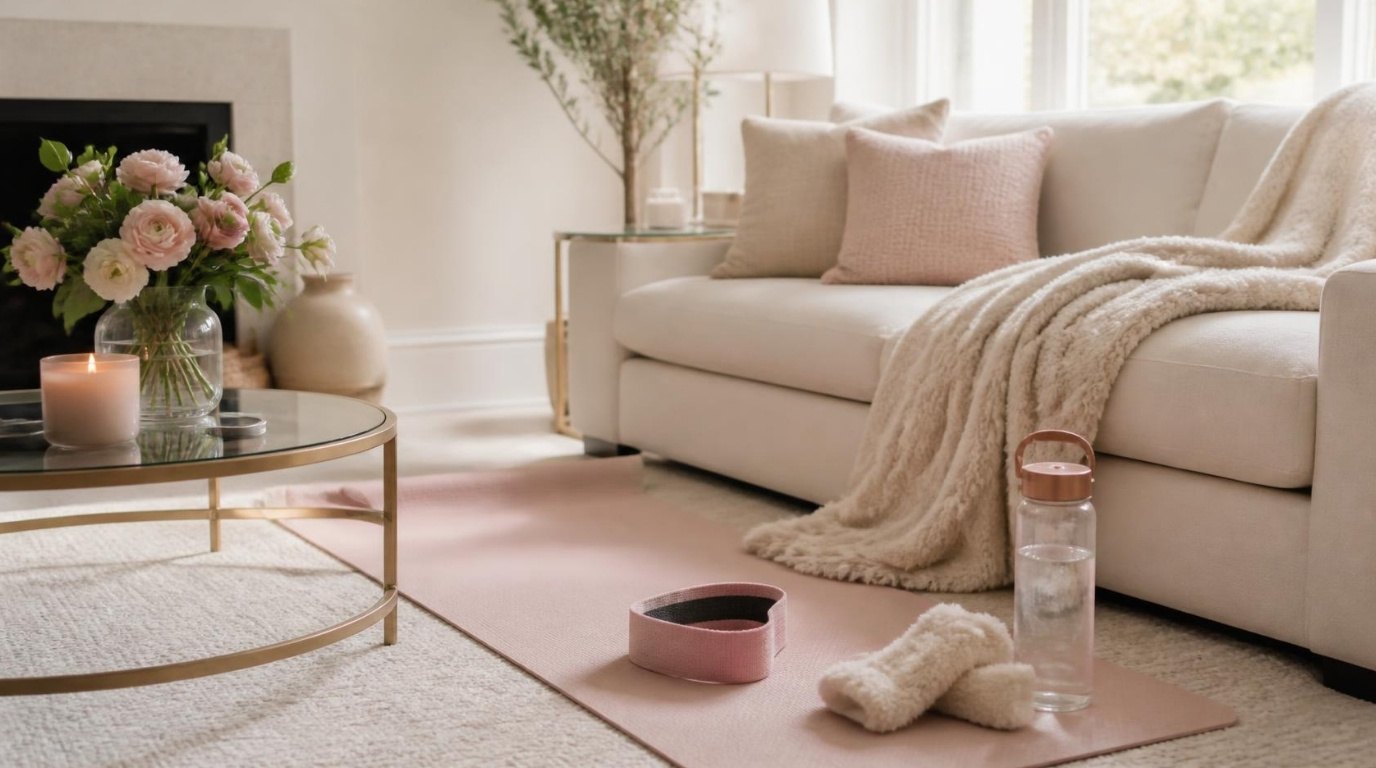
Find a spot about the length of your body plus an arm's reach on each side. A rug under the mat stops it from sliding. For kneeling poses, thickness matters more than grip, so I'd choose an extra-thick yoga mat (around 10–15 mm) in a soft color you'll enjoy rolling out. Keep a folded blanket nearby for under your knees or hips, open a window if you can, and lower the lights a little. A calm room makes a calm practice.
Props That Make Every Pose Easier
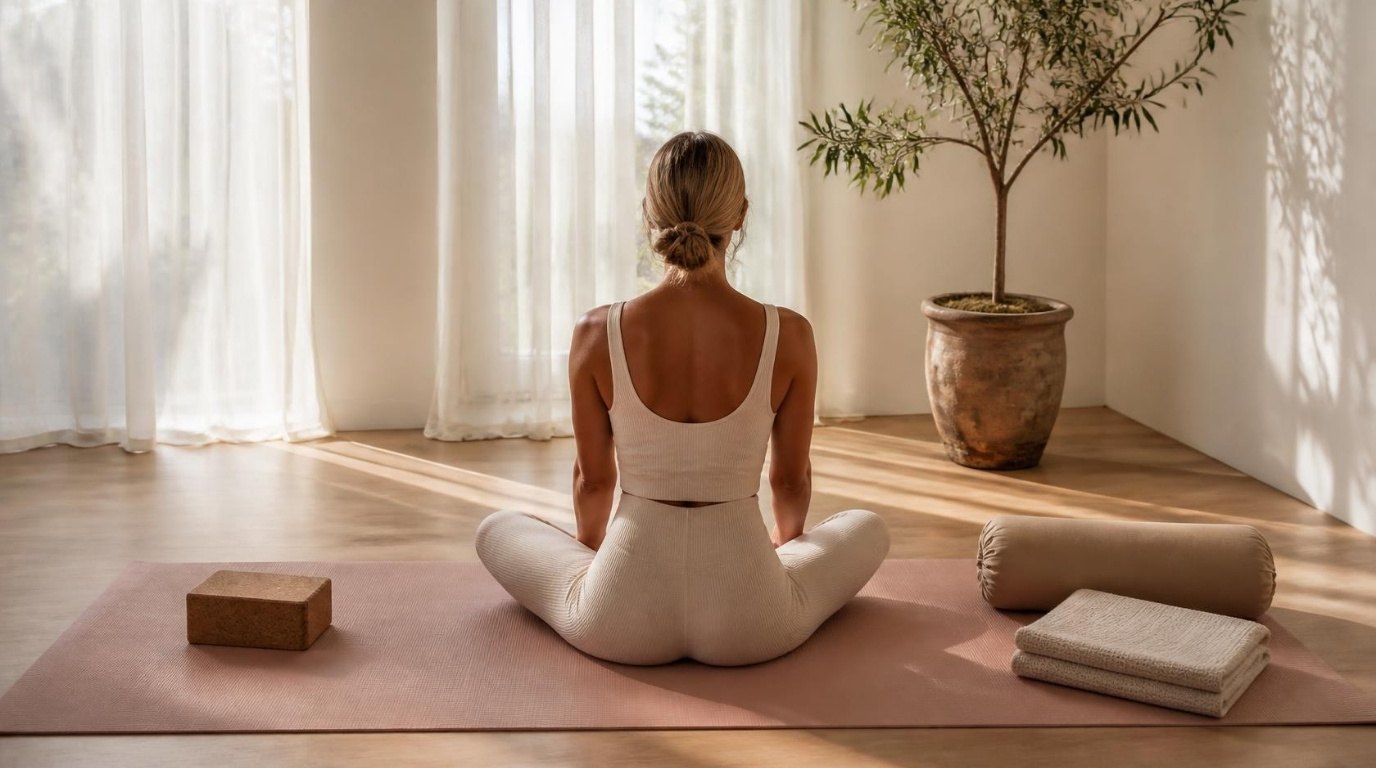
- Blocks. Look for a cork yoga block set, because cork is sturdy and doesn't wobble. Use them under your hands in lunges and forward folds, or under your hips in bridge.
- A strap. A simple cotton yoga strap with a buckle lets you reach your feet in seated stretches without rounding your back.
- A bolster or firm pillow. For child's pose and final rest, a rectangular yoga bolster is lovely, though two firm couch cushions work too.
What To Wear
Soft, stretchy and not too loose. Leggings or relaxed joggers, a fitted top that won't fall over your face when you fold forward, and bare feet so they don't slip. Because gentle yoga is slow, you can get chilly, especially in final rest, so keep a soft women's wrap cardigan or a light blanket within reach.
How To Breathe in Gentle Yoga
If you remember only one thing from this article, let it be this: breathe through your nose, and make your exhale a little longer than your inhale. That longer exhale is what tells your body it's safe to soften.
Here's a simple way to practice before you begin the flow:
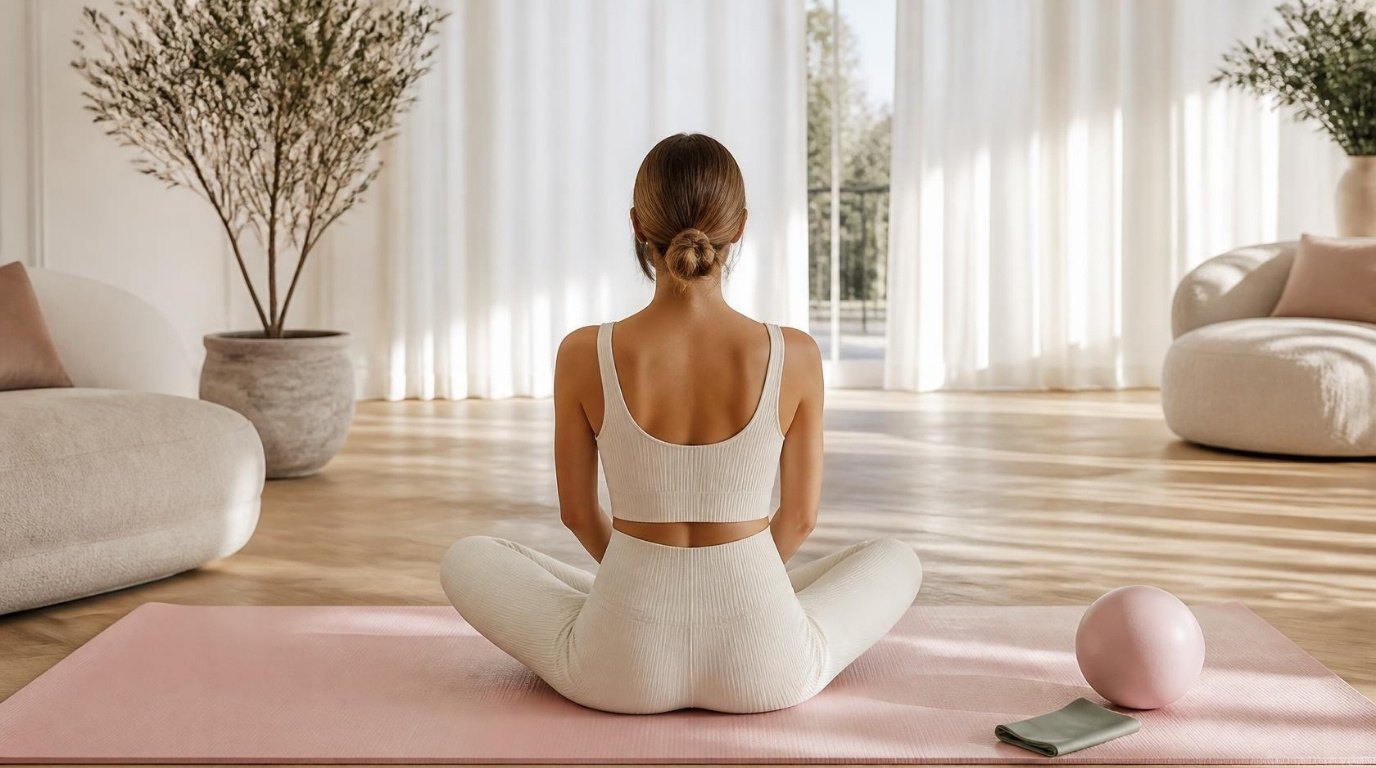
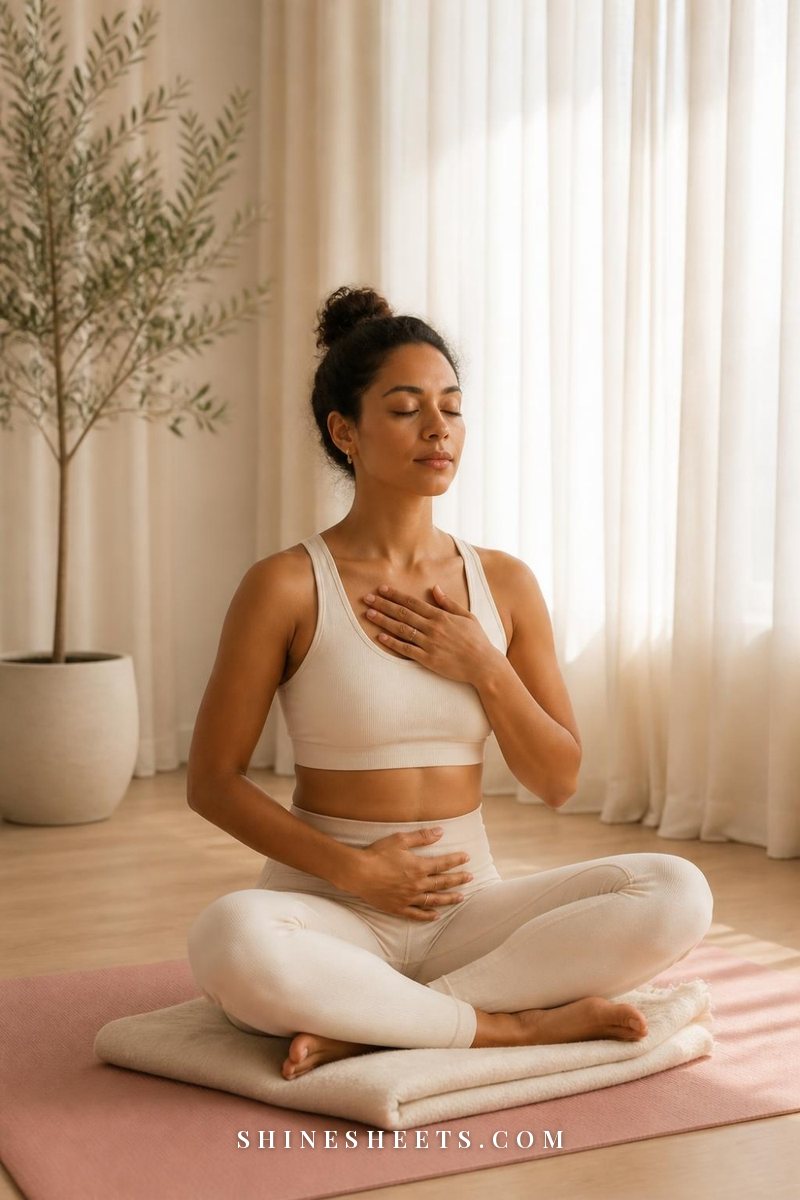
- Sit cross-legged on a folded blanket so your hips are higher than your knees.
- Rest one hand on your belly and one on your chest.
- Inhale through your nose for a count of 4 and feel the belly hand rise first.
- Exhale through your nose for a count of 6 and feel the belly gently fall.
- Repeat for 5 rounds without forcing anything.
During the flow, use this rule of thumb: inhale to lengthen or open, exhale to fold or twist. If you ever notice you're holding your breath, back off the pose by about 20 percent. Your breath is your best guide to how hard you're working. For more ways to steady yourself, my guide to breathing exercises for calm has a few simple patterns to try off the mat too.
Your 15-Minute Gentle Yoga Flow at a Glance
Screenshot this table and keep it next to your mat for your first week. After that, you'll probably know the order by heart.
| Time | Pose | Key cue | Easier option |
|---|---|---|---|
| 0:00–1:30 | 1. Easy Seated Breathing | Long spine, exhale longer than inhale | Sit on a cushion or against a wall |
| 1:30–2:30 | 2. Seated Side Stretch | Reach up and over, both sit bones heavy | Keep the lifted hand on your head |
| 2:30–4:00 | 3. Cat-Cow | Inhale to arch, exhale to round | Blanket under knees, fists instead of flat palms |
| 4:00–5:00 | 4. Thread the Needle | Shoulder and temple rest down | Rest your head on a block |
| 5:00–6:00 | 5. Child's Pose | Hips back, forehead down, breathe into your back | Bolster lengthwise under your chest |
| 6:00–7:00 | 6. Downward Dog with Bent Knees | Long spine first, heels can float | Puppy pose: knees stay down, chest melts |
| 7:00–8:30 | 7. Low Lunge | Front knee over ankle, hips forward | Hands on blocks, blanket under back knee |
| 8:30–9:30 | 8. Ragdoll Forward Fold | Soft knees, hold opposite elbows, sway | Hands on blocks or thighs |
| 9:30–10:30 | 9. Mountain Pose with Arm Reach | Feet hip-width, ribs soft, arms up on inhale | Arms to shoulder height only |
| 10:30–11:30 | 10. Supported Bridge | Lift hips, slide block under sacrum | Small lift, no block |
| 11:30–12:30 | 11. Reclined Twist | Knees to one side, both shoulders heavy | Pillow between or under knees |
| 12:30–15:00 | 12. Final Rest (Savasana) | Let the floor hold you, natural breath | Bolster under knees, blanket over you |
If fifteen minutes feels like too much today, do poses 1, 3, 5, 10 and 12. That five-pose mini version takes about eight minutes and still leaves you feeling looser.
The 12 Poses of Your Gentle Yoga Flow, Step by Step
Move slowly between poses. The transitions are part of the practice, not a race to the next shape.
1. Easy Seated Breathing
Sit cross-legged on a folded blanket, hands resting on your knees. Lengthen up through the crown of your head and soften your shoulders away from your ears. Breathe in for 4, out for 6, for about 8 rounds (90 seconds).
Easier option: If your knees float high or your back aches, sit on a firmer cushion or lean your back against a wall.
2. Seated Side Stretch
Still seated, place your right hand on the floor beside you. Inhale and sweep your left arm up; exhale and lean gently to the right, reaching over your head. Keep both sit bones heavy on the floor. Stay for 4 breaths, then switch sides (30 seconds each).
Easier option: Rest your lifted hand on top of your head instead of reaching. You'll still feel the side of your waist open.
3. Cat-Cow
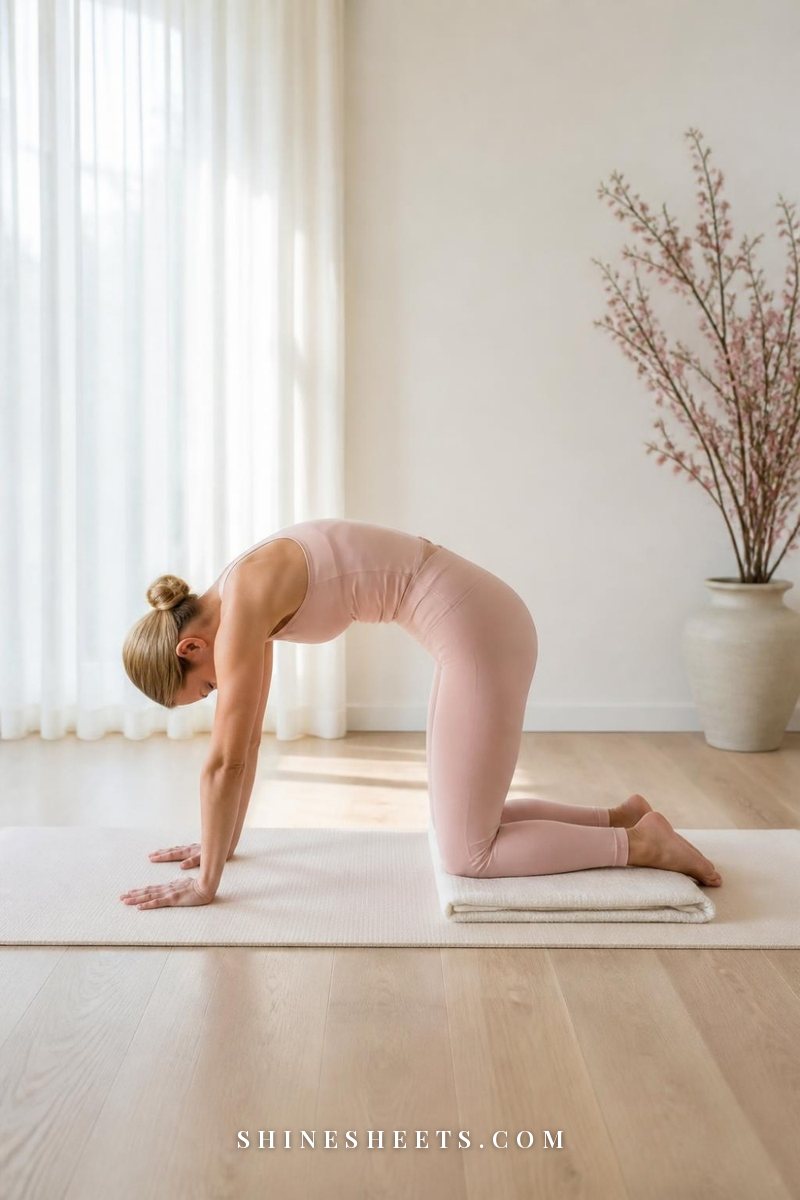
Come onto hands and knees, wrists under shoulders, knees under hips. On an inhale, drop your belly, lift your chest and look slightly forward (cow). On an exhale, press the floor away, round your back like a cat and let your head hang. Move slowly for about 8 rounds (90 seconds), letting each movement last the length of a breath.
Easier option: Put a folded blanket under your knees. If your wrists ache, make soft fists or rest your forearms on blocks.
4. Thread the Needle
From hands and knees, inhale and lift your right arm toward the ceiling. Exhale and slide it under your left arm, palm up, until your right shoulder and temple rest on the mat. Your left hand can stay planted or walk forward. Stay for 4 breaths, then switch (30 seconds each side). This one is a favorite for the spot between the shoulder blades that gets tight at a desk.
Easier option: Rest your head on a block instead of the floor so your neck stays relaxed.
5. Child's Pose
Bring your big toes together, knees wide, and sink your hips back toward your heels. Walk your hands forward and rest your forehead on the mat. Breathe into the back of your ribs and feel them widen. Stay for 60 seconds.
Easier option: Place a bolster or two pillows lengthwise under your chest and turn your head to one side halfway through. If your hips don't reach your heels, tuck a rolled blanket between them.
6. Downward Dog with Bent Knees
From hands and knees, tuck your toes and lift your hips up and back into an upside-down V. Keep your knees generously bent so your spine can be long; your heels don't need to touch the floor (they rarely do). Pedal your feet slowly, bending one knee then the other, for about 6 breaths (60 seconds), then lower your knees.
Easier option: Puppy pose. Keep your knees on the mat under your hips, walk your hands forward and let your chest melt toward the floor.
7. Low Lunge
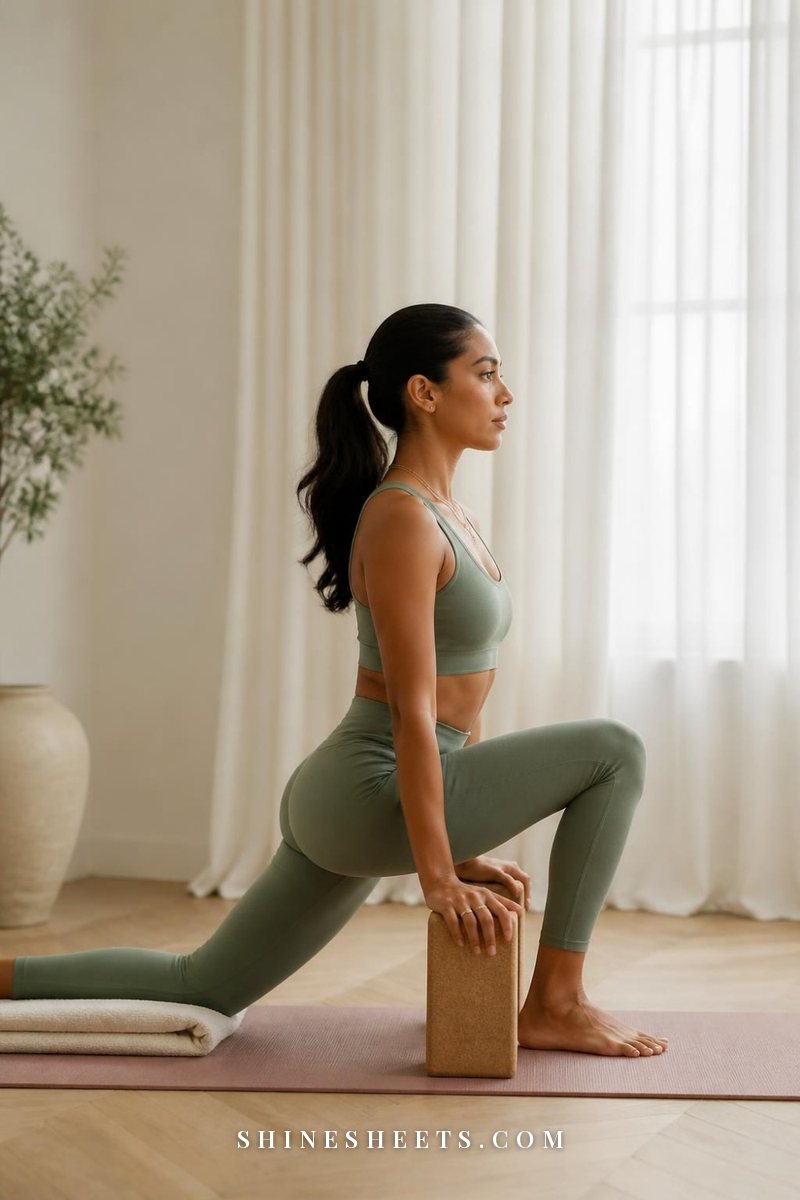
From hands and knees, step your right foot forward between your hands so the knee stacks over the ankle. Lower your back knee onto the mat. Bring your hands to your front thigh or onto blocks on either side of your foot. On each exhale, let your hips sink forward an inch, feeling the front of the left hip open. Stay for 45 seconds, then switch sides.
Easier option: Fold a blanket under your back knee and keep your hands on blocks at their tallest height. If you sit a lot, this is the pose your hips have been waiting for.
8. Ragdoll Forward Fold
Step your back foot forward to meet the front one, feet hip-width apart. Bend your knees generously and let your upper body hang over your legs. Hold opposite elbows and sway gently from side to side. Let your head be heavy. Stay for 60 seconds, then roll up slowly, one vertebra at a time, with your head coming up last.
Easier option: Rest your hands on blocks or on your thighs. If you feel dizzy when you come up, pause halfway with hands on knees.
9. Mountain Pose with Arm Reach
Stand tall with feet hip-width apart, weight even through both feet, knees soft. Inhale and sweep your arms out and up overhead; exhale and float them back down. Move with your breath for 6 rounds (60 seconds). Keep your ribs soft rather than flaring them forward. If you'd like more upright moves for desk days, my gentle posture exercises pair beautifully with this one.
Easier option: Lift your arms only to shoulder height, or keep your hands on your heart and simply breathe.
10. Supported Bridge
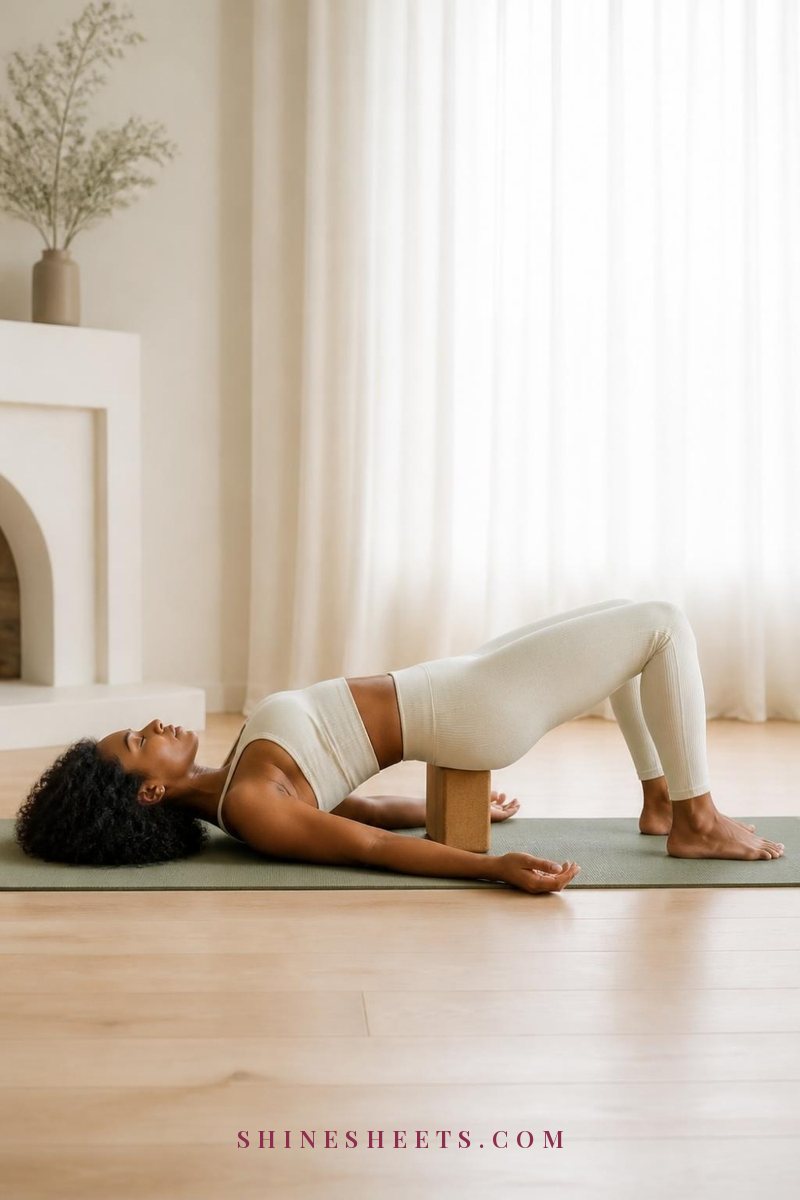
Lower yourself to the mat and lie on your back, knees bent, feet flat and hip-width apart, close enough that your fingertips can graze your heels. Press into your feet and lift your hips a few inches. Slide a block (on its lowest or middle height) under the flat bony part at the base of your spine, then relax your weight onto it. Arms rest by your sides, palms up. Stay for 60 seconds, breathing slowly.
Easier option: Skip the block and do 6 small, slow bridge lifts instead, lifting on the inhale and lowering on the exhale.
11. Reclined Twist
Remove the block and lower your hips. Hug your knees toward your chest, then let them fall slowly to the right while your arms open into a T. Turn your head to the left only if it feels good for your neck. Try to keep both shoulders heavy. Stay for 30 seconds, then switch sides.
Easier option: Place a pillow under your knees so they don't have to reach all the way to the floor.
12. Final Rest (Savasana)
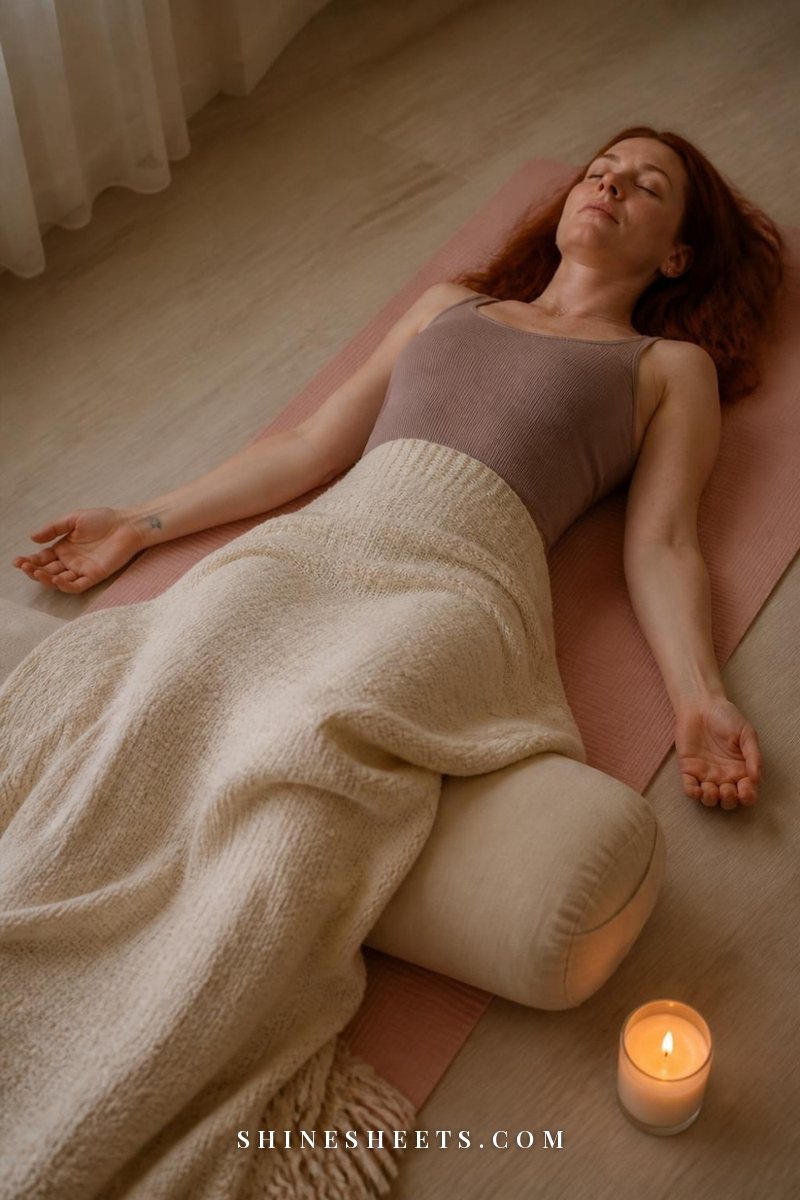
Stretch your legs out long, let your feet fall open and rest your arms a little away from your body, palms up. Slide a bolster under your knees if your lower back prefers it, and pull your blanket or cardigan over you. Close your eyes. Stop controlling the breath and let it become natural. Stay for at least 2 minutes (up to 5 if you have time).
This is the pose people skip, and it's arguably the most important. It's where your nervous system catches up with what your muscles just did. When you're ready, wiggle your fingers and toes, roll onto your right side and press yourself up slowly.
How Often Should You Do Gentle Yoga?
For most beginners, a short practice often beats a long practice rarely. Here's a simple rhythm to start with:
- Weeks 1–2: 3 times a week, the full 15-minute flow or the 8-minute mini version.
- Weeks 3–4: 4–5 times a week, adding a few extra breaths in the poses you like most.
- After a month: daily if you enjoy it. Gentle yoga is kind enough on the body to do every day.
Morning or evening both work. In the morning, the flow wakes up a stiff back; my morning stretches guide has a five-minute version for days you're short on time. In the evening, you can swap the standing poses for extra floor time, or try my bedtime yoga flow, which is built for winding down. I like ending an evening practice with tea and a few lines in my journal, but that part is entirely optional.
Whatever you choose, attach it to something you already do: after your morning coffee, before your shower, right after work. A habit that has a "home" in your day is much easier to keep.
When Gentle Yoga Is Enough (and When To Add More)
Gentle yoga can absolutely be your whole movement practice for a season, especially when you're tired, recovering from a stressful stretch or just starting to move again. It improves how you feel in your body, and that counts.
Gentle yoga is probably enough if:
- Your main goal is to feel less stiff and less stressed.
- You're coming back to movement after a long break.
- You already walk, strength train or do another workout and want a calm counterbalance.
- Busy weeks leave you with energy for 15 minutes, not 45.
You might be ready to add more if:
- The full flow feels easy and you want to feel a little warmer by the end.
- You'd like to build strength in your legs, core and arms, not just flexibility.
- You catch yourself wishing it lasted longer.
Adding more doesn't have to mean a sweaty power class. Hold each pose for 2–3 extra breaths, repeat the lunge-to-ragdoll section twice, or add a short strength session on alternate days. My wall Pilates for beginners routine is a lovely next step because it builds strength while staying low-impact.
5 Common Beginner Mistakes in Gentle Yoga
1. Forcing the Stretch
More stretch isn't more benefit. A pose that feels like a 4 out of 10 lets your muscles relax; a pose at 8 out of 10 makes them brace. Back off until you can breathe smoothly.
2. Locking Your Knees
In ragdoll and mountain pose, keep a tiny bend in your knees. Locked knees push the stretch into your joints instead of your muscles.
3. Skipping the Props
Blocks and cushions aren't for "bad" yogis. They let you get the actual benefit of the pose with good alignment. Experienced teachers use them constantly.
4. Rushing the Transitions
Many little tweaks happen between poses, not in them. Take two breaths to move from one shape to the next, especially when standing up from a fold.
5. Leaving Out Final Rest
Two minutes of lying still can feel unproductive, but it's where the calm actually settles in. Set a gentle timer if you worry about falling asleep, and let yourself have it.
A Kind Safety Note
Gentle yoga is suitable for most people, but every body is different. If you're pregnant, recovering from surgery or an injury, or living with back, joint, heart or blood pressure concerns, check with your doctor or a physical therapist before starting, and look for a teacher who specializes in your situation. The NIH has a clear, balanced overview of yoga safety and what to know before you begin.
On the mat, follow one simple rule: discomfort that feels like stretching is fine, but sharp, pinching or shooting pain means stop. Come out of the pose slowly and rest in child's pose or on your back instead. Skipping a pose is always allowed.
Final Thoughts
Gentle yoga for beginners is really about showing up for fifteen kind minutes. You don't need to touch your toes, hold a balance or look like the photos. You only need a mat, a few slow breaths and the willingness to move a little more softly than usual.
Start with three practices this week, keep the table nearby and let the poses become familiar. Before long, unrolling your mat will feel less like a task and more like coming home to your own body.