It usually happens around three in the afternoon. I'm deep in something on my laptop, I reach for my tea, and I suddenly notice where my shoulders are. Up near my ears. Head pushed forward like I'm trying to climb into the screen. Lower back slumped into a shape no chair designer ever intended. And the moment I notice, I feel it too: the tight neck, the achy spot between my shoulder blades, the stiffness when I finally stand up.
If you spend long days at a desk, you probably know this feeling. And you've probably also heard "just sit up straight," which works for about four minutes before you melt right back down. That's not a willpower problem. Bodies aren't built to hold any one position for hours, perfect or not. (When I'm anxious, I hold even more tension in my shoulders, so I've had to learn this one the gentle way.)
What actually helps is movement, little and often. In this guide you'll find 10 posture exercises made for desk days, most of which you can do in work clothes, a quick desk setup check, a 10-minute desk-day routine you can follow straight from the table, and a "posture check every hour" mini script that takes about thirty seconds. No gym, no fancy equipment, no pressure to become a perfectly upright statue.
What Good Posture Actually Means
Let's clear up one thing first: there's no single "perfect" posture you're supposed to hold all day. Even a beautifully aligned position gets uncomfortable if you stay frozen in it. The best posture, as the saying goes, is your next one.
That said, there is a comfortable, balanced starting point to come back to. When you sit, it looks roughly like this:
- Feet flat on the floor (or on a footrest), knees about level with your hips.
- Hips back in the chair, with your lower back gently supported.
- Shoulders relaxed and down, not pulled back hard like a soldier.
- Head stacked over your shoulders, chin level, ears roughly in line with your shoulders.
- Elbows close to your sides, bent about ninety degrees, wrists straight.
Think of it as a home base, not a rule. The exercises below help your body find that base more easily, and the hourly check helps you remember to come back to it.
Set Up Your Desk Before Anything Else
No amount of stretching can fully undo a setup that pulls you out of shape for eight hours. A few small changes make every exercise in this article work better:
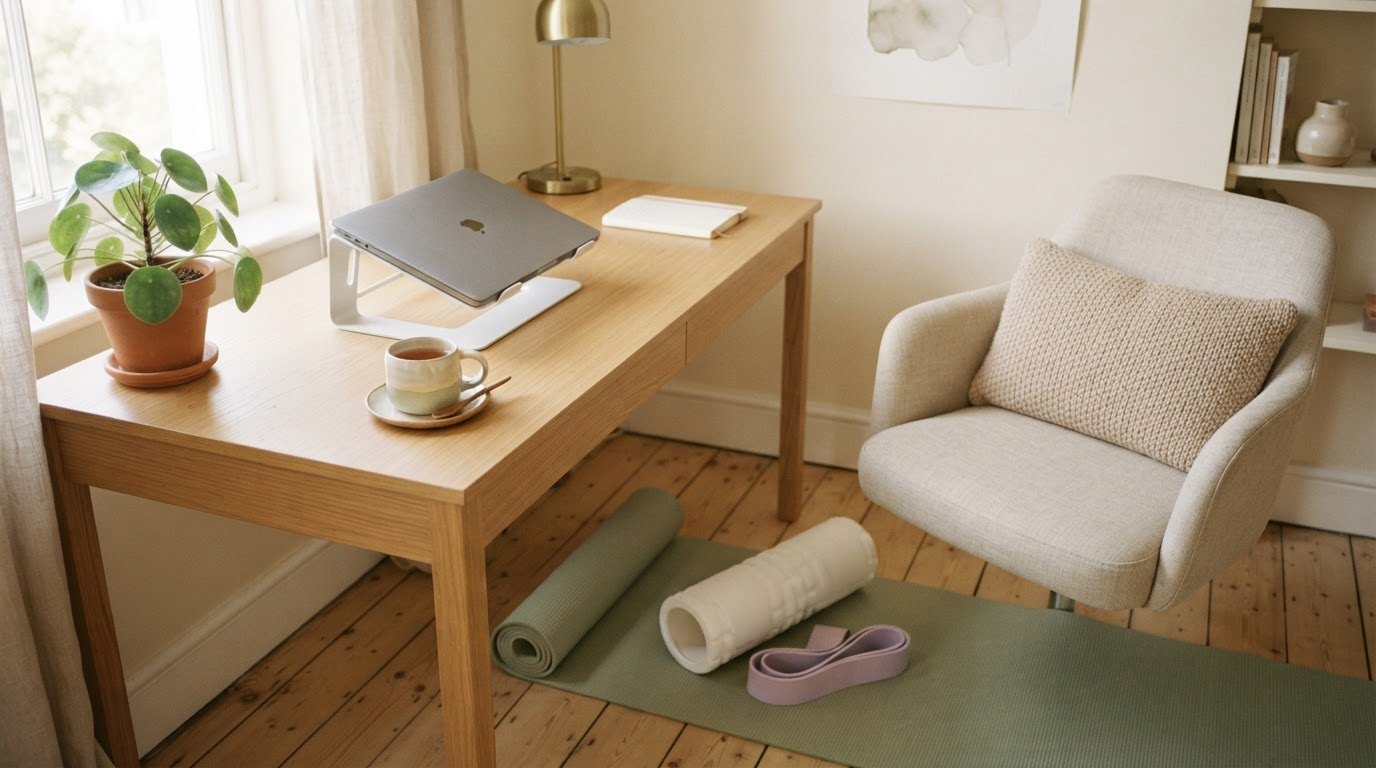
- Raise your screen. The top of your screen should sit at or slightly below eye level, about an arm's length away. If you're on a laptop, a white adjustable laptop stand plus a separate keyboard is one of the kindest things you can do for your neck.
- Support your lower back. Most chairs leave a gap behind the curve of your lower back, so you slump to fill it. A memory foam lumbar pillow in beige fills that gap. Look for one with an adjustable strap so it stays in place, and a removable, washable cover.
- Check your chair height. Feet flat, thighs roughly parallel to the floor. If your feet dangle, stack a couple of books or use a footrest.
- Bring things closer. If you're constantly reaching for your mouse, phone or mug, move them in. Every reach is a tiny lean forward.
10 Posture Exercises for Desk Days
Move slowly and gently. A stretch should feel like a pleasant pull, never sharp or painful. If anything hurts, ease off or skip that move. You can do these as a full routine (see the table below) or sprinkle one or two through your day.
1. Chin Tucks
This is the classic fix for "laptop head," when your head drifts forward of your shoulders. Sit tall, look straight ahead and gently glide your chin straight back, as if you're making a small double chin. Don't tip your head down; it's a backward slide, not a nod. Hold for three seconds, release and repeat 10 times. You'll feel a gentle stretch at the base of your skull and a little work in the front of your neck. It looks a bit silly, which is exactly why it's great on video calls with your camera off.
2. Shoulder Rolls and Shrugs
Your shoulders take the brunt of a stressful day. Lift both shoulders up toward your ears, hold for two seconds and let them drop completely with a big exhale. Do that 5 times. Then roll your shoulders slowly backward in big circles 10 times: up, back, down and around. Focus on the "back and down" part of each circle. It's a tiny move that resets the whole upper body and feels lovely after a tense meeting.
3. Seated Upper Back Extension
Hours of hunching round the upper back forward. This move gently does the opposite. Sit near the front of your chair (a chair with a low backrest works best), clasp your hands lightly behind your head with elbows wide, and slowly lean back over the top of the backrest, lifting your chest toward the ceiling. Keep your lower back neutral and let the movement come from between your shoulder blades. Hold for two breaths, come back up and repeat 5 times. If your chair back is high, simply lift your chest and look slightly up without leaning.
4. Doorway Chest Stretch
When you type all day, your chest muscles get short and pull your shoulders forward. Stand in a doorway and place your forearms on each side of the frame, elbows at shoulder height. Step one foot forward and gently lean in until you feel a stretch across your chest and the front of your shoulders. Keep your shoulders down and your belly lightly engaged. Hold for 30 seconds, breathe slowly and repeat once more. No doorway nearby? Clasp your hands behind your back, straighten your arms and gently lift them while opening your chest.
5. Wall Angels
Stand with your back against a wall, feet about a step away from it. Try to keep your lower back, upper back and head lightly touching the wall. Raise your arms into a "goalpost" shape (elbows bent ninety degrees, backs of your hands toward the wall), then slowly slide your arms up overhead and back down, like making a snow angel. Only go as high as you can while your back stays against the wall. Do 8 to 10 slow reps. It's harder than it looks, and it's one of the best moves for waking up the muscles that hold your shoulders back.
6. Band Pull-Aparts
This strengthens the upper back muscles that tend to get lazy at a desk. Hold a light resistance band in a soft pastel color with both hands, arms straight out in front at shoulder height, hands about shoulder-width apart. Pull the band apart by squeezing your shoulder blades together, bringing your arms out to the sides. Pause, then return slowly. Do 12 to 15 reps. Look for a set with a few resistance levels and start with the lightest; the slow, controlled return matters more than strength. Keep it in a desk drawer and it'll actually get used.
7. Cat-Cow
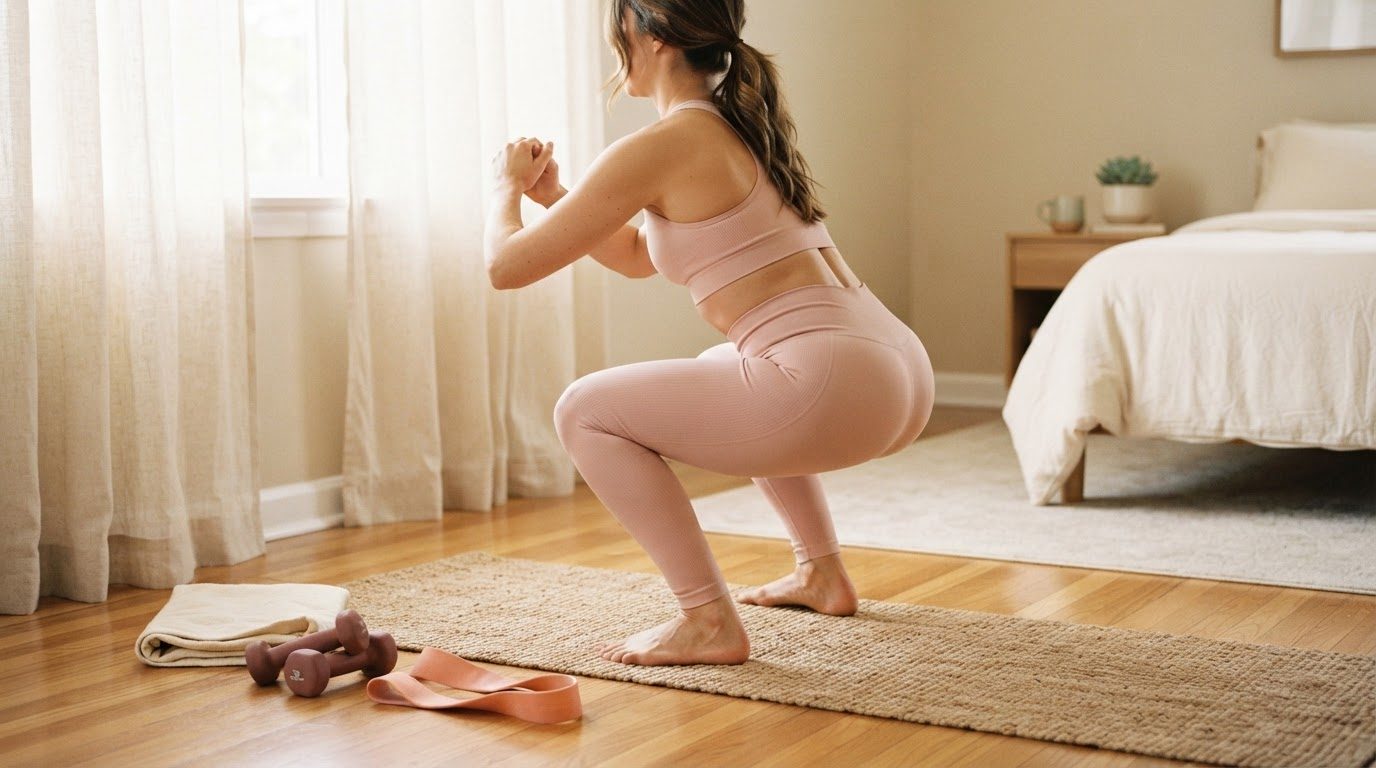
A gentle, flowing move that wakes up your whole spine. On your hands and knees on a sage green yoga mat (look for one at least 6mm thick if your knees are sensitive), inhale as you let your belly drop and lift your chest and tailbone (cow). Exhale as you round your back, tuck your chin and tailbone and press the floor away (cat). Move slowly with your breath for 8 to 10 rounds. Working from home? This is a lovely lunchtime reset. In the office, a seated version works too: hands on knees, arch and round your back in your chair.
8. Standing Hip Flexor Stretch
Sitting keeps the muscles at the front of your hips in a shortened position all day, which can tug on your lower back. Step one foot forward into a small lunge, back heel lifted, and gently tuck your tailbone under until you feel a stretch at the front of the back hip. Keep your torso upright and your front knee over your ankle. Hold the back of a chair if you need balance. Hold for 30 seconds per side. For a deeper version, raise the arm on the same side as the back leg overhead.
9. Glute Bridges
Your glutes are a big part of good posture, and sitting all day switches them off a little. Lie on your back on your mat, knees bent, feet flat and hip-width apart. Press through your heels and lift your hips until your body makes a straight line from shoulders to knees, squeezing your glutes at the top. Hold for two seconds, then lower slowly. Do 12 reps. Avoid arching your lower back at the top; the lift should come from your hips, not your spine.
10. Foam Roller Upper Back Release
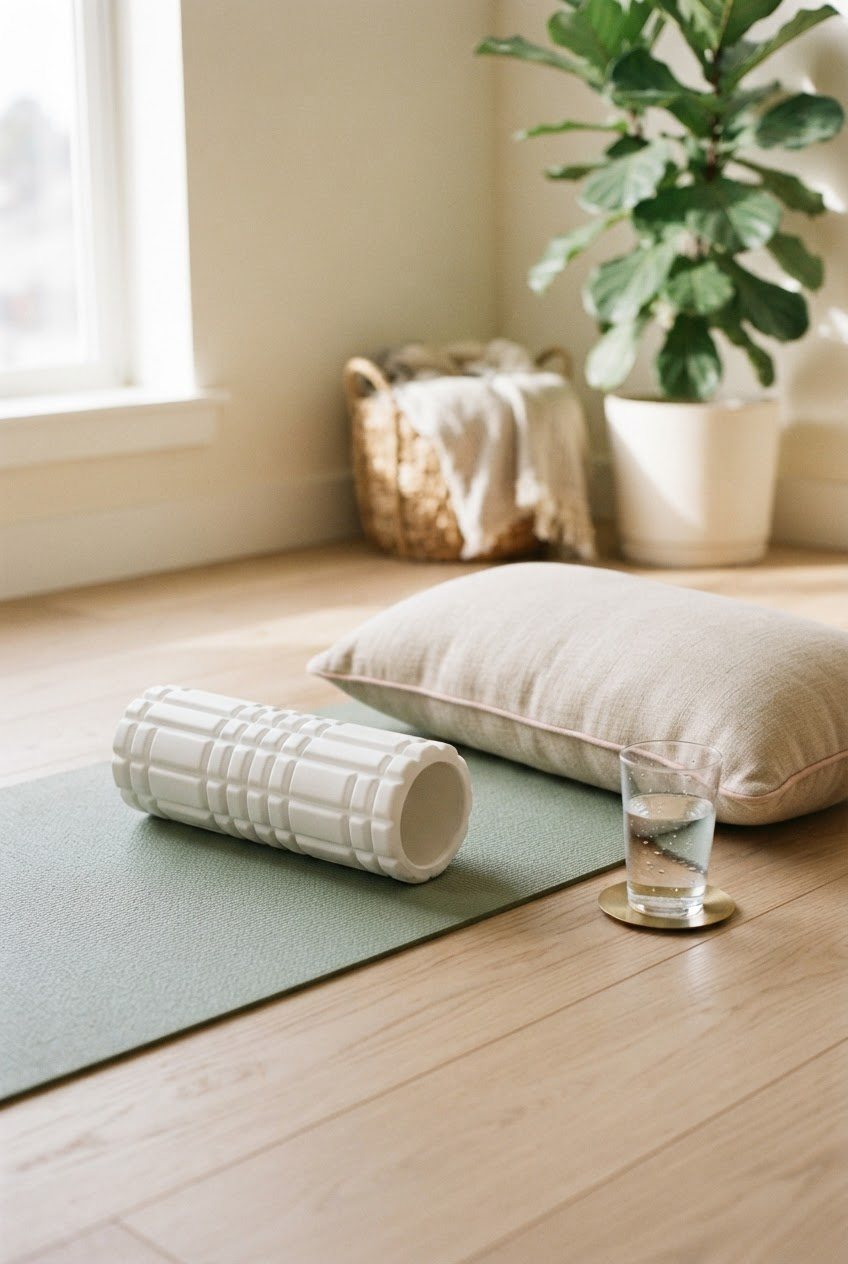
This is the end-of-day treat. Place a white foam roller (a medium-density one is a gentle place to start) horizontally on your mat and lie back over it so it sits under your upper back, just below your shoulder blades. Support your head with your hands, elbows in, and lift your hips slightly. Slowly roll up and down the upper back for about 60 seconds. Then pause at a few spots and gently extend back over the roller for a breath or two. Keep it on the upper and mid back only; don't roll your lower back or neck.
The 10-Minute Desk-Day Routine
Here's how to put the moves together into one short routine. Do it once a day (mid-afternoon is perfect, right when the slump hits) or split it into two five-minute halves: the seated moves at your desk, the floor moves at home in the evening.
| Move | Reps or time | What it helps |
|---|---|---|
| 1. Chin tucks | 10 reps, 3-second hold (about 45 sec) | Forward head, tight neck |
| 2. Shoulder rolls and shrugs | 5 shrugs + 10 rolls (about 45 sec) | Shoulder tension, stress |
| 3. Seated upper back extension | 5 reps, 2 breaths each (about 1 min) | Rounded upper back |
| 4. Doorway chest stretch | 2 x 30 sec (1 min) | Tight chest, rounded shoulders |
| 5. Wall angels | 8–10 slow reps (about 1 min) | Shoulder mobility, upper back strength |
| 6. Band pull-aparts | 12–15 reps (about 45 sec) | Weak upper back muscles |
| 7. Cat-cow | 8–10 rounds (about 1 min) | Stiff spine, overall reset |
| 8. Standing hip flexor stretch | 30 sec per side (1 min) | Tight hips, lower back strain |
| 9. Glute bridges | 12 reps (about 1 min) | Sleepy glutes, pelvis support |
| 10. Foam roller upper back | 60–90 sec | Upper back stiffness, unwinding |
Total: about ten minutes. If you only have three minutes, do moves 1, 2 and 4. That little trio is the best value for desk necks and shoulders. And if you want more easy movement on low-energy days, these lazy girl workouts pair beautifully with this routine.
The "Posture Check Every Hour" Mini Script
Exercises help, but the real magic is noticing more often. Set a quiet, repeating reminder on your phone or computer for once an hour (I'd pick a soft chime, not an alarm). When it goes off, run through this script in your head. It takes about thirty seconds:
- "Feet." Both feet flat on the floor. Uncross your legs.
- "Hips." Scoot your hips all the way back in the chair, against your lumbar support.
- "Shoulders." Lift them to your ears, then let them drop. Leave them there.
- "Head." One chin tuck. Ears over shoulders.
- "Breathe." One slow breath in through your nose, a longer breath out.
- "Move." Stand up, take a sip of water and walk somewhere, even just to the window and back.
That last step matters most. Every standing break is a mini posture reset, and pairing it with a glass of water helps you drink more water without thinking about it. After a couple of weeks you'll start catching yourself before the reminder even goes off.
Small Habits That Make Posture Easier
Beyond the exercises and the hourly check, a few everyday habits quietly support your posture:
- Raise your phone, lower your eyes. Bring your phone up toward eye level instead of dropping your head down to it.
- Switch positions often. Sit, stand, perch on the edge of a chair, take a call while walking. Variety is good for your body.
- Take micro-breaks. Even a two-minute stretch between tasks counts. Here are little ways to sneak in self-care at work that pair well with posture breaks.
- Carry bags evenly. Switch shoulders, or use a backpack or crossbody on heavy days.
- Walk a little every day. Walking naturally lengthens the hips and gets your arms swinging, the opposite of desk posture.
- Notice your stress posture. Clenched jaw, raised shoulders, held breath. When you catch it, exhale slowly and let everything drop an inch.
If you want even more ideas, this older post has simple ways to improve your posture throughout the day.
How Often To Do Posture Exercises
Consistency beats intensity here. Ten gentle minutes most days will do far more than one long, sweaty session on a Sunday. Here's a simple weekly rhythm that fits around real desk days:
- Every hour: the thirty-second posture check, plus a short walk or stand.
- Every workday: the three-minute trio (chin tucks, shoulder rolls, doorway stretch) mid-afternoon.
- Three or four evenings a week: the full ten-minute routine, ending with the foam roller.
- Weekends: a long walk, some gentle yoga or anything that gets you moving in a different shape than your desk chair.
Give it two to three weeks before you judge how it's going. Most people notice the hourly check first: you start catching the slump earlier, and your shoulders don't climb quite as high by the end of the day. The strength moves (wall angels, band pull-aparts, bridges) take a little longer to show up, usually as "oh, sitting tall feels easier than it used to."
A small tip that helps the habit stick: keep your band in your desk drawer and your mat somewhere you can see it. If you have to dig them out of a closet, the routine quietly disappears. And if a day goes sideways, skip the guilt. One chin tuck still counts.
When To Check With a Professional
These exercises are gentle and meant for everyday stiffness from long desk days. They're not a treatment for injuries or medical conditions. Please check with your doctor or a physical therapist before starting if you're pregnant, recovering from an injury or surgery, or living with a back, neck or joint condition.
And please don't push through pain. Reach out to a professional if:
- Pain lasts more than a couple of weeks or keeps getting worse.
- You notice numbness, tingling or weakness in your arms or legs.
- Pain wakes you up at night or comes with other symptoms like fever.
- Pain started after a fall or accident.
A physical therapist can look at how you sit and move and give you exercises tailored to your body, which is always better than a general list.
Final Thoughts
Better posture isn't about sitting perfectly straight for eight hours. It's about moving a little more, noticing a little sooner and giving your body small kindnesses throughout the day: a chin tuck here, a doorway stretch there, a short walk to refill your water.
Start with the hourly check and one three-minute mini routine this week. Your shoulders will slowly come down from your ears, the afternoon stiffness will soften, and you'll leave your desk feeling a little taller and a lot more like yourself.