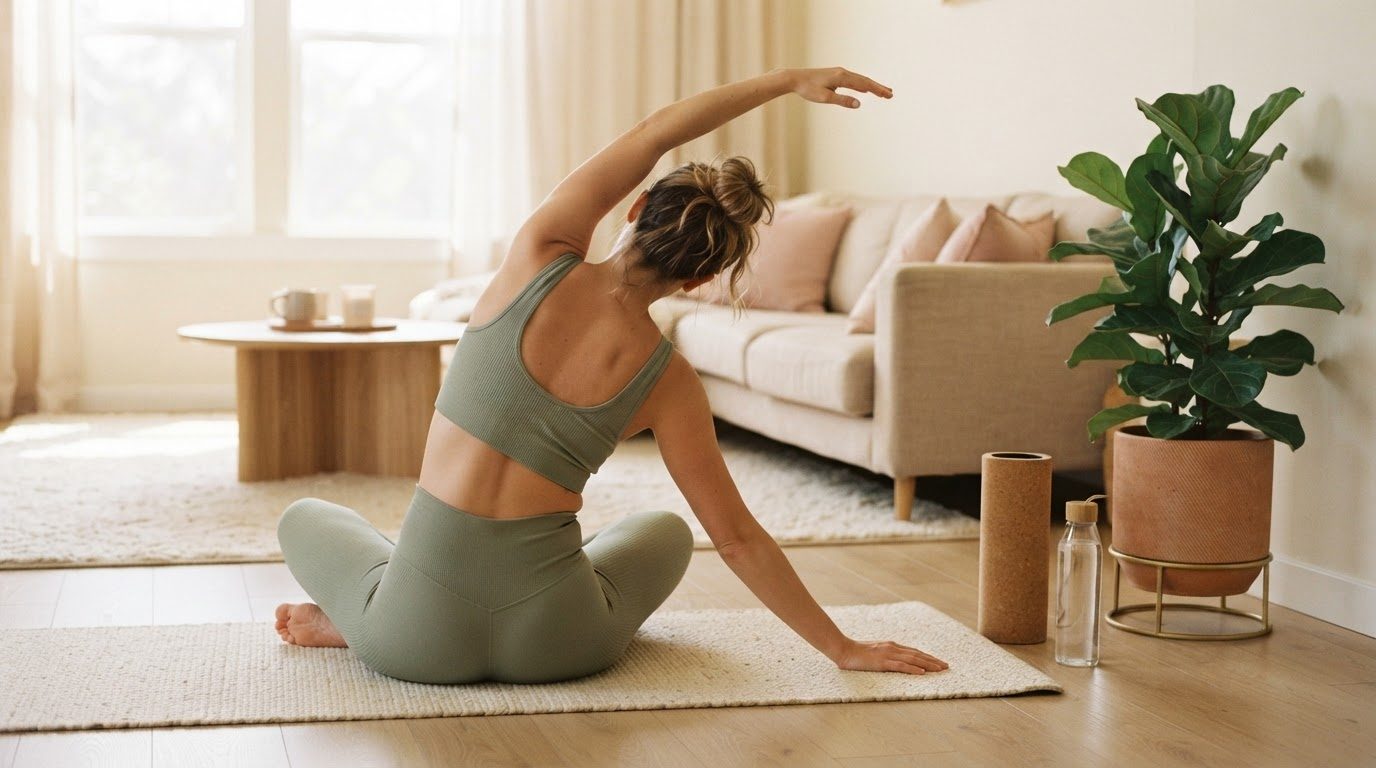
Morning stiffness usually isn't a sign that your body is "bad" at mornings. After hours of lying fairly still, your muscles and joints simply haven't moved much, and they need a few minutes of gentle motion before they feel like yours again. That's exactly what a short stretch routine gives them: a soft, slow invitation to wake up.
You don't need a full workout, a big chunk of time or even to get out of bed for the first few moves. Ten unhurried minutes is enough to loosen your back, open your hips and shoulders, and get your breathing deep and even before the day starts asking things of you.
This guide walks you through morning stretches you can do in 10 minutes: a simple routine table with 8 gentle stretches (the first three happen right in bed), a breathing cue card to pair with them, step-by-step instructions for each move and a few mini versions for rushed mornings.
A small honest admission: I'm prone to anxiety, and slow stretching with long exhales does more to settle my mornings than coffee does (coffee sometimes perks me up and sometimes just makes me jittery). These ten minutes are gentle on both body and mind.
Why Morning Stretches Feel So Good
Stretching in the morning isn't about becoming super flexible. It's about moving gently after a long stretch of stillness. Here's what many people notice when they make it a habit:
- Less of that "rusty" feeling. Slow movement warms up muscles and joints that have been in one position for hours, so getting dressed and walking down the stairs feel smoother.
- Calmer breathing. Pairing stretches with long exhales naturally slows your breath, which can make the first hour of the day feel less rushed.
- A moment that's just yours. Ten minutes before the phone, the emails and the to-do list is a small daily act of self-respect.
- Better body awareness. You start to notice where you hold tension (for many of us, the neck, shoulders and hips) and can be kinder to those areas during the day.
Stretching won't fix everything, and it's not a replacement for medical care. But as a daily ritual, it's one of the easiest ways to start the morning feeling more at home in your body.
Before You Start: A Few Kind Safety Notes
Morning muscles are a little cooler and stiffer than evening ones, so this routine is designed to be gentle. Please keep these in mind:
- Never stretch into pain. You're looking for a mild, pleasant pull, around a 3 or 4 out of 10. Sharp, pinching or burning pain means stop and back off.
- No bouncing. Ease into each position slowly and hold it. Bouncing can strain muscles.
- Move slowly when you first sit or stand up. If you sometimes feel lightheaded in the morning, pause on the edge of the bed for a few breaths before standing.
- Check with your doctor first if you're pregnant, recovering from an injury or surgery, or living with back, joint or other health conditions. A doctor or physical therapist can tell you which moves to skip or adapt.
Your body on a Monday may feel different from your body on a Saturday. Meet it where it is today.
The Breathing Cue Card
Breath is what turns a few stretches into a calming ritual. Screenshot this little card and keep it in mind as you move through the routine.
- The rhythm: inhale through your nose for a count of 4, exhale slowly through your nose or softly parted lips for a count of 6.
- Inhale to lengthen: on every in-breath, imagine growing a little taller or longer through your spine.
- Exhale to soften: on every out-breath, let the stretch deepen just slightly, without forcing.
- Count in breaths, not seconds: one breath cycle (4 in, 6 out) takes about 10 seconds, so a 30-second hold is three slow breaths.
- The check-in: if you're holding your breath, you're pushing too hard. Ease off until breathing feels easy again.
Before the first stretch, spend one minute lying on your back with one hand on your chest and one on your belly, just breathing to this rhythm. It's the quietest possible start to the day.
The 10-Minute Morning Stretch Routine
Here's the whole routine at a glance. It begins with one minute of breathing, then moves through 8 stretches: three in bed, one sitting on the edge of the bed and four on the floor or standing. The times add up to 10 minutes.
| Stretch | Time | How to | What it feels like |
|---|---|---|---|
| Breathing warm-up (in bed) | 1 min | Lie on your back, hands on chest and belly, breathe 4 in, 6 out | Slower heartbeat, softer shoulders |
| 1. Full-body reach (in bed) | 45 sec | Arms overhead, point toes, reach in opposite directions, relax, repeat | A long, yawning stretch from fingers to toes |
| 2. Knees-to-chest rock (in bed) | 1 min | Hug both knees in, rock gently side to side | A gentle release across the lower back |
| 3. Lying spinal twist (in bed) | 1 min (30 sec per side) | Knees bent, let them fall to one side, look the other way | Soft opening through the back and chest |
| 4. Seated neck and shoulder release | 1 min | Sit on the bed's edge, ear toward shoulder, then slow shoulder rolls | Tension melting from the sides of the neck |
| 5. Cat-cow | 1 min 30 sec | On hands and knees, round and arch the spine with the breath | Your whole spine waking up, one segment at a time |
| 6. Child's pose | 1 min | Knees wide, hips back to heels, arms forward | A calm stretch through the back, hips and shoulders |
| 7. Low lunge hip opener | 1 min 30 sec (45 sec per side) | One knee down, other foot forward, shift hips gently forward | A long stretch at the front of the hip |
| 8. Standing forward fold and roll up | 1 min 15 sec | Soft knees, fold forward, hang, then roll up slowly | Back of the legs lengthening, head clearing as you rise |
Total: 1 minute of breathing plus 9 minutes of stretching. If a stretch feels especially good, stay longer and skip another. The routine is a guide, not a rulebook.
The 8 Morning Stretches, Step by Step
Here's how to do each stretch, plus easy ways to make it gentler. Move slowly and follow the breathing cue card throughout.
1. Full-Body Reach
Still lying on your back, stretch your arms overhead and point your toes, as if someone is gently pulling your hands and feet in opposite directions. Hold for one long inhale, then relax completely on the exhale. Repeat three or four times. On the last round, reach your right arm and right leg longer, then the left side, to stretch the sides of your body.
Gentler option: keep your arms by your ears with elbows bent if overhead reaching pinches your shoulders.
2. Knees-to-Chest Rock
Bend your knees and hug them toward your chest, holding behind your thighs or around your shins. Let your lower back sink into the mattress. Rock slowly from side to side, like a tiny massage for your lower back, for about 30 seconds. Then make small circles with your knees in each direction.
Gentler option: hug one knee at a time, keeping the other foot flat on the bed.
3. Lying Spinal Twist
Plant both feet on the bed with knees bent. Open your arms out to the sides in a T. On an exhale, let both knees fall slowly to the right while you turn your head to the left. Stay for three slow breaths, letting gravity do the work. Bring the knees back to center on an inhale, then switch sides.
Gentler option: place a pillow under your knees so they don't drop all the way down.
4. Seated Neck and Shoulder Release
Sit on the edge of your bed with your feet flat on the floor and your spine tall. Tip your right ear toward your right shoulder and let the weight of your head create the stretch. Hold for two breaths, then switch sides. Finish with five slow shoulder rolls backward: lift the shoulders up toward your ears, roll them back and let them drop down.
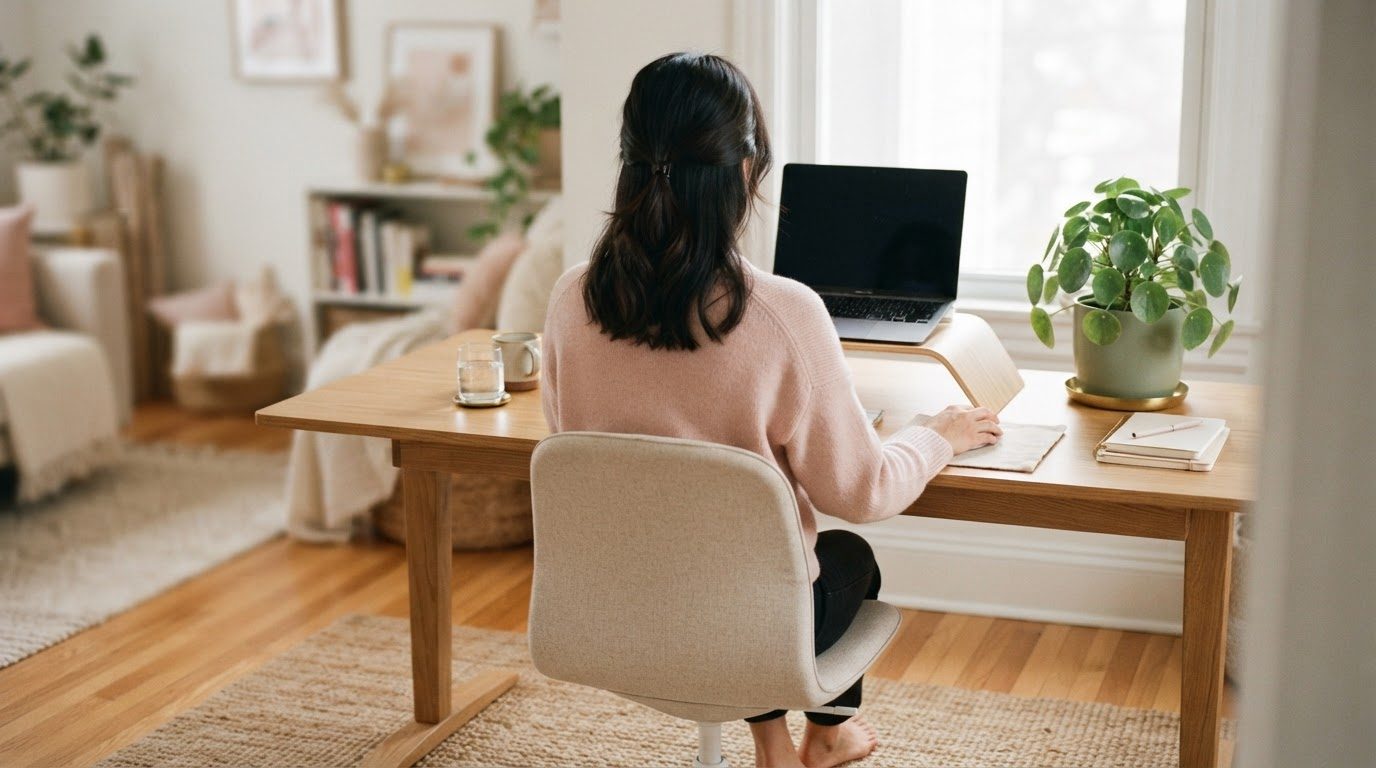
If you spend a lot of time at a desk, this one is worth repeating at lunchtime too. My posture exercises guide has more moves for rounded shoulders and a tight upper back.
5. Cat-Cow
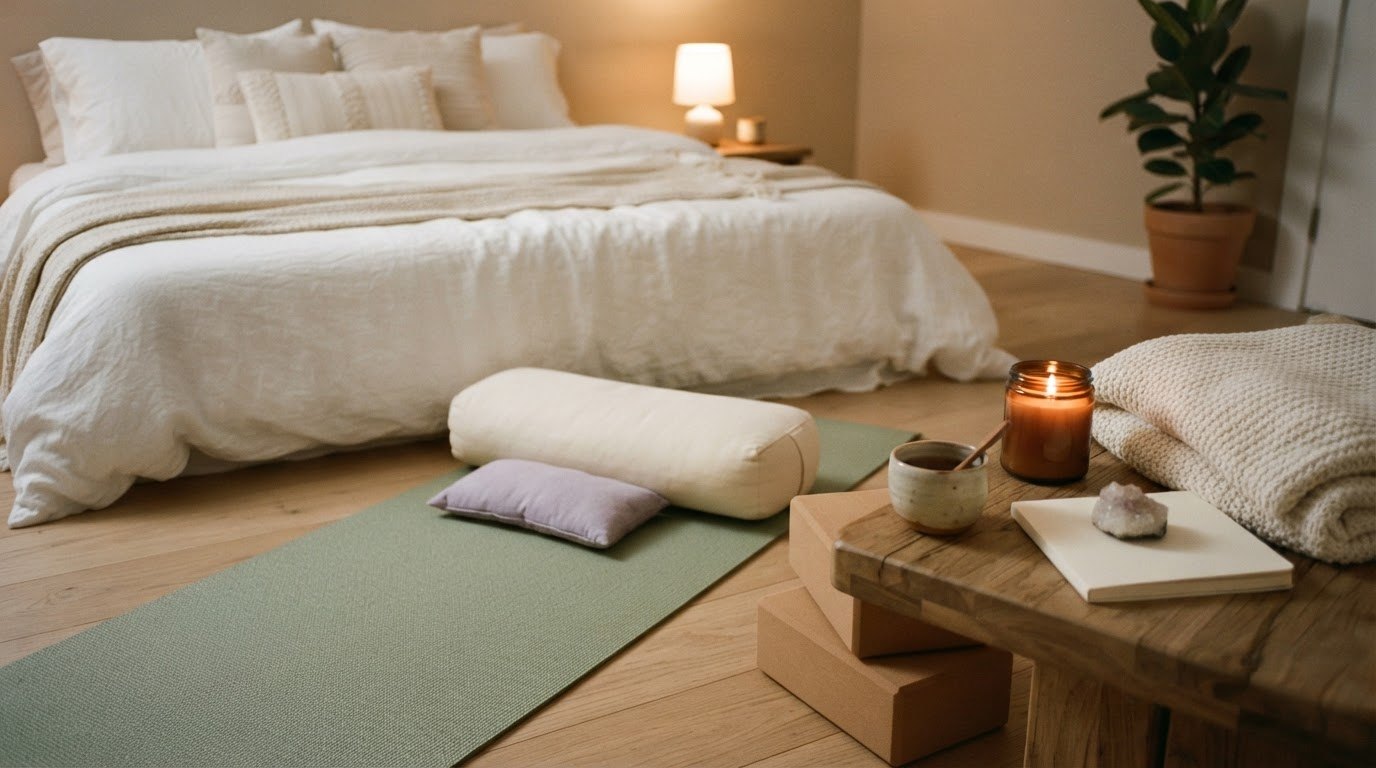
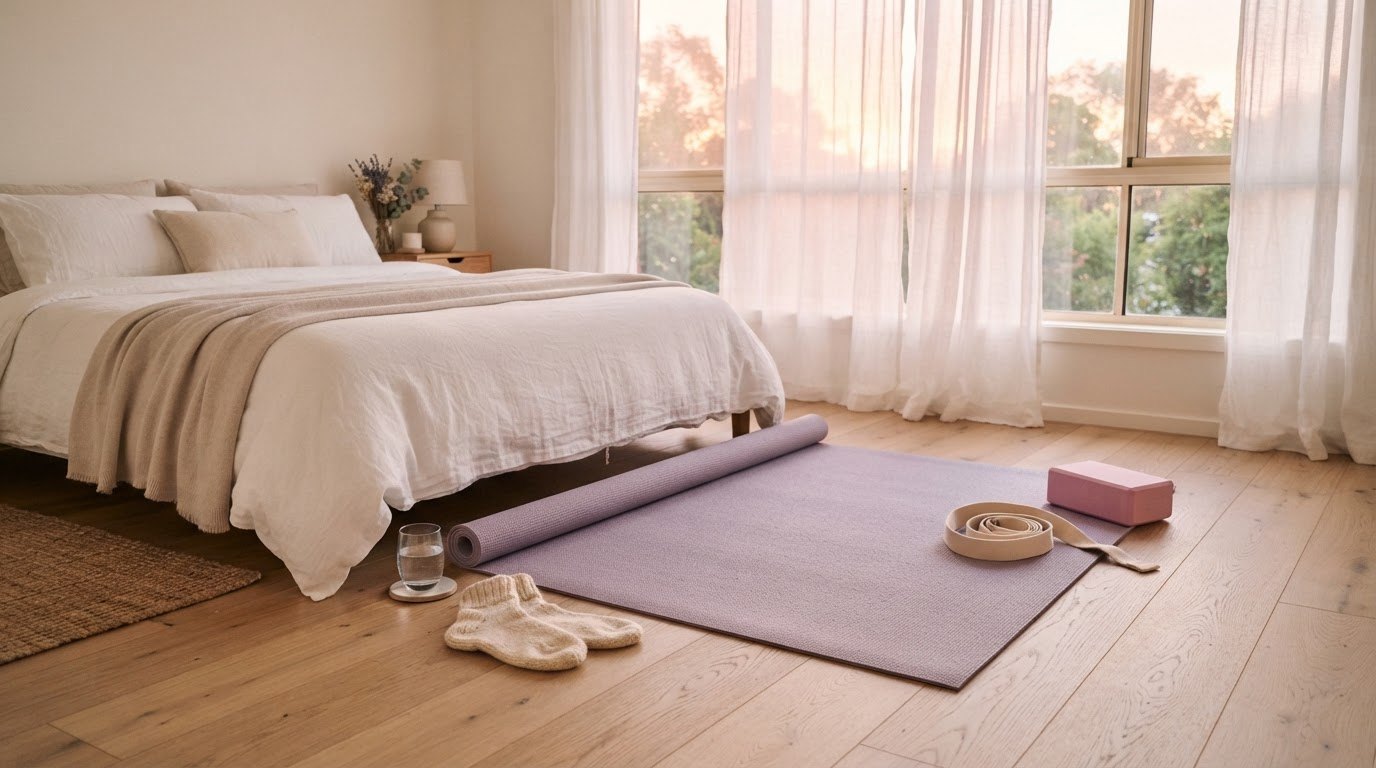
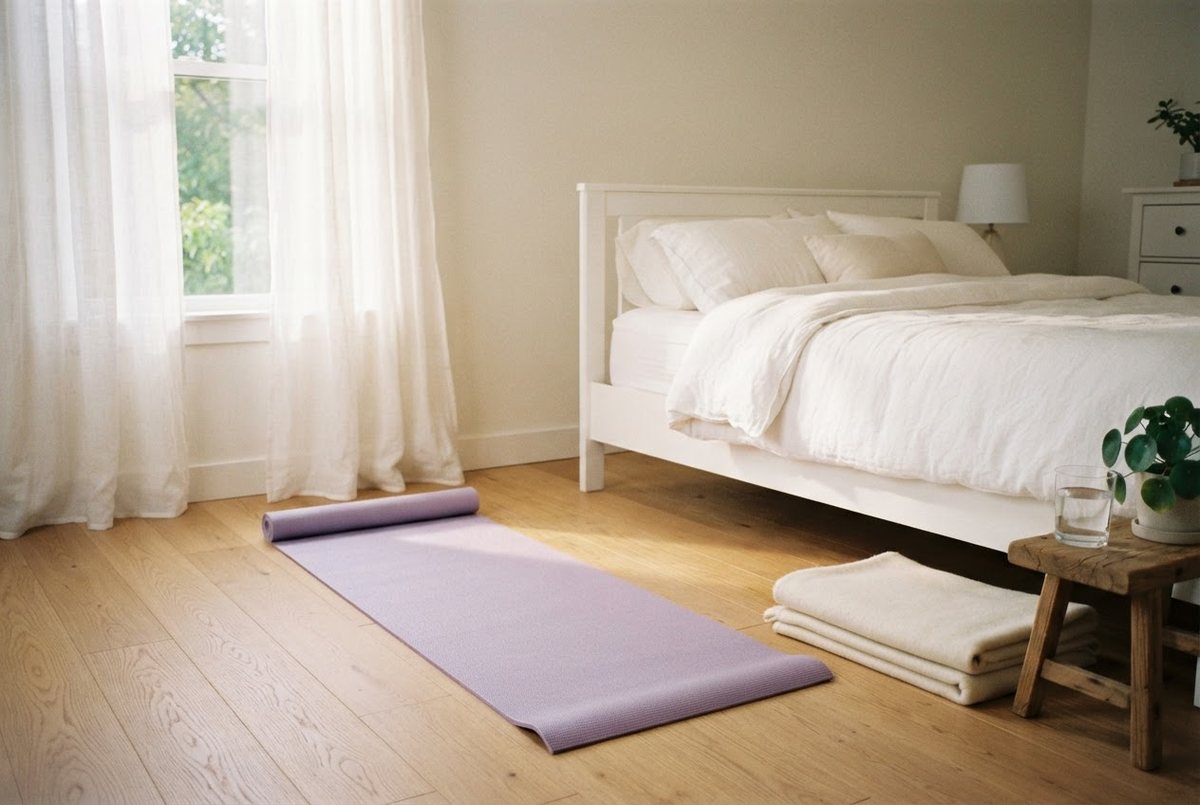
Come onto your hands and knees on the floor, hands under shoulders and knees under hips. A soft surface makes this much kinder on the knees; I'd choose a thick yoga mat in a soft lavender or blush shade that you can leave unrolled by the bed so it's ready every morning. On an inhale, drop your belly, lift your chest and gaze slightly forward (cow). On an exhale, round your spine toward the ceiling and tuck your chin (cat). Move slowly with your breath for about nine rounds.
Gentler option: fold the mat or add a folded blanket under your knees.
6. Child's Pose
From hands and knees, bring your big toes together and widen your knees. Sink your hips back toward your heels and walk your hands forward, letting your forehead rest on the mat. Breathe into your back body, feeling your ribs expand on each inhale. Stay for six slow breaths.
Gentler option: if your hips don't reach your heels or your forehead doesn't reach the floor, rest your head on a soft foam yoga block or a stacked pair of fists. Supported is just as good as deep.
7. Low Lunge Hip Opener
From hands and knees, step your right foot forward between your hands. Lower your left knee to the mat (cushion it if needed). Bring your hands to your front thigh, lift your chest and gently shift your hips forward until you feel a stretch at the front of your left hip. Hold for four or five breaths, then switch sides. Hours of sitting can leave the front of the hips tight, and this stretch tends to feel lovely.
Gentler option: keep your hands on the floor or on blocks on either side of your front foot instead of lifting your chest.
8. Standing Forward Fold and Roll Up
Stand with your feet hip-width apart and knees softly bent. On an exhale, fold forward from your hips and let your upper body hang heavy. Hold opposite elbows and sway gently for a few breaths. Then, with knees still bent, roll up very slowly, stacking one vertebra at a time, with your head coming up last. Take one big inhale with your arms overhead and exhale them down. You're done.
Gentler option: rest your hands on your thighs or a chair instead of hanging all the way down, and come up extra slowly if you're prone to dizziness.
A Few Helpful Things (Completely Optional)
You can do this whole routine in pajamas on a rug. Still, a few small things make it more comfortable and easier to stick with:
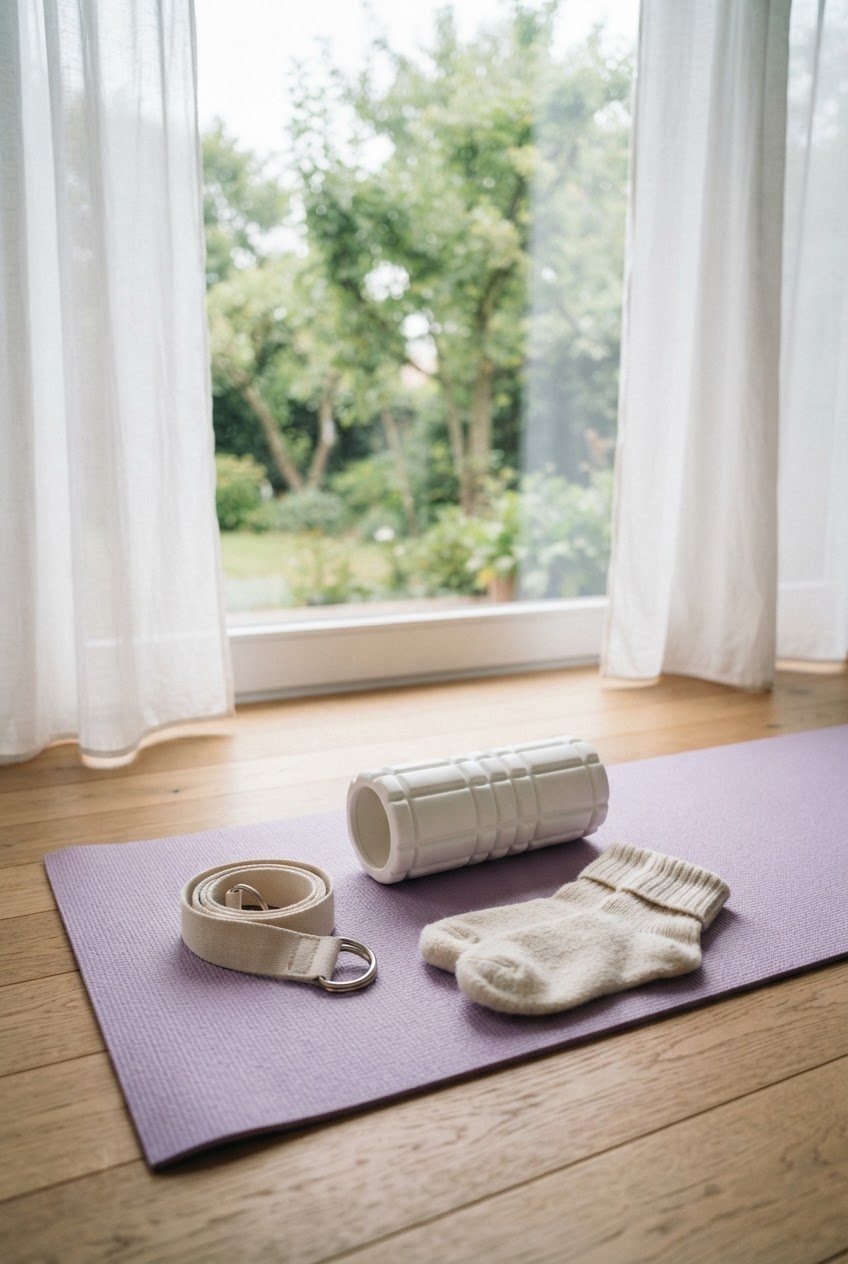
- A stretching strap. If you'd like to add a lying hamstring stretch on lazier mornings, a stretching strap with loops lets you hold your foot without straining. Loop it around the sole, keep your leg as straight as feels comfortable and breathe.
- A foam roller. Rolling your upper back slowly for a minute after the routine can feel wonderful. Look for a medium-density foam roller rather than a very firm one, which can be intense for beginners. Avoid rolling directly on your lower back or neck.
- Warm, grippy socks. Cold feet are a fast way to talk yourself out of getting on the floor. A pair of cream socks with non-slip grips keeps you warm and steady on the mat.
- Something soft to wrap up in. Morning rooms can be chilly. A light knit wrap cardigan you can take off halfway through makes the first few minutes far more inviting.
- A glass of water nearby. Having it ready by the bed means you finish the routine with a few sips. If water is hard for you to remember, my tips on how to drink more water might help.
How To Make Morning Stretching a Habit
The routine itself is easy. Remembering to do it, especially on cold or busy mornings, is the tricky part. These small tricks help it stick:
- Attach it to something you already do. Stretch right after you turn off the alarm, before you reach for your phone. The habit rides on an existing one.
- Leave the mat out. A rolled-away mat in a closet is easy to forget. One left on the floor next to the bed is an invitation.
- Start with just the in-bed stretches. On the first week, only do the breathing and the first three moves. Three minutes is a win. Add the rest when it feels natural.
- Keep your phone out of reach. Charge it across the room so the first ten minutes of the day belong to you.
- Notice how you feel afterward. A one-word note in your journal ("looser," "calmer," "still sleepy") helps you see the effect over time and keeps you motivated.
- Be flexible about the flexibility. Some mornings you'll do the full ten minutes; some mornings only the full-body reach. Both count.
If you love slow starts, morning stretches pair beautifully with a calmer wake-up overall. My slow morning routine shows how to build a gentle first hour around small rituals like this one.
Short on Time? 3 Mini Versions
Some mornings, ten minutes simply isn't there. These shorter versions still give your body a kind start:
- The 2-minute in-bed version: full-body reach (30 seconds), knees-to-chest rock (45 seconds) and a lying twist (45 seconds total). You never have to leave the covers.
- The 5-minute version: one minute of breathing, then cat-cow, child's pose and a standing forward fold, about one minute each, with a final minute of shoulder rolls.
- The desk-day version: neck and shoulder release, low lunge on each side and a forward fold. These target the places that tend to tighten when you sit for long hours.
For days when you'd like a little more movement without a full workout, my lazy girl workouts are low-effort ways to build on this routine.
Morning vs. Evening Stretching
Both are worth doing, and they serve slightly different purposes. Morning stretches are about waking up: moving gently, warming the body and setting a calm tone for the day. Evening stretches are about winding down: holding poses a little longer, slowing the breath even more and signaling to your body that it's time to rest.
If you want to stretch at night too, you don't need a separate routine to start. Child's pose, the lying twist and knees-to-chest work beautifully in the evening as well. My bedtime yoga sequence builds on these with a few extra restful poses.
Final Thoughts
Ten minutes of gentle stretching won't make you a different person, but it can make your mornings feel different. Slower. Kinder. A little more like they belong to you before the world starts knocking.
Start with the breathing and the three in-bed stretches tomorrow morning, and let the rest grow from there. Your body has been carrying you all along, and a few quiet minutes of care each morning is a lovely way to thank it.