A bullet journal doesn't need to be pretty to work. The beautiful spreads you see online are lovely, but the real magic of this system is how flexible it is: a blank dotted notebook that becomes exactly the planner, tracker and memory book you need, one page at a time.
Most beginners get stuck in the same place. They buy the notebook, open to page one and freeze, because there are a hundred possible pages and no clear place to start. The fix is simple: start with a few pages that are genuinely useful, add one new page only when you feel a need for it, and let the journal grow with you.
This guide gives you 40 bullet journal ideas for beginners, grouped into planning, habits and health, mind and mood, home and money, and fun and memory pages. Each idea comes with a quick explanation and a few lines on how to set it up. You'll also find a "first 10 pages" setup order, so you know exactly what to draw first, and a minimal supply table that tells you what you need, what's nice to have and what to skip.
No artistic skills required. A pen, a ruler and ten quiet minutes are plenty.

What Is a Bullet Journal (the Short Version)
A bullet journal is a do-it-yourself planner in a blank notebook, usually a dotted one. Instead of buying a planner with fixed pages, you draw only the pages you need. The original method is built on a few simple parts:
- Index: a table of contents at the front where you write page numbers as you go.
- Future log: an overview of the coming months for birthdays, trips and deadlines.
- Monthly log: a calendar and task list for the current month.
- Daily or weekly log: your day-to-day tasks, events and notes.
- Rapid logging: short bullets with simple symbols, like a dot for a task, a circle for an event and a dash for a note. When a task is done, you mark it with an X.
That's it. Everything else (trackers, collections, lists, doodles) is optional. If you love the idea of writing things down but prefer free-flow prompts over structure, my list of journaling ideas might suit you better. Many people end up doing a little of both in the same notebook.
What You Actually Need: The Minimal Supply List
It's very easy to spend a small fortune before you've drawn a single page. Please don't. Start with the basics, use the journal for a month, and only then decide what's worth adding.
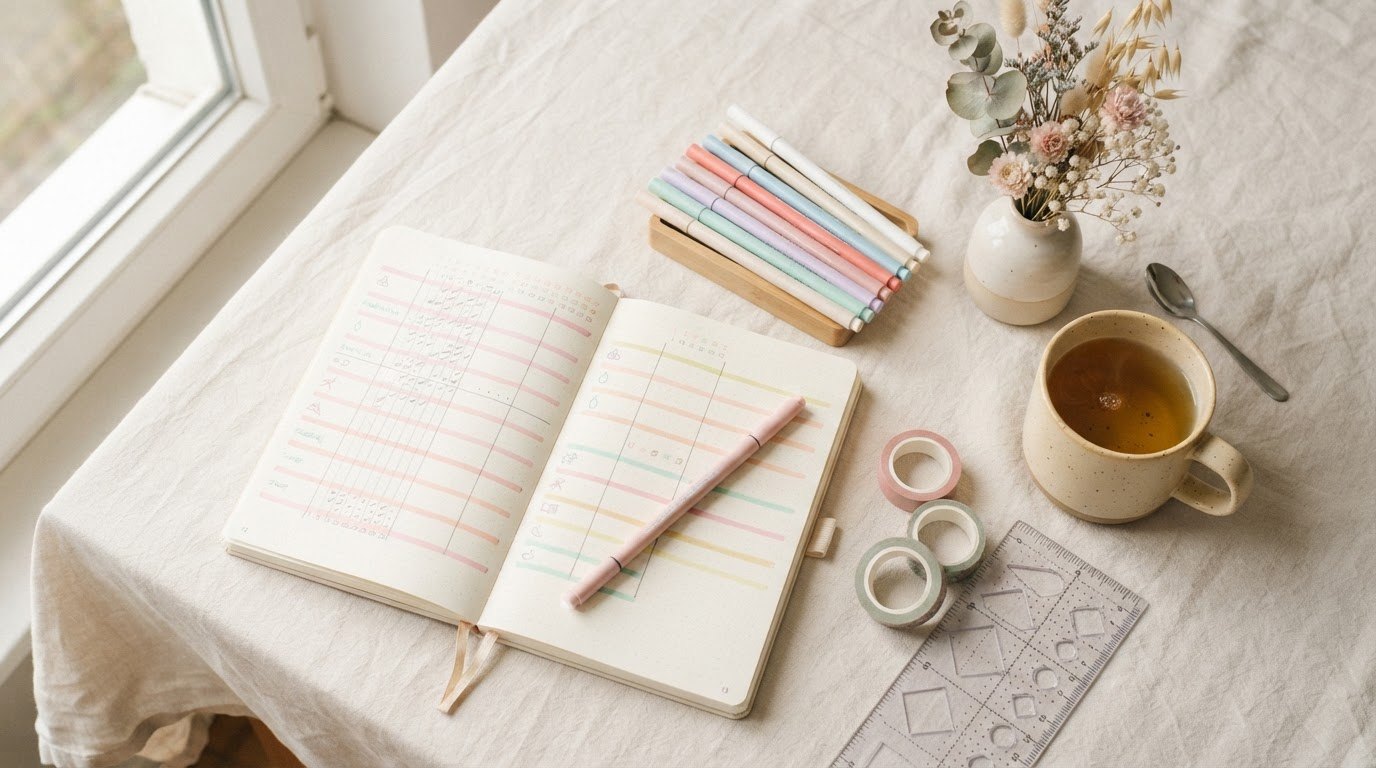
| Item | Need, nice to have or skip | Why |
|---|---|---|
| Dotted notebook (A5) | Need | Dots guide your lines without the strict look of a grid. A5 fits in a bag. |
| One black fine-liner pen | Need | Fine tips (0.3–0.5 mm) keep small writing neat and don't bleed as much. |
| A ruler | Need | Straight lines make even the simplest page look tidy. |
| Pastel fine-liners | Nice to have | Great for color-coding trackers and headings. |
| Washi tape | Nice to have | Instant decoration and handy for marking sections. |
| Ruler stencil | Nice to have | Speeds up circles, boxes and checkboxes. |
| Mild highlighters | Nice to have | Soft colors for highlighting without overpowering the page. |
| Brush pens and calligraphy sets | Skip (for now) | Fun later, but they take practice and slow beginners down. |
| Stickers in bulk | Skip (for now) | They fill pages fast and rarely get finished. |
| A second notebook "for the good stuff" | Skip | One notebook, messy and real, is the whole point. |
For the notebook itself, look for a cream dotted A5 notebook with thick paper (around 120 gsm or more is ideal) so your pens don't show through on the other side. A lay-flat binding and a ribbon bookmark are both worth having.
If you want a little color, a set of pastel fine-liner pens covers headings, color-coding and small doodles. That's all the color a beginner really needs.
Your First 10 Pages: The Setup Order
Here's the order I'd recommend for setting up a brand-new bullet journal. Do the first five in one sitting, then add the rest over the first week as you need them. You'll find details for most of these in the 40 ideas below.
- Index (2 pages): leave them blank for now and number the rest of your pages as you go.
- Key: a tiny list of your symbols (task, event, note, done, moved).
- Future log (2 pages): six months at a glance, three per page.
- Monthly calendar: the dates of this month down one side, events beside them.
- Monthly task list: everything you want to get done this month.
- Habit tracker: three to five habits, no more.
- Your first weekly spread: seven boxes and a short to-do list.
- Brain dump page: a blank page for everything rattling around in your head.
- One "fun" collection: books to read, films to watch or places to visit.
- A gratitude or memory page for the month, so the journal isn't only about tasks.
Ten pages, and you have a fully working system. Everything after that is a bonus.
40 Bullet Journal Ideas for Beginners
Pick two or three that make you think "oh, I'd actually use that," and ignore the rest for now. You can always come back to this list next month.
Planning Pages: 8 Ideas
- Future log. A bird's-eye view of the next six months. Divide two facing pages into six boxes, label each with a month, and add birthdays, trips, appointments and deadlines as you learn about them.
- Monthly calendar. Write the dates of the month in a column down the left side with the first letter of each weekday next to them. Add events beside each date in short bullets.
- Monthly goals. Three goals for the month, no more. Write each one, then add one small first step underneath so the goal doesn't just sit there looking at you.
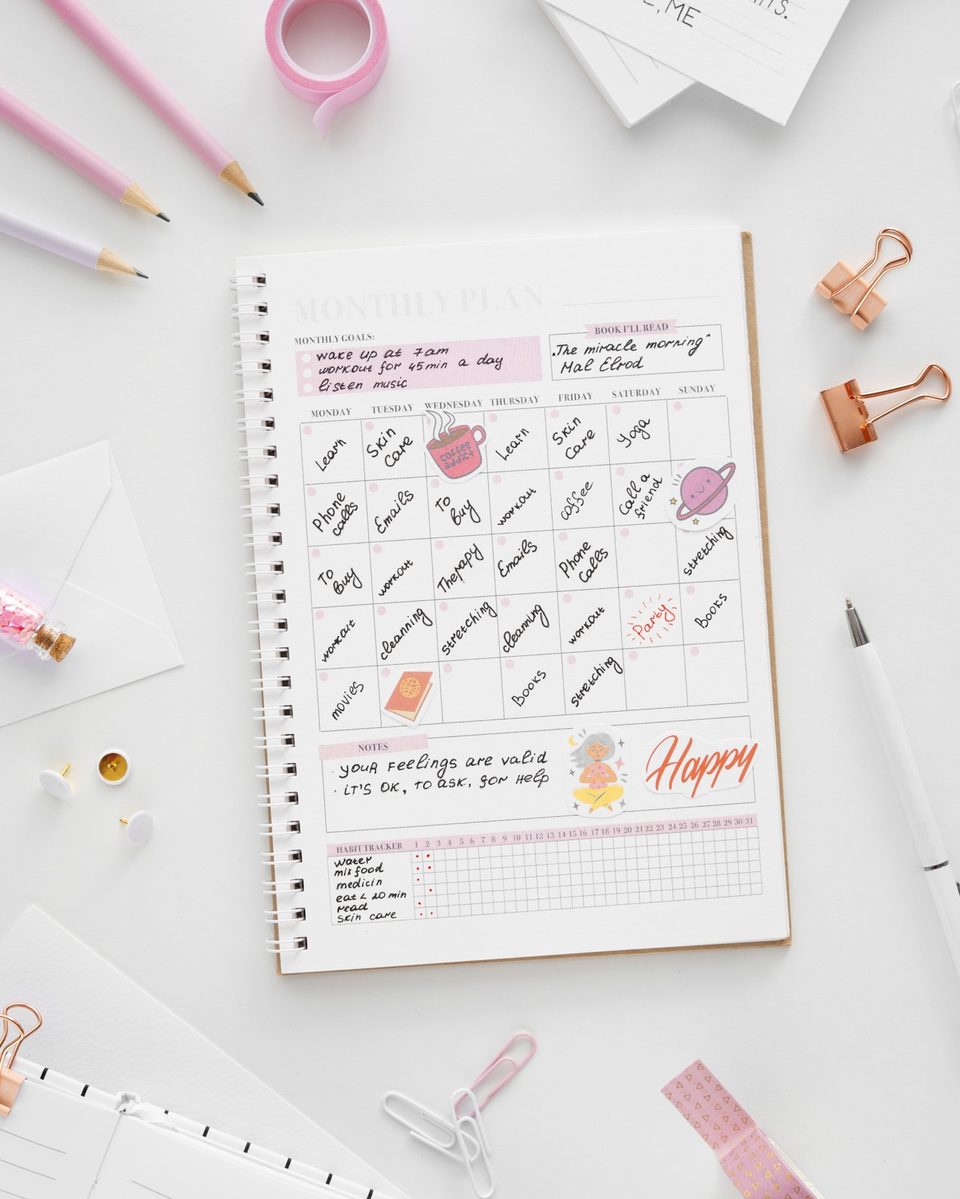
- Weekly spread. Seven boxes, one for each day, plus a small "this week" to-do list in the corner. If you want to go deeper into planning your week, my guide on how to plan your week pairs perfectly with this page.
- Daily log. The simplest page of all: write today's date as a heading, then list tasks, events and notes as the day unfolds. Some days take three lines, some take a whole page.
- Top three priorities. A small box at the top of each week with the three things that matter most. Everything else is a bonus. This one page stops so many overwhelmed weeks.
- Important dates. One page for birthdays and anniversaries, sorted by month. Fill it once and copy it into each new journal.
- Project planner. For bigger things like a move, a trip or a study course. Write the project name, the end date, then break it into steps with a checkbox and a target date for each.
Habits & Health Pages: 8 Ideas
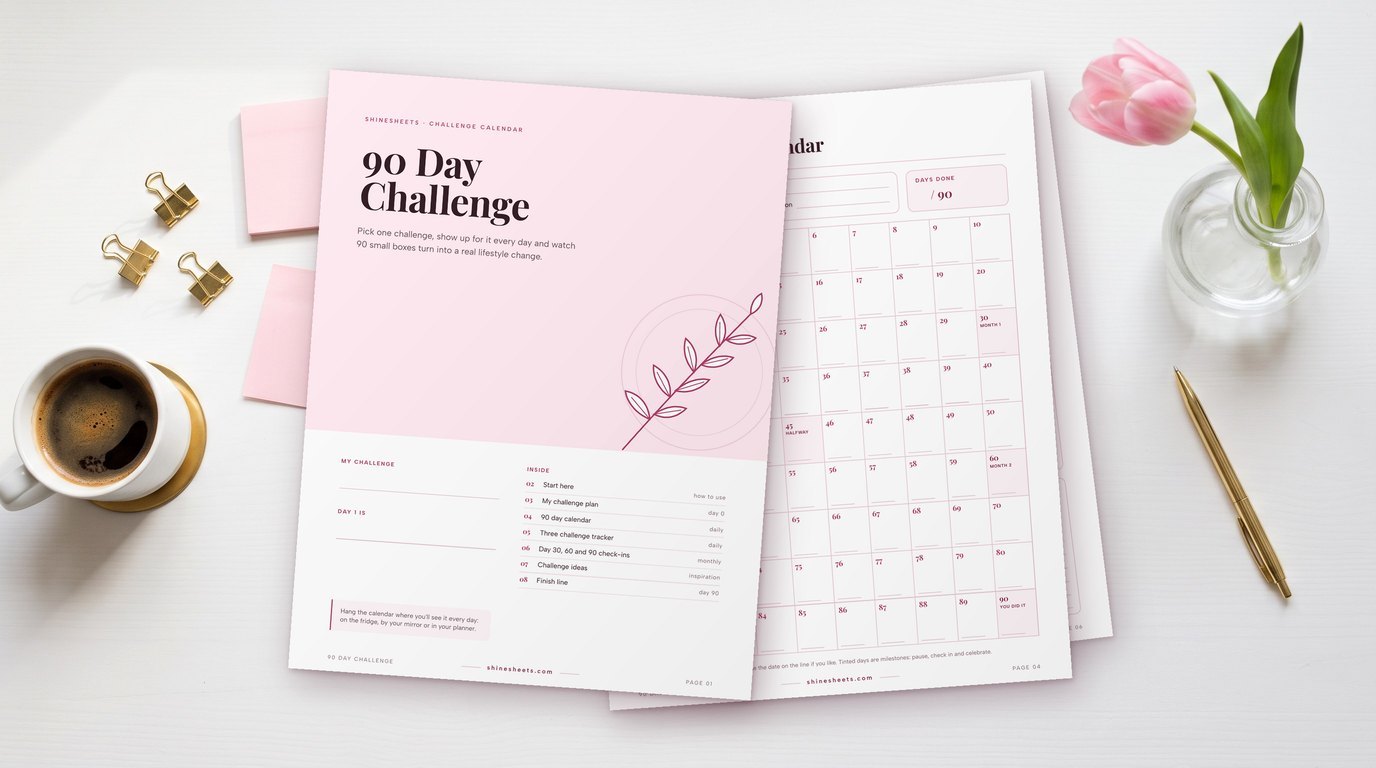
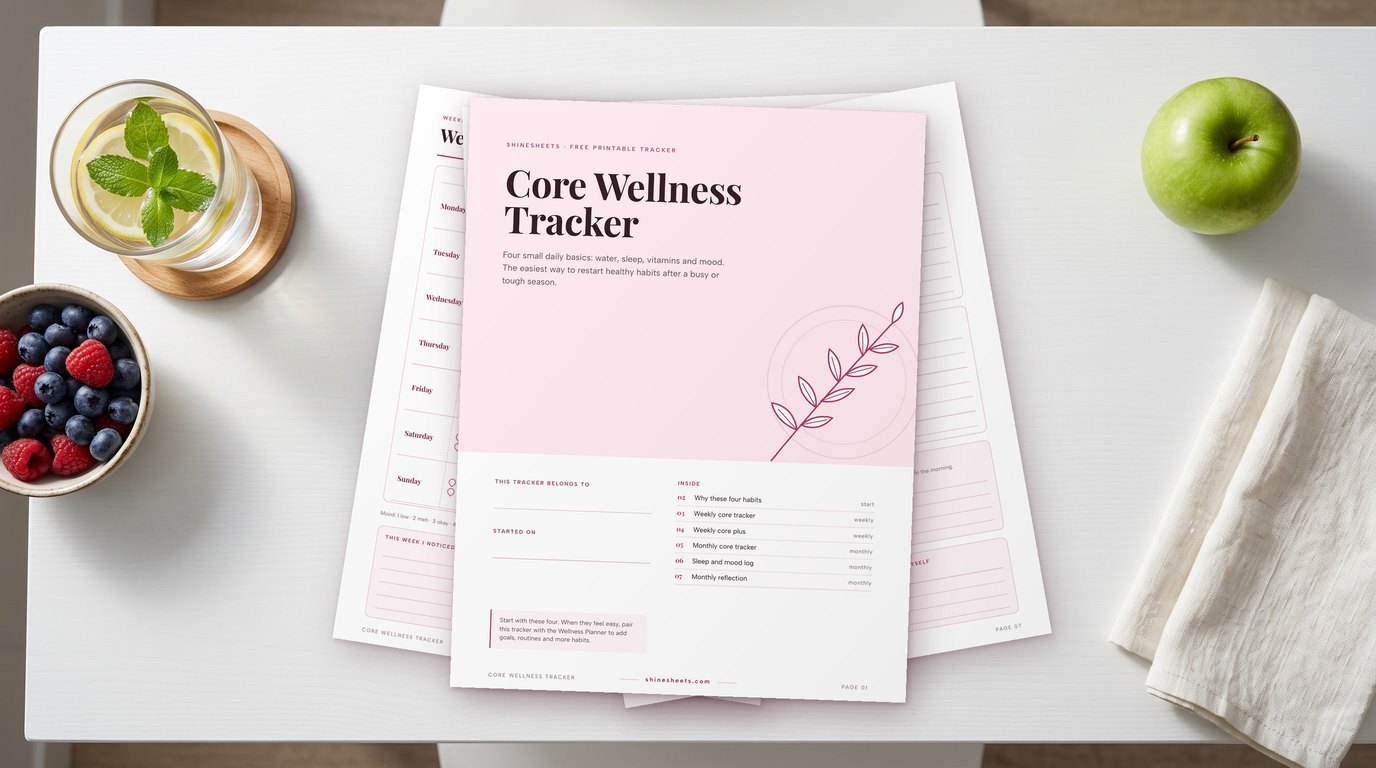
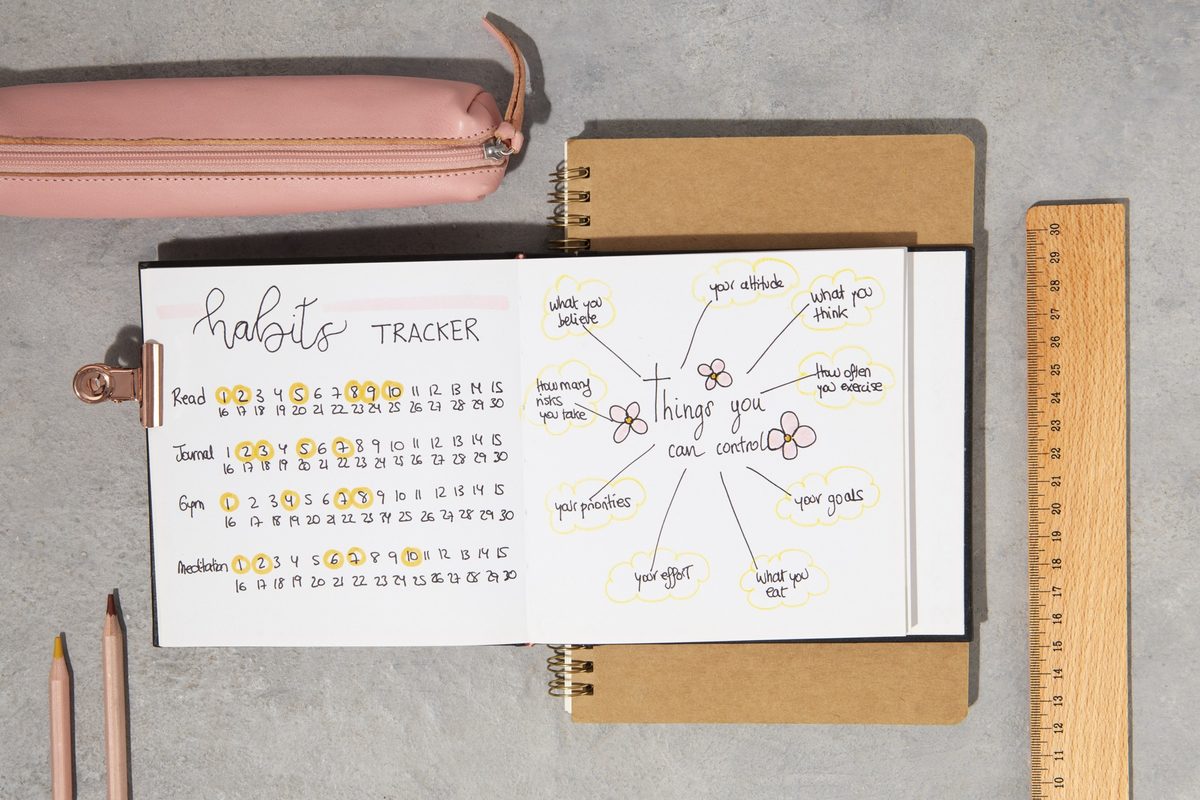
- Habit tracker. List your habits on the left and the days of the month along the top, then shade a little box each day you do one. Keep it to three to five habits. If you love this kind of page, my list of tracking journal ideas has many more.
- Water tracker. Draw eight little glasses or droplets for each day of the week and color one in every time you finish a glass. Simple, satisfying and surprisingly motivating.
- Sleep log. A grid with the days down the side and hours along the top. Shade from the time you fell asleep to the time you woke up. After a month, patterns jump out.
- Movement log. Not a strict workout plan, just a record. Each day, write what you did: a walk, stretching, yoga, dancing in the kitchen. All movement counts.
- Self-care menu. A list of small things that make you feel better, sorted into five-minute, 30-minute and one-hour ideas. When you're low, you don't have to think, you just pick.
- Screen time tracker. One row per day with your phone screen time in hours. No judgment, just noticing. Awareness alone often shrinks the number.
- Cycle tracker. A simple circle or row for the month where you note your period days, energy and any symptoms. Helpful for spotting patterns and for doctor visits.
- Appointments page. Dentist, doctor, hair, car service. Write the date, what it's for and when the next one is due. Never miss a check-up again.
Mind & Mood Pages: 8 Ideas
These are the pages that make a bullet journal feel less like a to-do list and more like a friend. If you want to know why this kind of writing feels so steadying, I've written about how bullet journals are good for your mental health.
- Mood tracker. Assign a color to five moods (calm, happy, tired, anxious, low) and color one small shape per day. A grid of squares works; so does a simple flower with 30 petals.
- Gratitude log. One line per day for the whole month on a single page. Just write one small good thing, like "warm socks" or "a kind message." It adds up beautifully.
- Brain dump. A blank page with no rules. Write everything that's on your mind, then go back and circle what actually needs action. The rest can stay on the page.
- Worry list. Two columns: "I can do something about this" and "I can't control this." Sorting worries onto paper often makes them feel smaller.
- Affirmations page. Five short, believable sentences you want to hear more often, like "I'm allowed to rest" or "I can do hard things slowly." Decorate it a little and come back to it on hard days.
- Things that make me happy. A running list that grows over months. Small things only: the smell of rain, clean sheets, a good song in the car.
- Monthly reflection. At the end of each month, answer four questions: what went well, what was hard, what I learned and what I want more of next month.
- Letter to future me. Write a short letter to yourself to read in three or six months. Fold the page corner so you remember it's there.
Home & Money Pages: 8 Ideas
- Cleaning schedule. Split chores into daily, weekly and monthly lists. A small checkbox next to each makes it oddly fun to tick off.
- Monthly budget. Income at the top, then fixed costs, savings and spending money. Keep it simple at first. If budgeting feels new, start with my guide to budgeting for beginners.
- Spending log. One line per purchase: date, what, how much. Just a week of this teaches you more about your money than any app.
- Savings tracker. Draw a simple shape, like a jar or a heart, and divide it into sections. Color one section every time you save a set amount.
- Bills and subscriptions. A table with each bill, its amount and its due date. Review it every few months and cancel what you don't use.
- Meal planning grid. Seven boxes for the week where you jot down what you'll cook. Just the dish names, so grocery shopping gets easier. Keep a shopping list on the facing page.
- Home projects list. Everything you'd like to fix, paint, organize or buy for your home. Add a rough cost and a "someday" or "this month" label.
- Wishlist. Things you want to buy, with the price and the date you added them. If you still want it after 30 days, it's probably a real want, not an impulse.
Fun & Memory Pages: 8 Ideas
This is where a bit of decoration feels really good. A strip of pastel washi tape across the top of a page turns a plain list into something you love to flip back to.
- Books to read. Draw book spines on a shelf and write a title on each one. Color in the spine when you finish it. If you're hoping to read more this year, my tips on how to read more books go nicely with this page.
- Movies and series to watch. A simple list with a checkbox and a little star rating (just for you) once you've watched each one.
- Places to visit. Cafés, museums, weekend trips, dream destinations. Split it into "nearby" and "someday" so it feels doable.
- Bucket list. Big and small things you want to do. Number them and add the date next to each one when you finally do it.
- Monthly memories. A page at the end of each month with tiny notes about what happened: a fun evening, a funny conversation, a ticket stub taped in.
- Year in pixels. A grid with 12 columns (months) and 31 rows (days). Color one square per day based on your mood. By December, it's a little artwork of your year.
- Birthday gift ideas. One section per person you buy for. Whenever someone mentions something they'd love, write it down right away.
- Doodle or sticker page. One page a month with no purpose at all. Practice lettering, doodle flowers, test pen colors. Creative play counts as rest.
Easy Tricks That Make Simple Pages Look Pretty
You don't need to draw well for your bullet journal to look lovely. A few small habits make even the most minimal pages look intentional:
- Pick a palette per month. Two or three colors only, such as blush and gold, or sage and cream. It instantly looks cohesive.
- Use a stencil for shapes. A bullet journal ruler stencil gives you perfect circles, boxes and checkboxes in seconds, no shaky lines.
- Write headings in capital letters. Simple block capitals look neat and take no practice at all.
- Leave white space. Empty space around a list looks calm. Don't feel you need to fill every corner.
- Highlight gently. A few mild pastel highlighters are perfect for underlining headings or color-coding trackers without the page looking loud.
- Pencil first. Sketch layouts lightly in pencil, ink them in, then erase. It removes all the fear of "ruining" a page.
Common Beginner Mistakes (and What To Do Instead)
Almost everyone makes these in their first month. Knowing them ahead of time saves a lot of frustration:
- Setting up too many pages at once. Twenty trackers on day one means twenty abandoned trackers by day ten. Start with the first 10 pages above and add slowly.
- Drawing the whole month in advance. Weekly spreads drawn weeks ahead don't adapt when life changes. Draw one week at a time.
- Comparing your pages to online photos. Those spreads took hours and good lighting. Yours just has to work for you.
- Tracking too many habits. Pick three to five. Once a habit is automatic, take it off the list and add a new one.
- Quitting after a messy page. A crossed-out page is still a page. Turn over and carry on. Messy and used beats perfect and empty.
- Forgetting the index. Write page numbers in your index as you go. Future-you looking for that budget page will be so grateful.
How To Keep Your Bullet Journal Going
The hardest part isn't starting. It's still opening the notebook three weeks later. A few gentle ways to make it stick:
- Give it a home. Keep the journal and one pen in the same spot, ideally where you sit with your morning coffee or evening tea.
- Attach it to an existing habit. I love journaling right after my evening tea. Five minutes, cup in hand, plan tomorrow and write one good thing from today.
- Do a weekly check-in. Ten minutes on Sunday to set up the new week and look back at the old one.
- Allow gaps. Missed a week? Just write today's date and keep going. No catching up, no guilt.
- Let it change. If a page isn't helping, stop drawing it. Your journal should evolve as your life does.
Final Thoughts
A bullet journal is simply a notebook that bends to fit your life. Start with a dotted notebook, one good pen and the first ten pages, then add new ideas only when you feel the need. Some months it will be beautifully decorated, other months it will be three crossed-out lists and a coffee stain, and both are exactly right.
The best bullet journal is the one you actually open, so keep it simple, keep it kind to yourself and let it grow one page at a time.