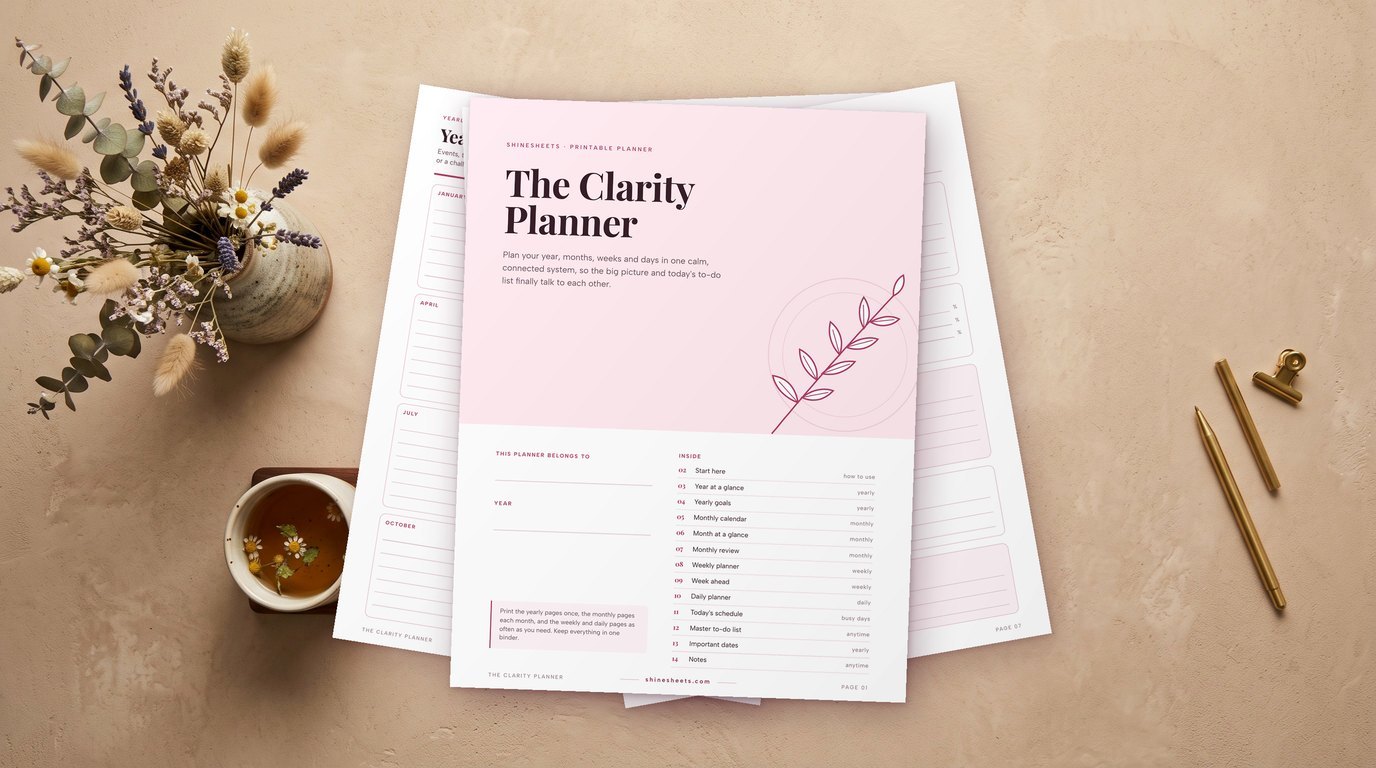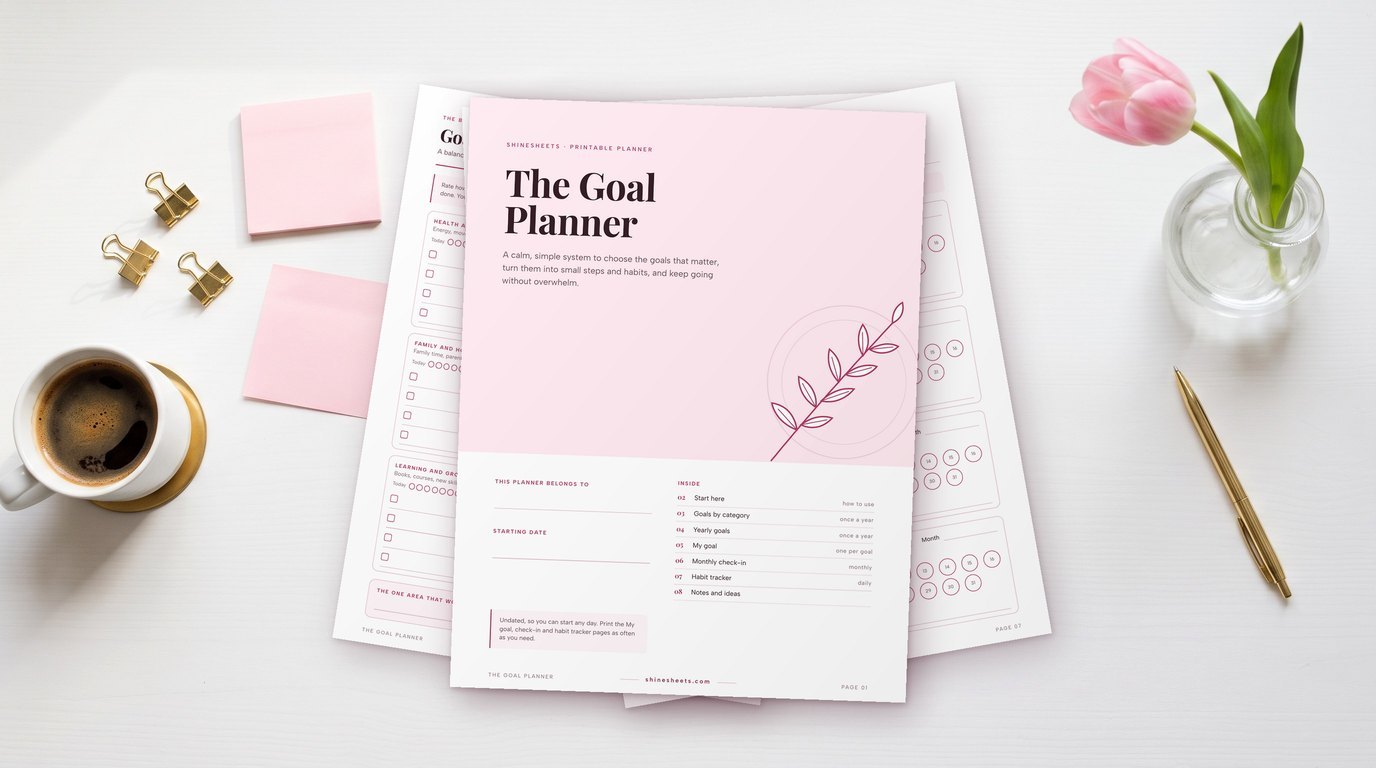
A good year plan isn't a long list of resolutions. It's a short, kind map that tells you what matters most, when you'll focus on it and where the rest is going to fit. The overwhelm usually comes from trying to plan everything at once. Calm yearly planning does the opposite: it chooses a few things and gives them room.
It took me a few new years to understand that the plans I actually followed were never the ambitious ones. They were the ones with space built in, where a slow month or an unexpected detour didn't mean the whole year had failed.
This guide walks you through yearly planning step by step: reflecting on the year behind you, choosing a theme, picking a handful of focus areas, turning them into quarters and months, protecting rest, and checking in so your plan stays alive. There's also a "year on one page" table you can fill in during a single afternoon.
Pour yourself something warm, clear a little corner of the table, and let's plan a year that feels like yours.
Why Yearly Planning Feels Overwhelming

Planning twelve months ahead can feel strangely heavy. Here's why it so often goes wrong, so you can design around it:
- Too many goals. Ten goals means ten things competing for the same energy. Most of them quietly fade by February.
- No connection to real life. A plan that ignores birthdays, busy seasons and travel will clash with your calendar within weeks.
- All-or-nothing thinking. One missed week starts to feel like failure, and then it's easier to abandon the whole plan.
- Planning from pressure. Goals chosen because you "should" rarely survive. Goals chosen because they genuinely matter to you do.
The method below fixes all four. It starts small, works with your real dates and builds in permission to adjust. Set aside two to three hours (or two shorter sessions), because rushing this is the quickest way back to overwhelm.
How To Set Up Your Planning Afternoon
Yearly planning goes much more smoothly when you treat it like a small appointment with yourself rather than something to squeeze in between other tasks. Here's a simple way to structure it:
- Prepare your space (10 minutes). Clear a table, make tea, light a candle if you like, and put your phone in another room or on do-not-disturb.
- Gather your materials (5 minutes). A planner or notebook, a few pens, sticky notes, last year's planner if you have one, and your phone photos for reference.
- Reflect (30 to 45 minutes). Look back first, without planning anything yet.
- Take a real break (15 minutes). Stretch, step outside, refill your cup. Reflection can stir things up, and fresh eyes help.
- Plan (60 to 90 minutes). Theme, focus areas, goals, quarters and known dates.
- Close gently (5 minutes). Write one sentence about how you want the year to feel, and stop there, even if a few details are unfinished.
If the whole afternoon feels like too much, split it: reflection one evening, planning the next weekend. There's no prize for doing it all in one go.
Step 1: Look Back Before You Look Ahead
The best year plans start with honest reflection. Before you decide where you want to go, spend 30 to 45 minutes looking at where you've been. Open your journal or a fresh page and answer a few questions:
- What am I proudest of from this past year, big or small?
- What drained me most, and what could I do less of?
- When did I feel most like myself?
- What did I start that I'd love to continue?
- What do I want to leave behind?
Flip through your phone photos and old planner pages while you write. You'll remember wins you'd completely forgotten. If you'd like a deeper set of prompts, my list of end-of-year reflection questions is designed for exactly this moment.
When you're done, circle two or three themes that keep showing up. Maybe you felt happiest when you were outdoors, or the busiest months left no time for friends. Those patterns become the foundation of your plan.
Step 2: Choose a Theme or Word for the Year
A theme gives your year a feeling instead of just a to-do list. It's the gentle question you come back to whenever you're unsure: does this fit the year I want?
Your theme can be one word (Steady, Bloom, Home, Brave, Ease) or a short phrase ("The year of slow mornings," "Less, but better"). Choose something that came out of your reflection. If last year was frantic, maybe your word is Calm. If you held back a lot, maybe it's Bold.
Write it at the very top of your planning page. If you'd love help choosing, my guide to picking a word of the year has prompts and plenty of examples.
Some people love turning their theme into something visual they can see every day. If that sounds like you, these vision board ideas are a lovely way to give your word a home on the wall, a desk or the first page of your planner.
Step 3: Pick 3–5 Focus Areas

Focus areas are the parts of life you want to pay attention to this year. Not every area of your life, just the ones that need care right now. Three is lovely, five is the most I'd recommend.
Some common focus areas to choose from:
- Health and energy
- Home and space
- Money and security
- Relationships and friendships
- Career or learning
- Creativity and hobbies
- Rest and mental well-being
- Adventure and travel
Pick the ones that made you feel something during your reflection. The areas you leave off aren't unimportant; they're simply on "maintenance mode" this year. That's a decision, not a failure.
If you'd like to see the bigger picture behind your focus areas, my guide on how to make a vision for your life helps you connect this year to where you want to be in five or ten.
Step 4: Choose 1–2 Goals per Focus Area
Now each focus area gets one or two goals. Not five, not a dozen. One or two. This is the step where most yearly plans get overloaded, so be ruthless and kind at the same time.
A good goal for the year passes three tests:
- It's specific enough to recognize. "Be healthier" is a wish. "Walk 30 minutes four mornings a week" is a goal you can see yourself doing.
- It's within your control. "Get promoted" depends on other people. "Finish the certification and ask for a review in the fall" depends on you.
- It fits your theme. If your word is Ease, a goal that requires six new habits at once probably doesn't belong.
Here's a simple goal formula I like: I will [action] [how often or how much] by [when], because [why it matters to me]. For example: "I will read one book a month by December, because I miss the version of me who always had a book on the go."
Write the "because" part down. On the days motivation disappears, the reason is what keeps you going.
Step 5: Break the Year Into Quarters
Twelve months is too long to hold in your head. Three months is perfect: long enough for real progress, short enough to feel urgent.
Give each quarter one main focus. Not every goal has to be active every quarter. In fact, it's better if they take turns:
- Quarter 1 (January to March): Often a natural fit for fresh habits and home resets.
- Quarter 2 (April to June): Longer days suit outdoor goals, energy and social plans.
- Quarter 3 (July to September): Summer is good for travel, fun and lighter goals, with a "back to school" reset in September.
- Quarter 4 (October to December): Finish strong, protect holiday rest and reflect.
Those are just suggestions. If summer is your busiest season, put your big push in the spring and keep summer light. The point is that each quarter has a clear priority, so you're never trying to do everything at once.
Your Year on One Page
This is the heart of your plan. Fill in each row with your quarter's main focus, the one key goal you'll work on, and one fun thing to look forward to. That last column matters as much as the others, because a year of only goals is a hard year to love.
| Quarter | Focus | Key Goal | One Fun Thing |
|---|---|---|---|
| Q1: January to March | Example: Home and routines | Declutter one room a month and set up a Sunday reset | A winter weekend away or a solo spa day |
| Q2: April to June | Example: Health and energy | Walk four mornings a week and try a beginner class | A picnic with friends on the first warm Saturday |
| Q3: July to September | Example: Creativity and rest | Finish one creative project and take a real vacation | A summer evening outdoors with no plans |
| Q4: October to December | Example: Money and reflection | Build a small savings cushion and plan holidays early | A cozy movie night tradition every Friday in December |
Copy the table into your planner or notebook and replace the examples with your own. Keep the finished page somewhere you'll see it often, like the inside cover of your planner. A cream undated yearly planner is a good pick here, because you can start it any month and never feel behind if you skip a week.
Step 6: Give Each Month a Gentle Theme
Once your quarters are clear, give each month a small theme of its own. It's a softer way to break down your goals without writing a strict monthly to-do list.
For example, if your Q1 focus is home and routines, your months might be: January "Clear out," February "Organize the kitchen," March "Make it pretty." Each month has a direction, but you decide the details as you go.
Add one simple question to each month: What would make this month feel good? Sometimes the answer is a goal. Sometimes it's a book, a dinner with friends or a quiet Sunday. Both belong in your plan.
A few pastel rolls of washi tape make this part feel lovely: give each month its own color strip at the top of the page so you can spot it at a glance.
Step 7: Map the Dates You Already Know
Before you schedule anything new, write down everything that's already happening. This step alone prevents most mid-year overwhelm.
Go month by month and add:
- Birthdays and anniversaries
- Holidays and long weekends
- Planned trips and events (weddings, reunions, visits)
- Work busy seasons and deadlines
- Renewals, tax dates and annual appointments
- School breaks if they affect your schedule
Now you can see which months are already full and which have space. If March is packed with three birthdays and a big work deadline, that's not the month to start a new fitness challenge.
A wall planner in a soft neutral color is my pick for this step. Seeing all twelve months at once on the wall makes busy stretches and empty weeks jump out instantly, in a way a phone app never quite does. Use a different pastel gel pen for each type of date (birthdays in pink, travel in blue, work in sage) and the whole year becomes readable at a glance.
Step 8: Build In Buffer and Rest Weeks

This is the step almost everyone skips, and it's the one that makes a plan feel calm instead of tight. Real life always takes more time than you think. Plan for it.
Here's what I'd build in:
- One buffer week per quarter. No new goals, no big plans. It's for catching up, falling behind gracefully or simply resting.
- One fully free weekend per month. Block it out now, before invitations fill it.
- A slower month. Choose one month (often August or December) where expectations drop on purpose.
- Recovery time after big events. After a trip, a move or a busy season, leave a few quiet days before the next push.
Rest isn't something you earn after the plan works. It's part of what makes the plan work. Write your buffer weeks into the planner in the same ink as your goals, so they look just as official. When an invitation or a new project tries to take that week, you'll see it already has a purpose.
Step 9: Create a Quarterly Check-In Ritual

A yearly plan only works if you look at it. A quarterly check-in keeps it alive without the pressure of reviewing it every single week.
At the end of each quarter, set aside one hour. I like to make it a little ritual: evening tea, a glass candle, my journal and the year-on-one-page table. Then answer these five questions:
- What went well this quarter, and what am I proud of?
- What didn't happen, and why (without judgment)?
- Does my next quarter's focus still feel right?
- What do I want to stop, start or keep doing?
- What's the one fun thing I'm going to protect next quarter?
Then update your plan. Cross things out, move goals, change the order. Your weekly planning can follow from there, and my guide on how to plan your week shows how to turn a quarterly focus into small daily actions.
Keep your planner, pens and tape together in a cream desk organizer so your check-in kit is ready and you're not hunting for supplies every three months.
How To Adjust Your Plan Mid-Year
Around June, most people look at their year plan and feel a little sheepish. That's normal. Life changes, priorities shift and some goals simply stop fitting. Adjusting isn't giving up. It's planning well.
Here's how to adjust kindly:
- Keep the theme, change the goals. Your word for the year often stays true even when the specific goals don't.
- Shrink instead of quitting. If "run three times a week" isn't happening, try "move my body for 20 minutes twice a week."
- Move goals, don't delete them. A goal that doesn't fit Q3 might fit Q4 perfectly.
- Let some goals go completely. If something no longer matters to you, crossing it off is a sign of growth.
- Add something new. If a new interest appeared this year, it's allowed in the plan.
A mid-year review can be a little longer than your usual quarterly check-in. Give yourself an extra half hour to reread your reflection notes from the start of the year. You'll often find that you've grown in ways your goals never measured: more patience, clearer boundaries, a friendship that deepened. Write those down too. They count.
The question isn't "Did I stick to the plan?" It's "Is this plan still serving the life I want?"
Yearly Planning Mistakes That Lead To Overwhelm
A few habits make yearly planning feel harder than it needs to be. Here are the six I see most often:
- Planning in one rushed sitting. Split it into two sessions: reflection first, planning on another day.
- Copying someone else's goals. Their year isn't your year. Let your reflection guide you.
- Filling every week. A plan without empty space has nowhere to put real life.
- Forgetting the fun. If your plan is all work, you'll start avoiding it. Joy deserves a spot too.
- Never looking at it again. Put your quarterly check-ins in your planner right now, before you close it.
- Judging a slow month. One quiet month doesn't cancel the year. It's part of it.
Final Thoughts
Yearly planning doesn't have to be a pressure-filled list of everything you're not yet. It can be a calm, hopeful conversation with yourself about what matters and how you want the year to feel.
Reflect first, choose a few focus areas, give each quarter its turn and leave plenty of room to breathe. The year will surprise you either way, and with a gentle plan in hand, you'll meet those surprises steady and ready, with a clear sense of what you're walking toward.