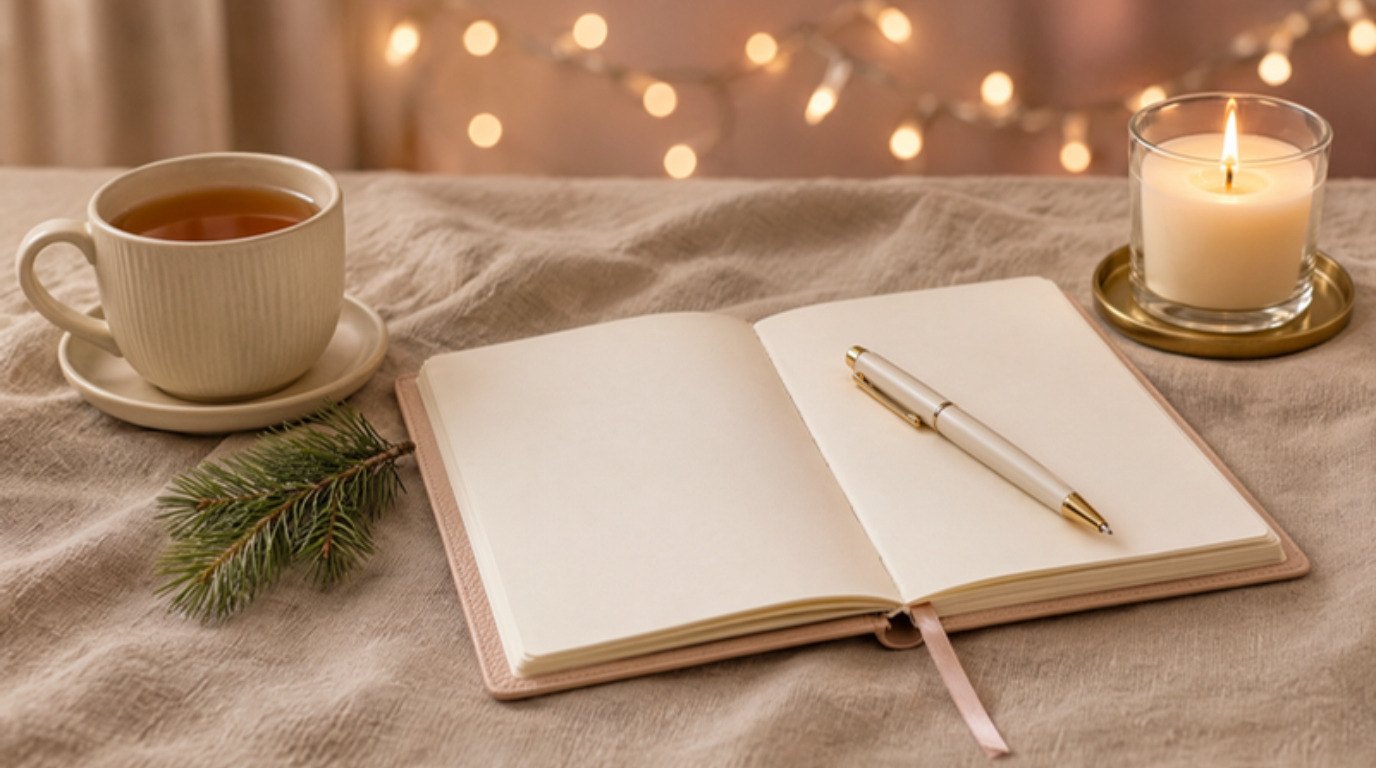
For a long time I let the quiet evenings of late December slip by. Then I started using them. One candle, one notebook and a handful of good questions. It has become my favorite ritual of the whole season, because it turns a blurry year into something I can actually see, hold and learn from.
Below you'll find 50 end-of-year reflection questions sorted into nine gentle categories: gratitude, wins, hard moments, relationships, self-care and body, home and money, who you became, letting go and looking ahead. You'll also get a simple 3-evening reflection ritual so you don't have to answer all 50 in one sitting, plus a 5-question shortlist for when you only have 10 minutes.
One promise before we start: this isn't a performance review. It's a soft place to land at the end of the year.

Why End-of-Year Reflection Is Worth Your Time
Most of us rush from one year straight into the next with a list of resolutions and zero idea what actually worked last time. Reflection fills that gap. It shows you what to keep, what to drop and what you've already survived, which is usually more than you give yourself credit for. I love doing a smaller version on my birthday too, and I walk through it in my guide to a gentle birthday review.
A few things I've noticed once I started doing this every December:
- Your goals get smarter. When you know what drained you, you stop setting goals that need more of it.
- You notice your own growth. Change is slow, so it's invisible day to day. Looking back across twelve months makes it visible.
- Hard things get smaller. Naming a difficult season on paper often shrinks it to its real size.
- Gratitude gets real. Not the forced kind, but the kind where you remember a specific Tuesday and smile.
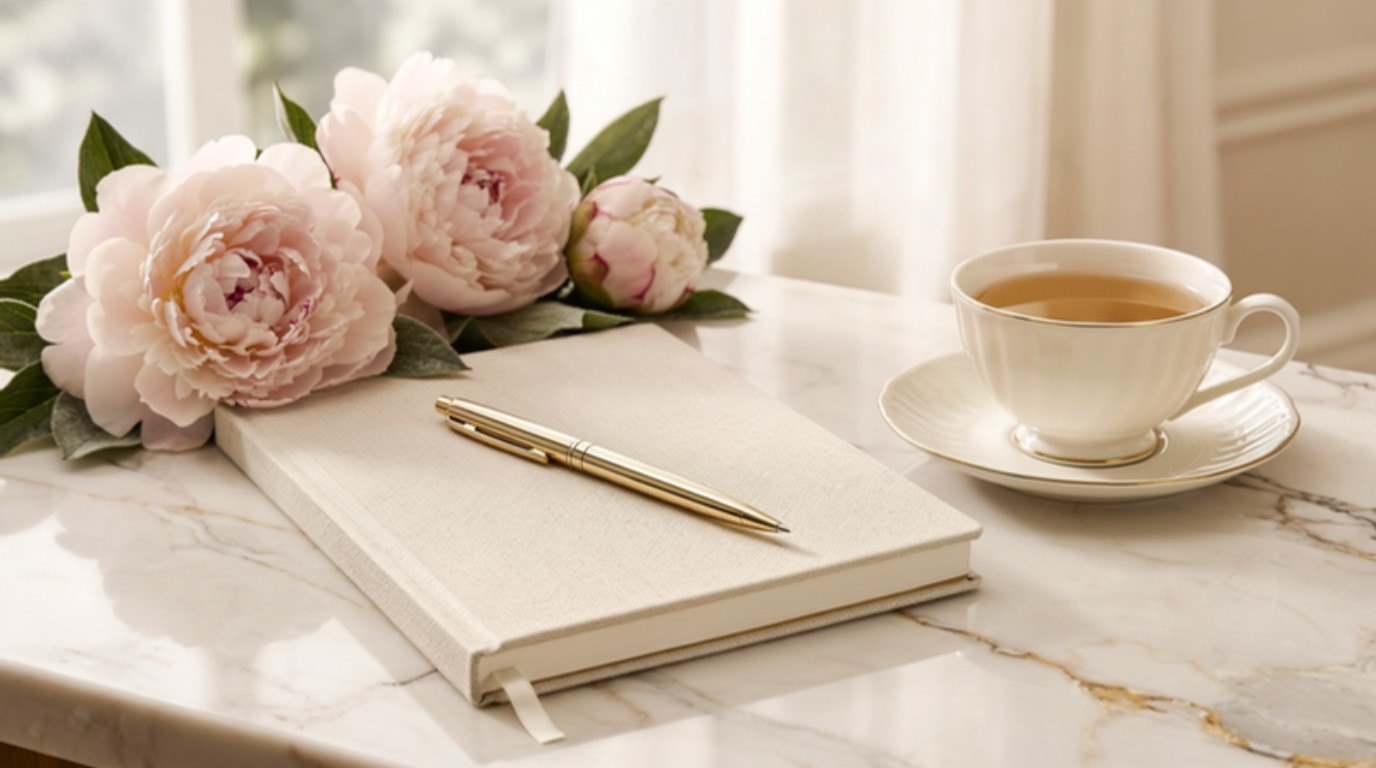
You don't need anything special to start. A notebook and a pen will do. That said, I love having one journal that lives just for reflection, so all my end-of-year answers sit together and I can reread past years. A pastel linen-covered lined journal with thick pages is a lovely pick for this, because you'll want it to last for years.
How To Use These Questions
Before you dive in, a few ground rules that make this feel gentle instead of overwhelming:
- You don't have to answer all 50. Pick the ones that make you pause. Skipping is allowed.
- Write by hand if you can. It slows your thoughts down just enough to hear them.
- Set a timer for each question. Two to four minutes is plenty. When the timer goes off, move on, even mid-sentence.
- Answer honestly, not impressively. Nobody is going to read this but you.
- Stop when you're tired. Reflection works best in small, warm doses. Close the notebook before it starts to feel heavy.
I like to set the mood a little: lamp on, phone in another room, a glass jar candle in a soft cream or vanilla scent on the table. (Glass candles are my weakness, I'll admit it.) If you light one, keep it on a stable surface away from your papers and blow it out before you go to bed. The NFPA candle safety page has a quick checklist worth a glance.
50 End-of-Year Reflection Questions
The questions are numbered all the way through, so it's easy to come back to a specific one. Each comes with a little nudge to help you get started if your mind goes blank.
Gratitude (Questions 1–6)
I always start here, even in a rough year. Not because you have to be thankful for everything (you don't), but because warm memories make the harder questions feel safer to answer. Think small: a sound, a smell, a Tuesday.
1. What are three ordinary moments from this year I'd happily live again? Not the big events. The walk, the phone call, the quiet morning. Write them in as much detail as you can remember.
2. Who showed up for me this year, even in a small way? List names. Then put a little star next to anyone you haven't thanked yet.
3. What simple comfort carried me through the busiest weeks? A playlist, a particular mug, an evening bath. Knowing your comforts is useful information for next year.
4. Which place made me feel most at home this year? It might be a corner of your bedroom, a café table, a friend's kitchen or a park bench.
5. What did my body let me do this year that I took for granted? Carry groceries up the stairs, dance in the kitchen, hug someone. Just notice.
6. What is one thing I have now that I once wished for? This one surprises people. Look back a few years and you'll usually find something.
If gratitude feels easy for you right now, my list of 40 things to be grateful for is a nice way to keep going after these six.
Wins (Big and Tiny) (Questions 7–12)
Most of us skip straight past our wins because they don't feel big enough. This is your permission to count the tiny ones. Getting through a hard week counts. Drinking more water counts. Saying no once counts.
7. What am I most proud of this year? Answer fast, before your inner critic gets a vote. Then write one sentence about why it mattered.
8. What did I do this year that scared me a little? A conversation, a new class, a solo trip, posting something you made. Brave doesn't have to be loud.
9. Which habit, even a half-kept one, actually made my life better? Half-kept habits still count. If you walked twice a week instead of five times, that's still dozens of walks.
10. What did I finish, fix or finally deal with? The junk drawer, the overdue appointment, the email you'd been avoiding for months. Write them all down.
11. What skill or piece of knowledge did I gain? Something practical (a recipe, a spreadsheet trick) or something emotional (how to rest without guilt).
12. When did I surprise myself? A moment when you handled something better, calmer or braver than old-you would have.
Hard Moments (Questions 13–18)
This is the section I go slowest on. You don't need to relive anything painful in detail. The goal is to name what happened and notice what it taught you, then close the notebook and do something soft. If a question feels like too much this year, skip it. Truly.
13. What was the hardest part of this year? One or two sentences is enough. You're naming it, not writing the full story.
14. What helped me get through it? People, routines, places, thoughts. This becomes your personal toolkit for the next hard season.
15. What did I worry about that never actually happened? As someone prone to anxiety, I find this one strangely comforting. My list is usually long.
16. Where did I expect too much of myself? Look for the places you felt behind. Were those expectations even fair?
17. What would I say to myself in that hardest moment, knowing what I know now? Write it like a note to a friend. Start with "Hey, you're doing better than you think."
18. What did this year teach me that I didn't want to learn? Sometimes the most useful lessons arrive in the most unwelcome packages. You're allowed to be grateful and annoyed at the same time.
A gentle note about hard years. If this year was a heavy one (a loss, an illness, a breakup, a season where you were simply surviving), please go easy on yourself. A hard year doesn't need to be turned into a lesson or a highlight reel. Sometimes the most honest answer is "I made it through," and that's enough. If these questions stir up more than you can hold alone, reach out to someone you trust or a counselor. In the US, you can call or text 988 any time, and the 988 Lifeline website has chat support too. My emotional self-care ideas for when life gets hard might help on the evenings in between.
Relationships (Questions 19–24)
Think friends, family, neighbors, coworkers, the barista who remembers your order. These questions aren't about judging anyone. They're about noticing where your heart felt full and where it felt stretched thin. If you notice you have been giving too much of yourself, here is how to stop people pleasing, one small step at a time.
19. Which relationships made me feel most like myself? Notice who you feel relaxed around, the people you don't have to perform for.
20. Who did I drift away from, and how do I feel about that? Some drifting is natural. Some is worth a message. Write down which is which.
21. Where did I give more than I had to give? Look for the yeses that left you exhausted. No blame, just information.
22. What new connection came into my life? A new friend, a group, a neighbor you finally chatted with. Small connections count too.
23. Is there a conversation I've been putting off? You don't have to have it this week. Just write down what you'd want to say if you did.
24. How did I show love this year, and how do I like to receive it? Your answer might be time, words, little gifts or help with tasks. It's worth knowing about yourself.
Self-Care & Body (Questions 25–29)
This isn't a health audit or a guilt list. It's a kind check-in with the body and mind that carried you through the whole year.
25. When did I feel most rested this year, and what made that possible? Look for the conditions: early nights, a quiet weekend, fewer plans, less screen time.
26. Which self-care habit did I actually enjoy, not just tolerate? Keep the ones you enjoy. Let the ones you dreaded go without ceremony.
27. What did my body keep trying to tell me? Tension in your shoulders, tired eyes, a racing mind at night. Gently note the patterns. Anything that worries you belongs with a doctor, not in a journal alone.
28. How did I speak to myself on my hardest days? Write one actual sentence you said to yourself. Then rewrite it the way a kind friend would say it.
29. What is one small way I can care for myself better in the new year? Small enough that you could start tomorrow. Ten minutes, not a whole new lifestyle.
Home & Money (Questions 30–34)
Your space and your money shape how your days feel more than we like to admit. Keep these practical and judgment-free. You're gathering information, not grading yourself.
30. Which corner of my home made me happiest, and which one stressed me out? Walk through your rooms in your head. The answers often point to one easy project for January.
31. What purchase this year genuinely added joy or ease to my life? Notice the pattern. Was it experiences, comfort, tools, beauty?
32. What did I spend on that I wouldn't buy again? No shame here. This question saves money next year better than any budget app.
33. How do I feel when I think about money right now, in one word? Calm, anxious, avoidant, hopeful? That one word tells you where to start.
34. What would make my home feel more restful in the new year? Fewer things on the counter, a reading lamp, a cleared nightstand. Think small and specific.

Who I Became (Questions 35–40)
This is my favorite part. Every year changes us a little, often in ways we don't notice until we stop and look. Be generous with yourself here.
35. How am I different from who I was this time last year? Think about what you believe, what you tolerate, what you care about and how you spend your time.
36. What did I stop apologizing for? Needing rest, having opinions, leaving early, liking what you like. Any growth here deserves a little celebration.
37. Which value guided my choices most this year? Freedom, security, kindness, creativity, peace? Look at your biggest decisions and the value behind them.
38. What did I learn about what I truly need? More alone time, more structure, more adventure, more sleep. Write it as "I need…" sentences.
39. What part of myself did I rediscover? An old hobby, a sense of humor, a style you used to love. Old Hollywood films brought back my love of a little everyday glamour.
40. If this year were a chapter in my life story, what would its title be? Have fun with this one. "The Year I Learned To Rest" is a perfectly good title.
A fun way to sum up this section: try finishing the sentence "Next year I want to be a woman who…" and see if one word pops out. That word could easily become your word of the year.
Letting Go (Questions 41–45)
Before you carry anything into the new year, decide what stays here. Letting go is rarely one big dramatic moment. It's usually a quiet decision you make again and again until it sticks.
41. What am I ready to stop carrying into next year? A grudge, a guilt, a goal that doesn't fit anymore, an old story about who you are.
42. Which expectation, mine or someone else's, can I release? Write it down, then write "I don't have to" in front of it and read it out loud.
43. What do I need to forgive myself for? Be specific and be kind. One forgiveness at a time is plenty.
44. Which commitment can I lovingly step back from? A group chat, a volunteer role, a standing plan that no longer feels good. Stepping back is allowed.
45. What story about this year am I ready to rewrite? "I wasted this year" might become "I spent this year surviving, and that was enough."
Looking Ahead (Questions 46–50)
Only now, after looking back, do I let myself dream about next year. These questions are about direction and feeling, not a strict plan.
46. How do I want to feel most days next year? Pick three feelings. They'll guide your choices better than any resolution list.
47. What is one thing I want more of, and one thing I want less of? Keep it to one each. Clarity beats a long list.
48. What small habit would make the biggest difference? The ten-minute version. A short walk, a page of journaling after tea, a phone-free first hour.
49. What am I genuinely excited about? Even if it's tiny, like a book coming out or a trip you haven't booked yet.
50. What do I want to remember about this year when it's over? Write a short note to future you and seal it in an envelope to open next December.
For question 50, a set of blush pink envelopes and matching notepaper makes the letter feel like a little gift to future you. Tuck it inside your journal so you know exactly where it is next December.
The 3-Evening Reflection Ritual
Fifty questions in one night is a lot. (I tried it once and ended up crying into my tea at midnight, which was not the vibe.) Spreading them over three evenings gives each part of the year the attention it deserves and leaves you room to rest in between. Any three evenings in the last weeks of December work, and they don't have to be in a row.
| Evening | Questions | Time | Cozy setup |
|---|---|---|---|
| Evening 1: Look back softly | Gratitude and Wins (1–12) | 30–40 minutes | Favorite blanket, one candle, a warm mug of tea, a playlist of songs from this year |
| Evening 2: Hold the hard parts | Hard Moments, Relationships, Self-Care & Body (13–29) | 45–60 minutes | Soft lamp light, tissues within reach, something comforting planned for afterward (a bath, a gentle show, an early night) |
| Evening 3: Release and dream | Home & Money, Who I Became, Letting Go, Looking Ahead (30–50) | 45–60 minutes | A fresh page, colored pens, your calendar for next year, an envelope for your letter to future you |
A few small things make the ritual feel special rather than like homework:
- Open and close the same way. Light the candle when you start and blow it out when you finish. The repetition tells your brain this is protected time.
- End evening 2 with something kind. It's the heaviest night, so plan a soft landing. Even five minutes of stretching or a warm shower helps.
- Bundle up. A cream chunky knit throw over your lap makes even a kitchen table feel like a reading nook.
- Color-code your answers. A set of pastel gel pens lets you underline the answers you want to act on in one color, say lavender, so they're easy to find when you plan the new year.
- Keep the tea warm. A white ceramic tea mug with a lid holds the heat while you get lost in a question. (I always forget my tea halfway through.)
If You Only Have 10 Minutes: 5 Questions
Some Decembers are chaos, and that's fine. If you only have a few spare minutes, between wrapping gifts or on the couch before bed, these five questions give you most of the benefit in a fraction of the time. Set a two-minute timer for each.
- What are three ordinary moments from this year I'd happily live again? (question 1, the warm start)
- What am I most proud of this year? (question 7, the honest pride)
- What helped me get through it? (question 14, your toolkit)
- What am I ready to stop carrying into next year? (question 41, the release)
- How do I want to feel most days next year? (question 46, the direction)
That's it. Ten minutes, five answers, and you'll walk into the new year knowing what to keep, what to carry forward and how you want to feel. If you have one more minute, read your answers out loud. It's amazing how different they sound.
What To Do With Your Answers
Reflection is lovely on its own, but it's even better when a few answers quietly shape your next year. Here's how I turn mine into something useful without making it a big project:
- Pick three keepers. Reread everything and circle the three answers that feel most alive. Those are your themes for the new year.
- Turn one into a tiny habit. Take your answer to question 29 or 48 and schedule it. Put the ten-minute version in your calendar for the first week of January.
- Choose a word. Your answers to questions 35–40 often hold your word for next year.
- Make it visual. Answers about how you want to feel translate beautifully into images, which is exactly what my vision board ideas are built around.
- Do a practical reset. Your home and money answers point straight to January tasks. Pair them with a new year reset checklist so they actually get done.
- Keep the notebook. Next December, read this year's answers before you write new ones. Watching yourself grow year after year is one of the sweetest parts of the whole practice.
Final Thoughts
You don't need a perfect year to reflect on it. You just need a quiet evening, a few honest questions and a little kindness toward the woman who lived through it all. And if you'd like to keep that kindness going all year, my guide to starting your own self-love journal is a sweet next step.
So light a candle, pour your tea, and start with question one. Whatever this year held, you made it here, and that alone deserves a gentle close.