
A goal list tells you what to do. A life vision tells you who you're becoming and how your days should feel while you get there. That small difference changes everything, because you can tick off every goal on a list and still feel strangely flat, while a clear vision gives your ordinary days a direction even when nothing big is happening.
Most of us were taught to plan in numbers: save this much, lose that much, get promoted by a certain date. Those things can matter. But numbers rarely tell you what kind of mornings you want, how you'd like to feel walking into your own home, or which people you want around your table. A vision fills in that missing part.
This guide walks you through how to make a vision for your life in a gentle, feeling-first way. You'll look back at what drained you and what lit you up, walk through seven life areas, write an "Ordinary Tuesday" three years from now, pick three core values, turn it all into three anchor habits and set up a simple monthly review. There's also a prompt card you can screenshot and keep.
It took me a while to understand that a vision isn't a pressure document. It's more like a letter of permission to want what you actually want. Let's write yours.
Life Vision vs. Goals: What's the Difference?

Here's the simplest way I can put it: goals are what you do, a vision is who you're becoming and how life feels. A goal has a finish line. A vision is more like a compass – you never "finish" it, you just keep walking in its direction.
| Goals | Life Vision | |
|---|---|---|
| Focus | Results and milestones | Identity, feelings and everyday life |
| Timeframe | Usually weeks or months | Years, revisited and adjusted over time |
| Example | "Run a 5K by spring" | "I live in a body I trust and enjoy moving" |
| When it's done | You tick it off | Never fully – you keep living it |
| What it answers | What should I do next? | Why does this matter to me? |
You need both, but the order matters. When the vision comes first, your goals stop being random. You stop chasing things because they look good on paper and start choosing the ones that actually lead toward the life you described.
This is also different from a detailed long-range plan. If you love spreadsheets and timelines, my guide on how to create your 10 year plan goes deep on that. What we're doing here is softer and, I think, a little more honest: we're starting with the feeling and letting the plans follow.
What You Need Before You Start
Almost nothing, which is part of the charm. You need about an hour (it can be split into three 20-minute sessions), a quiet spot and something to write on.
I'd choose a notebook that feels a little special, because you'll come back to this page for months. A cream linen hardcover journal with thick pages is a lovely pick – look for lay-flat binding so it stays open while you write, and paper heavy enough that ink doesn't show through.
A set of gold gel pens is a small luxury that makes the key lines stand out (I like using one color for the vision itself and another for the habits). And because atmosphere really does change how freely you write, light a candle in a glass jar, make a cup of evening tea and put your phone in another room.
One more thing: give yourself permission to write badly. This first draft is for you only. Nobody is grading the sentences.
Step 1: Look Back Before You Look Forward
A vision built only on daydreams can drift away from real life. A vision built on what you've already learned about yourself sticks. That's why the first step is looking back, not forward.
Take a page and draw a line down the middle. On the left write "What drained me" and on the right "What lit me up." Then think about the last 12 months and fill both columns with specifics. Not "work" but "back-to-back video calls with no break." Not "friends" but "slow Sunday walks with one close friend."
A few questions to help:
- Which days did I end with more energy than I started with?
- Which commitments did I dread every single time?
- When did I lose track of time in a good way?
- What did I keep saying "one day" about?
- Which small moments would I happily repeat a hundred times?
Spend 15–20 minutes here. When you're done, circle the three items in each column that feel strongest. Those six circles are your raw material. The drained side tells you what your vision should quietly leave out; the lit-up side tells you what it should be full of.
If you'd like more prompts for this kind of looking back, my list of end-of-year reflection questions works at any time of year, not just in December.
Step 2: Walk Through the 7 Life Areas
When people try to imagine their future in one big sweep, they usually end up with something vague ("I want to be happy and successful"). Breaking life into areas makes it concrete. I like seven, and I'd suggest giving each one just three to five minutes so you don't overthink it.
For every area, write two short lines: how it feels now and how you'd like it to feel. Feelings first, details second.
1. Home
Think about the space you come back to every evening. Is it calm or chaotic? Does it hold the things you love, or mostly the things you've never got around to sorting? Your vision might be "a home that feels light and easy to reset in ten minutes," not "a bigger apartment."
2. Health
Skip the numbers for now. How do you want your body to feel when you wake up? Rested, strong, unhurried? How do you want to feel about food, movement and sleep – calm instead of guilty, maybe?
3. Relationships
Picture the people around you: friends, family, a partner if you want one. Who do you see most? How do conversations feel? Many women realize here that they want fewer, deeper connections rather than a fuller calendar.
4. Work
Whatever your work looks like (a job, studies, caring for family, a business), describe how you'd like a working day to feel. Focused? Creative? Respected? Finished by a certain time so evenings are yours?
5. Money
Money in a vision is less about a figure and more about a feeling: safe, relaxed, generous, free to say no. Write what financial ease would look like in a normal week – paying bills without a knot in your stomach, for example.
6. Growth
What are you curious about? Skills you want to learn, books you want to read, a language, an instrument, a quality you want to grow into (patience, courage, steadiness). This is where who you're becoming lives.
7. Joy
This one gets skipped most often, and it matters most. What makes life feel like yours? Dancing in the kitchen, old films, fresh flowers on the table, travel, a weekly bath ritual. Write it down as if it's just as serious as work, because it is.
When you're done, read your "how I'd like it to feel" lines out loud. You'll notice a few words repeating – calm, free, close, light. Underline them. They'll come back in Step 4.
Step 3: Describe an Ordinary Tuesday Three Years From Now

This is the heart of the whole process, and it's my favorite exercise of all. Instead of imagining a dream vacation or a big milestone, you imagine a completely ordinary Tuesday about three years from now. No birthdays, no holidays, no big announcements. Just a normal day in the life you're building.
Why a Tuesday? Because your life is mostly made of ordinary days. If the regular Tuesday feels good, the whole life feels good. And it keeps the vision honest – it's hard to fake an ordinary day.
Write it in the present tense, from morning to night, and use your senses. What do you hear when you wake up? What does your kitchen smell like? What are you wearing? Who texts you? What do you do at 3 p.m. when energy dips? How does the evening end?
Here's a short example, just to show the tone:
"I wake up before my alarm because I went to bed on time. The light comes through linen curtains and the apartment is quiet. I make coffee and drink it by the window without my phone. My work starts at nine and I know exactly what my three priorities are. At lunch I walk for twenty minutes. In the evening a friend comes over and we sit on the floor talking until late. Before bed I light a candle, write half a page in my journal and feel, more than anything, steady."
Notice there's nothing extraordinary in it. That's the point. Aim for one to two pages and give yourself 20–30 minutes. If you get stuck, the prompt card below will carry you through.
The "Ordinary Tuesday" Vision Prompt Card
Here's the unique tool of this guide: two prompts for each of the seven life areas. One helps you see your Tuesday, the other helps you feel it. Answer them in order, then stitch the answers together into your Tuesday story. Screenshot it and keep it with your journal.
| Life Area | Prompt 1: See It | Prompt 2: Feel It |
|---|---|---|
| Home | What's the first thing you see when you open your eyes on that Tuesday? | How does it feel to walk through your front door at the end of the day? |
| Health | How do you move your body at some point that day, and for how long? | How does your body feel at 3 p.m. – heavy, steady, energized? |
| Relationships | Who do you talk to, see or hug that day? | How do you feel after spending time with them? |
| Work | What does your workspace look like, and what are you working on? | How do you feel when you close your laptop or finish for the day? |
| Money | What do you spend money on that Tuesday without a second thought? | How does it feel to check your bank balance? |
| Growth | What are you learning, reading or practicing this season? | What quality are you proud of showing that day? |
| Joy | What small pleasure is built into that Tuesday? | What makes you smile right before you fall asleep? |
A tip: if an answer feels like something you "should" want rather than something you actually want, cross it out and try again. A vision only works when it's genuinely yours.
Step 4: Choose 3 Core Values
Your Tuesday story is the picture. Your values are the frame that holds it together. They help you make decisions when life doesn't go to plan, which (let's be honest) is most of the time.
Go back to the words you underlined in Step 2 and the feelings in your Tuesday story. Write down every value-like word you see. Then add any of these that resonate:
- Calm, freedom, security, simplicity
- Connection, kindness, loyalty, family
- Creativity, beauty, curiosity, growth
- Health, balance, rest, presence
- Courage, honesty, independence, adventure
Now narrow it down to three. Not five, not ten. Three is few enough to remember on a hard day. A good test: imagine two options in front of you, like a promotion with long hours or a calmer role. If your three values instantly point to an answer, you've chosen well.
Write your three values at the top of your vision page in your gold pen. If you want to go a step further and turn them into a short guiding sentence, my guide to writing a personal mission statement shows you how in five simple steps.
Step 5: Turn Your Vision Into 3 Anchor Habits

A vision that stays on paper is just a nice story. What turns it into a life are small actions you repeat. I call them anchor habits: three tiny, repeatable behaviors that make your future Tuesday a little more real today.
Here's a simple formula to follow:
"Because I'm becoming someone who [vision line], I will [small action] [when/how often]."
A few examples:
- Because I'm becoming someone who feels calm in the mornings, I will leave my phone in the kitchen and drink my first coffee by the window every weekday.
- Because I'm becoming someone with a few close, deep friendships, I will message one friend every Sunday to set up a walk or a call.
- Because I'm becoming someone who feels safe with money, I will check my spending for 10 minutes every Friday.
Keep each habit small enough that you could do it on a tired day. Five minutes beats an hour you'll skip. Pick one anchor habit from three different life areas, so your vision moves forward on more than one front.
Once your anchors feel steady (usually after four to six weeks), you can add goals on top. That's when a resource like my goals for the new year by life area becomes really useful, because you'll know which goals actually serve your vision.
Step 6: Keep Your Vision Where You'll See It
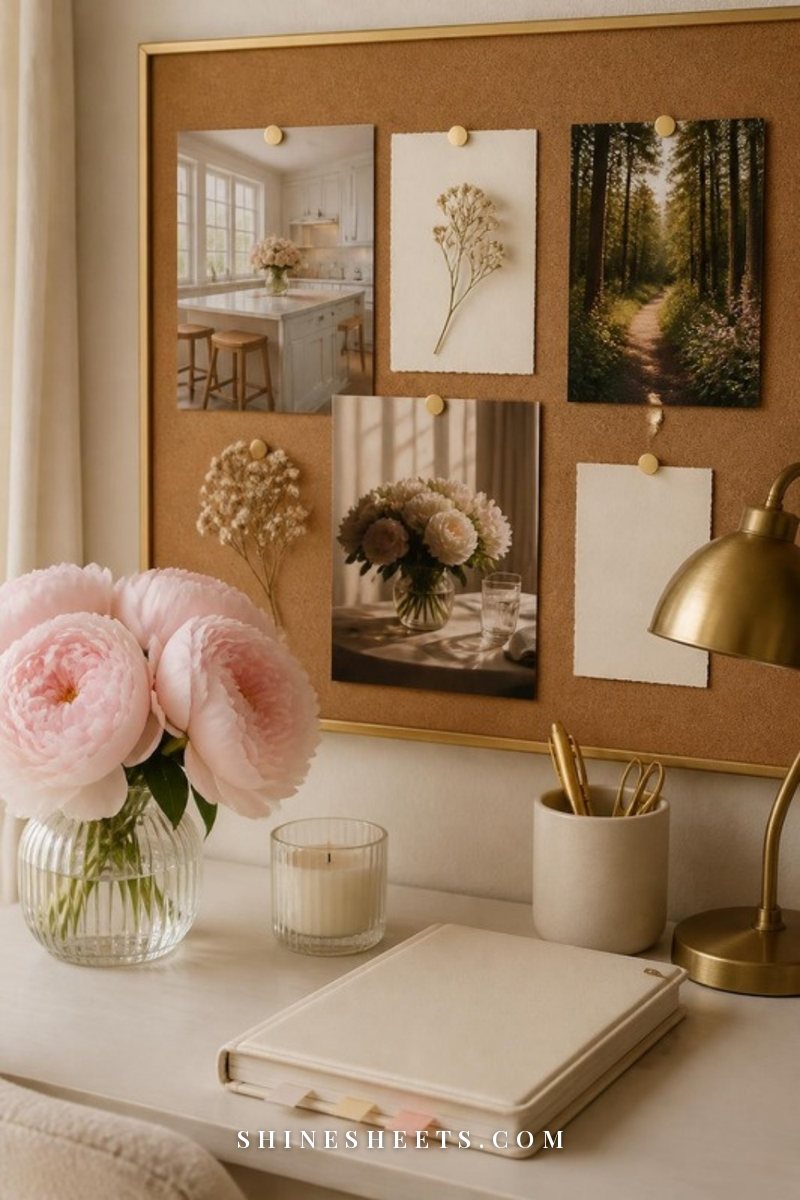
Out of sight really is out of mind. A vision you wrote once and tucked into a drawer will fade within weeks. Give it a place where your eyes land every day.
Here are a few gentle ways to do that:
- A desk board. A cork pinboard above your desk works beautifully – pin your three values, a short version of your Tuesday and a few images that capture the feeling (a sunny kitchen, a walking path, a table full of friends). My vision board ideas have nine easy layouts if you want inspiration.
- Your journal. Mark your vision page with pastel sticky tabs so you can flip to it in two seconds. I'd use one color for the vision, one for the values and one for your monthly reviews.
- A one-line version. Shorten your vision to one sentence and write it on a card by your bed or inside your wardrobe door.
Read your vision once a week – Sunday evenings are perfect. It takes two minutes and quietly reminds you which way you're walking.
Step 7: Review Your Vision Monthly
Your vision is a living document. You'll change, your circumstances will change, and that's exactly how it should be. A short monthly review keeps it alive without turning it into homework.
On the first weekend of each month, give yourself 20 minutes, a cup of tea and these five questions:
- Which of my three anchor habits did I actually keep, and roughly how often?
- Which life area felt closest to my vision this month?
- Which area felt furthest away, and what's one small thing that could help?
- Is there anything in my Tuesday story that no longer feels true?
- What's one moment this month that already looked like my future?
That last question is my favorite. You'll often discover that pieces of your vision are already happening – a calm morning here, a long talk with a friend there. Noticing them builds trust that the bigger picture is possible.
If an anchor habit isn't working, make it smaller instead of dropping it. If a whole part of your vision no longer fits, rewrite it without guilt. Updating your vision isn't failing at it. It's proof you're paying attention. Your monthly reviews are also a lovely thing to fold into a journaling routine; my list of journaling ideas has plenty of prompts for the weeks in between.
5 Common Mistakes When Creating a Life Vision

Most visions don't fail because people dream too small. They fail for a few predictable, very fixable reasons.
1. Writing Someone Else's Dream
It's easy to copy what looks impressive online or what your family expects. If a line in your vision gives you a sinking feeling instead of a warm one, it doesn't belong there. Your Tuesday should feel like relief, not like a performance.
2. Making It All About Achievements
A vision full of titles, numbers and trophies quickly becomes another to-do list. Keep at least half of it about feelings, people and daily rhythms – the things that make achievements worth having.
3. Trying To Change Everything at Once
Seven life areas don't mean seven new projects. That's why there are only three anchor habits. Let the other areas wait their turn; small progress in three places is far better than burning out in seven.
4. Forgetting the Joy Area
When life is busy, joy is the first thing we sacrifice and the last thing we plan for. Put at least one small pleasure into your Tuesday story and protect it like an appointment.
5. Treating It as Set in Stone
Your vision should grow with you. Writing it once and never touching it again makes it feel heavy over time. The monthly review keeps it light, honest and yours.
Final Thoughts
A life vision doesn't have to be grand to be powerful. Some of the most meaningful visions are full of small, ordinary things: a quiet morning, a body that feels rested, a few people who really know you, evenings that belong to you.
Start with one page and one Tuesday. Choose your three values, pick three tiny anchor habits and come back to it once a month. Little by little, the ordinary days you're living now will start to look more and more like the ones you wrote down – and that's the most beautiful kind of progress there is.