Self-reflection isn't about picking yourself apart. The most useful questions are the ones that help you notice what's already true – what drains you, what lights you up, what you keep circling back to – so you can make choices on purpose instead of on autopilot. A good question works like a flashlight, not a magnifying glass. It shows you the room; it doesn't zoom in on every speck of dust.
The tricky part is that most of us only reflect when something goes wrong. A breakup, a bad week at work, a birthday that feels heavier than expected. Reflection works so much better as a small, regular habit, when you're calm enough to hear your own answers. It took me a while to understand that ten quiet minutes with a notebook every week does more than one big, dramatic life audit a year.
This guide gathers 60 self-reflection questions for personal growth, sorted into six groups of ten: who you are now, emotions and patterns, relationships, work and purpose, values and dreams, and gratitude and growth. You'll also find a simple way to use them, a reflection ritual table for weekly, monthly and yearly check-ins, and what to do when a question feels heavier than you expected.
All you need is a quiet corner and something to write in. A cream linen-bound journal makes the habit feel a little more special, but the back of an envelope works too.
Why Self-Reflection Helps
Reflection sounds a bit abstract until you see what it actually changes. Here are the three things it does best:
- It gives you clarity. Thoughts that swirl in your head for days often settle within a few written sentences. Seeing "I'm not tired of my job, I'm tired of the commute" on paper is a completely different problem to solve than a vague "everything feels off."
- It makes decisions easier. When you know what you value and what tends to drain you, big and small choices get quicker. You stop asking "What should I do?" and start asking "What fits the life I'm trying to build?"
- It makes you kinder to yourself. Regular reflection shows you patterns, and patterns are much easier to forgive than random failures. "I snap at people when I skip lunch" is useful information, not proof that you're a bad person.
There's also a quieter benefit: reflection helps you notice progress. Growth is slow and mostly invisible from the inside. Reading your answers from three months ago is often the first moment you realize how far you've come.
How To Use These Self-Reflection Questions
Sixty questions can feel like homework if you try to answer them all at once. Please don't. Here's the simple method I'd suggest:
- Pick three questions. Choose from one group or mix across groups. Go with the ones that make you pause a little – that tiny "hm" is usually a sign the question has something for you.
- Write freely for ten minutes. Set a timer and keep your pen moving. Don't edit, don't cross out, don't worry about spelling. If you get stuck, write "What I really mean is…" and keep going.
- Drop the judgment. You're collecting information, not grading yourself. If an answer surprises or embarrasses you, write "interesting" next to it and move on. Curiosity first, conclusions later.
- Underline one line. When the timer ends, read what you wrote and underline the single sentence that feels most true. That's your takeaway for the week.
- Make it a weekly ritual. Same day, same time, same spot if you can. A routine removes the "when should I do this?" decision and makes the habit stick.
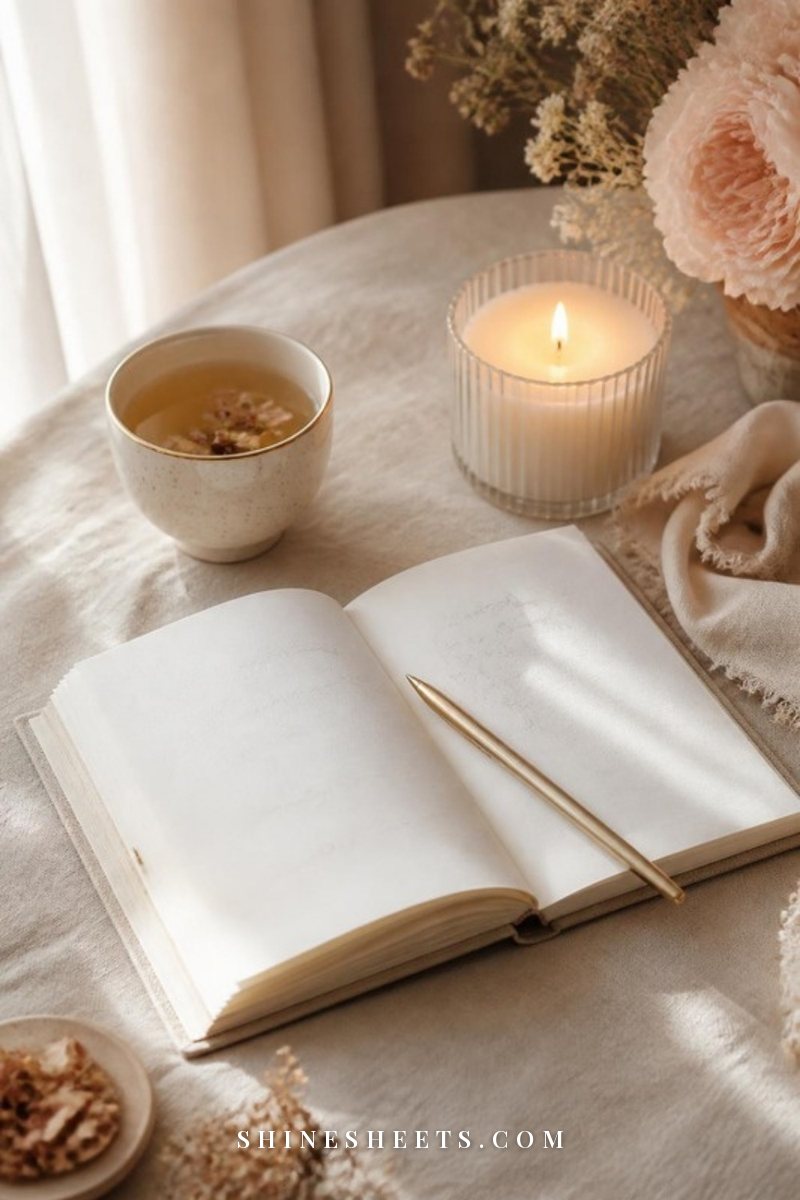
My own version happens in the evening, after a cup of tea, when the house is quiet. I light a candle, open the journal and write with a smooth gold ballpoint pen that lives only with that notebook (small rituals make it easier to start). A glass jar candle with a soft scent and a warm mug from an herbal tea sampler turn ten minutes of writing into something you look forward to rather than something you should do.
If you'd like more ways to fill the pages on days when you don't feel like answering big questions, my list of journaling ideas for when you don't know where to start has plenty of lighter options.
Your Reflection Ritual: Weekly, Monthly and Yearly
This is the heart of the guide. Instead of choosing questions at random, you can match each group to a rhythm. Weekly check-ins stay light and practical, monthly ones go a little deeper, and the yearly one is your big-picture review. Screenshot it and keep it in your journal.
| Rhythm | When | Time needed | Which groups | How many questions | Focus |
|---|---|---|---|---|---|
| Weekly | Sunday evening or any calm evening | 10–15 minutes | Emotions and Patterns + Gratitude and Growth | 3 (2 from one group, 1 from the other) | How you felt, what you noticed, one small win |
| Monthly | First weekend of the month | 20–30 minutes | Relationships + Work and Purpose | 4–5 | Who and what is getting your energy, and whether that feels right |
| Seasonally | Every three months | 30–40 minutes | Who You Are Right Now | 5 | How you've changed, what you're outgrowing |
| Yearly | Around your birthday or the new year | 60–90 minutes | Values and Dreams + a reread of your past answers | All 10 from Values and Dreams | Direction, priorities, the life you're building |
A few notes on the table: rotate the questions so you're not answering the same three every week, and date every entry. The dates are what make rereading so valuable. For the yearly session, my gentle end-of-year reflection questions pair beautifully with the Values and Dreams group below.
60 Self-Reflection Questions for Personal Growth
Each group has ten questions, plus a small nudge under some of them to help you go a layer deeper. Skip anything that doesn't speak to you today. Questions have a way of becoming relevant later.
Who You Are Right Now: 10 Questions

These questions take a snapshot of the present version of you – not who you were five years ago, and not who you think you should be.
- How would I describe myself in three words today? Then ask: would a close friend choose the same three?
- What does a normal, good day look like for me right now? Be specific – the time you wake up, what you eat, who you talk to.
- What am I currently outgrowing? A habit, a style, a friendship dynamic, a belief about yourself.
- Which part of my life feels most like "me" at the moment?
- Which part feels like I'm performing for someone else? Notice who that someone is.
- What do I spend most of my free time on, and does it actually refill me?
- What's one thing I believe now that I didn't believe a year ago?
- When do I feel most confident in my own skin? List the place, the clothes, the people, the time of day.
- What am I pretending not to know? This one can be quiet and uncomfortable. Write whatever comes first.
- If my current life were a season, which one would it be, and why?
Emotions and Patterns: 10 Questions
This group is perfect for weekly check-ins. You're not trying to fix your feelings, only to see them more clearly.
- What emotion showed up most this week? Try to name it precisely: not "bad," but disappointed, restless, lonely, overstimulated.
- When did I feel most like myself this week, and when did I feel least like myself?
- What situation keeps triggering the same reaction in me? Look for the pattern: the same type of person, place or time of day.
- How do I usually act when I'm stressed? Do you go quiet, get busy, shop online, snap at people?
- What do I need when I'm overwhelmed, and do I usually give it to myself?
- Which feeling am I most uncomfortable with, and why? For many of us it's anger or envy. Both carry useful information.
- What story did I tell myself this week that might not be true? "They're mad at me," "I always mess this up" – write the story, then write one kinder alternative.
- What drained my energy this week, and what restored it? Make two short lists side by side.
- Is there a feeling I've been postponing? Grief, frustration, excitement – feelings wait for us patiently.
- What would I say to a friend who felt exactly the way I feel right now? Then read it back as if it were written to you.
Relationships: 10 Questions

The people around us shape our days more than almost anything else. These questions help you look at your connections with honesty and warmth.
- Who do I feel most relaxed around, and what is it about them?
- Who leaves me feeling drained, and what usually happens in our conversations?
- Which relationship deserves more of my time and attention right now?
- Am I the friend I would want to have? Pick one small way to show up better this month.
- Where am I saying yes when I mean no?
- What do I need from the people closest to me that I haven't asked for? Try writing the request as one clear sentence.
- How do I usually handle conflict, and how would I like to handle it?
- Who has shaped the way I see myself, for better or worse?
- Is there someone I need to forgive, or someone I need to apologize to? You don't have to act on it yet. Naming it is enough for today.
- How do I treat myself when nobody is watching? Your relationship with yourself counts too.
Work and Purpose: 10 Questions
"Work" here means anything you put effort into – a job, studies, a creative project, caring for a home or the people you love.
- What part of my work makes time disappear?
- What part do I dread most, and is the dread about the task or the circumstances around it?
- What am I naturally good at that I tend to underrate? Ask yourself what people regularly come to you for.
- What did I learn this month, and where did I learn it?
- If I had to teach one thing, what would it be?
- Am I working toward something, or mostly away from something? Both are valid, but they feel very different.
- What would "enough" look like for me – enough money, enough success, enough effort?
- Where am I holding myself back because of fear of looking foolish?
- What kind of impact do I want my everyday effort to have on other people? If this one lights you up, my guide to writing a personal mission statement turns your answer into a few guiding sentences.
- What's one small step I could take this week toward work that feels more like mine?
Values and Dreams: 10 Questions

Save these for unhurried moments. They're the big-picture questions, and they're worth more than a rushed answer.
- What are my top five values right now? Think honesty, freedom, beauty, security, creativity, family, adventure – then rank them.
- Where does my calendar match those values, and where doesn't it? Your schedule is the most honest mirror of your priorities.
- What did I dream about as a child that still makes me smile?
- What do I want more of in the next year, and what do I want less of?
- Which dream have I quietly given up on, and is that a relief or a loss?
- What would I do if I knew nobody would judge me?
- What does a beautiful ordinary Tuesday look like in the life I want? Describe it in detail, from morning to bedtime. My guide on how to make a vision for your life builds on exactly this kind of answer.
- What truly makes me happy, beyond what I'm supposed to enjoy? If you draw a blank, these questions to find out what makes you happy are a gentle place to start.
- What am I willing to work hard for, even on the boring days?
- When I'm much older, what do I want to be glad I did?
Gratitude and Growth: 10 Questions
End on these. They balance the deeper digging with a reminder of what's already good and how much you've already grown.
- What's one ordinary thing I'm grateful for today? The smaller, the better – warm socks count.
- Who helped me recently, and do they know it mattered?
- What's something I handled better than I would have a year ago?
- Which mistake taught me the most, and what did it teach me?
- What part of my body or health am I thankful for today?
- What challenge am I secretly proud of getting through?
- What's a compliment I received and brushed off? Write it down and let it land this time.
- What habit is quietly making my life better?
- Which win from this month deserves a little celebration, even if it seems small?
- What would I like to thank my past self for? Finish the sentence "Thank you for…" at least three times.
When Reflection Feels Heavy

Some questions open doors you weren't expecting. That's normal, and it doesn't mean you did anything wrong. If your chest tightens or your thoughts start spiraling, here's what helps:
- Stop writing. You're allowed to close the journal mid-sentence. The question will still be there tomorrow, and so will you.
- Ground yourself in your body. Put both feet flat on the floor, press your palms together and take five slow breaths, making each exhale a little longer than the inhale. Then name five things you can see in the room.
- Switch to something soft. Wrap yourself in a cream knit throw blanket, make a warm drink, put on a familiar show. Comfort first, insight later.
- Write one closing line. If you can, end with "Right now I'm safe, and I can come back to this when I'm ready." It helps your mind put the topic down.
- Return later with a lighter question. Pick something from Gratitude and Growth next time, and approach the heavy one again only when you feel steady.
A small, kind safety note: journaling is a lovely tool, but it isn't a replacement for support. If certain questions keep bringing up pain from the past, or you notice low mood that lasts for weeks, please reach out to a therapist or a doctor you trust. And if you're ever in crisis in the US, you can call or text 988 to reach the Suicide and Crisis Lifeline at any hour.
Turning Your Answers Into Small Changes
Reflection becomes growth only when one of your answers turns into a tiny action. You don't need a full life overhaul. You need one small, concrete step at a time.
Here's a simple formula to use at the end of each session: "I noticed ___, so this week I'll try ___." For example: "I noticed I feel drained after long phone sessions at night, so this week I'll leave my phone in the kitchen after 10 p.m." Or: "I noticed I miss my old friend, so this week I'll send her a voice message."
Keep the step small enough that you could do it on a tired day. If a reflection leads you to a bigger crossroads – a move, a career change, a relationship decision – slow down and work through these questions to ask yourself before a big decision before acting.
Once a month, flip back through your underlined lines. You'll start to see themes: the same values, the same wishes, the same small fears showing up in different outfits. Those themes are the real gift of self-reflection. They tell you who you are and what you want much more reliably than any single answer.
Final Thoughts
You don't need to have yourself figured out to start reflecting. That's the whole point of asking questions. Three questions, ten minutes and a little kindness toward whatever shows up on the page is enough to begin.
Some weeks your answers will feel profound and some weeks they'll be a list of what you ate and how tired you are. Both count. Over time, those quiet pages become a map of who you're becoming, and that person deserves your curiosity, your patience and a very good cup of tea.