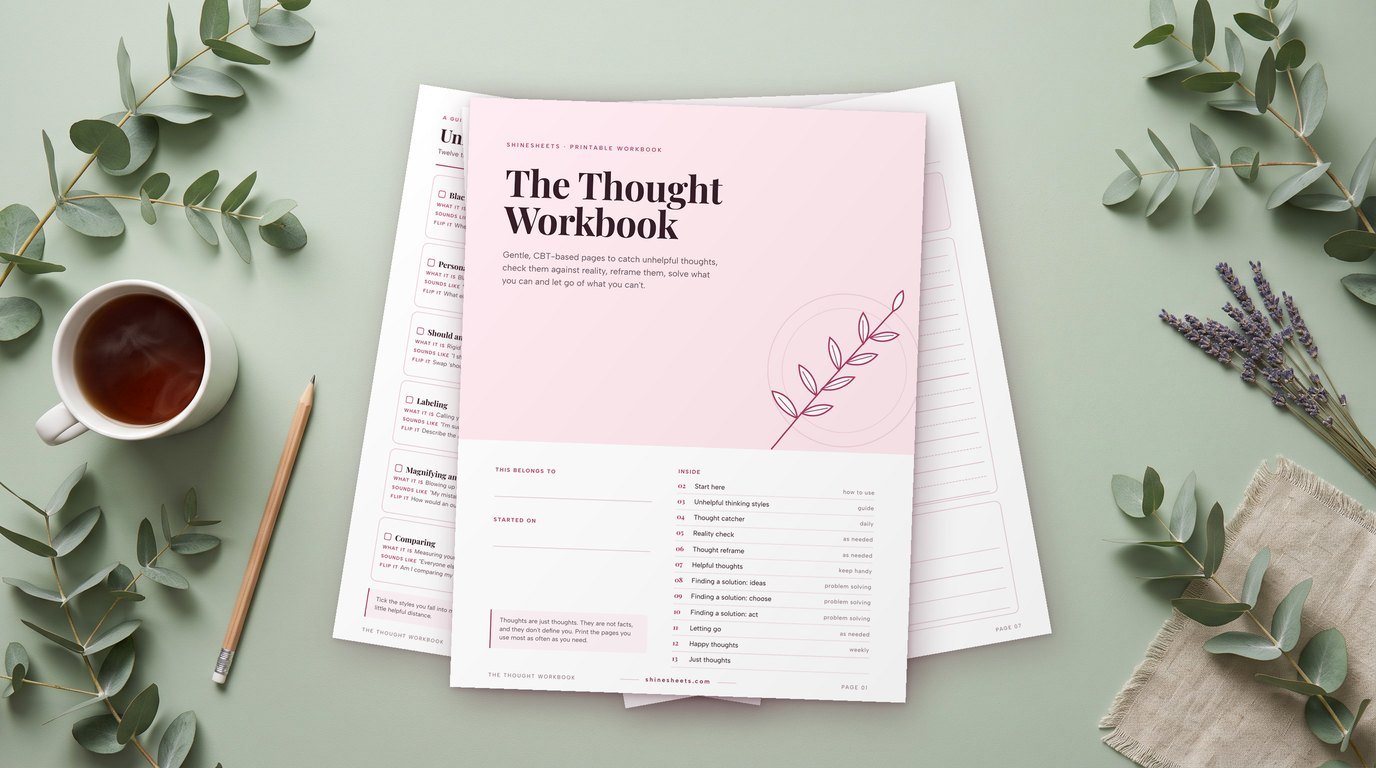
Your thoughts are not always telling you the truth. That sounds dramatic, but it's actually one of the most freeing ideas you can learn. Minds take shortcuts, especially when we're tired, stressed or anxious, and those shortcuts often lead to the same few distorted conclusions: everything is ruined, everyone is upset with me, this will never get better.
Psychologists call these patterns cognitive distortions. I prefer the gentler name, thinking traps, because that's exactly how they feel: you step into one without noticing, and suddenly a small problem feels enormous. The good news is that once you can name a trap, it loses a surprising amount of its grip. As someone prone to anxiety, I find that naming the pattern is often the moment the volume turns down.
This guide is all about thinking traps: the 10 most common ones, explained simply with an everyday example and a kinder reframe question for each. You'll also find how to catch them in the moment, a thought record table you can copy into your journal, and why this gets easier the more you practice.
None of this is about forcing yourself to think positively. It's about thinking more accurately, and more kindly.
What Thinking Traps Are and Why Everyone Has Them

A thinking trap is a habitual way of interpreting things that leans toward the most negative, rigid or self-critical conclusion, even when the facts don't fully support it. They're automatic, which means they arrive before you've had a chance to consider the situation calmly. They also feel true, because they come with real emotions attached.
Everyone has them. Thinking traps aren't a sign that something is wrong with you. They're a normal side effect of a brain that's trying to protect you. Long ago, assuming the worst could keep you safe. Today, it mostly keeps you awake at night replaying a text message.
They tend to show up more when you're:
- tired, hungry or run down,
- stressed or overwhelmed,
- feeling anxious or low,
- in a situation that touches an old hurt or insecurity.
That last one is worth noticing. Thinking traps often get louder around the topics that already feel tender, which is why my guide on understanding your emotional triggers pairs so well with this one.
How To Use This List
You don't need to memorize all ten. Read through them once and notice which two or three feel most familiar. Most people have a few "favorite" traps that show up again and again. Those are the ones worth learning really well.
Each trap below includes a short explanation, an everyday example and a reframe question. The reframe question is the most important part. It isn't meant to argue with your feelings. It simply opens a small window so a more balanced thought can come in.
Keep the tone gentle as you read. If you notice yourself thinking "I do all of these, I'm hopeless", that's actually a thinking trap too (you'll meet it in a minute). Smile at it and keep going.
10 Common Thinking Traps
1. All-or-Nothing Thinking
All-or-nothing thinking sees things in black and white, with no room for the middle. Something is either perfect or a failure, you're either on track or you've ruined everything. There's no "pretty good" and no "a mixed day."
Everyday example: You planned to work out four times this week and only managed two. Your mind says, "I've completely failed, there's no point trying."
Reframe question: What would the middle ground look like here? Two workouts is not zero. It's two more than you might have done, and it's a perfectly good starting point for next week.
2. Catastrophizing

Catastrophizing jumps straight to the worst possible outcome and treats it as likely, or even certain. One small problem quickly becomes a chain of disasters in your imagination.
Everyday example: Your manager asks for a quick chat tomorrow. By evening you've imagined being fired, not paying rent and having to move.
Reframe question: What's the most likely outcome, not the worst one? You can also ask: if the worst did happen, how would I cope? Most of the time, the most likely outcome is ordinary, and even the hard outcomes are things you'd find a way through.
3. Mind Reading
Mind reading means assuming you know what other people are thinking, usually something negative about you, without any real evidence.
Everyday example: A friend replies to your message with just "ok." You decide she must be annoyed with you, and spend the afternoon wondering what you did wrong.
Reframe question: What else could explain this? She might be busy, tired, driving or simply someone who writes short texts. If it still bothers you later, you can ask kindly. You don't have to guess.
4. Fortune Telling
Fortune telling predicts that things will turn out badly, and treats that prediction as a fact. It often stops you from trying something at all.
Everyday example: "There's no point going to that event. I won't know anyone and I'll just stand there feeling awkward."
Reframe question: How do I actually know this will happen? And: has it always happened before? Usually, the honest answer is "I don't know yet," which leaves room for something better.
5. Overgeneralizing
Overgeneralizing takes one event and turns it into a rule about everything. You'll often hear words like "always," "never," "everyone" and "nothing."
Everyday example: One date goes badly and you think, "This always happens to me. I'll never meet anyone."
Reframe question: Is this really always true, or is it true this time? Try finding one exception. There nearly always is one, and it breaks the rule.
6. Should Statements

Should statements are rigid rules about how you (or others) are supposed to behave. "I should be further along by now." "I shouldn't feel this way." They tend to create guilt when aimed at yourself and frustration when aimed at others.
Everyday example: "I should be able to handle all of this without help. Other people manage fine."
Reframe question: What would I say if I swapped "should" for "I'd like to" or "it would be nice if"? "I'd like to feel more on top of things, and asking for help is one way to get there" is softer, and much more useful.
7. Labeling
Labeling takes a single mistake or behavior and turns it into a judgment about who you are. Instead of "I made a mistake," it becomes "I'm an idiot," "I'm a failure," or "I'm too much."
Everyday example: You forget a friend's birthday and think, "I'm a terrible friend."
Reframe question: Am I describing what I did, or deciding who I am? You forgot a birthday. That's an action you can repair with a warm message, not a definition of your whole character.
8. Emotional Reasoning
Emotional reasoning treats feelings as proof. "I feel anxious, so something must be wrong." "I feel stupid, so I must be stupid." Feelings are real and worth listening to, but they're not always accurate reports about the outside world.
Everyday example: You feel nervous before a presentation and conclude, "I feel this scared, so it's definitely going to go badly."
Reframe question: What are the facts, separate from how I feel right now? You prepared, you know the topic, and nerves are your body getting ready. The feeling is uncomfortable, but it isn't a forecast.
9. Discounting the Positive
Discounting the positive brushes off anything good as luck, politeness or "not counting." It keeps a negative belief alive by refusing to let any evidence against it in.
Everyday example: A colleague compliments your work and you think, "She's just being nice," or "Anyone could have done that."
Reframe question: If a friend got this compliment, would I tell her it doesn't count? Try saying "thank you" and letting it land, even if only for a moment. If insecurity makes this one especially sticky, my guide on how to stop feeling insecure goes deeper.
10. Personalizing
Personalizing means taking responsibility for things that aren't fully (or at all) in your control, or assuming that other people's moods and actions are about you.
Everyday example: Your partner is quiet at dinner and you immediately think, "I must have done something to upset him."
Reframe question: What other factors could be involved here? People have whole inner lives: work stress, tiredness, a headache, their own worries. You're one part of their world, not the cause of every mood in it.
Thinking Traps Often Travel Together
In real life, thinking traps rarely show up one at a time. They link together like beads on a string, and each one makes the next feel more believable. Here's a common chain:
- Your friend cancels plans (the situation).
- "She doesn't really want to see me" (mind reading).
- "This always happens, people drift away from me" (overgeneralizing).
- "I'm just not someone people want around" (labeling).
- "I'll probably end up alone" (fortune telling).
Within a minute, a cancelled coffee has turned into a conclusion about your whole future. The helpful part is that you don't need to untangle every link. Catching the very first one, the mind reading, is often enough to stop the rest of the chain from forming. Ask "what else could explain this?" and the whole string loosens.
How To Catch a Thinking Trap in the Moment

Knowing the traps is the first step. Catching them as they happen is the skill. Here's a gentle five-step process you can use whenever a thought makes your stomach drop:
- Notice the feeling first. A sudden wave of anxiety, shame or dread is your cue. Feelings usually arrive before we notice the thought behind them.
- Pause and breathe. Take one slow breath in through your nose and a longer breath out. You're giving your thinking brain a moment to catch up.
- Find the thought. Ask, "What just went through my mind?" Write it down word for word if you can, exactly as harsh as it sounded.
- Name the trap. Is it catastrophizing? Mind reading? All-or-nothing? Simply naming it ("Oh, that's fortune telling") creates a little distance.
- Ask the reframe question for that trap, and write down a kinder, more balanced thought. It doesn't need to be cheerful. It just needs to be fair.
At first you'll often catch the trap hours later, while replaying the day. That still counts. Over time, the gap between the thought and the noticing gets shorter. If your traps tend to pile up at bedtime, my guide on how to stop overthinking at night has calming steps for exactly that moment.
Your Thought Record Table
A thought record is a simple tool used in cognitive behavioral approaches, and it's one of the most effective ways to practice. You write down the situation, the automatic thought, the trap it falls into and a kinder alternative. Here are a few examples to show how it works. Copy the four columns into your journal and fill in your own.
| Situation | Automatic thought | Thinking trap | Kinder thought |
|---|---|---|---|
| Friend hasn't replied for a day | "She's upset with me." | Mind reading | "She's probably busy. I'll check in kindly tomorrow if I still wonder." |
| Small mistake in an email at work | "I'm so careless. I'm terrible at my job." | Labeling | "I made one small error and I can send a quick correction. Everyone does this sometimes." |
| Missed two planned workouts | "I've blown it. No point continuing." | All-or-nothing | "Two workouts still count. I'll pick up again on Monday." |
| Headache that won't go away | "Something must be seriously wrong." | Catastrophizing | "Most headaches are from tiredness or stress. I'll rest, drink water and call a doctor if it continues." |
| Compliment on an outfit | "They're just being polite." | Discounting the positive | "Maybe they genuinely liked it. I can just say thank you." |
| Invited to a party with new people | "I'll be awkward and no one will talk to me." | Fortune telling | "I don't know how it will go. I can stay for an hour and see." |
You can also add a fifth column for how strongly you believe the original thought, from 0 to 100, before and after. Watching that number drop from 90 to 50 is a quiet but real kind of progress.
What a Kinder Thought Is and Isn't
When people first try reframing, they often feel like they're lying to themselves. That's because they're reaching for an overly positive thought, like turning "I'll fail this interview" into "I'll definitely get the job!" Your mind doesn't believe that, so it pushes back even harder.
A kinder thought is different. It's:
- Balanced, including the hard part and the hopeful part ("I'm nervous, and I've prepared well").
- Believable, something you could say out loud without rolling your eyes.
- Specific, about this situation rather than your entire life.
- Kind in tone, the way you'd speak to a friend you love.
A useful test: would you say this thought to a friend in the same situation? If yes, it's a good reframe. If it sounds harsh or falsely cheerful, adjust it until it feels fair.
How To Practice Without Overthinking It

The aim isn't to analyze every thought you have all day. That would be exhausting (and, ironically, a new form of overthinking). Instead, choose a few small, low-pressure habits:
- A five-minute evening thought record. After your evening tea, pick one thought from the day that stung and run it through the four columns. One is enough. A linen-covered notebook kept by the bed makes this feel like a small ritual instead of homework.
- Try a guided journal. If a blank page feels daunting, a guided journal for anxiety with prompts can give you structure on harder days. Choose one with gentle, open-ended questions rather than strict daily rules.
- Sticky note reminders. Write your two most common reframe questions on pastel sticky notes and put them where you'll see them: your desk, the bathroom, the inside of a cupboard door.
- Color-code your traps. If you enjoy journaling, a set of soft pastel gel pens lets you mark each trap with its own color. After a few weeks, you'll see your patterns at a glance.
- Make it calm, not clinical. Light a candle in a cream glass jar, put on soft music and give yourself ten unhurried minutes. Your nervous system reflects on things more kindly when it feels safe.
It also helps to keep a few balanced phrases ready for the moments you can't sit down and write. A short list of affirmations for anxiety can act as quick, kind counter-thoughts when a trap shows up in the middle of your day.
Why It Gets Easier
The first few weeks of noticing thinking traps can feel strange. You might suddenly see them everywhere and wonder how you never noticed. That's actually a good sign: awareness always comes before change.
With practice, a few things tend to happen:
- You catch traps sooner. At first you'll notice them hours later. Eventually you'll notice them while they're happening, and sometimes just before.
- The reframes become automatic. You'll start hearing "what's the most likely outcome?" in your own voice without needing the table.
- Thoughts lose their urgency. A catastrophic thought might still pop up, but it feels more like a familiar visitor than a fire alarm.
- You become kinder to yourself. Many thinking traps are forms of self-criticism. Questioning them is, quietly, an act of self-compassion.
This is a bit like learning to spot typos. Once you know what to look for, you can't unsee it, and fixing it becomes quicker each time. If you want a simple starting framework for those spiraling moments, my guide on how to stop overthinking in 3 easy steps is a nice companion to this one.
Be patient with yourself if old patterns return during stressful weeks. That's normal. The skill doesn't disappear. It just needs a little dusting off.
When To Reach Out for More Support
Thinking traps are something we all deal with, and self-help tools like thought records can make a real difference. But if negative thoughts feel constant, overwhelming or hard to shake, or if they're affecting your sleep, work, relationships or your ability to enjoy things, please consider talking to a therapist or your doctor.
Cognitive behavioral therapy (CBT), the approach these ideas come from, is widely available and works especially well with a trained professional guiding you. Reaching out isn't a sign that you've failed at doing it alone. It's a sign that you take your wellbeing seriously. And if you ever have thoughts of harming yourself, please contact a crisis line or emergency services right away.
Final Thoughts
Thinking traps are not character flaws. They're habits of a mind that's trying, in its slightly clumsy way, to keep you safe. Once you can see them clearly, you get to choose a fairer, gentler way of looking at things.
Start with the two traps that feel most familiar, write down one thought tonight and ask it a kinder question. Every time you do, you're teaching yourself that your thoughts are worth listening to, and also worth questioning.