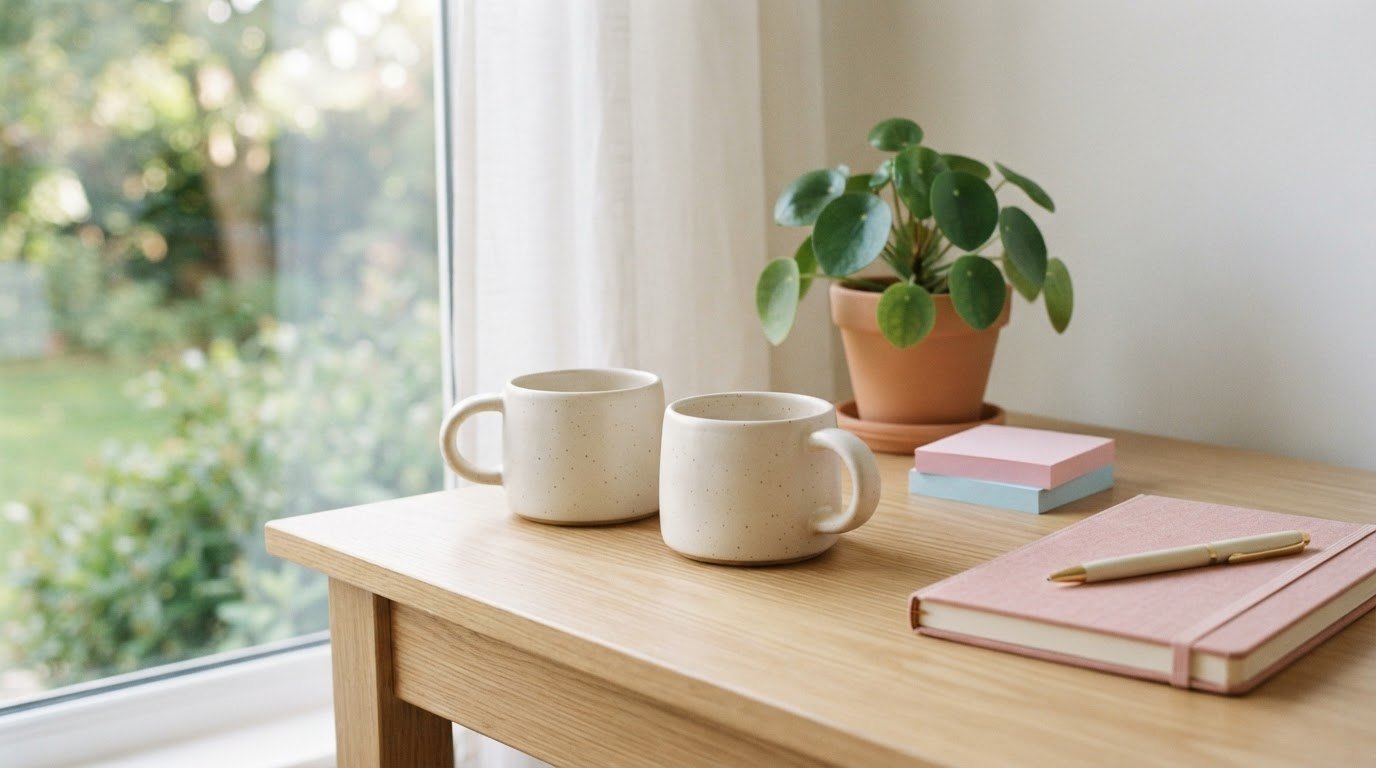
A while ago I knocked a full cup of tea across my desk, all over a notebook I'd been writing in for months. And the very first thing that came out of my mouth, out loud, to an empty room, was: "Of course. You ruin everything."
Then I stopped, mop-up towel in hand, and thought: if my best friend had done exactly the same thing, I would have laughed, grabbed more towels and said, "Oh no, your poor notebook! Let's dry the pages on the radiator." I would never, ever have told her she ruins everything.
That moment stuck with me. Most of us are wonderful friends to other people and quietly awful roommates to ourselves. We hold their hands through breakups and job worries, then speak to ourselves in a voice we'd never accept from anyone else.
So this is a guide to changing that, gently. You'll learn what it really means to be your own best friend, get a "what would a best friend say?" reframe table for the harsh lines your inner critic loves to repeat, and find 20 kind habits that turn self-friendship from a nice idea into something you actually practice on an ordinary Tuesday.

What It Means To Be Your Own Best Friend
Being your own best friend isn't about thinking you're perfect or never wanting other people around. It's about bringing the same warmth, loyalty and honesty you give your favorite people to the relationship you have with yourself, the only one that lasts your whole life.
Think about what a good best friend actually does:
- She's on your side, even when you mess up.
- She tells you the truth, kindly, because she wants good things for you.
- She notices when you're tired and makes you sit down.
- She celebrates your wins, even the small ones nobody else saw.
- She wants to spend time with you, not just help you be more productive.
Being your own best friend means doing those five things for yourself. Not instead of having friends (we all need people), but so you're never completely alone in your own head. And it's a skill, which means it gets easier the more you practice.
A small honest admission: as someone prone to anxiety, my inner voice used to sound more like a strict manager than a friend. What helped wasn't forcing positive thinking. It was learning to catch the harsh line and ask one simple question. That's where the table below comes in.
The "What Would a Best Friend Say?" Reframe Table
When your inner critic speaks up, don't argue with it and don't pretend it's not there. Just pause and ask: "What would my best friend say if she heard me say this?" Then say that instead, out loud if you can, or write it down.
Here are the inner critic lines I hear most often (from myself and from the women I talk to), with a best-friend version you can borrow until you find your own words.
| Your inner critic says… | Your best friend would say… |
|---|---|
| "You ruin everything." | "That was an accident. Accidents happen to everyone. Let's clean it up together." |
| "You're so lazy." | "You've been running on empty. Rest isn't lazy, it's how you refill." |
| "Everyone else has their life together." | "You're comparing your messy middle to their highlight reel. You're doing better than you think." |
| "You should be further along by now." | "There's no deadline on your life. Look how far you've already come." |
| "You look awful today." | "You look tired, love. Let's get you some water and an early night." |
| "Why did you say that? They must think you're weird." | "They've probably forgotten already. And if they remember, it's that you were warm and real." |
| "You always quit." | "You stopped because it wasn't working. Trying something new isn't failing." |
| "You're too much." | "The right people love exactly how much you are." |
| "You can't do this." | "You don't have to do all of it today. What's one small step?" |
| "Nobody cares about you." | "I care. And I bet there are people who'd love to hear from you. Text one of them." |
| "You wasted the whole day." | "You got through the day. Some days that's the whole achievement." |
| "You don't deserve that." | "You don't have to earn kindness. Take the nice thing." |
How to use it: pick the two lines that sting the most and copy the best-friend versions onto a sticky note or into your phone's lock screen. For the next week, every time you catch the critic, read the note. You're not trying to silence the voice in one go; you're simply giving it a kinder neighbor. If negative self-talk feels loud most days, my five steps to stop negative self-talk go deeper.
20 Kind Habits To Be Your Own Best Friend
These are grouped into four parts of any good friendship: how you talk, how you show up, how you spend time together and how you have each other's back. Pick one habit from each group to start, not all twenty at once.
Talk to Yourself Kindly: 5 Habits
1. Use Your Own Name, Gently
When you're stressed, try talking to yourself in the third person: "Okay, Amber, you've got this. One thing at a time." It sounds a little silly, but it creates a small distance between you and the panic, the way a friend's voice does. Keep the tone warm, like you'd use with someone you love.
2. Swap "Should" for "Could"
"I should go to the gym" sounds like a scolding. "I could go for a 15-minute walk" sounds like an offer. Notice how many "shoulds" you say in a day, and try swapping just three of them tomorrow. A best friend makes suggestions, not demands.
3. Thank Yourself Out Loud
When you finish something, even something boring like folding laundry or answering an awkward email, say "thank you" to yourself. It feels odd for about two days and then becomes a sweet little habit. Future-you appreciates being thanked for the clean kitchen as much as anyone would.
4. Give Yourself a Pep Talk Before Hard Things
Before a difficult call, a doctor's appointment or a party where you only know the host, take 60 seconds for a pep talk. A simple formula: "This is hard because ___. I can handle it because ___. Afterward, I'll ___." That last line is important. Give yourself something kind to look forward to.
5. Keep a Pocket Phrase for Bad Moments
Choose one short sentence for when things go wrong and you feel the critic winding up. Mine is "It's okay, love, we'll figure it out." Others I like: "This is a hard moment, not a hard life" and "I'm still on my side." A pocket phrase works because you don't have to think of it in the moment; it's already there. A small pastel affirmation card deck on your desk or nightstand can help you find words that sound like you.
Show Up for Yourself: 5 Habits
6. Keep the Small Promises You Make to Yourself
We trust friends who keep their word. The same goes for self-trust. If you tell yourself you'll go to bed at 10:30 or drink a glass of water after coffee, do it, even once. Start with promises so small they're almost impossible to break, and let them grow from there.
7. Have a Weekly Check-In Over Tea
Once a week, sit down with a warm drink and ask yourself the questions a friend would ask: How are you, really? What was hard this week? What was lovely? What do you need next week? I do this in the evening with a cup of tea and my journal, and it's become one of my favorite rituals. A blush hardcover journal kept just for these check-ins makes it feel special, and looking back through the pages after a few months is surprisingly moving. For more prompts, try my journaling ideas.
8. Take Your Own Feelings Seriously
If a friend told you she was hurt, you wouldn't say "get over it." When you feel sad, angry or anxious, name it ("I'm feeling left out") and give it a moment before you move on. You don't have to act on every feeling, just acknowledge it the way you would for someone you love.
9. Plan Something Nice for Future-You
Best friends think ahead: they bring your favorite snack, they remember you have a big day. Do the same for yourself. Lay out a comfy outfit for Monday morning, put fresh sheets on the bed before a long week or leave your favorite mug next to the kettle for the morning. Tiny acts of care that say "I've got you."
10. Let Yourself Rest Without Earning It
You'd never tell a tired friend she has to finish three more tasks before she's allowed to sit down. Give yourself the same grace. Rest is part of being human, not a reward for being productive enough. If this one is hard for you, my guide on how to stop feeling guilty for resting was written for exactly that feeling.
Spend Quality Time Together: 5 Habits
11. Take Yourself on a Monthly Date
Once a month, put a "date with me" in your calendar and keep it like you'd keep plans with a friend. A gallery, a long walk through a new neighborhood, a matinee movie, a bookstore and a hot chocolate. Go alone on purpose, phone in your bag. You'll be amazed how good your own company can feel. My list of things to do at home by yourself has ideas for when you'd rather stay in.
12. Create an Evening Ritual Just for You
Friends have their rituals: the same café, the same Friday call. Give yourself one. Mine is simple: light a glass candle, make an evening tea, journal for ten minutes. A white glass jar candle in a soft scent you love becomes a signal to your brain that this time is yours. Keep it to 15–20 minutes so it's easy to repeat every night.
13. Learn What You Actually Like
Many of us know our partners' and friends' favorite things better than our own. Get curious: what music makes you happy right now? Which season, color, scent, kind of evening? Try one new thing a week and notice your reaction honestly, without asking anyone else's opinion first. Getting to know yourself is the first step of any friendship.
14. Move Your Body Because It Feels Good
Swap punishing workouts for movement you'd invite a friend to do with you: a slow stretch, a dance in the kitchen, a walk to look at the neighbors' window boxes. Even 10 minutes on a soft yoga mat in the living room counts. Ask yourself afterward, "Do I feel better?", not "Did I burn enough?"
15. Protect Your Sleep Like a Friend Would
A good friend would send you to bed when you're yawning through a conversation at 1 a.m. Be that friend. Set a gentle bedtime alarm 30 minutes before you want to sleep, dim the lights and put your phone on the other side of the room. A silky sleep mask is a sweet little upgrade if streetlights or early sunrises wake you.

Have Your Own Back: 5 Habits
16. Say No Without a Long Explanation
A best friend would tell you: you don't owe everyone your evenings. Practice a short, kind no: "Thank you for thinking of me, but I can't this time." No three-paragraph excuse required. Each time you protect your time, you're showing yourself that your needs matter too.
17. Celebrate Your Wins (All of Them)
Keep a "done list" alongside your to-do list, or a pretty glass jar with a gold lid where you drop a folded note every time something goes well: a hard conversation handled, a bill paid on time, a run finished. Read it when you feel stuck. A friend would remind you of how far you've come, so collect the proof.
18. Forgive Yourself Faster
Best friends don't hold grudges about a forgotten birthday from three years ago. When you make a mistake, use this three-step formula: own it ("I snapped at my sister"), repair what you can (send the apology), release it ("I've done what I can, I'm allowed to move on"). Replaying it for weeks doesn't fix anything; it just hurts you twice.
19. Stop Comparing Yourself to Strangers
You'd never tell your friend she's not as pretty, successful or put-together as some woman on the internet. Notice which accounts leave you feeling small and mute them for a month. Fill the space with people who make you feel inspired instead of behind.
20. Ask for Help When You Need It
Being your own best friend doesn't mean doing everything alone. Sometimes the kindest thing a friend can say is, "This is too much for one person. Who can we call?" Reaching out to a friend, a family member or a professional is not weakness, it's self-friendship in action. And if you'd like more people in your corner, my guide on how to make friends as an adult is a gentle place to start.
A 7-Day Best Friend Starter Plan
If twenty habits feel like a lot, start here. One small thing a day for one week, about 10 minutes each:
- Day 1: Write down three harsh lines your inner critic says often. Next to each, write the best-friend version using the table above.
- Day 2: Choose your pocket phrase and save it as your lock screen.
- Day 3: Keep one tiny promise to yourself (a glass of water, a 10-minute walk, an earlier bedtime).
- Day 4: Thank yourself out loud for three ordinary things you did.
- Day 5: Start your done list and add everything from this week.
- Day 6: Take yourself on a mini date: a walk, a coffee, a bookstore, an hour that's just yours.
- Day 7: Have your first weekly check-in over tea and plan one nice thing for next week.
Then keep the two habits that felt best and add one new one each week. Slow and steady is exactly how real friendships grow, too. For even more ideas to weave in, here are 50 ways to practice self-love every day.
When Being Kind to Yourself Feels Impossible
For some of us, the inner critic isn't just a grumpy voice; it's loud, constant and exhausting. If kind self-talk feels fake or impossible, that doesn't mean you're doing it wrong. It may mean you're carrying more than one article can help with.
Talking to a therapist or counselor can be one of the most loving things you do for yourself. And if you're ever in crisis or worried about your safety, please reach out to a local emergency number or crisis line right away. Asking for support is exactly what a best friend would tell you to do.
Final Thoughts
You've spent your whole life with yourself, and you'll spend the rest of it together too. It's worth making that relationship a warm one. Not perfect, not endlessly positive, just kind, loyal and on your side.
Start with one line from the reframe table today. Say the best-friend version out loud, even if it feels a little awkward. The next time you spill the tea (literally or not), you'll have a kinder voice ready, and it will sound more and more like your own.