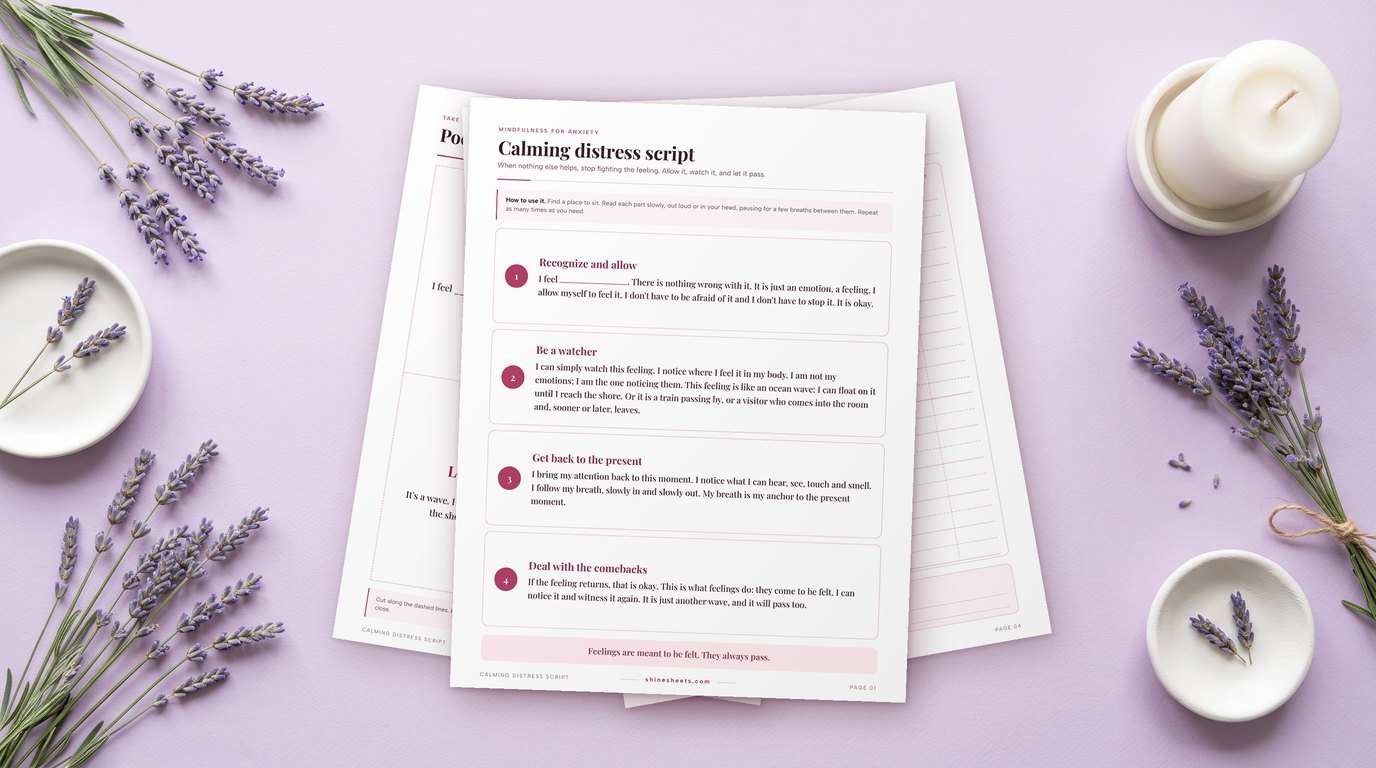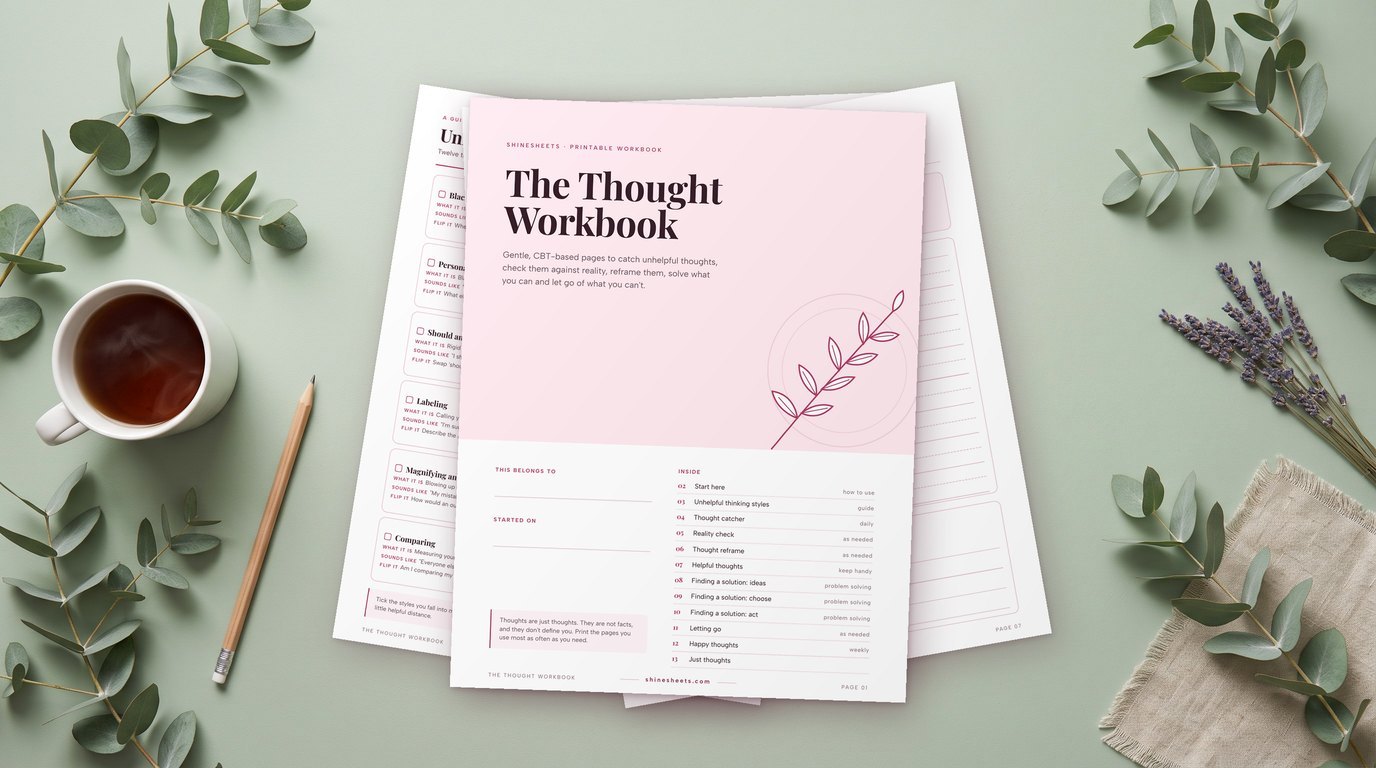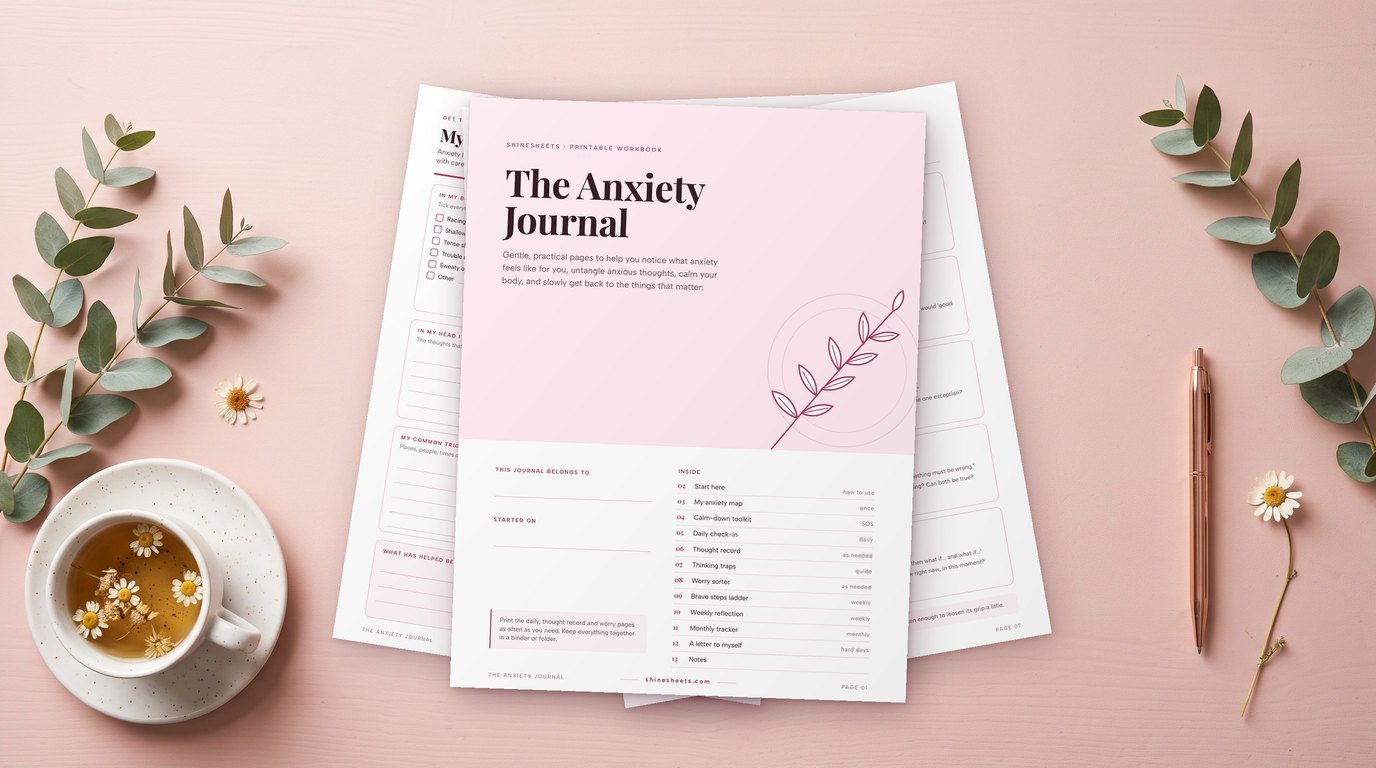
Affirmations for anxiety work best when they sound like a calm friend, not a motivational poster. "I am fearless" rarely helps when your heart is racing. "This feeling is uncomfortable, but it will pass" often does, because your nervous system can actually believe it.
That's the whole secret: small, believable phrases said slowly, ideally after a breath or two. They won't make anxiety disappear, but they can turn the volume down enough for you to think clearly again, call a friend, finish the email or fall asleep. As someone prone to anxiety I mostly manage, I keep a few of these ready the way you'd keep tissues in your bag.
Below you'll find 50 affirmations for anxiety sorted into five moments where worry tends to show up: racing thoughts, panic, social situations, bedtime and uncertainty about the future. You'll also find a simple "how to use them" card and a table that shows you how to turn a scary thought into a calm phrase of your own.

Do Affirmations Actually Help With Anxiety?
They can, with the right expectations. Affirmations aren't magic words and they aren't a treatment. What they do is give your mind something steady to hold onto when anxious thoughts are spinning. Instead of arguing with every "what if," you have one short sentence to come back to.
They tend to help most when they're:
- Believable. If your brain rolls its eyes at a phrase, it won't calm you. "I can get through the next hour" beats "Everything is perfect."
- Present-focused. Anxiety lives in the future. Words like "right now," "in this moment" and "today" gently pull you back.
- Paired with the body. A phrase on its own is nice. A phrase plus a slow exhale or your feet on the floor is much stronger.
- Repeated. The more often you practice on calm days, the easier they are to reach for on hard ones.
A kind note before we start: affirmations support, they don't replace professional help. If anxiety is affecting your sleep, work, relationships or daily life, talking to a doctor or therapist is a strong, wise step. And if you're ever in crisis in the US, you can call or text 988, the Suicide and Crisis Lifeline, any time, day or night.
How To Use Affirmations for Anxiety: The 4-Step Card
Screenshot this little card and keep it in your phone's favorites. It's the difference between reading a phrase and actually feeling it land.
- 1. Breathe first. Before any words, take two slow breaths with a longer exhale than inhale (in for 4, out for 6). Your body needs a moment to hear you.
- 2. Say it slowly. Out loud if you can, in a whisper if you're in public, in your head if you must. Say it at half your normal speed. Rushing a calm phrase makes it feel anxious too.
- 3. Pair it with a grounding cue. Press your feet into the floor, hold something cool or textured, or place a hand on your chest. The same cue every time trains your brain to link it with calm.
- 4. Believable beats big. If a phrase feels false, soften it. "I am calm" becomes "I'm getting a little calmer." "I'm safe" becomes "I'm safe enough right now."
Repeat your chosen phrase three to five times, then notice what changed, even if it's only one percent. One percent counts. If you want more body-based tools to go with this, my guide on how to calm anxiety fast has twelve grounding techniques that pair perfectly with these phrases.
10 Affirmations for Racing Thoughts
For the moments when your mind feels like twenty browser tabs playing music at once. These phrases don't try to win the argument with each worry. They simply let you step back from the noise.
- My thoughts are loud right now, and loud is not the same as true.
- I don't have to solve everything tonight.
- I can notice this thought and let it pass like a car on the street.
- One thing at a time is enough.
- I am allowed to set this worry down for the next ten minutes.
- My mind is trying to protect me. I can thank it and still choose calm.
- I have handled hard days before, and I can handle this one.
- Not every thought deserves an answer.
- I return to my breath, and my breath returns me to now.
- Right now, in this moment, I am okay.
Try this: when thoughts race, write the loudest one on paper, then write one affirmation underneath it. Seeing the worry outside your head makes it look smaller, and the calm sentence gets the last word.
10 Affirmations for Panic Moments
Panic can feel terrifying, especially the physical side: a pounding heart, tight chest, shaky hands. These phrases remind your body what it already knows, that the wave will pass. Keep them short and say them with long, slow exhales.
- This feeling is uncomfortable, but it is not dangerous.
- It will rise, peak and pass. It always does.
- I am safe, even though my body feels unsafe.
- My heart is beating fast because it's working hard to look after me.
- I can breathe slowly, even if it feels strange at first.
- I don't have to fight this wave. I can float through it.
- My feet are on the floor. I am here.
- I have survived every panic I've ever felt.
- In a few minutes, this will feel smaller.
- I can be gentle with myself while my body settles.
Holding something in your hand during panic can be a surprisingly strong anchor. A smooth worry stone to rub with your thumb, or a soft pastel stress ball to squeeze in time with your breathing, gives your hands a job while your mind catches up. Pick whichever feels nicer to hold and keep it in the same pocket every day.
Please remember: if you're experiencing chest pain or symptoms that feel new or different, it's always okay to get checked by a doctor. Being careful is never an overreaction.
10 Affirmations for Social Situations
Parties, meetings, first dates, small talk with neighbors. Social anxiety often whispers that everyone is watching and judging. These phrases gently correct the story and give you permission to be human in a room full of other humans.
- I'm allowed to take up space in this room.
- People are thinking about themselves far more than they are thinking about me.
- I don't have to be impressive. I only have to be here.
- A pause in conversation is normal, not a failure.
- I can leave whenever I need to, and that makes it easier to stay.
- My worth is not measured by how well I perform tonight.
- I bring warmth to people, even when I'm quiet.
- If I say something awkward, I can laugh and move on.
- It's okay to need recovery time after being around people.
- I belong in rooms like this one.
Say one or two of these in the car, in the bathroom or on the walk over. It also helps to plan a soft exit ahead of time ("I'll stay for an hour and then see how I feel"), which makes it much easier to relax while you're there. If you often feel drained after seeing people, my piece on your social battery explains why and how to recharge without guilt.
10 Affirmations for Sleep and Night Anxiety
Night is when worries get bigger, louder and more dramatic. The house is quiet, there's nothing to distract you and your brain decides it's the perfect time to review every awkward moment since school. These phrases are for that exact hour.
- The day is done, and whatever I didn't finish can wait until morning.
- My bed is a safe place to rest.
- I don't need to fall asleep. I only need to rest, and rest still counts.
- I release today's worries onto the page and leave them there.
- My body knows how to sleep. I can let it.
- Nothing needs my attention right now except my breathing.
- Night thoughts are always bigger than daytime thoughts.
- I can make every decision better after rest.
- I'm allowed to soften every muscle, starting with my jaw.
- Tomorrow-me will handle tomorrow. Tonight-me gets to rest.
A few things make bedtime affirmations work even better:
- Brain dump first. Spend five minutes writing every worry in a simple linen journal on your nightstand, then close it. The affirmation "I release today's worries onto the page" becomes literal.
- Add gentle weight. Many people find deep pressure soothing. A soft weighted blanket in a breathable fabric is a pick for restless nights; choose one around 10% of your body weight and skip it if you have circulation or breathing concerns.
- Use scent as a cue. A spritz of lavender pillow mist on your pillow each night can become a signal that it's time to wind down. Look for a light, natural-smelling formula and spray it a few minutes before you lie down.
My evening ritual is tea, a glass candle (blown out before bed) and a few lines of journaling. The repetition is what makes it calming. For more ideas, my gentle sleep routine walks through a full evening wind-down.

10 Affirmations for Uncertainty About the Future
Waiting for test results, a job answer, a big move, a relationship that feels unsure. Uncertainty is one of the hardest feelings for an anxious mind, because it wants a clear answer and the world won't give one yet. These phrases help you stay steady in the not-knowing.
- I don't need to know how it ends to take the next step.
- Uncertainty is uncomfortable, and I can live with uncomfortable.
- I trust myself to respond to whatever comes.
- Most of what I fear never happens, and when hard things do happen, I find a way.
- I can plan for the future without living in it.
- My future isn't decided by tonight's worst-case scenario.
- I focus on what is in my hands today.
- Change is hard, and I am capable of hard things.
- Not knowing leaves room for good surprises too.
- Whatever happens, I will keep showing up for myself.
A small practice that helps: draw two columns on paper. On the left, write what you can't control. On the right, write one tiny thing you can do today. Then read affirmation 7 out loud and do the tiny thing.
Turn a Scary Thought Into a Calm Phrase
The best affirmations are often the ones you write yourself, because they answer your specific worry in your own words. Here's the formula: name the thought, acknowledge the feeling, then add one true, steady sentence. These six examples show how it works.
| Scary thought | Calm phrase |
|---|---|
| "Something terrible is going to happen." | "I'm feeling scared, and feelings aren't predictions. Right now, I'm okay." |
| "I can't handle this." | "This is hard, and I can handle the next five minutes." |
| "Everyone thinks I'm weird." | "I don't know what people think, and most of them are thinking about themselves." |
| "I'll never fall asleep." | "Resting with my eyes closed still helps my body. Sleep will come when it's ready." |
| "I'm going to fail." | "I'm worried about doing well because I care. I'll do my best, and my best is enough." |
| "Why am I like this?" | "My anxious brain is trying to protect me. I can be patient with it." |
Notice that none of the calm phrases pretend everything is perfect. They simply make the thought a little more accurate and a lot kinder. That kindness is the heart of self-compassion, which is one of the most effective long-term companions to any anxiety toolkit.
Ways To Keep Your Affirmations Close
An affirmation only helps if you can find it in the moment. A few easy ways to keep them within reach:
- Your phone lock screen. One phrase, changed weekly.
- A sticky note on your bathroom mirror frame, laptop or car dashboard.
- A card deck. An affirmation card deck lets you pull one phrase in the morning and carry it in your wallet all day. Look for cards with short, gentle wording rather than big, bold promises.
- A voice note. Record yourself reading your top five phrases slowly, then play it when your own thoughts are too loud. Hearing your calm voice is strangely powerful.
- Your journal. Write one phrase at the top of each page and let it set the tone for whatever comes next.
If you'd like affirmations for brighter days too, my list of positive affirmations for confidence is a lovely companion for mornings when you want to feel braver rather than calmer.
Best Times of Day To Practice
Anxiety affirmations work best as a habit, not only as an emergency button. Linking them to moments you already have in your day makes them almost effortless:
- While the kettle boils. Two minutes, one phrase, slow breaths. Your morning tea or coffee becomes a tiny calm ritual. (Coffee sometimes perks me up and sometimes makes me jittery, so on anxious mornings I swap it for tea and say my phrase while it steeps.)
- Before opening your inbox or messages. A quick "One thing at a time is enough" can change how the next hour feels.
- In the car or on the bus. Transitions are perfect for a reset. Say your phrase at the first red light or the first stop.
- Before a hard conversation. Choose a social phrase, take two breaths and walk in a little steadier.
- After washing your face at night. Pair it with something sensory, like the cool water or your moisturizer, and let it signal that the day is closing.
Over a few weeks, these small repetitions build a well-worn path in your mind. When a hard moment comes, the calm phrase is already there, waiting, instead of something you have to search for while your heart races. That's the quiet power of practicing on easy days.
Common Mistakes With Anxiety Affirmations
- Choosing phrases that feel like lies. If it makes you tense, soften it until it feels true enough.
- Only using them mid-panic. Practice on calm days, so the words feel familiar when you need them.
- Saying them fast. Speed tells your body "emergency." Slow tells it "safe."
- Using too many at once. Pick one phrase per moment. Repetition beats variety.
- Expecting instant relief. The goal is a little calmer, not completely calm. Small shifts add up.
- Using them instead of support. Affirmations are one tool. Friends, rest, movement, therapy and medical care are tools too, and you deserve all of them.
A Simple 7-Day Practice
If you'd like to start gently, here's a week-long plan that takes about three minutes a day:
- Day 1: Read all 50 affirmations and mark the five that feel most believable.
- Day 2: Say your top phrase slowly, three times, after two long exhales. Morning and evening.
- Day 3: Choose your grounding cue (feet on the floor, a stone, a hand on your chest) and pair it with your phrase.
- Day 4: Write your loudest worry and turn it into a calm phrase using the table formula.
- Day 5: Put one phrase somewhere you'll see it often.
- Day 6: Record a short voice note of your favorite phrases.
- Day 7: Look back. Which phrase helped most? Keep it as your anchor phrase for the month.
Final Thoughts
You don't need to feel calm to start using calm words. You only need one phrase that feels a little bit true and a breath to go with it. On hard days, that might be all you can manage, and that's more than enough.
Anxiety may visit often, but it doesn't get to be the only voice in the room. Keep your favorite phrases close, be patient with your nervous system and remember that reaching out for support is one of the bravest, kindest things you can do for yourself.