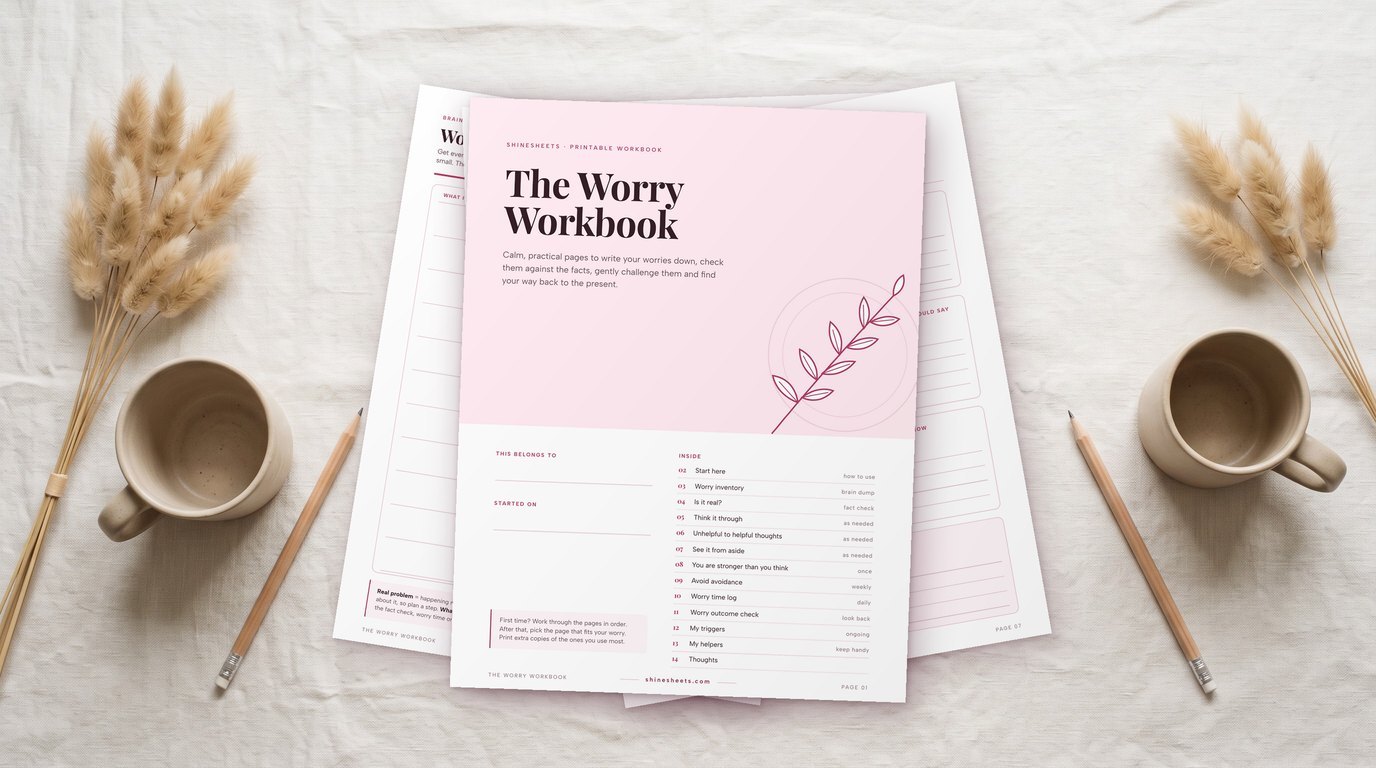
Overthinking at night rarely means something is wrong with you. It usually means your mind finally has room to talk. All day, your thoughts compete with emails, errands, conversations and noise. Then the lights go off, the house goes quiet, and every unfinished worry gets the microphone at once.
The good news is that a racing mind at bedtime responds well to small, boring, repeatable habits. You don't have to "think positive" or force your brain to go blank (which never works anyway). You just need a few ways to give your thoughts somewhere else to go, a body that feels safe enough to rest, and a plan for the nights when sleep still won't come.
This guide covers how to stop overthinking at night in three parts: what to do in the evening before bed, what to do once you're lying down and the spiral starts, and what to do if you've been awake for twenty minutes or more. You'll also find my 3 a.m. thought script, a quick table that matches each technique to the situation you're in, and the daytime habits that make nights quieter.
As someone prone to anxiety, I can tell you that nights were where mine used to live loudest. These are the gentle tools that helped me most, written so you can start with one tonight.
Why Overthinking Gets Louder at Night
It helps to understand what's going on, because the moment you see the pattern, it feels a little less personal. There are three main reasons your thoughts seem to turn up the volume after dark.
- Fewer distractions. During the day, your attention is constantly pulled outward. In a dark, quiet bedroom, there's nothing left to pull it, so it turns inward and starts scanning for problems.
- A tired brain. When you're exhausted, the part of your mind that keeps worries in perspective is running low on fuel. That's why a slightly awkward remark from lunch can feel like a disaster at midnight and like nothing at all by breakfast.
- Unfinished business. Your mind likes closure. Tasks you didn't finish, conversations you didn't have and decisions you postponed all wait in a queue, and bedtime is the first quiet moment they get to remind you they exist.
None of these mean you're bad at sleeping. They mean you need to give your thoughts a time and place that isn't your pillow. If overthinking follows you around during the day too, my guide on how to stop overthinking in three easy steps is a lovely companion to this one.
Before Bed: 6 Ways To Quiet Your Mind Earlier in the Evening
The most helpful work happens before you even get into bed. Think of these as clearing the queue, so there's less waiting for you when the lights go out.
1. Schedule a Worry Window

This sounds strange, but it's one of the most effective habits I know. Pick a 15-minute slot in the early evening (ideally at least two hours before bed) and give yourself full permission to worry during it. Sit down with a notebook and a timer, and let every concern come out.
When a worry pops up later, you can tell yourself, "That already had its time today," or "I'll save that for tomorrow's window." Your brain learns that worries have an appointment, so they stop showing up uninvited at 11 p.m. Give it at least a week before deciding if it works for you, because the first few days can feel a bit silly.
2. Do a Brain Dump
A brain dump is different from a worry window. It's not about the scary stuff, it's about everything: the dentist appointment, the gift you need to buy, the email you forgot, the vague feeling that you said something odd in a meeting. Write it all down in one messy list, no order, no editing.
Keep a simple cream notebook and a pen on your nightstand so this becomes automatic. Five minutes is usually enough. Seeing your thoughts on paper turns a fog of "so much to do" into a list that is, in most cases, shorter than it felt.
3. Write Tomorrow's Short List
After the brain dump, pick the three things that actually need to happen tomorrow and write them on a fresh line. Only three. Everything else can stay on the dump list for later.
This gives your mind the closure it's looking for. Instead of rehearsing tomorrow on a loop in the dark, it knows the plan exists somewhere safe. If you like planning, my guide on sleep hygiene habits pairs this with a full evening rhythm.
4. Dim the Lights an Hour Before Bed

Bright overhead light keeps your body in daytime mode, and a body in daytime mode is much easier for a busy mind to hijack. About an hour before bed, switch off the main lights and use lamps instead.
A warm, dimmable bedside lamp is one of the simplest upgrades for this. Look for a soft, warm-toned bulb and a dimmer you can reach from bed, so you don't have to get up and face bright light again once you're settled.
5. Put the Phone to Bed First
Your phone feels like a distraction from your thoughts, but it often feeds them: a news headline, a friend's perfect life, a work message you weren't meant to see until morning. Every one of those becomes new material for your mind to chew on.
Try charging your phone outside the bedroom, or at least across the room, 30 to 60 minutes before sleep. I wrote a whole guide on putting your phone down before bed if this is the hardest one for you (it was for me).
6. Build a Short Wind-Down Ritual
Your brain loves cues. If the same three or four small things happen in the same order every night, it starts relaxing as soon as the first one begins. Keep it short, around 20 minutes, so it's realistic on busy nights.
Mine is simple: a warm mug of evening tea, a few lines of journaling, skincare, lights low. A caffeine-free drink works beautifully here, and my list of bedtime drinks has plenty of calm ideas. The point isn't the specific steps. It's the repetition.
In Bed: 6 Things To Do When Your Thoughts Start Racing
Even with a lovely evening routine, some nights your mind will still start spinning as soon as your head hits the pillow. That's normal. Here's what to do in the moment, without getting up.
1. Name It
Overthinking feels like real problem-solving while it's happening. Naming it breaks the spell. Quietly say to yourself, "I'm overthinking right now," or even just "Thinking, thinking."
This tiny label creates a gap between you and the thoughts. You're no longer inside the story, you're watching it. It won't stop the thoughts on its own, but it makes every other technique on this list work better.
2. Try 4-7-8 Breathing
Breathe in quietly through your nose for a count of 4, hold for 7, then breathe out slowly through your mouth for 8. Repeat this for four rounds to start. The long exhale is the important part, because it gently signals your body that it's safe to slow down.
If holding for 7 feels uncomfortable, shorten every count (for example 3-5-6) and keep the exhale longer than the inhale. Never strain. You can find more options in my guide to breathing exercises for calm.
3. Or Use Box Breathing
Some people find 4-7-8 too long. Box breathing is steadier: in for 4, hold for 4, out for 4, hold for 4. Picture tracing the four sides of a square as you go.
I like this one when my thoughts feel jumpy rather than heavy, because counting evenly gives the mind something structured to hold on to. Do it for two to three minutes, then let your breath return to normal.
4. Play the Cognitive Shuffle
This one feels almost too simple, but it's my favorite for nights when breathing alone isn't enough. Pick a random, neutral word, like "garden." Take the first letter, G, and slowly picture as many unrelated things as you can that start with G: grapes, a guitar, a glove, a giraffe. Spend a few seconds imagining each one. When you run out, move on to the next letter, A.
The trick is that the images are random and calm, which is the opposite of the logical, connected chain of thoughts that overthinking runs on. Your mind gets busy without getting worried, and that's a lot like the drifting state you naturally pass through on the way to sleep.
5. Do a Slow Body Scan
Start at your toes and slowly move your attention up through your body: feet, ankles, calves, knees, and so on, all the way to your forehead. At each spot, notice what's there (warmth, tension, the weight of the blanket) and let that part soften a little as you breathe out.
Take about 10 minutes for a full scan, and don't worry if you get distracted. Just return to the last body part you remember. Many people find a cream weighted blanket makes this easier, because the gentle, even pressure gives your body something calm to feel. Choose one around 10% of your body weight, and skip it if you have breathing or circulation concerns.
6. Use the "Not Now" Script
When a specific worry keeps coming back, don't argue with it. Arguing just keeps it in the conversation. Instead, acknowledge it and postpone it with one short, kind sentence:
Try: "I hear you. This matters, and I'll think about it tomorrow at 6 p.m. Right now, I'm resting."
Then return to your breath or the shuffle. If the worry comes back ten times, repeat the sentence ten times, as calmly as the first. It's not a failure. It's practice, and it does get easier with repetition.
The 3 A.M. Thought Script

Thoughts at 3 a.m. are different. They're heavier, more dramatic and somehow very convincing. This is the script I come back to on those nights. Read it once in the evening, or screenshot it and keep it near your bed so you don't have to think of the words when you're groggy.
- Notice: "I'm awake, and my mind is busy. That happens to everyone sometimes."
- Remind: "Things always feel bigger in the middle of the night. This thought will look smaller in daylight."
- Sort: "Is there anything I can actually do about this right now, in bed, in the dark? No. So it can wait."
- Postpone: "I'll write it down and look at it tomorrow, when I'm rested and can actually help."
- Allow: "I don't have to fall asleep this second. Resting quietly is still good for me."
- Return: "Now back to my breath. In, and a long, slow out."
Step 5 is the one people skip, and it's the most important. Pressure to sleep is one of the fastest ways to stay awake. Giving yourself permission to just rest takes that pressure off, and sleep often sneaks in right after.
Can't Sleep After 20 Minutes? Do This

If you've been lying awake for what feels like about 20 minutes (no clock-checking, just a rough sense), staying in bed usually makes things worse. Your brain starts linking your bed with frustration. Here's the gentle reset sleep experts often recommend, in five steps:
- Get up calmly. No sighing, no "here we go again." Just get up as if it's the most normal thing in the world.
- Go somewhere with dim light. Another room or a chair in the corner, with one low lamp. Avoid overhead lights and your phone.
- Do something boring and calm. Fold laundry, read a slow book (nothing thrilling), do a simple puzzle or write in your notebook. The goal is mild, pleasant boredom.
- Wait for real sleepiness. Heavy eyelids, yawning, losing your place on the page. Don't go back just because you think you should.
- Return to bed and repeat if needed. If you're awake again after a while, get up again. It can feel like a lot at first, but over a week or two it teaches your body that bed is for sleeping, not thinking.
And please be gentle with yourself the next day. One rough night is uncomfortable, but you can get through it. Keep your normal wake-up time if you can, and keep any nap short.
Which Technique To Use When: A Quick Table
On a tired night, you don't want to read through a whole article to decide what to do. Use this table to match the situation to the tool.
| Situation | What helps most | How long |
|---|---|---|
| Your to-do list keeps replaying | Brain dump + tomorrow's short list | 5–10 minutes before bed |
| One big worry keeps returning | Worry window earlier + "not now" script in bed | 15 minutes in the evening, one sentence in bed |
| Your heart is racing or chest feels tight | 4-7-8 breathing or box breathing | 2–4 minutes |
| Thoughts are jumping everywhere | Cognitive shuffle | Until you drift off |
| Your body feels tense and restless | Slow body scan, weighted blanket | About 10 minutes |
| You wake up at 3 a.m. with a heavy thought | The 3 a.m. thought script | 1–2 minutes, then breathing |
| You've been awake about 20 minutes | Get up, dim light, boring calm activity | Until you feel truly sleepy |
Most nights, one or two tools are enough. Start with the row that feels most like you and add others only if you need them.
A Calm Bedroom Setup for Quieter Nights

Your environment can't fix overthinking on its own, but it can remove the small things that keep your mind alert. These are the pieces I'd choose if I were setting up a bedroom for a busy mind.
- Complete darkness. Even a little light from the street or a charger can keep you more alert. A soft blush silk sleep mask is an easy fix. Look for one with an adjustable strap that doesn't press on your eyes.
- Steady background sound. Silence can make every creak and every thought feel louder. A small white noise machine gives your mind a smooth, unchanging sound to rest on. Pick one with a few sound options and a volume you can keep low.
- A calming scent cue. Scent is a lovely signal that it's time to wind down. A light spritz of lavender pillow mist on your pillow before bed works well as part of your ritual. Spray it a few minutes before you lie down so it's soft, not strong, and skip it if fragrance bothers your skin or breathing.
- A cool room. A slightly cool bedroom tends to feel better for sleep than a warm one. Layer blankets so you can adjust without getting up.
- A clear nightstand. Keep only your lamp, notebook, pen and maybe a glass of water. Fewer objects means fewer reminders of things to do.
5 Daytime Habits That Make Nights Quieter
Quiet nights are often built during the day. These habits won't change everything overnight, but together they lower the pressure that builds up by bedtime.
1. Get Morning Daylight
Spend 10 to 15 minutes outside within an hour or two of waking, even on cloudy days. Morning light helps set your body clock, so you feel naturally sleepier at night instead of wired.
2. Watch Your Afternoon Caffeine
Coffee sometimes perks me up and sometimes makes me anxious, and a late cup almost always makes my nights busier. Try keeping caffeine to the morning, with a cutoff around early afternoon, and see how your evenings feel after a week.
3. Move Your Body
A daily walk, a gentle workout or a few minutes of stretching gives restless energy somewhere to go. Aim for something most days, and keep intense workouts away from the last couple of hours before bed.
4. Close Small Loops Early
Reply to that one message, make that two-minute phone call, put that thing back where it belongs. Small open loops are exactly what your mind likes to replay at night, and closing a few during the day means fewer of them follow you to bed.
5. Practice Calm When You're Already Calm
Breathing and grounding tools work best when they're familiar. Try a couple of minutes of slow breathing at lunch or during a short break, so your body already knows the routine at night. My guide on how to calm anxiety fast has grounding techniques that are easy to practice anywhere.
When To Talk to Someone
Everyone has restless nights, and the ideas in this guide can make a real difference. But some things are worth bringing to a doctor or a licensed therapist, and asking for help is a strong, sensible choice, not a last resort.
- You struggle to fall or stay asleep several nights a week for more than a few weeks.
- Lack of sleep is affecting your mood, focus, work or relationships.
- Your worries feel constant, hard to control or are there most of the day, not just at night.
- You notice panic attacks, a racing heart that doesn't settle, or feeling low for long stretches.
- You snore loudly, wake up gasping or feel exhausted even after a full night in bed.
Persistent insomnia and anxiety are both very treatable, and approaches like cognitive behavioral therapy for insomnia are designed for exactly this kind of night. If your thoughts ever turn to harming yourself, please reach out to a crisis line or emergency services right away. You deserve support.
Final Thoughts
Learning how to stop overthinking at night isn't about winning a fight with your mind. It's about giving your thoughts a better place to go, giving your body enough calm to rest and being kind to yourself on the nights that still feel long.
Start with one thing tonight. Maybe a five-minute brain dump, maybe dimming the lights an hour earlier, maybe the 3 a.m. script on your nightstand. Small, steady habits add up, and quieter nights are closer than they feel right now.