You don't need to know exactly what you want to start setting goals. That's the part most goal advice gets backwards. It asks for a clear five-year vision first and a plan second, when for a lot of us the honest answer to "What do you want?" is a quiet, slightly embarrassed "I'm not sure."
Not knowing isn't a failure. It's information. It usually means something has shifted, you're tired, or you've been following someone else's map for a while. And the way out isn't to force a big answer. It's to collect small clues, test them gently and let clarity build from real experience instead of guesswork.
This guide shows you how to set goals when you don't know what you want: why feeling unsure is so common, how to start with direction instead of a destination, six discovery exercises that surface your clues, and how to turn those clues into 30-day experiment goals you can keep, change or drop. There's also a table that connects what you noticed to a small experiment you can try this month.
No pressure, no perfect plan required. Just curiosity and a notebook.
Why Not Knowing What You Want Is So Common

If everyone around you seems to have a clear plan, it's easy to assume you're the only one drifting. You're not. Feeling unsure about what you want is one of the most common experiences in adult life, and it usually has a very understandable reason behind it.
Life Changes
A move, a breakup, a new city, a finished degree, a friendship that faded, a job that ended. When your circumstances change, the goals that fit your old life may not fit the new one. It's normal to need a while before new wants take shape. Think of it as the pause between chapters.
Burnout
When you're exhausted, wanting anything feels hard. Burnout flattens desire: everything seems like more effort, and nothing sparks much excitement. In that state, "I don't know what I want" often really means "I don't have the energy to want right now." Rest has to come before big goals here, and that's okay.
Living by Other People's Expectations
Many of us spent years choosing what made parents proud, what looked impressive or what seemed sensible. Those choices weren't wrong, but they can leave you a bit out of touch with your own preferences. When the outside voices quiet down, you may find you're not sure which wants are actually yours.
Too Many Options
Ironically, having lots of choices can make deciding harder. When you could learn anything, live anywhere and try any career, every option you pick seems to close a hundred doors. That pressure can freeze you, so you choose nothing and feel stuck. (This one is very common, and very fixable.)
Start With Direction, Not Destination

A destination is a specific outcome: "become a nurse," "run a marathon," "move to Portland." A direction is softer: "more creative," "more connected," "less rushed." When you don't know your destination yet, direction is enough to start walking. You can find the specific place along the way.
Three questions help you find your direction.
Your Values
Values are what matter most to you, the qualities you want your life to be built around: freedom, security, creativity, kindness, adventure, beauty, learning. They're more stable than goals, so they make a great compass when goals feel blurry. If you've never named yours, the core values list has 100 ideas and a simple way to narrow them to your top five.
How You Want To Feel
You may not know what you want to do, but you probably know how you want to feel: calmer, more alive, more confident, less lonely, more at home in your own life. Feelings are excellent clues. Write down three feelings you'd love to have more of this year. They'll guide your experiments later.
What Drains You
Sometimes the clearest signal is what you don't want. Notice what leaves you depleted, resentful or numb: certain tasks, environments, conversations, routines. You don't have to fix them all at once. Just knowing what drains you points you, by contrast, toward what might fill you up.
6 Discovery Exercises To Find Your Clues
These exercises are about gathering information, not making decisions. Try one a week, or do a couple over a quiet weekend. A guided self-discovery journal can give you a gentle structure, but any notebook works.
1. Do a One-Week Energy Audit

For seven days, notice how different parts of your day make you feel. Once or twice a day, write down what you did and give it a quick energy mark: plus (energized), minus (drained) or zero (neutral).
Keep it short: "Lunch walk with Mia: plus. Spreadsheet afternoon: minus. Reorganizing the bookshelf: plus." At the end of the week, look for patterns. Which pluses keep showing up? Do they involve people, solitude, making things, helping, learning, being outdoors? Those patterns are your first real clues.
2. Write a "More Of / Less Of" List
Draw a line down the middle of a page. On the left, write "More of." On the right, "Less of." Then fill each side with at least ten things, big or small, without judging them.
"More of: slow mornings, live music, cooking with friends, reading in the bath, quiet weekends." "Less of: late-night emails, group chats I mute anyway, rushing, saying yes out of guilt." It sounds simple, but this list often reveals what you want more clearly than any big question, because it's grounded in your actual life.
3. Pick Your Top 5 Core Values
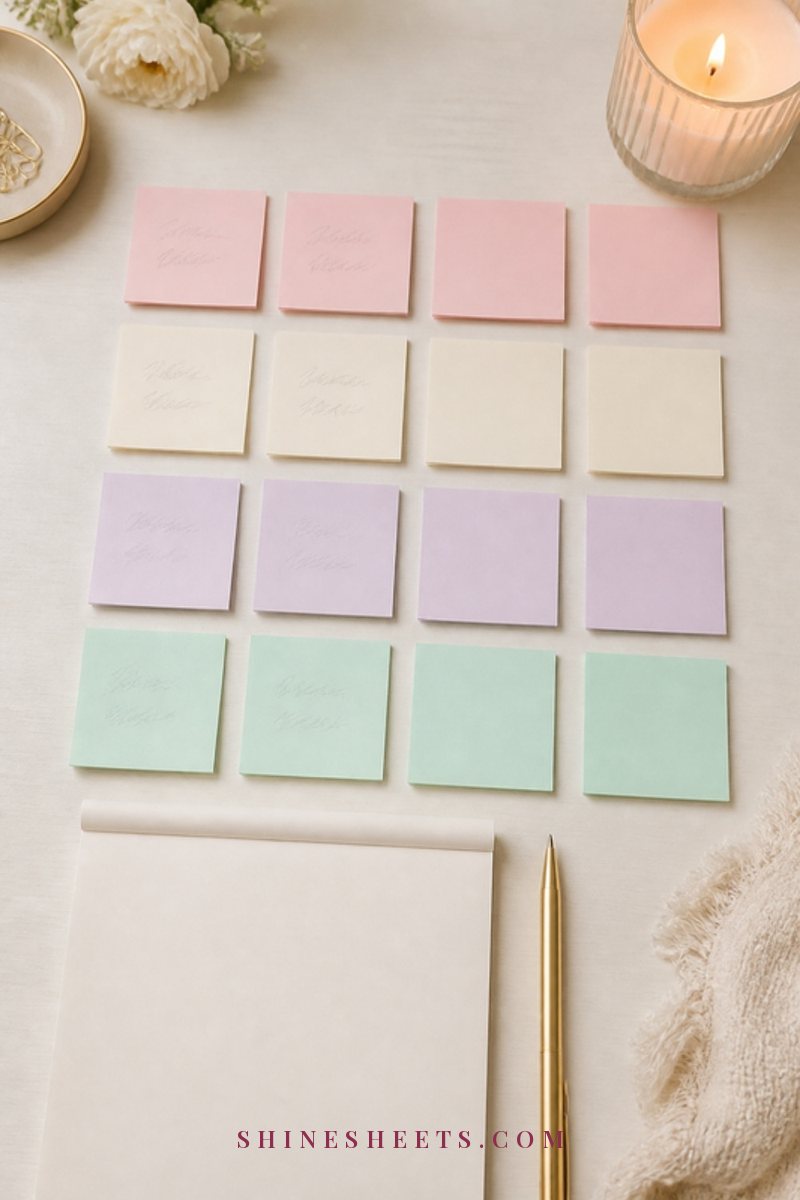
Write down every value that resonates with you, then narrow the list to five. A lovely way to do this: write each value on its own sticky note, spread them out and move them around until five feel most like you. Pastel sticky notes make it feel more like play than homework.
Once you have your five, ask of each: "Where is this value showing up in my life right now? Where is it missing?" A missing value is a strong hint about where to aim your first experiment.
4. Start a Curiosity List
Curiosity is quieter than passion, and much easier to find. For two weeks, write down anything that makes you pause and think, "Huh, that's interesting." An article you read to the end, a hobby someone mentioned, a place you looked up, a skill you watched someone use.
Don't evaluate the items. Just collect them. After two weeks, you'll often see themes. If you've been waiting to feel a big spark before trying anything, my guide on how to find your passion when nothing excites you explains why curiosity usually comes first and passion follows.
5. Describe Your Ideal Ordinary Day

Not your dream vacation. Your ideal ordinary Tuesday, a few years from now. Write it from morning to night in the present tense: where you wake up, what the light looks like, what you do in the morning, who you see, what kind of work fills your hours, how your evening feels.
Write freely for 15 minutes with a pen you enjoy (a gold-accent pen set makes this feel a little special). Then underline the details that made you smile. Those small details (more time outside, a quiet workspace, cooking for friends, working with your hands) are often more useful than any job title.
6. Try the Regret Test
Imagine yourself a few years from now, looking back at this time. Ask: "What would I regret not trying?" Not "what should I achieve," just what you'd be sad to have never explored.
Write down whatever comes up, even if it seems small or silly: "taking a pottery class," "living somewhere near the sea," "telling my friend how much she means to me," "finally learning Spanish." Regret points toward real desires, not borrowed ones, which is exactly what you're looking for.
Turn Your Clues Into 30-Day Experiment Goals

Here's where the pressure lifts. Instead of choosing a five-year plan, you choose a small experiment to try for 30 days. An experiment can't fail. It can only give you information: "I loved this," "this wasn't for me" or "interesting, but I want a different version."
An undated monthly planner is handy for this, because you can start your 30 days on any date and see the whole month at a glance.
How To Write an Experiment Goal
Use this simple formula:
"For the next 30 days, I'll try [small action] [how often], to find out [what I want to learn]."
- "For the next 30 days, I'll sketch for 10 minutes three evenings a week, to find out if I enjoy making things with my hands."
- "For the next 30 days, I'll take a 20-minute walk outside every lunch break, to find out if more time outdoors changes how I feel at work."
- "For the next 30 days, I'll invite one friend for tea each week, to find out if more connection is what's been missing."
Keep experiments small enough that you could do them on a tired day. One or two at a time is plenty. Once something clicks and you want a more defined goal, the SMART goals guide shows you how to make it specific and measurable.
Clues-to-Experiments Table
Use this table to connect what you noticed in the exercises to a small experiment. Screenshot it if it helps, and add your own rows in your notebook.
| Clue you noticed | What it may mean | 30-day experiment | How to review it |
|---|---|---|---|
| Time with people keeps showing up as a "plus" | Connection matters more than you've been allowing | One tea date or phone call with a friend every week | Did I look forward to them? Did I feel less alone? |
| Afternoons at your desk feel heavy | Your work setup or role may not fit you | A short walk outside every work day, plus notes on which tasks drain you most | Which tasks drained me most? Did movement help? |
| You keep reading about gardens or plants | Curiosity about nurturing and slow, hands-on things | Care for three houseplants or a balcony herb pot | Did I enjoy the daily care, or only the idea of it? |
| "Creativity" made your top 5 values, but it's missing | You may need a creative outlet | Ten minutes of drawing, writing or crafting, three times a week | Did I feel lighter afterward? Did I want more time? |
| Your ideal day was slow and quiet | Your current pace may be too rushed | One calm morning routine without your phone, five days a week | Did my days feel different? What did I miss? |
| The regret test said "learn a language" | A genuine wish to grow and explore | 15 minutes of practice four days a week | Am I curious to keep going, or relieved to stop? |
| "Less rushing" topped your "less of" list | You may need fewer commitments, not more goals | Say no to one optional plan a week | Did I feel more rested? Did anyone really mind? |
Review Your Experiment: Keep, Change or Drop

At the end of 30 days, set aside 20 minutes for a gentle review. I like doing this with a cup of evening tea and a candle, because it feels like a small ritual rather than a performance review. A cream linen notebook kept just for these reviews makes it easy to look back over several months and see your own story forming.
Ask yourself:
- How did this experiment make me feel, honestly?
- Did I look forward to it, or did I have to push myself every time?
- What surprised me?
- What did I learn about what I want, or don't want?
Then choose one of three paths:
- Keep: It felt good and you want more. Continue for another 30 days, or turn it into a bigger goal.
- Change: Something was right, but not quite. Adjust the size, the timing or the version ("sketching was nice, but I think I want to try pottery").
- Drop: It wasn't for you. That's a successful experiment too. You now know one more thing about yourself, and you can cross it off without guilt.
After three or four rounds, you'll usually notice a direction emerging. That's how clarity tends to arrive: not in one big moment, but in small, honest steps.
Other Gentle Ways To Set Goals
Thirty-day experiments aren't the only option. If you prefer a softer structure, these two approaches also work well when you're unsure.
Season Goals
Instead of a yearly plan, set one or two goals for a single season, about three months. "This season, I want to rest more and read on weekends." "This season, I want to explore two new hobbies." A season is long enough to make real progress and short enough that it never feels like a lifelong commitment. When the season changes, you choose again.
Feeling-Based Goals
Start with the feeling you wrote down earlier, then ask, "What would help me feel this way more often?" If you want to feel calmer, your goals might be an earlier bedtime, a weekly walk alone and fewer evening plans. If you want to feel more confident, you might take one small brave action each week. The feeling stays fixed, and the actions can change as you learn what works.
If you want to zoom out and think about the bigger picture once a few clues have appeared, how to make a vision for your life walks you through it gently, step by step.
When Comparison and Fear of Choosing Wrong Get Loud

Two things tend to get in the way, even after you've found some clues.
Comparison. Someone your age just bought a house, launched a business or moved abroad, and suddenly your small experiment feels silly. Remember that you're seeing their highlight, not their whole path. Many people who look certain went through exactly this kind of searching, often more than once. Your timeline is allowed to be yours. If social media makes it louder, mute a few accounts for the 30 days of your experiment.
Fear of choosing wrong. When every choice feels permanent, you freeze. But most choices are far more reversible than they feel. You can quit a class, change jobs again, move back, start over. Experiments are designed for exactly this fear: they let you try without committing. A helpful line to repeat: "I'm not choosing my whole life. I'm choosing my next small step."
It also helps to remember that "I don't know yet" is a perfectly respectable answer when people ask about your plans. You're allowed to be in the middle of figuring it out. My post on personal growth ideas for women who feel lost in life has more gentle ways to move forward during this kind of season, and the 30 days of self-discovery journal prompts are lovely to pair with your experiments.
When Feeling Lost Is More Than Uncertainty
Not knowing what you want is normal. But sometimes feeling lost overlaps with something heavier. If you notice that nothing has felt enjoyable for weeks, that you feel low most days, that you're sleeping much more or less than usual, or that getting through the day feels hard, please talk to a therapist or your doctor. Persistent low mood deserves real support, and it's not something you need to solve with a goal plan.
A coach can also be a helpful sounding board if you feel well overall but want someone to think things through with. There's no prize for figuring everything out alone.
Final Thoughts
You don't have to know where you're going to start moving. A direction, a few clues and one small experiment are more than enough for now.
Be patient with yourself while the picture fills in. Every experiment you keep, change or drop teaches you a little more about the woman you're becoming, and that's real progress, even when it doesn't look like a five-year plan.