Your core values are the quiet reason some choices feel right in your body and others leave you uneasy even when they look great on paper. Once you can name them, decisions get faster, guilt gets quieter, and you stop borrowing other people's priorities without noticing.
Most of us never sit down and actually name what matters to us. We absorb values from family, school, social media and whoever we spend the most time with, and then wonder why a life that looks good from the outside feels slightly off on the inside. It took me a while to understand that a lot of my stress came from living by values I'd never really chosen.
This guide gives you a core values list of exactly 100 personal values, grouped into seven families so they're easy to scan, plus a simple four-step exercise to find your top five, a worksheet table you can copy into your journal, a weekly check-in to actually live by them, and what to do when two of your values pull in opposite directions.
Make a cup of tea, grab a pen, and give yourself about 45 minutes. This is one of the most useful things you can do for yourself this year.
What Are Core Values?
Core values are the few principles that matter most to you in how you live, work and love. They're not goals (things you want to achieve) and they're not rules (things you should do). They're more like a compass: the qualities you want your life to be full of, no matter what you're doing.
A few things that help make the idea clearer:
- Values are ongoing. You never "finish" kindness or freedom the way you finish a project. You keep choosing it.
- Values are personal. There are no right or wrong ones. Security isn't better than adventure; honesty isn't better than harmony. They're just different.
- Values can shift with seasons of life. What mattered most a few years ago might sit lower on your list now, and that's normal.
- You probably already live by them. Look at what makes you angry, what makes you proud and what you protect without thinking. Your values are hiding there.
Values are also the foundation for bigger pieces of self-knowledge. If you've ever tried to write a personal mission statement and felt stuck, it's usually because the values underneath it weren't clear yet.
Why Knowing Your Values Makes Decisions Easier
When you don't know your values, every decision becomes a fresh negotiation: what will people think, what's the sensible option, what would someone else do? When you do know them, you have a simple filter.
Here's what clear values tend to change:
- Faster decisions. Instead of making endless pros and cons lists, you can ask: "Which option honors my top values?"
- Less guilt. If rest is one of your values, a slow Sunday isn't laziness; it's alignment.
- Easier boundaries. Saying no gets simpler when you know what you're saying yes to.
- Better relationships. You can see why certain people energize you (shared values) and why some conflicts keep repeating (clashing values).
- A calmer sense of self. Comparison loses some of its sting when you realize someone else's life is built on different values than yours.
If you're facing a big choice right now, my list of questions to ask yourself before a big decision pairs beautifully with the values exercise below.
The Core Values List: 100 Personal Values
Here are 100 personal values, grouped into seven families: connection, growth, freedom, security, creativity, integrity and wellbeing. The groups are just to make scanning easier; your top values will probably come from several of them. As you read, notice which words make you feel a little spark, a pull of recognition, or even a pang (sometimes we feel a pang for a value we've been neglecting).
Connection Values

- Belonging – feeling part of something and making room for others.
- Community – showing up for the people and places around you.
- Compassion – meeting suffering, including your own, with care.
- Empathy – trying to feel what someone else feels before judging.
- Family – nurturing the people you call home, by birth or by choice.
- Friendship – investing in deep, steady friendships.
- Generosity – giving time, attention and resources freely.
- Kindness – choosing the gentle response when you can.
- Love – letting love guide how you treat people.
- Loyalty – standing by people through good and hard seasons.
- Partnership – building things together rather than alone.
- Service – using your skills to help others.
- Teamwork – valuing shared effort over individual credit.
- Trust – being someone others can rely on, and extending trust wisely.
- Warmth – making people feel welcome and at ease.
Growth Values
- Achievement – setting meaningful goals and reaching them.
- Ambition – aiming high and wanting more for your life.
- Challenge – choosing things that stretch you.
- Courage – acting even when you feel afraid.
- Curiosity – asking questions and following your interest.
- Discipline – keeping promises to yourself.
- Excellence – caring about doing things really well.
- Learning – staying a student of life.
- Mastery – going deep on a skill over years.
- Patience – letting good things take the time they need.
- Perseverance – continuing when it gets hard or boring.
- Progress – valuing small steps forward over perfection.
- Resilience – bouncing back and learning from setbacks.
- Self-awareness – knowing your patterns, triggers and strengths.
- Wisdom – turning experience into good judgment.
Freedom Values
- Adventure – seeking new experiences and a bit of thrill.
- Autonomy – making your own choices about your life.
- Choice – keeping options open rather than feeling trapped.
- Exploration – discovering new places, ideas and people.
- Flexibility – adapting plans without losing yourself.
- Fun – making room for lightness and laughter.
- Independence – being able to stand on your own.
- Openness – being receptive to new perspectives.
- Play – doing things simply because they're enjoyable.
- Self-expression – showing who you are through words, style and choices.
- Simplicity – wanting less so you can enjoy more.
- Spontaneity – saying yes to unplanned, good things.
- Travel – seeing the world and how others live.
- Variety – mixing up routines and experiences.
Security Values
- Balance – giving different parts of life their fair share.
- Calm – protecting a steady, peaceful pace.
- Commitment – following through on what you've promised.
- Consistency – showing up in the same way over time.
- Financial stability – building a calm, steady relationship with money.
- Home – creating a place that feels safe and nourishing.
- Order – keeping your space and schedule organized.
- Planning – thinking ahead so life feels less chaotic.
- Preparedness – being ready for what might come.
- Reliability – being someone people can count on.
- Responsibility – owning your part in things.
- Safety – protecting your physical and emotional wellbeing.
- Stability – valuing roots over constant change.
- Structure – having routines that hold your days together.
Creativity Values

- Beauty – noticing and creating beautiful things.
- Craftsmanship – caring about the quality of what you make.
- Elegance – choosing grace and refinement in small details.
- Experimentation – trying things without knowing how they'll turn out.
- Humor – finding and sharing the funny side of life.
- Imagination – dreaming up what doesn't exist yet.
- Innovation – finding new and better ways to do things.
- Inspiration – seeking and sharing what lights people up.
- Originality – doing things your own way.
- Resourcefulness – making something good with what you have.
- Storytelling – making sense of life through stories.
- Style – expressing yourself through how things look and feel.
- Vision – seeing the bigger picture of what could be.
- Wonder – staying amazed by ordinary things.
Integrity Values
- Accountability – owning your mistakes without excuses.
- Authenticity – being the same person in every room.
- Dignity – treating yourself and others with deep respect.
- Equality – believing everyone deserves the same chances.
- Ethics – doing the right thing when no one is watching.
- Fairness – treating people evenly and justly.
- Forgiveness – letting go of grudges for your own peace.
- Honesty – telling the truth kindly.
- Humility – staying open to being wrong.
- Justice – standing up when something isn't right.
- Keeping promises – letting your word mean something.
- Respect – honoring people's boundaries and choices.
- Sincerity – meaning what you say.
- Transparency – being open about your intentions.
Wellbeing Values

- Contentment – feeling that what you have is enough.
- Gratitude – noticing the good, daily.
- Health – caring for your body and mind.
- Hope – believing better things are possible.
- Inner peace – protecting a quiet, settled mind.
- Joy – letting yourself feel delight fully.
- Nature – spending time outdoors and protecting the natural world.
- Optimism – looking for what could go right.
- Pleasure – enjoying good food, fabric, music and sunlight.
- Presence – being where you are, not three steps ahead.
- Rest – treating recovery as necessary, not earned.
- Self-compassion – speaking to yourself like a friend.
- Slowness – choosing a gentler pace on purpose.
- Vitality – feeling energized and alive in your body.
How To Find Your Top 5 Core Values
A list of 100 is a starting point, not an answer. This four-step exercise narrows it down to the five values that actually run your life. A cream linen journal and a gold pen make it feel a little more special, but any notebook works.
Step 1: Circle Everything That Resonates
Read through all 100 values quickly, without overthinking, and write down every one that feels true or important to you. Aim for 15–25. Trust your first reaction. If you're unsure, ask: "Would I feel a loss if this were missing from my life?" If yes, include it.
Step 2: Group the Similar Ones
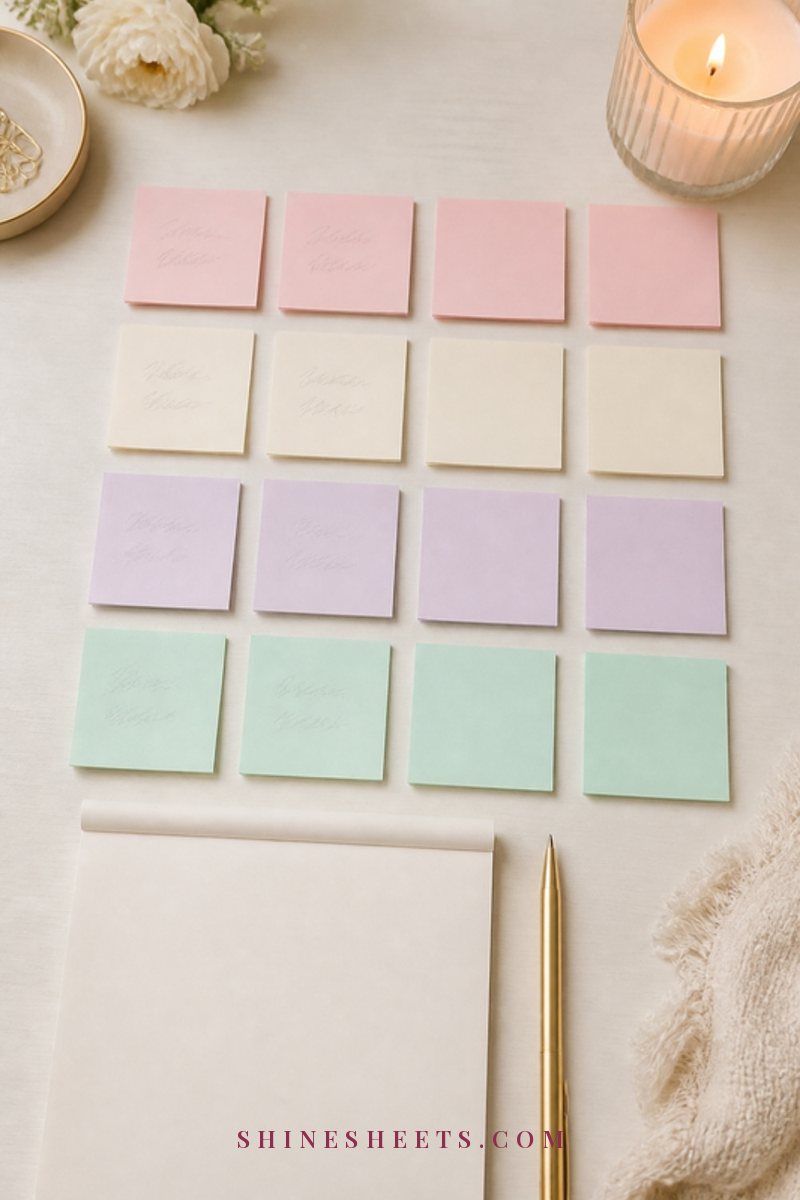
Look at your list and cluster values that feel related. For example, calm, inner peace and slowness might sit together, or honesty, authenticity and sincerity. Pastel sticky notes are perfect here: one value per note, then move them around on a table until the groups make sense. Aim for five to seven clusters.
Step 3: Rank and Name Your Top Five
Pick one word from each cluster that captures the whole group best (or write your own word that says it better). Then rank them. If you have more than five, compare them in pairs: "If I could only have one of these for the next year, which would I choose?" The one you'd protect wins.
Step 4: Test Them With Real Decisions
This is the step most people skip, and it's the most important. Think of three decisions from the last few months: one you're proud of, one you regret, and one you're still unsure about. For each, ask which of your five values it honored and which it ignored. Your real values show up in the decisions that felt right. If a value never appears, it might be one you admire rather than one you live by, and that's useful information too.
If you'd like more prompts to go deeper, my self-reflection questions work wonderfully alongside this exercise.
Your Core Values Worksheet
Copy this table into your journal or screenshot it. The first row shows an example; fill in the rest with your own top five. Rate each value from 1 (barely living it) to 5 (living it fully) right now.
| My value | What it means to me | Where I live it now | Where I'm not living it | One small action this week | Score (1–5) |
|---|---|---|---|---|---|
| Example: Rest | Recovery without guilt | Slow Sunday mornings | Weeknights packed with plans | Keep Wednesday evening free | 2 |
| Value 1 | … | … | … | … | … |
| Value 2 | … | … | … | … | … |
| Value 3 | … | … | … | … | … |
| Value 4 | … | … | … | … | … |
| Value 5 | … | … | … | … | … |
A low score isn't a failure. It's a signpost. Usually one or two values are "starving" while others get plenty, and that imbalance often explains a vague sense of restlessness.
When you're done, write your five values somewhere you'll see them often: the first page of your journal, a card tucked into your cream planner, or a sticky note on your mirror's frame.
How To Live Your Values Every Week

Knowing your values is lovely. Living them is where things change. A short weekly check-in keeps them from becoming a nice list you forget by February.
Once a week (Sunday evening works well for many people), light a glass jar candle, open your journal and spend 10 minutes on these four questions:
- Which of my values did I live well this week? Where exactly?
- Which value got pushed aside, and why?
- Is there anything on next week's calendar that clashes with my values?
- What is one small action that would honor my lowest-scoring value?
Keep the action tiny: a phone call for connection, a free evening for rest, a 20-minute sketch for creativity, a transfer to savings for financial stability. Small, repeated actions are what turn values into a way of life.
If this kind of reflection appeals to you, building self-awareness as a daily habit will make your values feel clearer every month.
When Your Values Conflict
Sooner or later, two of your values will pull in different directions. Adventure wants you to take the trip; financial stability wants you to save. Family wants you at Sunday lunch; rest wants you on the couch. This doesn't mean you chose the wrong values. It means you're human.
A few ways to work through it:
- Look for a both/and. Often there's a version that honors both: a smaller, cheaper trip; a shorter family visit followed by a slow evening.
- Check your ranking. In a true tie, your top-ranked value usually wins, but notice how you feel afterward. Sometimes the conflict shows your ranking needs updating.
- Think in seasons. One value can lead for a few months while another waits its turn. Security might lead while you build savings; freedom might lead next year.
- Ask what you'd regret. Imagine looking back in a year. Which choice would you be more at peace with?
- Notice whose value it is. Sometimes the conflict isn't between two of your values, but between your value and someone else's expectation.
Values are also a beautiful foundation for something bigger. When your five feel steady, try using them to create a vision for your life that actually feels like yours.
Common Mistakes When Choosing Your Values
A few gentle warnings, because these trip up almost everyone the first time:
- Choosing the values you think you should have. If "ambition" is on your list because it sounds impressive, but you light up around rest and beauty, trust the second feeling.
- Picking too many. Twelve top values are the same as none. Five (or even three) gives you a real filter.
- Copying someone else's list. A partner, parent or best friend can share some values with you, but your ranking will almost always differ, and that's healthy.
- Treating them as rules to punish yourself with. Values are a direction, not a pass-or-fail test. A week that drifts from them simply shows you where to steer next.
- Never revisiting them. Check your list every three to six months, or after big life changes like a move, a new job or the end of a relationship.
Final Thoughts
Your core values aren't something you need to invent; they're already there, shaping what makes you proud, restless, calm and alive. This list and exercise simply help you see them clearly enough to choose them on purpose.
Come back to your five every few months, let them evolve with you, and remember that living by your values is a gentle practice, not a test. Every small choice that honors what matters to you is a quiet act of self-respect.