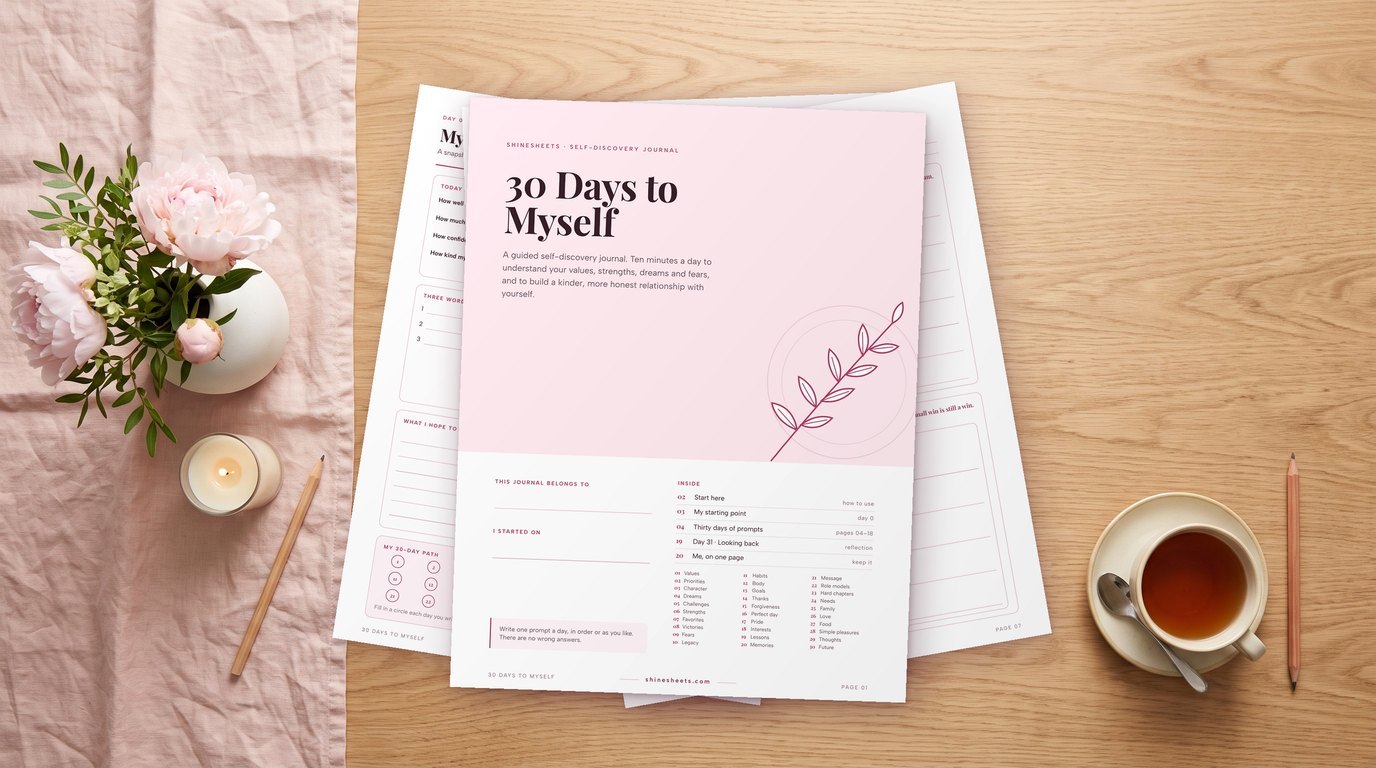
Your worth doesn't disappear on a bad day. It just gets harder to see, because the inner critic talks loudly and the good evidence sits quietly in the background. Writing is one of the gentlest ways to turn the volume back up on that evidence, one honest page at a time.
A journal can't argue you into feeling valuable. What it can do is slow your thoughts down enough to notice what's true: the hard things you've handled, the kindness you give without thinking, the strengths you've stopped counting because they feel ordinary.
These self-worth journal prompts are made for exactly that. You'll find 40 gentle questions in five groups, a simple way to use them, a table to help you pick the right group for your mood, a closing ritual for writing a letter of worth, and what to do if a prompt touches something tender. If you're in a really hard season, my journal prompts for healing might suit you better right now. This list is only about remembering your value.
Why Writing Helps You Remember Your Worth

Low self-worth has a sneaky habit: it edits your memory. You remember the awkward thing you said at dinner in vivid detail but forget the friend who texted to say how much your advice helped. Writing works against that editing in two quiet ways.
- It slows the inner critic down. Thoughts in your head can loop at full speed. On paper, they have to wait for your pen, and that small delay gives you room to ask, "Is this actually true?"
- It gathers evidence you'd otherwise forget. Every page becomes a small record of your kindness, courage and growth. On a low day, you can open the notebook and read proof instead of relying on a mood.
There's one more quiet benefit. When you answer a question about your value in your own handwriting, you're practicing a new habit of attention. Instead of scanning the day for what went wrong, you start scanning it for what you handled, what you gave and what you're learning. After a few weeks, many people notice they catch those moments in real time, not only on the page. That shift doesn't fix everything, but it makes ordinary days feel a little kinder.
It also helps to know where these feelings come from. If you'd like the bigger picture first, my guide to self-worth vs self-esteem explains why your sense of value can feel shaky even when life is going well. And if you're still at the very beginning, how to start feeling your self-worth is a gentle first step.
How To Use These Self-Worth Journal Prompts

There's no wrong way to do this, but a little structure makes it much easier to keep going. Here's the simple rhythm I'd suggest:
- One prompt a day. Pick one question, not five. A single thoughtful answer does more than a rushed page of many.
- Ten minutes, no more. Set a gentle timer. If you're still writing when it ends, you can continue, but you never have to.
- No right answers. Bullet points, half sentences and "I don't know yet" all count. You're not writing for anyone else.
- Write the date at the top. It turns your notebook into a timeline you can look back on.
- Re-read old pages on low days. This is the secret step. Your past answers are the evidence your low mood can't see.
Any notebook works. If you like a little extra guidance, a guided self-love journal in a cream cover gives you structure on the days your mind feels blank. If you prefer open pages, I'd choose a cream hardcover notebook that lies flat and feels sturdy enough to keep for years. Pair it with a smooth gold-accent ballpoint pen, because a pen you love makes the ten minutes feel like a small treat rather than homework.
If you like a plan, try a gentle five-week rhythm: one group per week, eight prompts over seven days, with the spare prompt saved for the weekend when you have more time. On the last day of the fifth week, write your letter of worth (more on that below). If a week gets busy, simply pause and pick up where you left off. The rhythm is there to support you, not to grade you.
For me, the best time is right after evening tea, when the house is quiet and I'm not trying to impress anyone, least of all myself.
Which Prompt Group To Choose
Not sure where to start? Use this table to match the prompts to your mood and your day. Screenshot it and keep it tucked in your notebook.
| Prompt Group | Focus | Best Time To Use It | Example First Line |
|---|---|---|---|
| Who I Am Beyond My Achievements | Your identity apart from productivity and roles | After a busy or unproductive day, or when you feel defined by work | "If nobody asked what I do, I'd say I'm someone who..." |
| What I've Survived and Learned | Resilience, growth and lessons from hard seasons | On a calm weekend morning when you have energy to reflect | "One season I rarely give myself credit for is..." |
| How I Want To Be Treated | Respect, boundaries and the standards you hold | Before a difficult conversation or after feeling dismissed | "I feel most respected when someone..." |
| The Kindness I Give and Deserve | Self-compassion and the care you offer others | On tired, overwhelmed or self-critical evenings | "A kindness I give others but rarely give myself is..." |
| My Strengths and Quiet Wins | Everyday strengths and small successes | At the end of the week, or before something new and scary | "This week I handled ___ better than I expected." |
40 Self-Worth Journal Prompts
The prompts are numbered so you can keep track of where you are. Work through them in order, or open to whichever group your table pick points to. Eight prompts per group, five groups, forty gentle questions in all.
Who I Am Beyond My Achievements

Start here when your sense of value feels tied to your to-do list. These prompts gently pull your attention toward the person underneath the productivity.
- 1. If nobody ever asked me what I do for a living, how would I describe myself?
- 2. What are three things people love about me that have nothing to do with being useful?
- 3. What makes me laugh, and what does that say about who I am?
- 4. Which small moments in an ordinary week feel most like "me"?
- 5. What would I still enjoy doing even if I were never good at it?
- 6. When do I feel most at ease in my own company?
- 7. What values do I want to be remembered for, more than any accomplishment?
- 8. If I described myself the way a kind friend would, what would I write?
What I've Survived and Learned

These prompts help you gather the evidence your inner critic conveniently forgets. Go slowly here, and skip anything that feels too raw for today.
- 9. What is one hard season I made it through that I rarely give myself credit for?
- 10. What did I learn about myself during that time that I still carry with me?
- 11. Which mistake taught me something I'm now grateful to know?
- 12. When did I keep going even though I was scared or tired?
- 13. What is something I once believed about myself that I've outgrown?
- 14. Who or what helped me through a difficult time, and what does it mean that I let them?
- 15. What would I tell my younger self about the thing she was most worried about?
- 16. How am I gentler, wiser or braver today than I was a few years ago?
How I Want To Be Treated

Knowing how you want to be treated is a quiet form of self-worth. These prompts are about your own standards, not about judging anyone else.
- 17. How do I feel after spending time with people who truly respect me?
- 18. What does kindness look like in my closest relationships, in small everyday actions?
- 19. Which boundary would make my life feel calmer if I held it more often?
- 20. What is one thing I keep accepting that I'd like to stop accepting?
- 21. How would I speak to myself if I treated myself the way I want others to treat me?
- 22. What do I need more of from the people around me, and how could I ask for it kindly?
- 23. When was a time I stood up for myself, and how did it feel afterward?
- 24. What does a relationship that feels safe and warm look like to me?
The Kindness I Give and Deserve

Most of us are generous with others and stingy with ourselves. These prompts invite you to notice both sides of that kindness.
- 25. What is a kind thing I did recently that nobody noticed?
- 26. Who have I supported this year, and what did that support look like?
- 27. Which kindness do I give others easily but rarely give myself?
- 28. What would it look like to offer myself the same patience I offer a friend this week?
- 29. How do I want to care for my body today, out of respect rather than criticism?
- 30. What is one gentle thing I can do for myself tomorrow morning?
- 31. When someone thanks me, what do I usually say, and what would I like to say instead?
- 32. What does "I deserve rest" mean to me, and where in my week could it fit?
My Strengths and Quiet Wins

Strengths aren't only the big, visible ones. These prompts help you catch the small, steady wins that make up most of a good life.
- 33. What is one strength I have that I tend to downplay?
- 34. What did I handle well this week, even if it seemed small?
- 35. Which skill have I quietly improved without celebrating it?
- 36. What do people often come to me for, and why do I think that is?
- 37. What is a decision I made that I'm proud of, regardless of how it turned out?
- 38. Which everyday task do I do with real care?
- 39. What compliment have I received that I secretly hoped was true, and what if it is?
- 40. If I listed ten quiet wins from this month, what would be on the list?
3 Ways To Go Deeper With Any Prompt
Some days your first answer will be short, polite and a little guarded. That's normal. Your mind tends to offer the safe answer first. When you have a few extra minutes, these small techniques help you get past it:
- Ask "and what else?" three times. After your first answer, write "And what else?" and keep going. The third answer is often the most honest one, because by then you've run out of the things you think you're supposed to say.
- Answer as your kindest friend. If a prompt feels impossible ("What do people love about me?"), imagine a friend who adores you sitting across the table. Write what she would say, in her voice. It's surprisingly easy to see your value through someone else's eyes.
- Add one concrete example. "I'm a good listener" is a start. "I'm a good listener, like the evening a friend called upset and I stayed on the phone for an hour" is evidence. Specific memories stick, and they're much harder for the inner critic to argue with.
You don't need to use all three every time. Pick one when a prompt feels flat, and let the others wait for another day.
A Closing Ritual: Write a Letter of Worth

Once you've worked through a group, or all forty prompts, try this small ritual. It gathers everything you've written into one page you can keep.
- Re-read your answers. Take 10 minutes and underline any line that surprised you or felt true.
- Start the letter with "Dear me." Write as if you're a wise, loving friend who has read every page.
- Include three things. One thing you've survived, one strength you'll stop downplaying and one way you deserve to be treated.
- End with a promise, not a goal. Something like "I'll remember that I matter on the days I forget." Keep it gentle and doable.
- Keep it somewhere you'll find it. Fold it into the back of your notebook or tuck it in a drawer, and read it whenever your inner critic gets loud.
The letter doesn't need to be long or beautifully written. Half a page is plenty. What matters is that it's in your handwriting and your words, so on a hard day it sounds like you, not like a poster on a wall.
If a Prompt Stirs Up Pain
Some of these questions might touch something tender, especially the ones about hard seasons or how you've been treated. That's not a sign you're doing it wrong. It just means you've reached a part of your story that needs extra care.
- Pause. Put the pen down. You don't have to finish the sentence.
- Breathe. Try four slow breaths in through your nose and a little longer out through your mouth. Feel your feet on the floor.
- Skip it. Draw a small star next to the prompt and move on. You can return to it next month, or never.
- Close gently. End the session with one easy line, like "One thing that felt okay today was..." so you don't leave the notebook on a heavy note.
I'm prone to anxiety, and I've learned that a prompt doesn't get extra points for hurting. If one sends my thoughts spinning, I skip it without guilt. Self-worth journaling should leave you a little steadier, not more shaken.
If writing brings up feelings that stay heavy for days, keep returning or make everyday life harder, please talk to a therapist or your doctor. A therapist can walk through those memories with you safely, and that's something no journal can replace.
Little Comforts That Make the Practice Feel Gentle
You only need paper and a pen. Still, a few small comforts can turn ten minutes of writing into a moment you look forward to:
- A warm cup. A lavender herbal tea sampler lets you try a few calming blends, and the act of making tea becomes your signal that it's writing time.
- A soft place to sit. The same corner every time helps your brain settle. Add a blush linen throw pillow cover to your chair or sofa so the spot feels like yours.
- A little candlelight. A candle in a cream glass jar, placed safely away from your pages, makes the evening feel slower. Blow it out when you close the notebook.
- A notebook only for this. Keeping your worth pages separate from to-do lists keeps them feeling special. My guide on how to build a self-love journal has ideas for setting one up.
If you finish all forty and want to keep going, my list of journaling ideas for when you don't know where to start has plenty more to write about. And on the days when you feel like you're falling short no matter what, these things to do if you're feeling not good enough pair well with a page or two.
Final Thoughts
You don't need to finish all forty prompts to feel the difference. One honest answer, written slowly, can remind you of something your mind has been too busy to notice.
Keep your pages, keep your letter and come back to them whenever the critic gets loud. Your worth was there before the first prompt, and it will be there long after the last one.