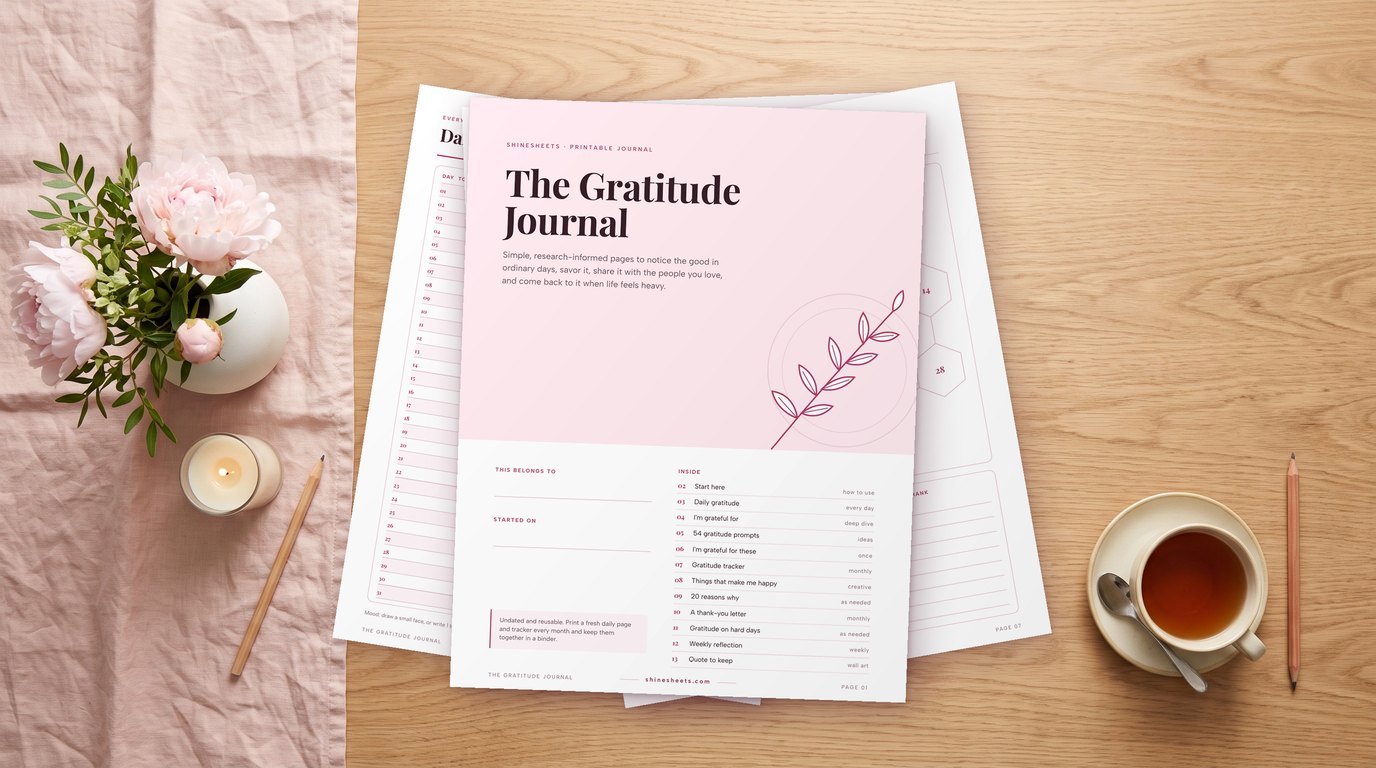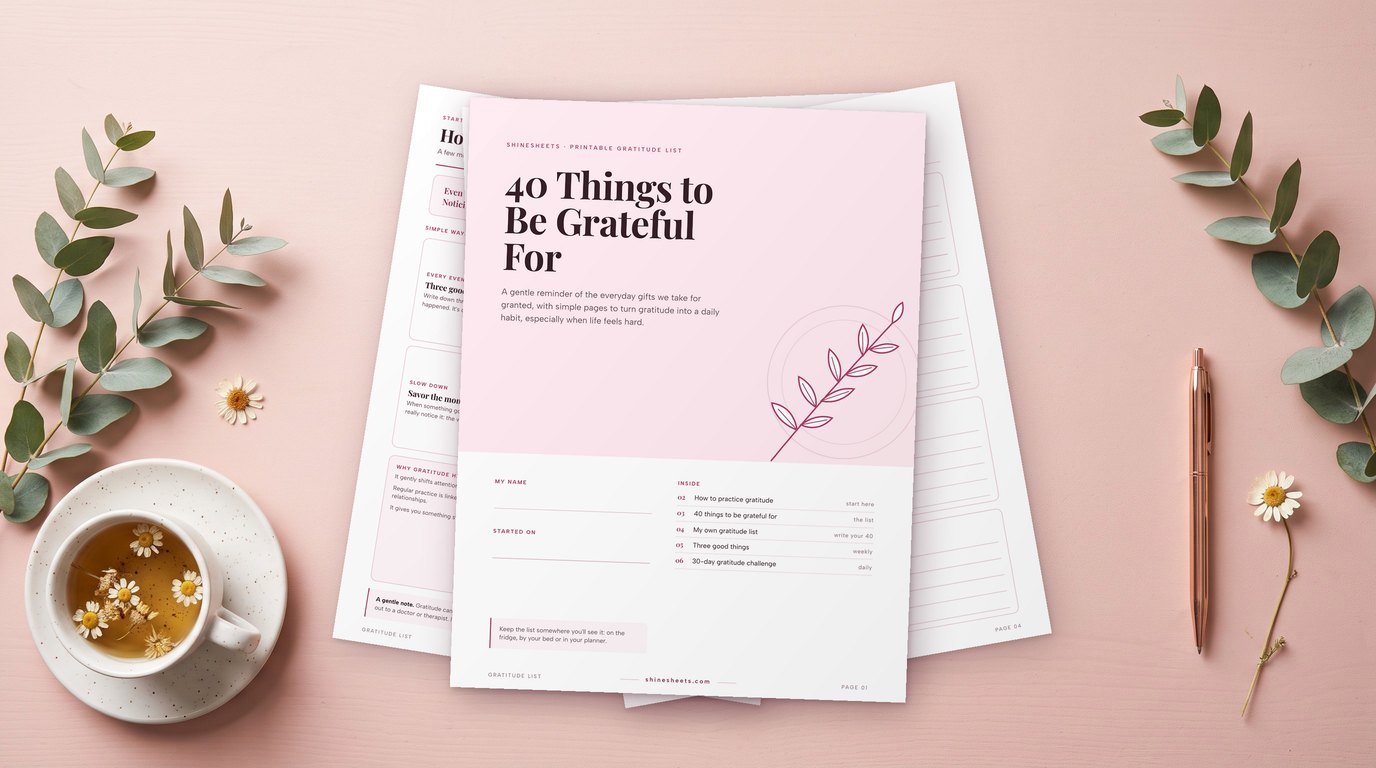
Gratitude journaling isn't about pretending everything is fine. It's about noticing what is actually good, even on ordinary or difficult days, so those small moments don't slip past unseen. The warm coffee, the friend who texted back, the ten quiet minutes before everyone else woke up. They were always there; writing them down just helps you see them.
That's also why prompts help so much. "What am I grateful for?" can feel huge and a little blank at the end of a long day, and you end up writing "my family, my home, my health" on repeat until it means nothing. A specific question gives your mind somewhere real to go.
In this guide you'll find 50 gratitude journal prompts, grouped into five themes: everyday moments, people, your body and self, hard days, and home and nature. You'll also learn how to start in just three minutes, how to use prompts on bad days without forcing positivity, a 7-day starter plan and a simple weekly review to help the habit stick. Journaling after my evening tea is one of my favorite parts of the day, and gratitude prompts are often where I begin.
Why Gratitude Journaling Helps

Our brains are naturally wired to notice problems. It's a protective habit: spotting what's wrong kept our ancestors safe. The downside is that good moments often pass by without leaving much of a trace, while a single awkward remark can replay for days.
Gratitude journaling gently balances that out. When you regularly write down specific good things, you start noticing them in the moment too. Many people find it helps them:
- Feel a little calmer and more grounded at the end of the day.
- Notice small joys they'd usually overlook.
- Feel more connected to the people around them.
- Keep a sense of perspective during stressful periods.
- Wind down before bed instead of replaying worries.
Writing by hand also slows you down. You can't rush through a sentence the way you might rush through a thought, so the moment gets a little more space to land. Even a few lines can shift how the evening feels.
It's not a cure for anything, and it won't make hard things disappear. It's simply a small, kind practice of paying attention.
Gratitude Without Toxic Positivity
There's a big difference between gratitude and forced positivity. Toxic positivity says, "Don't be sad, just be grateful," as if one feeling cancels out another. Real gratitude makes room for both: you can be exhausted and grateful, heartbroken and thankful for a friend, worried and appreciative of a quiet moment.
A few gentle rules for keeping it honest:
- You never have to be grateful for something painful itself.
- You can write about what's hard first, then look for one small good thing.
- "I'm grateful this day is over" is a completely valid entry.
- If gratitude feels impossible today, skip it. That's allowed.
If you've ever felt pressured to look on the bright side when you weren't ready, my guide to toxic positivity explains why that feels so heavy and what real support looks like instead.
How To Start a Gratitude Journal

Keep it small. A habit you can do in three minutes is a habit you'll actually keep. Here's the simplest way to begin:
- Choose a notebook you like. A linen gratitude journal or any plain notebook works. Keep it somewhere you'll see it, like your nightstand or next to the kettle.
- Pick a pen you enjoy writing with. It sounds small, but a gold pen set that feels nice in your hand makes the habit more inviting.
- Write 3 lines. Answer one prompt in about three sentences, or list three specific things.
- Spend 3 minutes. Set a soft limit so it never feels like a chore.
- Do it at the same time each day. Right after morning coffee, during your lunch break or after evening tea are all lovely options.
Be specific. "My friend" is fine, but "the voice note my friend sent me on my lunch break that made me laugh out loud" is much more powerful. Details are what make gratitude feel real. For more ways to fill your pages beyond gratitude, my guide to journaling ideas is full of gentle inspiration.
50 Gratitude Journal Prompts
Here are 50 prompts in five groups of ten. Pick one a day, start with whichever group fits your mood, or go through them in order. There's no wrong way to use them.
10 Prompts for Everyday Moments

These are the easiest place to begin. They train your eye to catch small, ordinary good things, the kind that are easy to miss when you're busy. Try to answer with one concrete detail each time.
- What was the best part of my morning today?
- What is one small thing that went right today?
- What did I eat or drink today that I really enjoyed?
- What made me smile or laugh today?
- What was a moment today when I felt calm?
- What is something I usually take for granted that made my day easier?
- What sound, smell or texture did I enjoy today?
- What is one thing I'm looking forward to tomorrow?
- What is a small comfort I had today that I'd miss if it were gone?
- What surprised me in a good way this week?
10 Prompts About the People in Your Life

Gratitude for people is often where the warmest entries come from. Be specific about what someone did or said, and notice how it made you feel.
- Who made my day a little better today, and how?
- Who is someone I can always count on, and what do they do that I appreciate?
- What is a kind thing someone did for me recently?
- Who taught me something important, and what was it?
- Which friend do I feel most like myself around, and why?
- What is a favorite memory with someone I love?
- Who is someone I've lost touch with that I'm still grateful for?
- What is something a stranger did that I still remember?
- Who believes in me, and how do they show it?
- Who could I thank this week, and what would I say?
If you share your life with a partner, these prompts can become a lovely shared ritual. My guide to gratitude practice for couples has simple ways to do that together.
10 Prompts for Your Body and Yourself

This group can feel a little awkward at first, especially if you're used to being hard on yourself. Go slowly, and remember that appreciating yourself isn't vanity. It's simply fair.
- What is one thing my body did for me today?
- Which of my senses am I most grateful for today, and why?
- What is a part of my personality I appreciate?
- What is something I handled better than I would have a year ago?
- What is a skill I have that I'm proud of?
- When did I take care of myself well this week?
- What is a challenge I've already survived?
- What is one thing I like about the way I treat other people?
- What do I enjoy doing that makes me feel most like myself?
- What would I thank my younger self for?
10 Prompts for Hard Days

Use these only when you feel ready. They aren't meant to fix a hard day, just to help you find one small steady thing inside it.
- What is one thing that helped, even a tiny bit, today?
- Who or what was a small comfort when things felt heavy?
- What is something I managed to do today, even if it was small?
- What is one thing that's still steady in my life right now?
- What did I learn about what I need from this hard day?
- What would make tomorrow a little easier, and can I do it?
- What is a strength that got me through a difficult time before?
- What small pleasure can I give myself tonight?
- Who could I reach out to, and what would I like from them?
- What am I grateful is over, or will soon be over?
10 Prompts About Home and Nature

Your surroundings shape your mood more than you might think. These prompts help you notice the comfort of home and the quiet beauty outside, whatever the season.
- What is my favorite spot in my home, and why?
- What is one thing in my home that makes daily life easier?
- What did I notice about the weather or the sky today?
- What is a season I love, and what do I love about it?
- What is a plant, tree or flower I enjoy seeing?
- What is a cozy ritual I have at home?
- Where is a place in nature that makes me feel peaceful?
- What is something about my neighborhood I appreciate?
- What did I see on a walk recently that I'd like to remember?
- What is something in my home that holds a happy memory?
A small bud vase on your desk with a single flower is a lovely, low-effort reminder of this group of prompts.
How To Use Gratitude Prompts on Bad Days
On really hard days, a cheerful prompt can feel almost insulting. That doesn't mean gratitude journaling isn't for you; it just means you need a softer approach.
- Write the hard part first. Get it out on paper in a few lines. Then, only if you want to, answer one prompt from the hard days group.
- Go tiny. "My bed." "Warm socks." "The tea was hot." Tiny counts.
- Thank yourself. "I'm grateful I got through today" is honest and enough.
- Skip without guilt. Missing a day, or a week, doesn't undo anything. You can pick it back up whenever you're ready.
If you're going through a particularly difficult season, my guide on how to feel grateful when life gets hard goes deeper into finding small anchors without dismissing real pain. And if low feelings are lasting, a therapist or doctor can be a wonderful support alongside journaling.
Morning or Evening: When To Write
Both work beautifully; they just do slightly different things.
- Morning gratitude sets the tone for the day. It tends to be more forward-looking: what you're grateful for in your life in general, what you're looking forward to, who you'd like to appreciate today. Pair it with your first coffee or tea and keep it to two minutes.
- Evening gratitude looks back at the day that just happened, so it's easier to be specific. It's also a gentle way to wind down and shift your mind away from worries before sleep. This is when I write, after my evening tea, and it's become a signal to my body that the day is done.
If you're not sure, try evenings first. Specific memories from the same day are the easiest place to start, and there's something soothing about ending the day on a small good note.
Ways To Format Your Entries
A gratitude journal doesn't have to look the same every day. Changing the format keeps it fresh and helps you notice different kinds of good things. Here are six simple formats to rotate through:
- Three good things. List three specific things from today, each with one detail.
- One deep entry. Pick one prompt and write five or six sentences about it, including how it made you feel.
- A thank-you letter you don't send. Write a short note to someone you're grateful for. You can send it later if you'd like, or keep it just for you.
- Senses list. One thing you saw, heard, smelled, tasted and touched today that you enjoyed.
- Before and after. Something you once wished for that you have now.
- One word. On very tired nights, just one word for the best moment of the day. It still counts.
Common Gratitude Journaling Mistakes
None of these are serious, but avoiding them makes the practice feel much more alive:
- Being too general. "My home" again and again stops meaning much. Add what, when and why.
- Treating it as a test. There are no right answers and no grades. Messy, short entries are perfect.
- Comparing gratitude. "Other people have it worse, so I should be grateful" usually adds guilt rather than appreciation.
- Making it too long. If it takes 20 minutes, you'll start avoiding it. Three minutes is plenty.
7-Day Gratitude Starter Plan
If you're new to gratitude journaling, this one-week plan gives you a gentle structure. Each day has one prompt and a suggested time. Screenshot it and keep it next to your journal.
| Day | Prompt | Time |
|---|---|---|
| Day 1 | What was the best part of my morning today? | 3 minutes after lunch |
| Day 2 | Who made my day a little better today, and how? | 3 minutes after evening tea |
| Day 3 | What is one thing my body did for me today? | 3 minutes before bed |
| Day 4 | What is my favorite spot in my home, and why? | 3 minutes with morning coffee |
| Day 5 | What is one small thing that went right today? | 3 minutes after evening tea |
| Day 6 | What is a favorite memory with someone I love? | 5 minutes on a slow morning |
| Day 7 | Looking back at this week, which entry made me smile most? | 10 minutes on Sunday evening |
After seven days, notice which time of day felt most natural and keep that one. Then keep going with any prompts from the list above.
A Weekly Gratitude Review

Once a week, take 10 minutes to read back through your entries. It's a lovely way to end the week, especially on a Sunday evening with a candle lit and a warm drink in a cream mug.
Ask yourself:
- Which moment from this week do I want to remember?
- Did any person show up more than once in my entries?
- What patterns do I notice in what makes me happy?
- Is there someone I'd like to thank in real life?
That last question is where gratitude journaling becomes even more meaningful. Sending a short message, "I was just thinking about how much I appreciated you this week," can brighten someone else's day as much as your own. If you need ideas for where to look, my list of things to be grateful for covers everything from small daily joys to big life blessings.
How To Make Gratitude Journaling Stick
Like any habit, gratitude journaling is easier when it's simple, pleasant and attached to something you already do.
- Stack it. "After I pour my evening tea, I'll write in my gratitude journal."
- Keep the journal visible. Out of sight really is out of mind.
- Make it a small ritual. Light a glass jar candle, make your favorite drink, sit in the same comfortable chair.
- Vary the prompts. Writing "family, home, health" every day gets stale. Rotate through the five groups.
- Keep it short. Three lines is a complete entry. Long entries are a bonus, not a requirement.
- Don't chase streaks. Aim for most days, not every day.
- Reread old entries on hard days. Your own words can be surprisingly comforting.
Over time, you'll probably find yourself noticing good moments as they happen and thinking, "That's going in the journal tonight." That's the real gift of the practice.
Final Thoughts
Gratitude journaling doesn't ask you to ignore what's hard or pretend to feel happier than you do. It simply invites you to notice the good that's already there, one small, specific moment at a time.
Start with three lines and three minutes. Choose a prompt that fits your day, be honest on the hard ones and give yourself grace when you miss a few. These 50 gratitude journal prompts will be here whenever you need a place to begin, and the quiet habit of noticing will keep giving back long after the page is full.