
Feeling behind in life is rarely about where you actually are. It is almost always about where you think you should be, measured against a schedule nobody sat down and agreed on. Change the schedule, and the feeling quietly changes with it.
That invisible schedule is loud, though. It shows up in engagement photos, promotion posts, new-house keys and the friend who seems to have it all figured out. And when you hold your messy, real middle up next to everyone else's highlights, of course you come up short. Anyone would.
This guide is about how to stop feeling behind in life in a gentle, practical way. You'll find why the feeling shows up, how to tell your own timeline from borrowed expectations, a few reframes that soften the panic, ten small steps, a "should vs. want" reflection table, a quick reset for the hard moments and journal prompts to take it deeper. A guided self-reflection journal or any notebook you like will make the exercises easier, but a plain page works too.
Take a breath. You are not late. You are here, and here is a perfectly good place to start.
Why You Feel Behind in Life

The feeling of being behind usually has a few quiet sources working together. Naming them takes away a lot of their power, because you start to see the feeling as a reaction to something, not a truth about you.
- Social media timelines. You see the announcement, never the years of doubt, the help they had or the parts that didn't work. Your whole story is competing with their trailer.
- Age milestones. "Married by this age, house by that age, career sorted by the next one." These markers are cultural habits, not laws, and many of them were built for a world that looked very different.
- Comparison with peers. People you grew up or studied with feel like a natural measuring stick, so when they move in a new direction, it can feel like you are standing still.
- The invisible schedule. A mix of family hopes, school expectations and movies you watched as a teen, quietly stored somewhere in your head as "the plan."
- A hard season. Illness, a breakup, money stress, caring for someone or simply a tired stretch can slow things down. Slowing down for a reason is not falling behind.
If comparison is the biggest piece for you, my guide on how to stop comparing yourself to others goes deeper into that habit on its own.
Whose Timeline Is It, Anyway?

Here is the question that changes everything: if nobody would ever see, judge or ask about your life, which of your "behind" goals would you still want?
Some will stay. Those are probably connected to your values, the things you genuinely care about, like closeness, creativity, security or freedom. Others will quietly fade the moment the audience disappears. Those are expectations, and you are allowed to put them down.
A simple way to sort them is this little formula:
Goal + "because I want…" = a value. Goal + "because I'm supposed to…" = an expectation.
"I want a home of my own because I want a calm, safe place that's mine" points to a real value. "I want a home of my own because I'm supposed to have one by now" is someone else's timer ticking in your ear. If you're not sure what you value yet, a core values list is a lovely place to start circling words that feel like home.
It took me a long time to notice how many of my "shoulds" belonged to other people. Seeing that didn't fix everything overnight, but it made the pressure feel a lot less personal.
Gentle Reframes To Remember
Reframes are not about pretending everything is fine. They are about choosing a kinder, truer sentence when your brain hands you a harsh one.
Life Is Not a Race With One Finish Line
A race needs everyone on the same track, heading toward the same finish line. Life has no single track. Someone can be ahead in their career and lonely at home. Someone else can have a full family life and still be figuring out what work feels meaningful. Everyone is "ahead" in some areas and "behind" in others, which means the words stop meaning much at all.
You Are in a Season, Not a Verdict

Gardens don't bloom all year, and nobody calls winter a failure. Some seasons are for growth you can see. Others are for rest, repair or roots you can't see yet. If you are in a slower season right now, try saying it out loud: "This is a season of rebuilding," or "This is a season of learning what I want." Naming the season gives it an end, and it reminds you that what you see today is not the final picture.
Nonlinear Paths Are Normal
Many people change careers, move cities, start over after a relationship, go back to studying or find their people later than they expected. Straight lines are rare. They just get told more often, because they make neater stories. Your zigzag is not a detour from your life. It is your life, and it is collecting experience that a straight line never would.
If you tend to think "I'm just not the kind of person who…", my article on growth vs. fixed mindset has gentle ways to shift that thought into "I'm not there yet."
10 Practical Ways To Stop Feeling Behind
Understanding the feeling helps. Doing small things helps even more. Pick two or three of these to start, not all ten at once.
1. Audit Your "Shoulds"
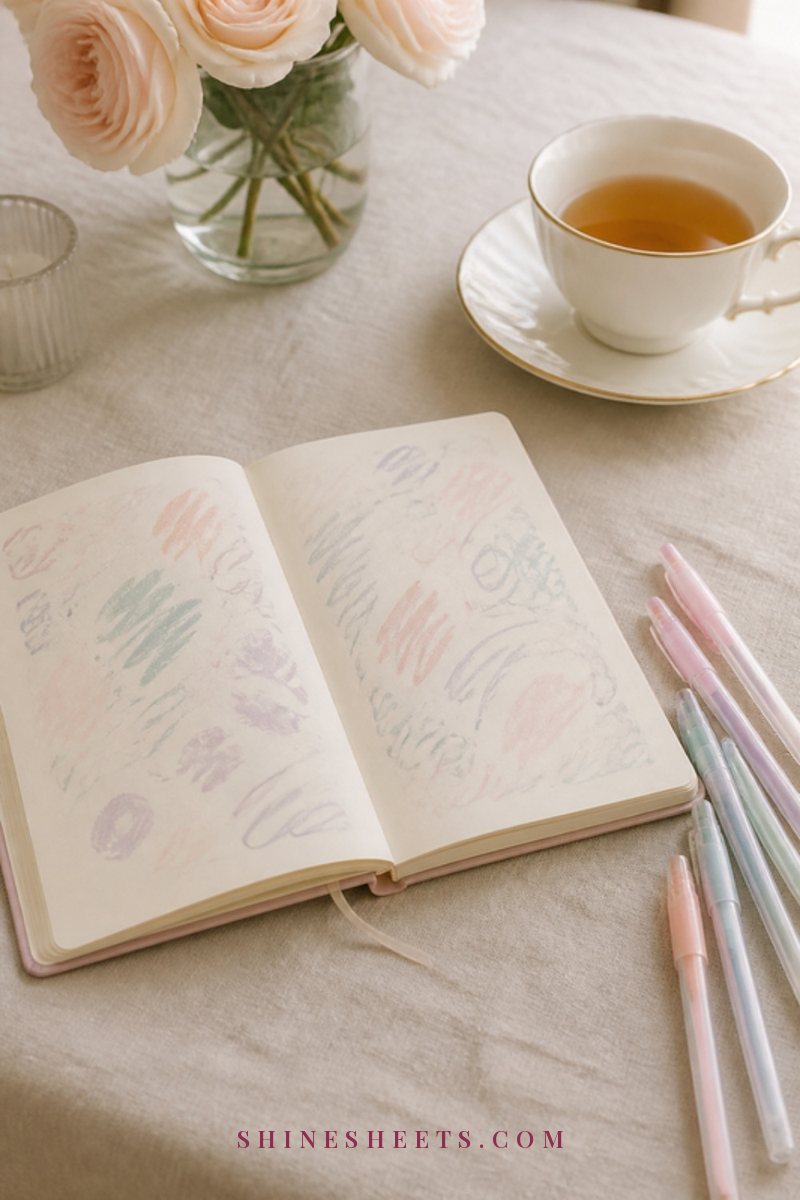
Set a timer for ten minutes and write every sentence that starts with "By now, I should…" Don't edit, just pour them out. Then go through the list with a few pastel gel pens: one color for shoulds you truly want, another for ones you're unsure about and a third for ones that belong to someone else. Most people find the third color shows up more than they expected. You don't have to act on anything yet. Seeing it is the first step.
2. Define What "On Track" Means to You
Instead of letting the world define your progress, write your own version in one or two sentences. For example: "For me, being on track means I feel mostly calm, I'm learning something, I have a few people I can call and I'm slowly building savings." Notice that this definition has no age, no title and no comparison in it. Read it on the days the old schedule gets loud.
3. Set One Small Goal per Life Area

Feeling behind often feels like being behind in everything, which is overwhelming. Break it into areas: home, health, money, relationships, work or learning and fun. For each one, choose one goal small enough to start this week, like "cook at home three nights," "call my sister on Sunday" or "save a small fixed amount each payday." An undated goal planner is handy here because you can start on any day without blank, guilty pages behind you.
4. Celebrate Progress You Usually Skip
Your brain is very good at noticing what's missing and very bad at noticing what's been built. Once a week, write three things you did, handled or learned, even if they seem tiny. "I asked for help." "I paid that bill on time." "I went to bed earlier twice." Small wins are still wins, and they stack up into a life that looks very different a year from now.
5. Curate Your Feed
You don't need to quit social media to feel better, but you do get to choose what you see. Mute accounts that leave you feeling small, even if you like the person. Follow a few that show real, unpolished lives, slower paths and people starting over. Try keeping your phone out of the bedroom for the first and last half hour of the day, when comparison tends to hit hardest. A good book is a gentler companion at those times.
6. Talk to People Who Took Other Routes

Some of the most reassuring conversations you can have are with people whose lives didn't follow the script. Ask an older friend, relative or colleague: "What did your path actually look like? What happened that you didn't expect?" Most people love being asked, and their answers are full of detours, late starts and second tries. Hearing real stories shrinks the myth of the perfect timeline faster than any pep talk.
7. Practice Gratitude for What Is Already Here
Gratitude isn't about pretending you don't want more. It's about noticing that your life already holds good things while you work toward the next ones. Each evening, name one person, one comfort and one small moment you're glad about. I like doing this with a cup of evening tea and a glass jar candle lit nearby, because the ritual makes it easier to remember.
8. Keep a "Done" List Next to Your To-Do List
A to-do list only shows what's left. A done list shows how far you've come. Every time you finish something, from replying to an email to finally booking that appointment, add it to the done list. On the days you feel stuck, read it back. It's much harder to believe "I never get anything done" when the page says otherwise.
9. Give Comparison a Smaller Window
Comparison will happen; you're human. Instead of fighting it all day, notice when it's strongest (after reunions, holidays, birthdays or certain apps) and plan a little buffer. Before a big event, remind yourself: "I'll probably feel a wobble, and that's okay." Afterward, do something grounding, like a short walk or a few minutes with your journal, before you let your mind spin.
10. Be Kind to Your Past Self
A lot of feeling behind is actually quiet blame: "If only I'd started sooner, chosen differently, been braver." Your past self made choices with the information, energy and support she had at the time. Try writing her a short note that begins, "You were doing your best with…" If self-criticism is loud for you, my guide to self-compassion has more ways to speak to yourself like a friend would.
The "Should vs. Want" Reflection Table
This is the heart of the guide. Use the table as a model, then copy the four columns into your journal (or screenshot it) and fill in your own rows. Seeing a should next to the real want underneath it is often the moment the pressure loosens.
| Area | The "should" | The real want underneath | One small step this month |
|---|---|---|---|
| Home | "I should own a house by now." | A calm, safe space that feels like mine | Make one corner of my current home truly cozy and mine |
| Career | "I should have a big title by now." | Work that uses my strengths and pays enough | Write down three strengths and look up one course or role that uses them |
| Love | "I should be married by now." | Closeness and being truly known | Plan one deeper conversation with a friend or partner |
| Money | "I should have more saved." | Feeling secure and less anxious | Set up a small automatic transfer on payday |
| Health | "I should be in perfect shape." | Energy and feeling good in my body | Take a 20-minute walk three times a week |
| Friends | "I should have a big friend group." | A few people I can call on a bad day | Reach out to one person I miss |
| Personal | "I should have it all figured out." | A sense of direction and meaning | Spend 15 minutes on a reflection prompt each Sunday |
Notice how the right-hand column is always smaller, kinder and more doable than the "should." That's the point. You don't need to fix the whole picture. You only need the next honest step toward what you actually want.
A Quick Reset for When the Feeling Spikes

Sometimes the feeling of being behind arrives like a wave: you see one post, hear one piece of news, and suddenly your chest is tight. For those moments, try this five-minute reset:
- Pause and name it (30 seconds). Say quietly, "I'm feeling behind right now. This is a feeling, not a fact."
- Breathe slower (1 minute). Breathe in for four counts and out for six. Repeat five or six times. A longer exhale helps your body settle.
- Put the phone down (immediately). Turn it face down or move it to another room for at least ten minutes.
- Ground yourself (1 minute). Wrap yourself in a soft knit throw, hold a warm mug or press your feet into the floor. Name three things you can see and two you can hear.
- Write one true sentence (2 minutes). Something like, "Their good news doesn't take anything away from me," or "I'm building something slower and that's allowed."
The wave usually passes faster than it feels like it will. You don't have to solve your whole life in the middle of it.
Journal Prompts for Feeling Behind

Pick one prompt per evening. There are no right answers, only honest ones.
- Where did my idea of "on time" come from, and does it still fit the life I want?
- Which area of my life do I feel most behind in, and what would "enough" look like there?
- What have I built, learned or survived in the last few years that I rarely give myself credit for?
- If I trusted that good things can still arrive later, what would I stop rushing?
- Whose life am I comparing myself to most, and what do I actually know about their full story?
- What would I tell a dear friend who felt exactly the way I feel right now?
- What is one thing I can enjoy about this season, exactly as it is?
- What does a good, ordinary day look like for me, and how close am I to having more of them?
For a deeper read on this guilty, comparison-heavy feeling, a gentle book about comparison and self-worth can be a nice companion to your journaling.
Late-Bloomer Reminders
Keep these somewhere you'll see them, maybe on a sticky note inside your planner:
- Plenty of people find their work, their partner, their friends or their confidence later than they expected, and it still counts.
- Starting later often means starting wiser, with more self-knowledge and fewer illusions.
- Skills you gather on a winding path tend to show up again in surprising ways.
- There is no age at which it becomes too late to learn, love, move, rest or begin.
- Your life is not a performance review. It is a place to live.
If the feeling is tied to a bigger "what am I even doing?" moment, my gentle guide on the quarter-life crisis walks through that season step by step.
When To Ask for More Support
Feeling behind now and then is very common. But if it turns into a heavy, lasting low mood, you lose interest in things you used to enjoy, sleep or appetite change a lot, or you feel hopeless most days, please reach out to a therapist or your doctor. That isn't a sign you've failed at handling it. It's a sign you deserve real support, and talking to someone trained can make a big difference.
Final Thoughts
You were never meant to live on someone else's schedule. The pressure to be "further along" is loud, but it's not the truth about your worth or your future.
Choose what matters to you, take the next small step and be gentle with yourself on the days the old feeling returns. Your life is unfolding at its own pace, and that pace is allowed to be yours.