
Self-esteem and self-worth sound like twins, but they behave very differently on a hard day. Self-esteem is the score you give yourself, and it moves: up after a compliment, down after a mistake, sideways after an evening of comparing yourself to other people's highlights. Self-worth is the floor underneath that score. It's the quiet knowing that you matter, even on the days the score drops to zero.
That difference sounds small until you notice how much of your life runs on the score. If your sense of value only shows up when you're winning, every setback starts to feel like a verdict. When the floor is solid, a bad week is just a bad week (annoying, yes, but not a referendum on who you are).
This guide explains self-worth vs self-esteem in plain words: what each one is, how they connect, a side-by-side table with everyday examples, seven signs your value has become performance-based, and gentle ways to build worth that doesn't depend on results. If you've already read my guide on how to start feeling your self-worth, think of this one as the map behind it.
Keep a simple cream linen notebook nearby if you like to think on paper. A few of the exercises below work best written down, and none of them take longer than ten minutes.
Self-Worth vs Self-Esteem: The Short Answer

If you only remember one thing from this article, let it be this pair of definitions:
- Self-esteem is how you rate yourself. It's an evaluation of your skills, looks, choices and how other people respond to you, and it naturally rises and falls with wins, praise and setbacks.
- Self-worth is the steady belief that you matter and deserve kindness regardless of performance. It isn't a rating at all. It's the starting point you bring to every rating.
A simple way to hold it: self-esteem is the weather, self-worth is the climate. The weather changes daily, sometimes hourly. The climate is what stays true across seasons. A rainy Tuesday doesn't turn a sunny place into a desert, and one failed exam doesn't turn a valuable person into a worthless one.
Both matter. You don't need to give up feeling proud of a good presentation or a lovely outfit. You only need that pride to sit on top of something steadier, so it can come and go without taking you with it.
What Self-Esteem Actually Is

Self-esteem is your opinion of yourself, built from evidence. It's tied to specific areas: how capable you feel at work, how you feel about your body, how you think you come across with friends, how well you handle money or your home. Most of us have a different "score" in each area, and they don't always agree.
It's completely normal for self-esteem to move. It tends to go up after you finish a big project, get a kind message or finally master a skill. It dips after an awkward conversation, a rejection or a week where nothing seemed to go right. A new job, a move or a breakup can make it wobble for months while you find your footing again.
Healthy self-esteem isn't sky-high or flawless. It's realistic. It sounds like: "I'm good at organizing, and I'm still learning to speak up in meetings." It can name strengths without bragging and name growth areas without spiraling.
Self-esteem isn't the enemy here. The trouble only starts when it's the only thing holding you up. If you're curious what low self-esteem looks like in quiet, everyday ways, my list of subtle signs of low self-esteem is a kind place to start.
What Self-Worth Actually Is

Self-worth isn't a score. It's the belief that you have value as a person and deserve respect, rest and kindness before you've done anything to earn them. It's not something you collect from achievements. It's something you were born with and sometimes lose sight of.
Having strong self-worth doesn't mean thinking you're better than anyone. It's actually the opposite: it's the same basic worth you'd grant a friend, a stranger or a newborn baby. Nobody asks a baby for a résumé before deciding she deserves to be held.
Self-worth sounds like this:
- "I made a mistake, and I'm still a person who deserves patience."
- "I didn't get the job. It hurts, and I'm still okay."
- "I'm tired today, and I'm allowed to rest without earning it first."
Notice the little word "and." It lets the feeling and the worth exist at the same time. You don't have to pretend the disappointment isn't there. You just don't let it decide whether you matter.
It took me a long time to understand that self-worth isn't something you earn back after a bad day. It was never gone. It just got quiet under all the noise, and part of the work is learning to hear it again.
Self-Worth vs Self-Esteem Side by Side
Here's the whole difference in one table. Screenshot it if it helps, and come back to the last column whenever you can't tell which one is speaking.
| Aspect | Self-Esteem | Self-Worth | Everyday Example |
|---|---|---|---|
| The question it answers | "How well am I doing?" | "Do I matter?" | After a work review, esteem asks about the score; worth reminds you that you're still a valuable person whatever the score says. |
| Where it comes from | Skills, looks, wins, praise, comparison | Being human; living by your values | You feel proud after a great hair day (esteem) and calm about yourself on a messy-bun day too (worth). |
| How stable it is | Rises and falls, sometimes daily | Steady, though it can feel quieter in hard seasons | A rude remark stings for an afternoon, but you don't question whether you deserve kindness. |
| What shakes it | Criticism, rejection, failure, comparison | Long patterns of being dismissed or neglected | One "no" from a date hurts your esteem; years of being talked down to can dim your worth. |
| What it sounds like | "I nailed that" or "I'm hopeless at this" | "I deserve kindness either way" | You burn dinner and think "I'm a terrible cook" versus "Dinner flopped, I'm still fine." |
| What helps it grow | Practice, realistic feedback, small finished goals | Self-compassion, boundaries, values, safe relationships | Taking a class builds esteem; saying no to an extra shift without guilt reflects worth. |
| When it's low | You doubt your abilities | You doubt you deserve good things | Low esteem: "I can't do this presentation." Low worth: "Even if I do it well, I don't deserve the praise." |
| The healthy version | Confident and honest about growth areas | Calm, with no need to prove yourself | You can enjoy a compliment without needing the next one, and hear feedback without falling apart. |
You can have high self-esteem and low self-worth at the same time. Think of the high achiever who looks confident from the outside but can't rest, can't fail and can't accept a compliment without immediately raising the bar. The reverse is possible too: someone who doubts her skills but knows deep down that she deserves to be treated kindly. The second one is actually the easier place to grow from, because skills can be learned.
How Self-Esteem and Self-Worth Connect
The two aren't separate rooms. They talk to each other all day long. When your worth feels steady, trying new things feels safer, because failing won't erase you. You try more, you learn more, your skills grow, and your self-esteem rises on real evidence.
When worth feels shaky, every attempt quietly becomes a test of whether you're allowed to take up space. That's exhausting, so you avoid the things that might go wrong. Avoiding means fewer chances to grow, and your self-esteem drops too. It's a loop, and it can run in either direction.
I like picturing a house. Self-worth is the foundation, poured once and mostly invisible. Self-esteem is the rooms you decorate: you repaint them, rearrange them and sometimes leave one a mess for a while. A pretty room on a cracked foundation always feels a little unsafe. A plain room on solid ground still feels like home.
Why Self-Esteem Built Only on Achievement Feels Fragile

When achievement is the only thing holding you up, you need a constant supply of new evidence. Praise wears off quickly, often within a day or two, and the next goal has to be a little bigger to give the same lift. It's a treadmill that keeps speeding up.
It also makes feedback feel dangerous. If your value lives in your performance, then a note about your work sounds like a note about you. You might get defensive, over-apologize or replay the conversation for days, not because the feedback was harsh, but because it touched the only support you had.
Comparison makes it worse. There is always someone further ahead, prettier in a certain light, more organized, more successful. Self-esteem built on ranking is permanently at risk, because the ranking never stops changing. If you notice yourself constantly checking how others see you, my guide on how to stop seeking validation goes deeper into that pattern.
None of this is a personal failing. Many of us were praised for good grades, for being helpful, for being "easy." Of course we learned that value is earned. Unlearning it takes gentle practice, not more willpower.
7 Signs Your Sense of Value Is Performance-Based

These are gentle observations, not a diagnosis. Most people recognize a few of them, especially during stressful seasons. Read them with curiosity rather than judgment.
- You crumble after criticism. A small correction can ruin your whole day, and you replay it at night long after the other person has forgotten it.
- You feel you have to earn rest. Sitting down feels allowed only after the to-do list is done, and since the list is never done, rest comes with a side of guilt.
- You compare constantly. Before you can feel good about something you did, you check how it measures up to what someone else did.
- Your mood follows your productivity. A busy, efficient day makes you feel like a good person. A slow day makes you feel like a lazy one.
- Compliments slide off, criticism sticks. You brush away praise ("oh, it was nothing") but can quote every negative remark word for word.
- Saying no feels risky. Being useful feels like your ticket to belonging, so turning down a request feels like you might lose your place.
- Mistakes feel like proof. Instead of "I got that wrong," your inner voice says "this is what's wrong with me."
If you nodded at four or more, please don't add this to your list of things you're bad at. It simply shows you where your floor needs a little reinforcement, and that's exactly what the next section is for.
5 Ways To Build Self-Worth Separately From Results
Self-worth grows through small, repeated experiences of treating yourself as someone who matters, especially when you haven't "earned" it. Pick one of these to practice this week. You can add another next week.
1. Anchor Yourself in Values, Not Outcomes

Outcomes are partly out of your hands. You can prepare beautifully for an interview and still not get the job. Values are different: they're about how you show up, and you get to choose them every day.
Write down three values that feel true to you, like kindness, curiosity, honesty, courage or calm. Then, each evening for two weeks, finish one sentence: "Today I was ___ when I ___." For example: "Today I was brave when I applied for that role, even though I didn't feel ready." The result is still unknown. The value is already lived. That's worth you can feel right now.
2. Practice Self-Compassion on Ordinary Days
Self-compassion is the daily maintenance of self-worth. It means speaking to yourself the way you'd speak to a friend who's struggling: warmly, honestly and without a lecture.
When something goes wrong, try this three-line script: "This is hard. Lots of people feel this way. What would help me right now?" Then do the small helpful thing, whether that's a glass of water, a short walk or ten minutes under a soft blush knit throw on the sofa.
The trick is to practice on tiny moments, like a spilled coffee or a missed train, so the habit is ready when the big moments arrive. My guide to self-compassion basics has more simple ways to start.
3. Separate What You Did From Who You Are
Behavior can be changed. Identity isn't on trial. When you blur the two, every slip becomes a character judgment, and that's when shame moves in.
Use this little formula card whenever you catch yourself saying "I'm so stupid" or "I'm a mess":
- I did: "I missed the deadline for the report."
- I can: "I can email my manager today and set a reminder two days earlier next time."
- I'm still: "I'm still a capable, caring person who had a hard week."
It works the other way too. "I'm a success" ties your worth to performance just as much as "I'm a failure" does. Try "I did something I'm proud of" instead, and let the pride be about the action.
4. Let Boundaries Say What Your Worth Already Knows
Boundaries are self-worth in action. Each time you protect your rest, your time or your feelings, you show yourself, through behavior, that you matter. Your nervous system believes actions more than affirmations.
Start small. Block one 20-minute slot each week that belongs only to you, and treat it like an appointment. When a request comes in that you can't take on, try: "I can't take that on this week, but thank you for thinking of me." No long explanation needed.
It will probably feel uncomfortable the first few times. That discomfort isn't a sign you're doing something wrong. It's a sign you're doing something new.
5. Notice Your Conditional Thoughts
Conditional thoughts are the sneaky little "when" and "once" sentences: "I'll be enough when I lose the weight." "I can relax once the house is clean." "I'll feel proud when I get the promotion." They quietly move your worth into the future, where you can never quite reach it.
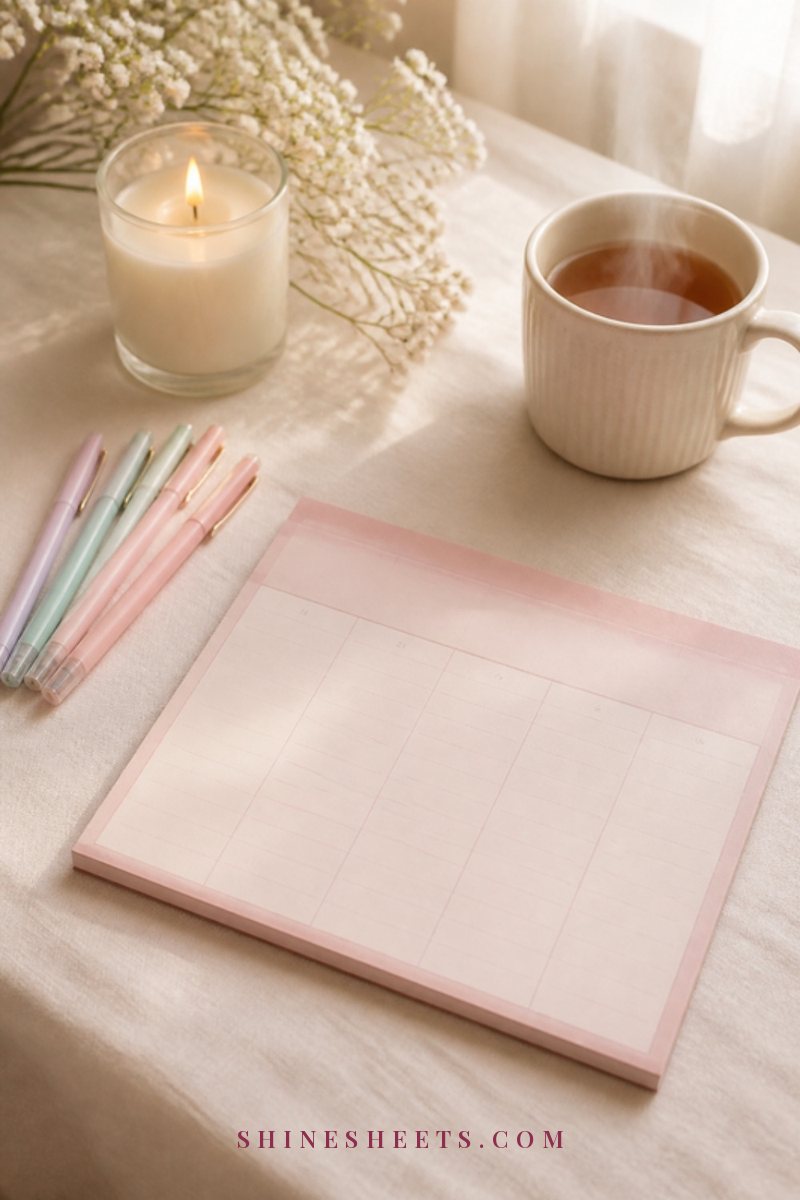
For one week, jot down every conditional thought you notice. Then rewrite each one: "I'm enough now, and I'd still like to ___." Using a set of soft pastel gel pens makes this oddly satisfying, with one color for the old thought and another for the rewrite.
My anxious brain adores a conditional. "Once the inbox is empty, then I can breathe." The inbox is never empty. Learning to breathe first and answer emails second has done more for my sense of worth than any finished to-do list ever did.
6 Healthy Self-Esteem Habits That Support Your Worth

Self-esteem still matters, and healthy self-esteem is built on realistic evidence rather than perfection. These habits support your worth instead of replacing it:
- Keep an evidence page. Once a week, write down three things you handled, learned or tried. A guided self-love journal can give you structure if a blank page feels intimidating. For more ideas like this, see my self-esteem activities for adults.
- Finish something small. A tidy drawer, a short online lesson, a 15-minute walk. Finished small things build real confidence faster than unfinished big ones.
- Take compliments with two words. Say "thank you" and stop there. No "oh, this old thing." Let the kindness land for three full seconds.
- Curate your inputs. Mute any account that consistently makes you feel behind, just for 30 days, and notice how your mornings feel.
- Care for your body as respect, not repair. Sleep, water, a little movement and a proper meal are things you do because you matter, not because something needs fixing.
- Close the day with a tiny ritual. Light a lavender soy candle in a glass jar, make a cup from a calming herbal tea sampler and spend five minutes writing. If you'd like something to write about, my list of self-worth journal prompts was made for exactly these evenings.
When To Ask for Extra Support
Sometimes low self-worth isn't a passing mood. If it feels heavy most days, lasts for weeks, makes it hard to enjoy things you used to love or comes with a sense of hopelessness, please consider talking to a therapist or your doctor. A good therapist can help you understand where the beliefs came from and give you tools that are much harder to build alone.
Reaching out isn't proof that you've failed at self-worth. It's one of the clearest ways to practice it. You're treating your inner life as something worth caring for, and that's the whole point.
Final Thoughts
Self-esteem will keep moving, and that's okay. Let it rise when you do something brave and dip when life gets messy. Underneath it, your worth was never up for review.
Start with one tiny practice this week: one values sentence, one boundary, one rewritten "when" thought. Little by little, the floor gets firmer, and you'll find you can stand on it even on the windy days.