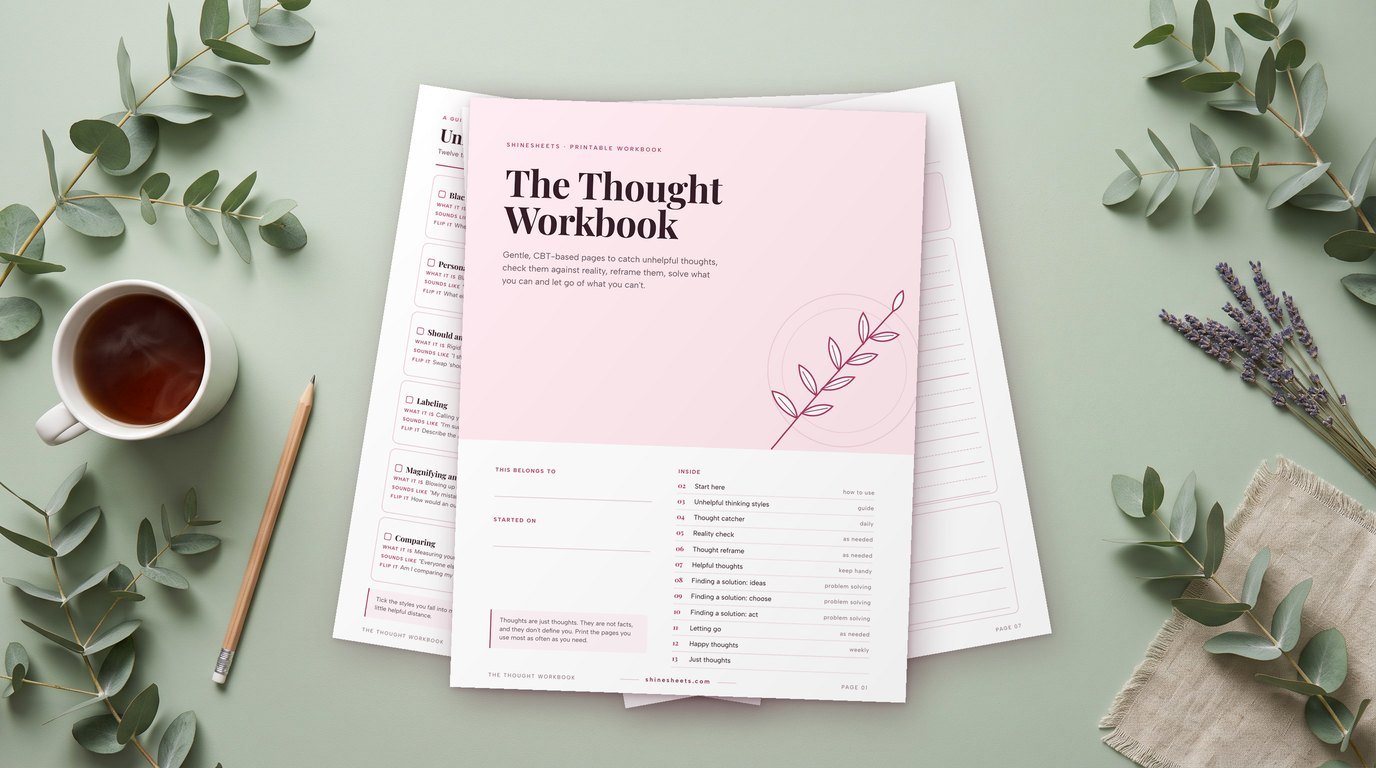
Reframing a negative thought doesn't mean pretending everything is fine. It means looking at the same situation from a fairer angle, the one you would naturally take if it were happening to someone you love. The thought "I ruin everything" becomes "I made one mistake, and I know how to fix it." Same facts, much kinder (and more accurate) lens.
That difference matters, because your mind tends to believe whatever it hears most often. When the loudest voice in your head is harsh, it colors how you feel, what you try and how you treat yourself. Learning to answer it with something balanced is one of the most useful skills I know, and it gets easier every time you practice.
This guide shows you how to reframe negative thoughts step by step. You'll find what reframing really is (and what it isn't), five simple steps, a reframe table you can screenshot, eight real-life examples with the original and the reframed thought side by side, and small tips that make the new thought actually believable.
Go gently with yourself while you read. You don't need to get it "right" for it to help.
What Reframing Negative Thoughts Really Means

A thought is not a fact. It is one interpretation of what happened, often the fastest one your brain could come up with, and fast thoughts are rarely the fairest ones. Reframing simply means slowing down and asking: is there another way to see this that fits the facts better?
Here's what reframing is:
- Looking at the full picture, not just the part that hurts.
- Finding a thought that is balanced, realistic and believable.
- Talking to yourself the way a wise, kind friend would talk to you.
And here's what it is not:
- Forcing yourself to feel happy about something painful.
- Telling yourself "everything happens for a reason" or "just be positive."
- Ignoring a real problem that needs attention.
If "I failed the exam" turns into "It doesn't matter at all, I'm amazing," that is toxic positivity, and your brain won't buy it. A real reframe sounds more like: "I didn't pass this time. That's disappointing. It shows me which topics I need to study, and I can retake it." It still admits the hard part. It just doesn't stop there.
Why Reframing Helps
Reframing comes from cognitive behavioral therapy (CBT), one of the most widely studied approaches in psychology. The core idea of CBT is simple: the way you interpret a situation shapes how you feel and what you do next. Change the interpretation, and the feeling often softens with it.
Think of it as a chain. Something happens, a thought pops up, a feeling follows, and the feeling pushes you toward an action. If the thought is "They think I'm annoying," the feeling might be shame, and the action might be pulling away. If the thought is "They're probably busy," the feeling is calmer, and you might simply wait or check in.
I'm prone to anxiety (mostly managed these days), and this chain explained so much for me. I couldn't always control the first thought, but I could learn to question it, and that small pause changed how many evenings I spent spiraling. If you notice you often jump to distorted conclusions, my guide to common thinking traps helps you spot the patterns. This article is the hands-on part: what to do once you've caught one.
5 Steps To Reframe Negative Thoughts
These five steps take about five to ten minutes on paper. With practice, you'll be able to do a shorter version in your head in under a minute. Start on paper anyway, because writing slows the thought down enough to look at it.
1. Notice the Thought

You can't reframe a thought you haven't noticed. The clue is usually a sudden shift in your mood: a sinking feeling, a tight chest, an urge to cancel plans or hide. When you feel that shift, ask yourself, "What was I just thinking?"
Write the thought down exactly as it sounds in your head, even if it's dramatic or unkind. "I'm such an idiot." "Everyone is better than me." Don't clean it up. You need the real version to work with.
A helpful tool here is a guided thought journal with prompts for the situation, the thought and the feeling, so you don't have to remember the steps when you're upset.
2. Name the Feeling and Its Strength
Next, name the feeling underneath the thought, using one or two words: sad, anxious, embarrassed, angry, ashamed, lonely. Then rate how strong it is from 0 to 100.
This step seems small, but naming a feeling tends to take a little of its power away. It also gives you a starting number, so you can notice whether the reframe actually helped. If "embarrassed, 80" becomes "embarrassed, 45" after the steps, that is real progress, even though the feeling didn't disappear.
A set of pastel gel pens is a sweet pick for this part: one color for the feeling and another for the reframe. It sounds silly, but seeing the balanced thought in a softer color makes it easier to come back to.
3. Check the Evidence For and Against

Now look at the thought like a fair detective, not a prosecutor. Draw two columns on the page:
- Evidence for the thought: real, specific facts that support it (not feelings, not guesses).
- Evidence against the thought: facts that don't fit it, times it wasn't true, other explanations.
Be honest on both sides. If the thought is "I'm terrible at my job," the "for" column might have "I missed a deadline this week." The "against" column might have "My manager praised my last project," "I've met most deadlines this year" and "This week I had three projects at once."
Most of the time, the "against" column is longer than you expected. Some of the time, the thought has a real point, and that's fine too. A balanced thought includes the true part.
4. Ask What You Would Tell a Friend
Imagine a close friend came to you with the exact same situation and the exact same thought. What would you say to her? Write it down in the words you would actually use.
Most of us are far kinder to friends than we are to ourselves. You would never tell her "Yes, you're an idiot," but you might say, "Everyone forgets things when they're overloaded. Send a quick apology and a new date, and it will be okay." That is your reframe in its rough form.
If this step feels hard, it is often a sign your inner voice has been strict for a long time. My guide to self-compassion has gentle ways to soften it, and if that harsh voice shows up all day long, these steps to stop negative self-talk are a good companion.
5. Write a Balanced Alternative

Now combine what you found into one or two sentences. A simple formula that works almost every time:
"It's true that [the real part]. And also [the evidence against or the bigger picture]. So [what I can do next / what this actually means]."
For example: "It's true that I missed a deadline. And also, I've met most of my deadlines and I had three projects at once. So I'll send an update today and ask for help planning next week."
Read it out loud, then rate the original feeling again from 0 to 100. If it dropped even a little, the reframe worked. If not, adjust the words until they feel more believable (more on that below).
If you like a small ritual, a lavender candle in a glass jar is a lovely pick to light while you write (blow it out when you close the notebook). The ritual tells your mind it is time to slow down, not to argue.
The Reframe Table
Here are common negative thoughts, the thinking trap behind each one, a quick evidence question to ask and a balanced reframe. Screenshot it and keep it on your phone for the moments when your mind gets loud.
| Negative thought | Thinking trap | Evidence check | Balanced reframe |
|---|---|---|---|
| "I always mess things up." | Overgeneralizing | Is it really always? What went well this week? | "I messed this one thing up. Plenty of other things went fine, and I can fix this." |
| "She's ignoring me, she must be upset with me." | Mind reading | What else could explain the silence? | "I don't know why she hasn't answered. She might be busy. I can check in tomorrow." |
| "If this goes wrong, everything is ruined." | Catastrophizing | What is the most likely outcome, not the worst? | "Even if it goes wrong, it would be hard, not the end. I've handled hard things before." |
| "I should be further along by now." | "Should" statements | Who decided the timeline? Is it fair? | "I'm on my own path. I've grown in ways a timeline doesn't show." |
| "The compliment doesn't count, they were just being nice." | Discounting the positive | Would I discount it if a friend got the same compliment? | "They chose to say it. I can let it count." |
| "I feel like a failure, so I must be one." | Emotional reasoning | Is this a feeling or a fact? | "I feel discouraged right now. Feelings are real, but they aren't proof." |
| "It was a total disaster." | All-or-nothing thinking | Was any part of it okay? | "Parts were hard and parts went fine. It was a mixed day, not a disaster." |
If the "worst case" row feels painfully familiar, my guide on how to stop always expecting the worst goes deeper into that one.
8 Examples of Reframing Negative Thoughts
Seeing reframes in real situations makes the method click. Each example below shows the original thought, the reframed thought and a short note on why it works. Notice that none of them pretend the situation is perfect.
1. A Mistake at Work

Original: "I sent the wrong file to the whole team. Everyone thinks I'm incompetent now."
Reframed: "I sent the wrong file, which is embarrassing. People send wrong files all the time, and most of them won't remember it next week. I'll send the right one with a quick, light note."
Why it works: It owns the mistake, drops the mind reading ("everyone thinks…") and ends with a clear next step.
2. A Friend Not Texting Back
Original: "She read my message hours ago and didn't reply. I must have said something wrong."
Reframed: "I don't actually know why she hasn't replied. She has a lot going on, and she's been a good friend for a long time. If I still haven't heard from her in a couple of days, I can simply ask how she's doing."
Why it works: It replaces a guess with an honest "I don't know" and leans on the real history of the friendship.
3. Body Image
Original: "I look awful in everything. I hate my body."
Reframed: "I'm having a hard body-image day, and that's a feeling, not a fact. My body carries me through every day. I don't have to love how I look today to treat myself kindly, so I'll wear something comfortable and stop checking."
Why it works: It doesn't force "I love my body" (which can feel fake on a hard day). It aims for neutral and kind, which is far more believable.
4. A Hard Conversation
Original: "If I bring this up, it will turn into a huge fight and ruin everything."
Reframed: "This conversation might be uncomfortable. Uncomfortable isn't the same as ruined. Most relationships get stronger when people speak honestly and calmly. I'll pick a quiet moment and start with how I feel, not with blame."
Why it works: It softens the catastrophe into a realistic outcome and gives you a plan that makes the good outcome more likely.
5. Being Late
Original: "I'm late again. I'm so irresponsible, I can never get anything right."
Reframed: "I'm running ten minutes late, which is annoying. I'll send a quick message now. Being late sometimes doesn't make me irresponsible. Next time I'll leave fifteen minutes earlier for this route."
Why it works: It separates one event from your whole identity and turns frustration into a small, practical change.
6. Comparison Online

Original: "Everyone my age has a nicer home, a better life and more friends. I'm so behind."
Reframed: "I'm comparing my everyday life to other people's best moments. I don't see their hard days, their bills or their lonely evenings. My life has good things in it too, and I can put the phone down and go enjoy one of them."
Why it works: It names the unfair comparison and pulls your attention back to your own real life.
On comparison evenings, try putting the phone face down for twenty minutes and doing something with your hands. A soft cream knit throw on the sofa makes that offline time feel like a treat, not a punishment.
7. A Rejected Idea
Original: "They said no to my idea. I should just stop suggesting things."
Reframed: "They said no to this idea, not to me. Good ideas get turned down all the time for reasons like timing or budget. I can ask what would make it work better, and keep sharing ideas, because some of them will land."
Why it works: It separates the idea from your worth and keeps you from making a big rule ("stop suggesting things") out of one moment.
8. Feeling Behind in Life

Original: "I'm nowhere near where I thought I'd be. I've wasted so much time."
Reframed: "My life looks different from the plan I had, and that can feel sad. I've still learned, grown and gotten through things I didn't expect. There is no single deadline for a good life. I can choose one small step toward what I want this month."
Why it works: It honors the disappointment, counts the growth you usually overlook and turns "too late" into "next step."
Tips To Make Reframing Stick

Reframing is a skill, which means it feels clunky at first and smoother over time. These three habits make the biggest difference.
Write It Down
Thinking a reframe is good. Writing it is better. On paper, the thought sits still long enough for you to look at it, and you can see how dramatic it sounds. Keep one notebook just for this, and come back to old entries now and then. Seeing how many of your worst predictions never happened is powerful. When a reframe really helps, copy it onto a pastel sticky note and put it where you'll see it, like inside a cabinet door or on your desk.
I usually do this after my evening tea, as part of my journaling. Ten minutes is plenty, and a big cream ceramic tea mug makes it feel like a calm little ritual rather than homework.
Reframe for Believability, Not Positivity
If the new thought makes you roll your eyes, it is too far from where you are. Move it closer. Instead of "I'm amazing at public speaking," try "I'm nervous, and I've prepared. Nervous people give good talks all the time." A small, believable step beats a big leap your brain rejects.
A quick test: rate how much you believe the reframe from 0 to 100. Aim for at least 50. If it's lower, add more evidence or soften the wording.
Practice When You're Calm First
It is hard to learn a new skill in the middle of a storm. Practice on small, mild thoughts first, like "I'll never get this inbox under control" on a quiet afternoon. The more you practice when you're calm, the more naturally the steps show up when something bigger happens.
Bedtime is when many negative thoughts get loudest. If that's you, my guide on how to stop overthinking at night pairs well with these steps.
When Thoughts Stay Heavy
Some days, you'll do every step and the thought will still sit on your chest. That is not a failure. Reframing lowers the volume; it doesn't always turn it off. On those days, it can help to step away from thinking altogether: take a short walk, take a shower, call someone you trust, or simply rest and try again tomorrow.
It is also okay to need more support than an article can give. If negative thinking feels constant, makes it hard to get through your day, or comes with low mood that doesn't lift, a therapist can help. Many therapists use CBT, the same approach these steps come from, and they can guide you through it in a way that fits your life. Reaching out is a strong, caring thing to do for yourself. If you ever have thoughts of harming yourself, please contact a local emergency number or a crisis line right away.
Final Thoughts
Your thoughts don't get to be the final word just because they arrive first. With a pen, a few quiet minutes and five simple steps, you can look at them more fairly, keep the true parts and gently let go of the rest.
Start small, practice on the easy thoughts and be patient with the hard ones. Each balanced thought you write is a little proof that you can be both honest and kind with yourself, and that is a beautiful habit to build.