For a long time my "desk" was whatever surface had the least clutter on it that day. Sometimes the kitchen table, sometimes the sofa with a laptop balanced on a cushion, sometimes the bed (we don't talk about the bed). I'd finish a few hours of emails and planning with a stiff neck, a tangle of chargers and the strange feeling that I'd never really started or stopped.
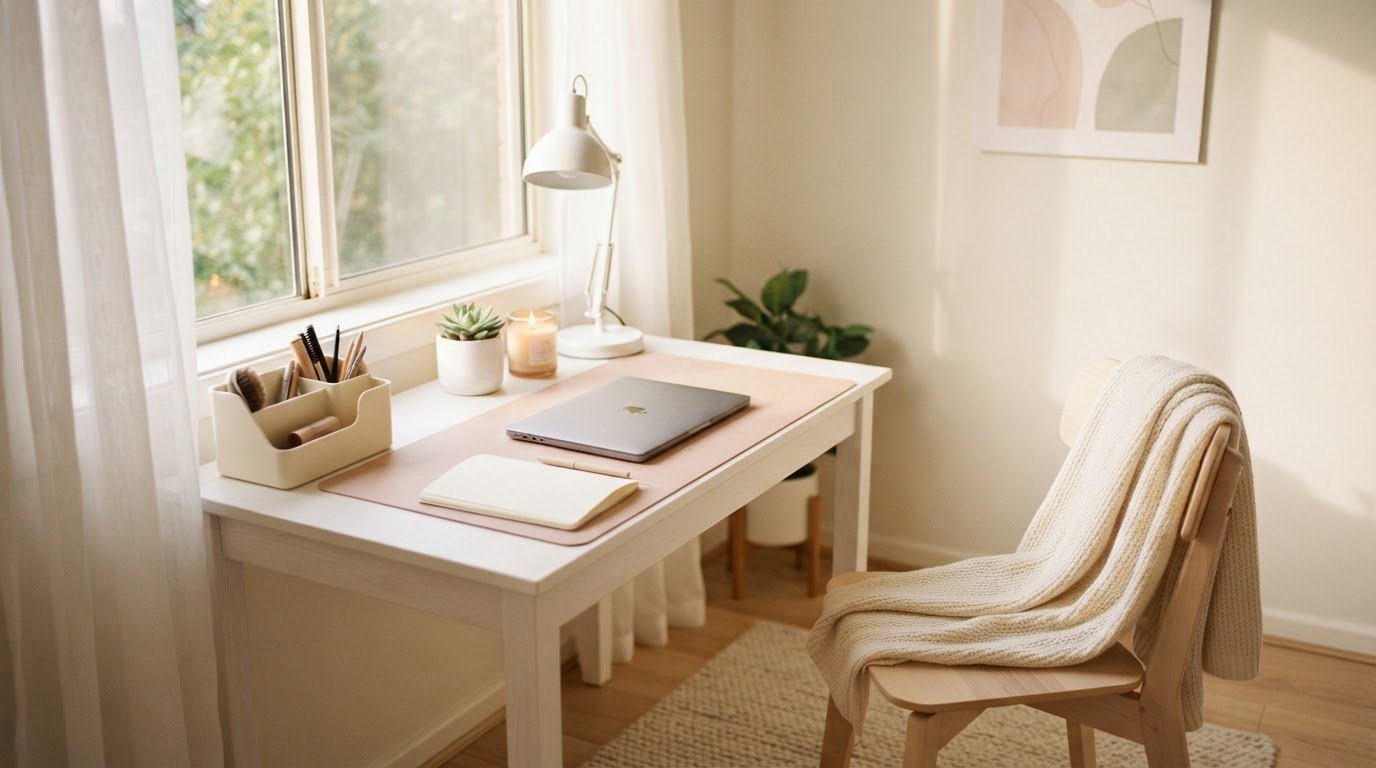
What finally changed things wasn't a bigger apartment or an expensive desk. It was giving one small spot a clear job, soft light and a little bit of beauty. Suddenly sitting down to plan my week or answer messages felt calm instead of chaotic – and getting up at the end felt like actually leaving.
So this guide is all about cozy home office ideas that work in real homes, including tiny ones. You'll find a simple three-zone desk layout (work, calm and storage), 18 pretty and practical ideas, a lighting and cable-tidy checklist written right here in the post and a five-minute reset for the end of the day. Nothing here needs a renovation – most of it fits in one weekend afternoon.
Clear a mug-sized spot on your desk, and let's start with the layout.
What Makes a Home Office Feel Calm
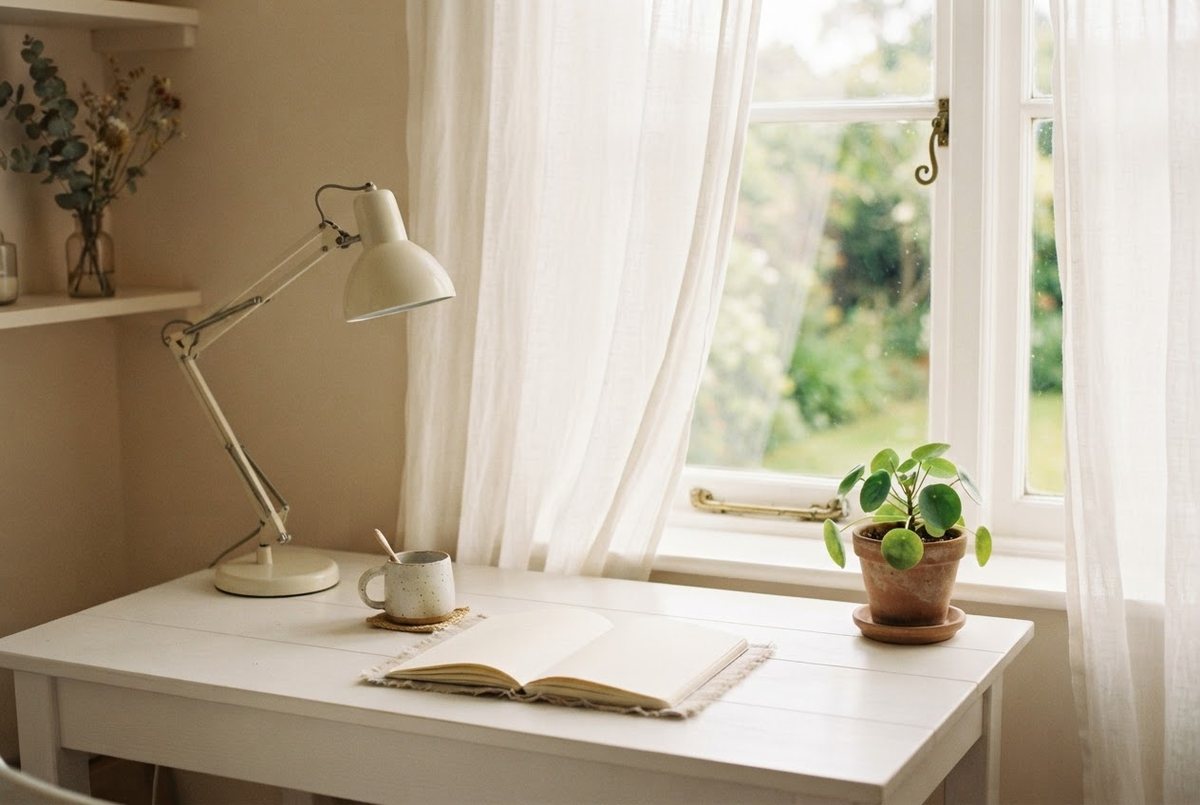
Before we get to the ideas, it helps to know what you're aiming for. When I look at desk setups that feel peaceful, they almost always have four things in common:
- A clear surface. Only what you need today is on the desk. Everything else has a home nearby.
- Kind light. Daylight from the side, a warm lamp for later, no harsh glare on the screen.
- Something soft and something living. A cushion, a rug or a throw, plus one plant or a few flowers.
- Your body is supported. Screen at eye level, feet on the floor, back supported. Pretty doesn't count for much if your shoulders hurt by noon.
Keep those four in mind. Every idea below serves at least one of them.
The Three-Zone Desk Layout: Work, Calm and Storage
This is the part that made the biggest difference for me. Instead of thinking of the desk as one surface, divide it (and the space around it) into three zones with three jobs. It works on a big desk and on a tiny one tucked into a bedroom corner.
| Zone | Where it goes | What lives there | Small-space tip |
|---|---|---|---|
| Work zone | Center of the desk, directly in front of you | Laptop or screen, keyboard, mouse, one notebook and one pen | Mark it with a desk mat so the "work area" has visible edges |
| Calm zone | One back corner of the desk, ideally on your dominant-hand side so your drink is easy to reach | Lamp, a small plant, a candle or a photo, your drink | Keep it to three objects so it stays pretty, not cluttered |
| Storage zone | Off the desk: a drawer, a shelf above, a cart or a basket below | Paper, chargers, stationery, files, anything you use less than daily | Go vertical: a wall shelf or a slim rolling cart takes almost no floor space |
The rule that holds it together: anything that isn't work and isn't calm goes to storage. When the desk starts filling up, I ask one question of each object – "work, calm or storage?" – and the answer tells me exactly where it belongs.
For a tiny desk (anything under about 40 inches wide), keep the work zone at least two-thirds of the surface and squeeze the calm zone into one corner. A clip-on or slim lamp and a single small plant are plenty.
18 Cozy Home Office Ideas for a Pretty, Calm Desk
You don't need to do all eighteen. Pick the three that would make the biggest difference in your space this week and start there.
1. Put Your Desk Beside the Window, Not in Front of It
Daylight is the most flattering and energizing light you'll ever get, but sitting directly facing a window can mean squinting at a bright glare all afternoon, and sitting with your back to it puts reflections on your screen. The sweet spot is usually side-on: the window to your left or right. If you can't move the desk, a sheer white curtain softens the light beautifully.
2. Choose a Desk Lamp That Does Real Work
One good lamp beats three pretty but weak ones. Look for an adjustable arm or head, so you can point the light at your notebook instead of your eyes, and a warm-to-neutral bulb. A white adjustable LED desk lamp with a few brightness settings is a lovely pick because it suits a bright morning and a dim winter afternoon equally well.
3. Layer a Second, Softer Light
Desk lamp for tasks, plus one softer light for mood: a small table lamp with a linen shade, a jar of warm fairy lights on a shelf or a lamp behind the screen to reduce the contrast between a bright monitor and a dark room. Your eyes will thank you on dark afternoons.
4. Define the Work Zone With a Desk Mat
A desk mat sounds like a tiny detail, but it does three jobs at once: it protects the desk, it makes your mouse glide nicely and it visually frames the work zone so clutter is easier to spot. I'd choose a cream or blush vegan leather desk mat that's large enough for both the keyboard and mouse – it instantly makes a plain desk look finished.
5. Hide the Cable Chaos
Nothing makes a desk look stressful faster than a nest of cables. Plug everything into one power strip, then put the whole strip inside a white cable management box on the floor or under the desk. Use a few reusable velcro ties to bundle the cords that run up to the desk. Ten minutes of work, and the space looks twice as calm.
6. Give Small Things One Home
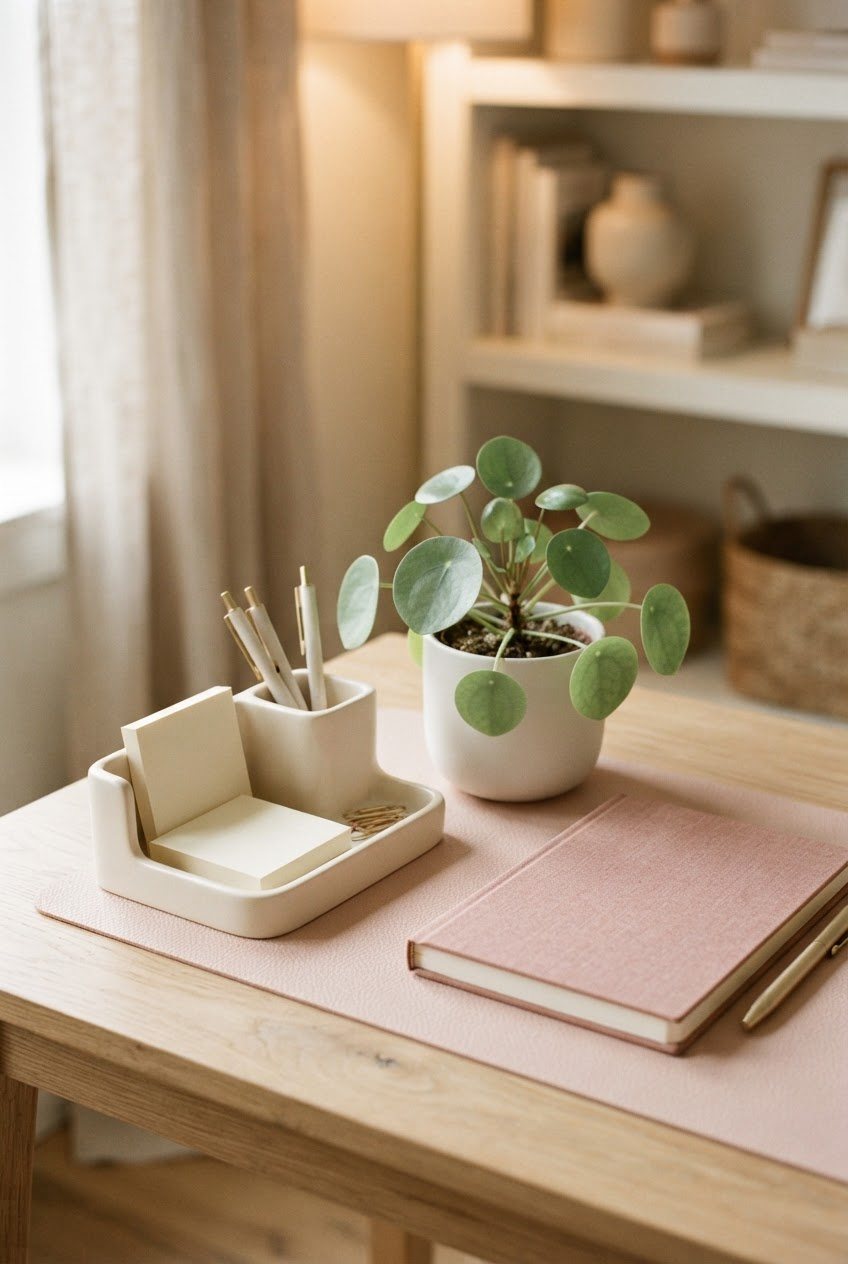
Pens, sticky notes, clips, lip balm, earbuds – small things breed on a desk. Corral them in one cream desk organizer with a couple of little drawers, so everything you reach for daily has a spot and everything else can disappear from sight. If it doesn't fit in the organizer, it probably belongs in storage.
7. Add One Living Thing
A single plant in the calm zone softens all the hard edges of screens and paper. Low-light, forgiving plants like a pothos, a snake plant or a ZZ plant survive even the most distracted weeks. Pot it in a white ceramic plant pot with a saucer so watering doesn't leave marks on the desk. If plants aren't your thing, a few fresh stems in a small glass bottle work too.
8. Support Your Back, Not Just Your Style
A pretty chair you can't sit in for an hour isn't a win. If your chair is a dining chair or a basic office chair, a lumbar support cushion in a soft neutral can help you sit back into the chair instead of hunching forward. Aim for feet flat on the floor (a footrest or a sturdy box helps if they dangle), knees roughly level with your hips and elbows close to your sides.
A kind note: if you have ongoing back, neck or wrist pain, a doctor or physical therapist can give you advice that fits your body. For gentle daily movement between work blocks, my favorite posture exercises take just a few minutes.
9. Raise Your Screen to Eye Level
Looking down at a laptop all day is one of the most common reasons for a sore neck. A simple laptop stand plus a separate keyboard and mouse brings the top of the screen to roughly eye level. No stand? A sturdy stack of hardback books does the job until you find one you like.
10. Put Something Soft Under Your Feet
A small washable rug under the desk makes a home office feel like a room instead of a corner, and it's lovely on cold mornings. Choose a low pile so your chair can still roll, and a soft neutral or pastel that ties the space together.
11. Keep a Throw on the Back of the Chair
Home offices are often the coldest room in the house (or the corner furthest from the radiator). A light knit throw over the chair back means you never have to stop and go find a sweater. It also makes the whole setup look softer from across the room.
12. Hang One Thing You Love at Eye Level
Skip the gallery wall of motivational quotes. One framed print, a postcard from a favorite trip or a small pinboard with three things that make you smile is enough. Hang it where your eyes naturally land when you look up from the screen, so every glance away is a tiny mental break.
13. Build a Tiny Drink Station
Every trip to the kitchen is a trip away from focus. A small tray in the calm zone (or on a nearby shelf) with your favorite mug, a coaster and a small water bottle helps you stay hydrated without wandering off. If you love a bigger setup for coffee or tea elsewhere in the house, these coffee corner ideas are full of inspiration.
14. Choose Closed Storage Over Open Shelves
Open shelves look lovely in photos, but in a working space they quickly fill with paper and become visual noise. A closed cabinet, a set of lidded boxes or baskets on a shelf keeps everything accessible but quiet. Label them simply (paperwork, stationery, tech) so things actually get put back.
15. Add a Gentle Scent, With Care
A lightly scented candle or a reed diffuser in the calm zone makes sitting down at the desk feel like a small ritual. Choose fresh, soft scents (linen, cotton, light citrus) over heavy ones that can feel distracting. If you light a candle, keep it well away from paper, never leave it burning when you step out and blow it out at the end of the day. My guide on how to style candles has ideas for making one look intentional on a small surface.
16. Make It Work in a Bedroom Corner
If your desk lives in your bedroom, the goal is to make it easy to "close" at night. Face the desk away from the bed if you can, keep the work zone completely clear at the end of the day and drape a pretty cloth over the screen or slide the laptop into a drawer. Out of sight genuinely helps your brain switch off.
17. Try a Closet or Nook Office
A shallow closet, an alcove or the space under a staircase can become a surprisingly calm little office. Add a wall-mounted shelf as a desk, a lamp, a hook for your bag and a stool that tucks underneath. When you're done, close the doors – the office literally disappears.
18. Keep Your Calm Zone to Three Objects
This is the rule I come back to most. Lamp, plant, candle. Or lamp, photo, mug. Three things look styled; six look cluttered. When you add something new to the calm zone, something else goes to storage.
The Lighting and Cable-Tidy List
These two areas make or break a calm desk, so here's the checklist I run through whenever my setup starts to feel off. It's right here in the post – screenshot it if that helps.
Lighting:
- The window is beside the desk, not directly in front or behind.
- A sheer curtain or blind softens harsh midday sun.
- The desk lamp has an adjustable arm or head and points at your work, not your eyes.
- Bulbs are warm white to neutral (roughly 2700K–4000K), not cold blue.
- There's a second soft light source for dark afternoons.
- No bright reflection lands on your screen at any time of day.
- The screen brightness roughly matches the room, not far brighter.
Cables:
- Everything plugs into one power strip.
- The power strip sits inside a cable box or is mounted under the desk.
- Cords running up to the desk are bundled with reusable ties.
- Chargers you don't use daily live in a drawer, not on the surface.
- One charging cable stays on the desk for your phone – and only one.
- Nothing is daisy-chained (power strip into power strip), and no cords run under a rug where they can overheat or trip someone.
If you tick off everything on both lists, your desk will already look calmer than most, even before a single pretty thing is added.
A Five-Minute End-of-Day Reset
The prettiest office in the world gets messy by Thursday. What keeps mine calm is a short reset at the end of every working session. It also works as a gentle "I'm done now" signal, which matters a lot when your office is also your home.
- Minute 1: Close every tab and app you don't need tomorrow.
- Minute 2: Write tomorrow's top three tasks on a sticky note and put it on the desk mat.
- Minute 3: Return everything to its zone – work, calm or storage.
- Minute 4: Take mugs and glasses to the kitchen and wipe the desk.
- Minute 5: Blow out the candle, switch off the desk lamp and push in the chair.
This little routine is also one of the simplest ways to build focus over time. If you'd like more ideas for showing up consistently, my post on how to be more disciplined is full of gentle, realistic habits.
Small Seasonal Touches
A calm desk doesn't have to look the same all year. Changing one or two small things each season keeps the space feeling fresh without adding clutter:
- Winter: a heavier knit throw, a warm white bulb in the second lamp and a candle in the calm zone on dark afternoons.
- Spring: a few fresh stems in a bud vase and a lighter cotton throw.
- Summer: pull the sheer curtain to soften strong sun and swap the candle for a small bowl of shells or stones.
- Autumn: a branch of dried leaves or eucalyptus and the warm lamp switched on a little earlier each week.
Keep the three-object rule in the calm zone: when a seasonal piece comes in, something goes back to storage.
Small Budget, Big Difference
If you only have a little to spend, this is the order I'd go in:
- Light first. A good lamp changes how every hour at the desk feels.
- Cables second. A cable box and a few ties make the biggest visual difference for the money.
- Support third. A cushion, a footrest or a laptop stand protects your body.
- Soft things last. Desk mat, plant, rug and throw are the finishing layer.
And before buying anything, shop your own home. A lamp from the living room, a basket from the bathroom or a throw from the sofa might be all your desk needs.
Final Thoughts
A home office doesn't have to be a whole room to feel like a calm place to work. It needs a clear job, kind light, a supported body and one or two pretty things that make you glad to sit down.
Start with the three zones and the cable box this weekend, then add softness slowly. Before long, that little corner will feel less like the place where work happens and more like a small, steady spot that's entirely yours.