Focus is much easier to find when it has an end in sight. That's the quiet genius of the Pomodoro Technique: instead of promising yourself a whole afternoon of concentration, you promise just 25 minutes, followed by a real break. Your brain can say yes to 25 minutes. It's the endless, shapeless stretch of "work until it's done" that makes us reach for our phones.
The method is wonderfully simple, which is exactly why it works for so many people, from students to writers to anyone staring down a pile of emails. All you need is a task, a timer and a little willingness to stop when the timer says stop.
This guide covers the Pomodoro Technique from the ground up: where it comes from, the basic steps, how to set up your space, what counts as a real break, how to handle interruptions and how to adjust the timing to your energy. You'll also find ideas for using it for studying, cleaning and creative work, a sample Pomodoro day table and a gentle first-day plan.
What Is the Pomodoro Technique?

The Pomodoro Technique is a time management method that breaks work into short, focused intervals separated by short breaks. Each focus interval is called a "pomodoro." The classic version looks like this:
- 25 minutes of focused work on one task
- 5 minutes of rest
- After four pomodoros, a longer break of 15–30 minutes
That's it. There's no app you have to buy and no complicated system to learn. The power comes from three simple ideas: work has a clear start and end, breaks are built in rather than earned, and you focus on one thing at a time.
It's especially helpful if you tend to procrastinate, get overwhelmed by big tasks, or work for hours without a pause and then crash. If procrastination is the bigger struggle, my guide on how to stop procrastinating pairs beautifully with this method.
Where the Pomodoro Technique Comes From
The technique is credited to Francesco Cirillo, who developed it in the late 1980s while he was a university student in Italy. As the story goes, he was struggling to focus on his studies and challenged himself to concentrate for just a few minutes at a time, using a tomato-shaped kitchen timer to keep track. "Pomodoro" is simply the Italian word for tomato.
Over time, he refined those short sessions into the 25-and-5 rhythm that's now used all over the world. What started as a personal study trick became one of the best-known focus methods out there, and it has kept its charming name.
You don't need a tomato timer to use it, but there's something lovely about a physical timer on your desk. A simple cube focus timer that you flip to start is an easy, phone-free option.
How the Pomodoro Technique Works

Here are the steps of one complete Pomodoro cycle:
- Choose one task. Be specific: "draft the first section of the report," not "work on the report."
- Set a timer for 25 minutes.
- Work only on that task until the timer rings. If a thought pops up ("I need to email Sarah"), jot it on a piece of paper and go right back.
- Stop when the timer rings, even if you're mid-sentence. Make a small tick mark for the pomodoro you just finished.
- Take a 5-minute break. Step away from the task completely.
- Repeat. After four pomodoros, take a longer 15–30 minute break.
The "stop when the timer rings" part feels strange at first, especially when you're in the flow. But stopping mid-thought actually makes it easier to start the next pomodoro, because you know exactly where to pick up. If you're truly in deep flow and the task needs it, finishing your sentence or the paragraph is fine. Just don't let one pomodoro quietly become two hours.
How To Set Up Your First Pomodoro

A little preparation makes those 25 minutes so much more focused. Before you start your first pomodoro of the day:
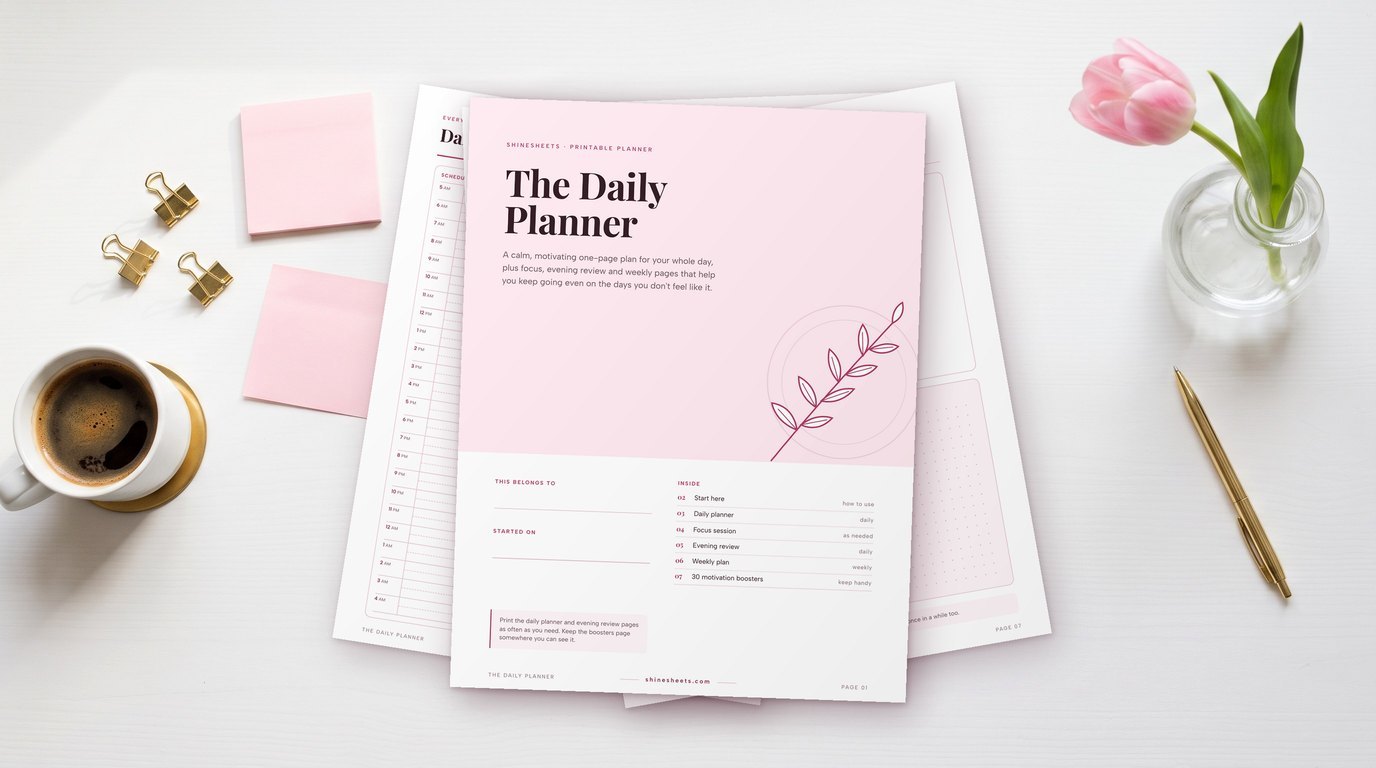
- Write one task list. Write down what you want to work on today, in order. Not ten lists across three apps, just one. A simple undated daily focus planner with space for tasks and tick marks works well, or any notebook.
- Estimate in pomodoros. Next to each task, note how many pomodoros you think it needs. "Reply to emails: 1. Write proposal: 3." This makes big tasks feel manageable.
- Put your phone out of reach. Not face down next to you. In another room, in a drawer, or in a phone lock box if you need extra help. Most of us check our phones out of habit, not need.
- Close extra tabs. Keep open only what you need for this task.
- Prepare your basics. A glass of water, a cup of tea, the right lighting. Fewer reasons to get up.
- Reduce noise. If your space is loud, cream noise-cancelling headphones can turn a busy home or office into a quieter bubble.
If your phone is the biggest focus thief, you might also like my guide to a gentle digital detox. Even small changes, like turning off non-essential notifications, make pomodoros feel much easier.
What Counts as a Real Break

The breaks are not a reward for good behavior. They're half of the method. Short breaks let your attention recover, so the next pomodoro is just as focused as the first. And just to say it clearly: rest is never wasted time. It's what makes the focused time possible.
The trick is choosing breaks that actually refresh you. Good 5-minute breaks:
- Stand up, stretch your back and roll your shoulders.
- Refill your water or make a cup of tea.
- Look out the window at something far away (your eyes will thank you).
- Walk to another room and back, or step outside for a breath of fresh air.
- Do a few slow breaths: in for 4, out for 6.
- Tidy one small thing, like your desk or a few dishes.
What doesn't work as well: social media, email or the news. These keep your brain switched on and can easily turn 5 minutes into 25. A glass water bottle with a straw on your desk is a sweet cue: use breaks to refill it, and you'll quietly drink more water too.
For longer breaks after four pomodoros, try a short walk, a snack, a phone call with a friend or simply lying down for a few minutes.
How To Handle Interruptions
Interruptions are part of real life, especially if you work around other people. Cirillo's original method suggests a simple three-step approach, often summarized as inform, negotiate, call back:
- Inform. Let the person know you're in the middle of something. "I'm focused on something right now."
- Negotiate. Offer a specific time. "Can I come back to you in 15 minutes?"
- Call back. When your pomodoro ends, follow up as promised. This is what builds trust, so people get comfortable waiting.
For internal interruptions (the sudden urge to check something, buy something or reply to someone), keep a small "later" list beside you. Write it down and return to your task. Your brain relaxes once it knows the thought is saved.
If an interruption is truly urgent, stop the pomodoro and handle it. Then start a fresh 25 minutes when you're back. A pomodoro that gets abandoned isn't a failure. It just doesn't get a tick mark.
Adjusting the Lengths To Fit Your Energy

The classic 25/5 rhythm is a starting point, not a rule. Different tasks and different days need different timing. Some popular variations:
- 50/10: Great for deep work like writing, coding or studying complex material, once you're used to focusing.
- 45/15: A gentle middle ground with longer recovery.
- 15/5: Perfect for low-energy days, tasks you're dreading or when you're just getting back into a routine.
- 10/2: For the tasks you really, really don't want to do. Ten minutes is almost always doable.
A small honest admission: coffee sometimes perks me up and sometimes makes me jittery, and on the jittery days, shorter pomodoros feel much kinder. Notice how your energy changes through the day and match the length to it. Many people focus best in the morning and do better with shorter sessions after lunch.
Using Pomodoro for Different Kinds of Tasks
The technique isn't only for desk work. Here's how to adapt it to different parts of your life.
Studying

Pomodoro was born as a study method, so it fits naturally. Use one pomodoro for reading, the next for making notes or flashcards, and a third for testing yourself. During breaks, try recalling what you just learned without looking. For exam prep, 25/5 often works better than long sessions, because shorter blocks keep your attention sharp.
Cleaning and Home Tasks
Set a timer for 25 minutes and clean one area: the bathroom, the kitchen counters, the laundry pile. When it rings, stop, even if it's not perfect. You'll be amazed how much gets done, and having an end point makes it so much easier to start. A "power hour" of two pomodoros on a Sunday can reset an entire home.
Creative Work
Creative work often needs warm-up time, so you might prefer 45 or 50-minute sessions. Use the first pomodoro for low-pressure tasks (gathering references, outlining, sketching) and save the deep creative work for the second and third. If you hit a wall, the break often brings the idea you were missing.
If Your Focus Works Differently
Many people whose attention naturally wanders, including people with ADHD, find timed sessions helpful, though everyone is different and it's not a treatment for anything. Some gentle tweaks that people find useful:
- Start with shorter sessions (10 or 15 minutes).
- Use a visual timer you can see counting down.
- Pair the task with a "body double" (a friend working alongside you, in person or on a call).
- Allow yourself to switch tasks between pomodoros if one feels stuck.
- Celebrate every completed pomodoro, even a small one.
If concentration feels hard most days, my guide to trouble focusing covers more gentle, everyday reasons and ideas.
A Sample Pomodoro Day
Here's what a realistic workday might look like using the Pomodoro Technique. Adjust the times and tasks to fit your life, and screenshot it if you'd like a starting point.
| Time | Block | What you do |
|---|---|---|
| 9:00–9:10 | Planning | Write today's task list, estimate pomodoros, phone away |
| 9:10–9:35 | Pomodoro 1 | Hardest or most important task |
| 9:35–9:40 | Short break | Stand, stretch, refill water |
| 9:40–10:05 | Pomodoro 2 | Continue the important task |
| 10:05–10:10 | Short break | Look out the window, slow breaths |
| 10:10–10:35 | Pomodoro 3 | Finish or move the task forward |
| 10:35–10:40 | Short break | Make tea |
| 10:40–11:05 | Pomodoro 4 | Emails and messages, batched |
| 11:05–11:35 | Long break | Walk outside, snack, call a friend |
| 11:35–12:25 | Pomodoros 5–6 | Second priority task |
| 12:25–13:15 | Lunch | Fully away from your desk |
| 13:15–14:45 | Pomodoros 7–9 (15/5 if energy dips) | Meetings prep, admin, smaller tasks |
| 14:45–15:15 | Long break | Stretch, fresh air |
| 15:15–16:05 | Pomodoros 10–11 | Wrap-up tasks, tomorrow's plan |
Eight to eleven pomodoros is a very full, very productive day. Many people find six to eight focused pomodoros is plenty, especially with meetings in between. If you like planning your day in blocks, the Pomodoro Technique fits right inside time blocking: block the time for a project, then work through it in pomodoros.
How To Track Your Pomodoros

Tracking is optional, but it can be surprisingly motivating, and it teaches you a lot about your work.
- Tick marks: Make a small mark next to a task for each finished pomodoro. At the end of the day, you see exactly where your focus went.
- Estimate vs actual: Compare how many pomodoros you guessed a task would need with how many it took. Over a few weeks, your estimates get much more accurate, which makes planning easier.
- Interruptions: Note with a small dash when you were interrupted. If the same interruption keeps appearing, you've found something worth fixing.
- Weekly glance: On Friday, count your pomodoros. Not to judge yourself, just to notice patterns. Which days felt easiest? Which times of day?
This kind of gentle tracking also makes it easier to stay on top of your workload, and my guide on how to be more organized at work has more ideas for keeping tasks clear and calm.
Pomodoro vs Other Focus Methods
The Pomodoro Technique plays nicely with other productivity methods, so you don't have to choose just one.
- Time blocking decides when you work on something. Pomodoro decides how you work inside that block.
- Eat the frog means doing your hardest task first. Pairing it with Pomodoro makes the frog much less scary, because you only have to face it for 25 minutes. My guide to the eat the frog method explains how to pick that one task.
- A priority matrix helps you choose what deserves your pomodoros at all, so your best focus goes to what truly matters.
Think of Pomodoro as the engine and the other methods as the map. One keeps you moving, the others make sure you're heading in the right direction.
Common Pomodoro Mistakes
Most people who say "Pomodoro doesn't work for me" are bumping into one of these:
- Skipping breaks. It feels productive in the moment, but it's the fastest way to burn out by the afternoon.
- Using breaks for social media. Your brain doesn't really rest, and the break stretches longer than planned.
- Choosing vague tasks. "Work on project" leads to wandering. "Write the introduction" leads to focus.
- Multitasking inside a pomodoro. One task per pomodoro, always.
- Being too rigid. If 25 minutes doesn't suit a task, change it. The method should serve you, not the other way around.
- Keeping the phone within reach. Even a silent phone on your desk pulls at your attention.
- Judging yourself for "bad" days. Some days you'll finish ten pomodoros, some days two. Both are fine.
Your First-Day Plan

If you'd like to try it tomorrow, here's a simple plan that keeps things light:
- Tonight: Write down three tasks for tomorrow. Choose one that you've been putting off.
- Tomorrow morning: Put your phone in another room and set out water and tea.
- First pomodoro: Work on the task you've been putting off for just 25 minutes.
- Break: Stand up, stretch, look out the window for 5 minutes.
- Do three more: Complete four pomodoros in total, then take a 20-minute break.
- End of day: Count your tick marks and note how it felt. Adjust the length for day two if needed.
Try it for one week before deciding whether it suits you. The first two days often feel a little awkward. By day four or five, many people notice that starting has become much easier.
Final Thoughts
The Pomodoro Technique works because it's kind to your brain. It asks for focus in small, achievable pieces and gives rest in return, again and again throughout the day.
You don't need perfect discipline or a perfect setup. One task, one timer and 25 minutes are enough to begin. Start with a single pomodoro tomorrow and let the small wins add up.