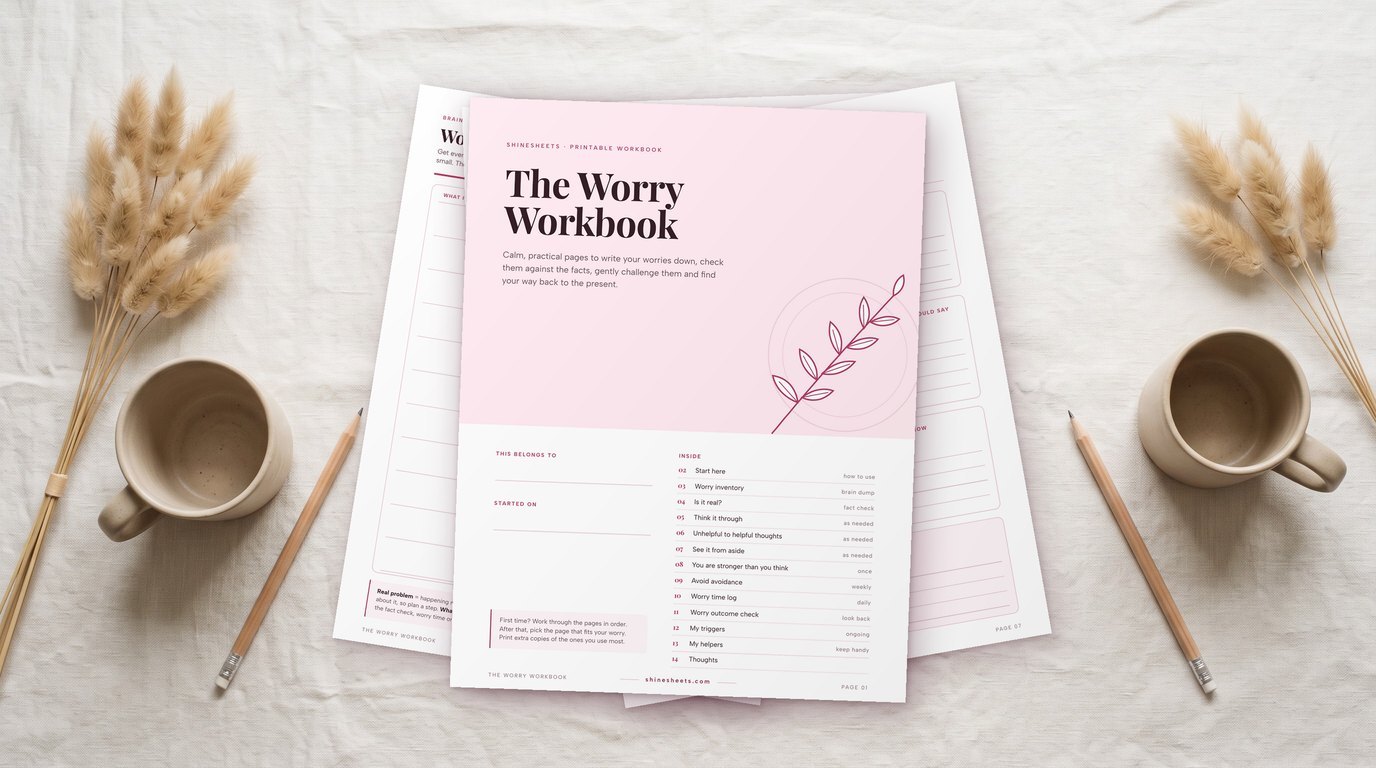
A busy mind is rarely full of big problems. It's full of small, unfinished things: the email you need to answer, the birthday next week, the light bulb in the hallway, the vague worry about money, the idea you don't want to forget. Each one takes up a little space, and together they create that buzzing, scattered feeling where you're tired but can't settle.
Your brain keeps replaying those unfinished things because it's afraid you'll forget them. The fastest way to quiet it is to move everything out of your head and onto paper, where it's safe. Then you can look at the pile calmly and decide what actually matters today. That's the whole idea of a brain dump, and it's one of the simplest tools I know for turning mental noise into a clear next step.
This guide covers what a brain dump is and why it works, the best times to do one, a step-by-step 15-minute method, a 4-box sorting grid that turns your messy list into a plan, prompt categories to catch the things you forgot, and whether paper or digital works better. By the end, you'll have a ritual you can use any time your head feels too full.
What a Brain Dump Is and Why It Calms Your Mind

A brain dump is exactly what it sounds like: you write down everything that's on your mind, without filtering, organizing or judging it. Tasks, worries, ideas, reminders, half-formed thoughts. Everything goes on the page.
It works because of something psychologists often call "open loops." When you have an unfinished task, your mind tends to keep it active in the background so you don't forget it. One or two open loops are fine. Thirty of them create a constant low hum of stress. Writing them down tells your brain, "This is captured. You can stop holding it." Many people feel the relief within minutes.
A brain dump also gives you perspective. In your head, everything feels equally urgent. On paper, you can see that "reply to the landlord" and "learn Italian someday" are not the same size. That clarity alone takes a lot of pressure off.
It's different from journaling, by the way. Journaling explores feelings and reflections. A brain dump is more practical: it empties the drawer so you can sort it. The two work beautifully together, though, and if you love writing, my list of journaling ideas is a lovely next step.
When To Do a Brain Dump
You can do a brain dump any time your head feels crowded, but a few moments make it especially useful:
- Sunday afternoon or evening. A brain dump is the perfect start to planning the week ahead. It fits naturally into a Sunday reset routine.
- Before bed. If your mind starts listing tasks the moment your head hits the pillow, a short brain dump an hour before sleep can help you let go of the day.
- On overwhelmed mornings. When you don't know where to start, 15 minutes of writing is faster than an hour of scattered half-starts.
- Before a big transition. A new month, a trip, a move, a busy season at work. Empty your head before life gets fuller.
- When you notice you're avoiding everything. Overwhelm often looks like procrastination. A brain dump shrinks the overwhelm back to a list.
Many people find a weekly brain dump on Sunday plus a quick one whenever needed is the sweet spot.
What You Need for a Brain Dump
Almost nothing, which is part of the charm. A pen and any paper will do. But a few small tools make it more inviting, and anything that makes you want to sit down is worth having:
- A dedicated notebook. A cream linen notebook used only for brain dumps keeps them all in one place, so you can look back and see patterns.
- A pen that writes smoothly. A set of pastel gel pens is handy if you like color-coding your four boxes later.
- Sticky notes. Pastel sticky notes are perfect for your top three tasks. One note, one task, stuck where you'll see it.
- A clipboard. If you like to brain dump on the sofa or in bed, a gold clipboard gives you a steady surface and looks pretty on a desk too.
- A timer. Fifteen minutes, so it stays a quick ritual rather than an afternoon project.
How To Do a Brain Dump in 15 Minutes: 5 Steps
Here's the simple method I'd recommend. The times are a guide, not a rule, but they help keep you moving instead of perfecting your list.
Step 1: Settle In (1 Minute)
Sit somewhere comfortable with your notebook and a pen. Put your phone face down or in another room. Take three slow breaths, longer on the exhale. This tiny pause helps you shift from doing mode to noticing mode.
Write today's date at the top of the page and set a timer for 15 minutes. That's it. You're ready.
Step 2: Write Everything Down Without Sorting (7 Minutes)

Now write down everything that's on your mind. Everything. Big tasks, tiny tasks, worries, ideas, things you need to buy, people you need to call, the thing you said last week that still bothers you. Write it all as a simple list, one item per line.
The rules for this step are simple:
- Don't sort. "Book dentist" can sit right next to "worried about my mom" and "try that new bakery." Sorting comes later.
- Don't judge. Nothing is too small or too silly. If it's taking up space in your head, it goes on the page.
- Don't solve. If you catch yourself planning how to do something, just write the item and move on.
- Keep the pen moving. When you run dry, use the prompt categories below to jog your memory.
Most people write between 20 and 50 items. If you write more, that's completely fine. It just means your brain was carrying a lot.
Step 3: Sort Into Four Boxes (4 Minutes)
Read through your list once and give every item a letter, or a color if you have gel pens:
- D for Do: things you'll do yourself this week.
- S for Schedule: things that need a specific date or time, or belong later.
- A for Ask or delegate: things someone else can do, or where you need someone's input.
- L for Let go: things that don't matter, can't be controlled, or aren't yours to carry.
Work quickly. Your first instinct is usually right, and you can always move something later. The full grid is below if you want to draw it out on a fresh page.
Step 4: Pick Your Top 3 (2 Minutes)
Look only at your "Do" items and choose three that would make the biggest difference this week, or today, if it's a daily dump. Not the easiest three. Not the most urgent-sounding three. The three that would make you feel most relieved once done.
Write each one on its own sticky note and put them somewhere you'll see them: your laptop, the fridge, the bathroom mirror frame. Three is a number you can actually finish, and finishing builds momentum.
Step 5: Park the Rest (1 Minute)
Everything else from "Do" and "Schedule" goes onto a parking lot list: a separate page in your notebook, a note in your phone or a page of a weekly planner. It's not forgotten, it's parked. You'll come back to it when your top three are done or during your next weekly planning session.
Then cross out everything in "Let go." Physically crossing it out is surprisingly satisfying, and it's a small signal to your mind that you've made a decision about it.
The 4-Box Brain Dump Sorting Grid
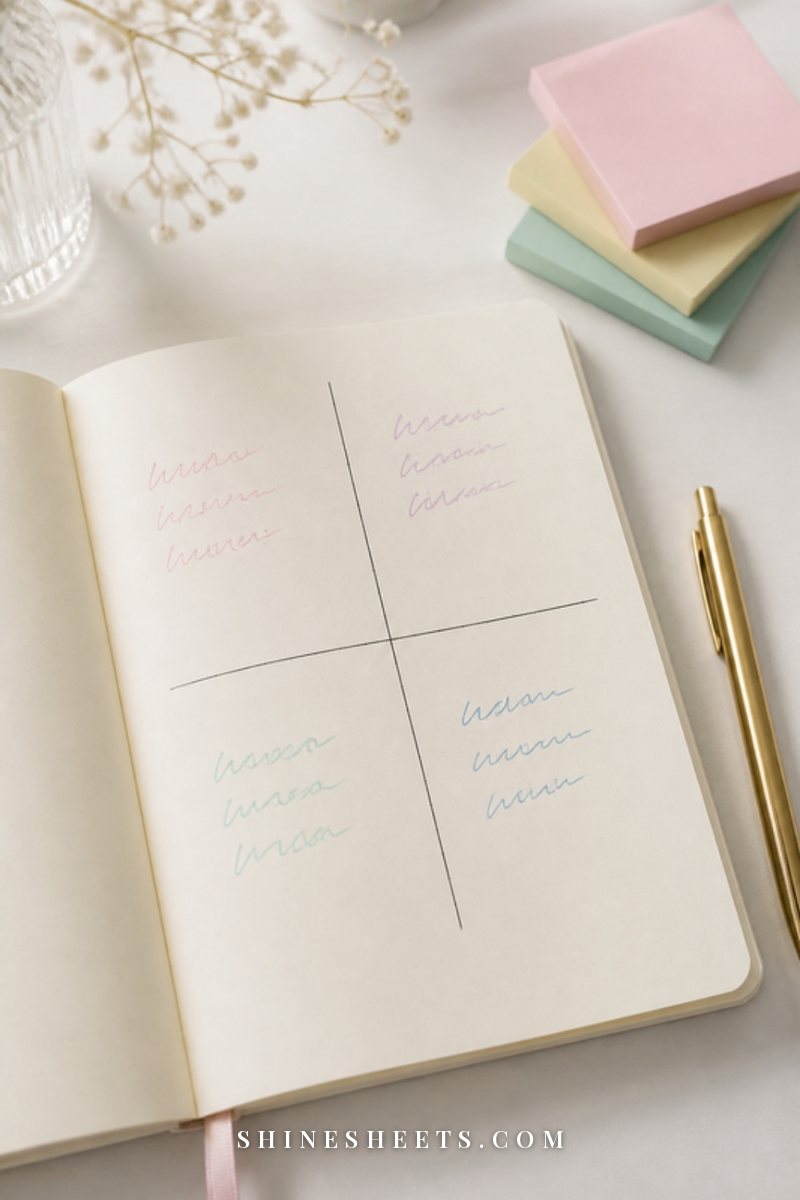
This grid is the heart of the method, and it's what turns a messy list into something you can actually act on. Draw it on a fresh page after your list, or screenshot this version and keep it on your phone.
| DO (this week, by me) | SCHEDULE (needs a date or later) |
|---|---|
| Tasks you'll handle yourself in the next 7 days. Choose your top 3 from here. Examples: reply to the landlord, pay the electric bill, buy a birthday gift. | Tasks tied to a date, or important but not this week. Put them in your calendar or planner now. Examples: book a dentist appointment, plan a weekend trip, renew a passport in spring. |
| ASK (delegate or need input) | LET GO (not mine to carry right now) |
| Things someone else can do, or where you're waiting on someone. Write who and send the message today. Examples: ask a partner or roommate to handle groceries, ask a coworker for the file, ask a friend for a recommendation. | Worries you can't control, "shoulds" you've outgrown and tasks that don't truly matter. Cross them out. Examples: what that person thought of something you said last month, reorganizing a drawer nobody sees, a hobby you no longer enjoy. |
A few notes on each box:
- Do should be realistic. If it has more than 10 items, move some to Schedule.
- Schedule only works if it actually goes on a calendar. An item without a date is just another open loop.
- Ask is the box most of us underuse. Even one delegated task can free up an evening.
- Let go is the kindest box. Some worries deserve attention and some just need to be acknowledged and released. If a worry keeps coming back, it may belong in a journal instead, where you can explore it gently.
Brain Dump Prompts To Catch Forgotten Items

When the pen stops, it's usually because you've emptied the top layer. Run through these eight categories and ask, "Is there anything here on my mind?"
- Home: repairs, cleaning, things to replace, household supplies, a room that bothers you.
- Work: emails to answer, deadlines, meetings to prepare for, ideas, conversations you're avoiding.
- People: birthdays, someone to call back, a thank-you you owe, a friend you've been meaning to check on.
- Money: bills, subscriptions to cancel, a budget check, a return to make, savings goals.
- Body: appointments, sleep, movement, prescriptions, that ache you keep ignoring.
- Errands: post office, pharmacy, dry cleaning, a gift to buy, the car.
- Worries: anything that's quietly bothering you, even if there's nothing to do about it.
- Ideas: things you'd like to try, places to visit, books to read, projects you dream about.
The "Worries" category is important. Writing down a worry, even one you can't act on, often makes it feel smaller. If the worries tend to show up at night, my guide on how to stop overthinking at night has more gentle tools for that.
Paper vs Digital Brain Dumps
Both work. The best one is the one you'll actually use. Here's how they compare:
Paper is slower, and that's a good thing. Writing by hand helps you process rather than just record, and there are no notifications waiting to pull you away. It also feels calmer: a notebook, a cup of tea, a quiet corner. Choose paper for weekly dumps, evening dumps and anytime you feel emotionally overwhelmed.
Digital is faster and easy to search. A notes app is great for quick, on-the-go dumps, like on a train or between meetings, and for long-term parking lot lists you'll edit often. The downside is that your phone is also where distractions live.
A combination works beautifully for many people: brain dump on paper, then move the Schedule items into your digital calendar and keep the parking lot list wherever you plan. A weekly planner pad on your desk is a nice middle ground, because you can see the whole week at a glance without opening a single app.
What To Do After Your Brain Dump
A brain dump is only half the magic. The other half is what happens next. Here's how to turn your page into a calmer week:
- Put the Schedule items on your calendar right away. Give each one a day or a reminder.
- Send your Ask messages today. Waiting turns them back into open loops.
- Give your top 3 a time slot. Block out 30 to 60 minutes for each one. If you'd like to try this properly, my guide to time blocking for beginners is a gentle place to start.
- Review your parking lot once a week. Pick the next three from it during your weekly planning. My guide on how to plan your week walks through that rhythm step by step.
- Close the notebook. Literally. It marks the end of the ritual and tells your mind it can rest.
Over a few weeks, your old brain dump pages become surprisingly useful. Flip back through them once a month and notice what keeps appearing. A task that shows up on every list is either something you need to schedule properly, ask for help with or decide to let go of for good. A worry that repeats every week might deserve a real conversation or some time with your journal. Patterns like these are hard to see in your head, but very easy to spot on paper.
And on the weeks when you only manage your top three and nothing else, count that as a win. The point of a brain dump was never to do everything. It was to stop carrying everything at once.
The 3-Minute Daily Mini Brain Dump
Once the weekly brain dump becomes a habit, a tiny daily version keeps your head from filling back up. It takes three minutes and works well at the end of the workday or with your evening tea.
- Write down anything new that's appeared in your head today. Usually it's just five to ten items.
- Give each item a letter from the four boxes: D, S, A or L.
- Choose tomorrow's one most important task and write it on a sticky note for the morning.
That's all. The daily version isn't about planning your whole life. It's about closing the day's open loops so they don't follow you into the evening. I like doing it right before I journal, because once the practical clutter is out of the way, there's room for the reflective thoughts underneath.
A brain dump is also a gentle way to see how much invisible work you're carrying. If your lists are always full of other people's appointments, birthdays and household details, you may be holding a big share of the mental load, and seeing it on paper is often the first step toward sharing it more fairly.
Common Brain Dump Mistakes
A brain dump is simple, but a few habits can make it less helpful than it should be:
- Sorting while you write. It slows you down and makes you censor things. Write first, sort later.
- Turning the whole list into a to-do list. Not everything needs doing. The Let go box exists for a reason.
- Picking ten top priorities. Three is enough. Ten just recreates the overwhelm on a sticky note.
- Doing it once and expecting lasting calm. New open loops appear every day. A weekly habit keeps your head clear.
- Making it pretty instead of useful. A beautiful notebook is lovely, but messy handwriting is completely fine. This page is for you.
- Doing it right before sleep with screens on. Give yourself a little gap between your dump and bedtime, and keep the lights low.
Final Thoughts
A brain dump is a small act of kindness toward your own mind. Instead of asking it to hold everything at once, you give it a page to rest on, a grid to sort with and three clear things to focus on.
Set a timer for 15 minutes this week, write until your head feels lighter, and let the rest wait in the parking lot. You don't need to do everything. You only need to know what comes next.