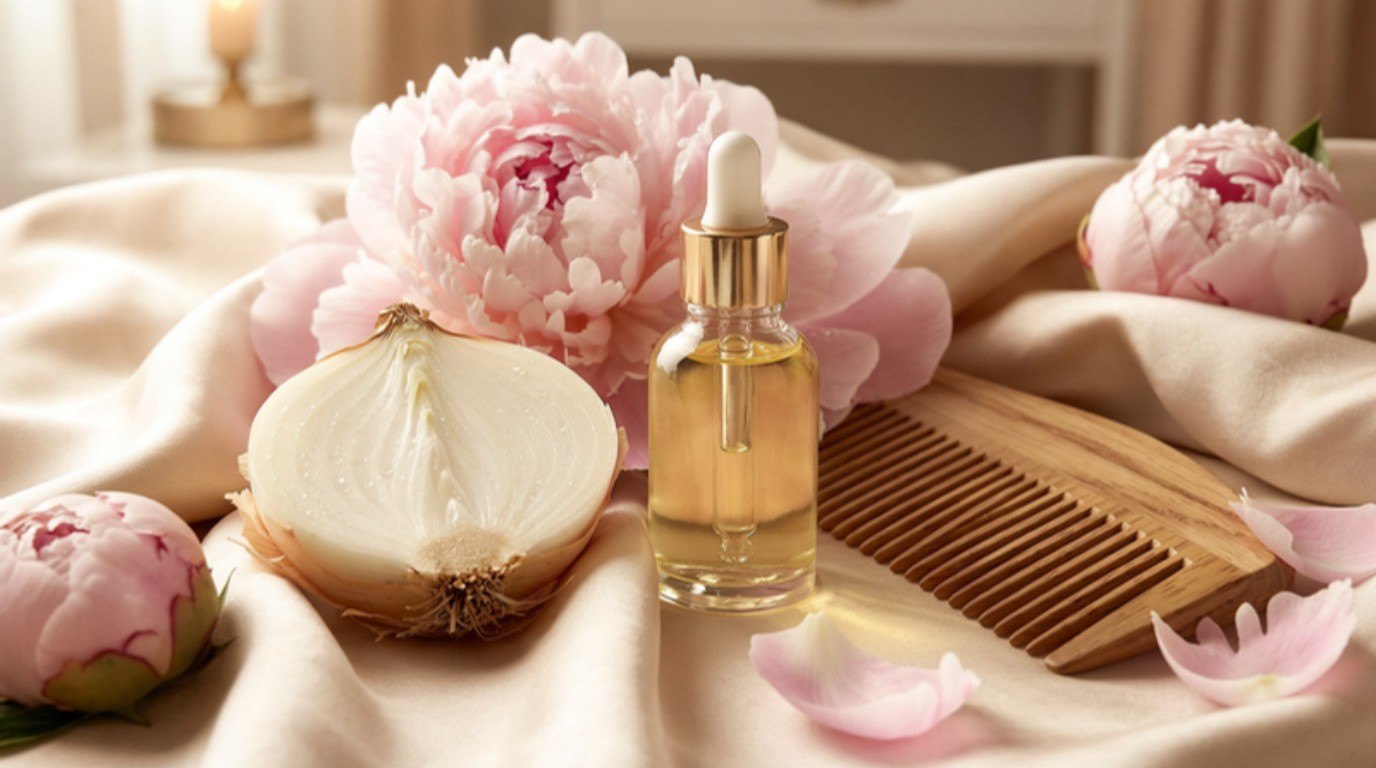
Onion juice for hair is one of those remedies that sounds almost too simple: grate an onion, put the juice on your scalp, wait for thicker hair. The internet is full of glowing before-and-after claims, and the idea is genuinely interesting. But the honest answer is a lot quieter than the hype, and you deserve the quiet version before you put something this strong on your skin.
Here is the short story: there is a believable theory behind it, a very small amount of research, and a real chance of irritation and a stubborn smell. That doesn't mean you can't try it. It means you go in with realistic expectations, a patch test and a plan for stopping if your scalp says no.
This guide to onion juice for hair covers what the research actually shows, a claims-versus-evidence table, who might want to try it and who should skip it, a careful step-by-step method, how to deal with the smell, and the four gentle basics that support healthy hair whatever you decide.
Does Onion Juice Really Help Hair Grow?
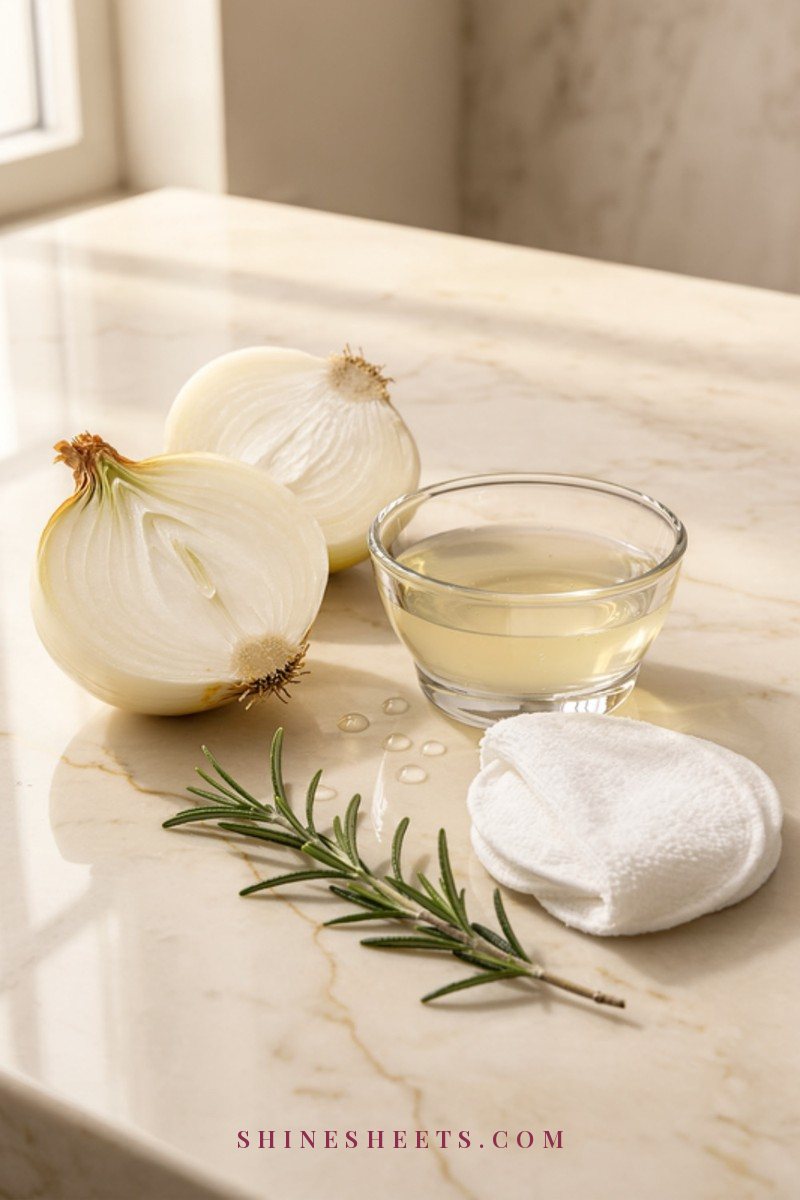
The theory goes like this. Onions are rich in sulfur compounds, and sulfur is part of keratin, the protein your hair is made of. Onions also contain antioxidant plant compounds, and fresh onion juice can have a mild antibacterial effect. Put those together and you get a tidy-sounding idea: feed the scalp sulfur, calm the environment around the follicle, and hair grows better.
The problem is that a tidy idea is not the same as proof. Your body doesn't pull keratin-building sulfur from juice sitting on the skin of your scalp for half an hour, and there is no good evidence that the follicle is short on sulfur in the first place.
What the Research Actually Shows
Most articles about onion juice point back to one small study from the early 2000s. It looked at a few dozen people with alopecia areata, an autoimmune condition that causes round, patchy hair loss, and compared crude onion juice with tap water. More people in the onion group saw regrowth in those patches.
That sounds encouraging, and it is a genuinely interesting result. But it comes with big limits:
- It was very small, with only a few dozen participants.
- It was not well blinded (you can't really hide the smell of onion from anyone).
- It was about patchy autoimmune hair loss, not everyday thinning, shedding or slow growth.
- Alopecia areata patches sometimes regrow on their own, which makes small studies hard to read.
- It hasn't been followed by larger, careful trials that confirm the effect.
Lab and animal studies on onion extracts exist too, but a cell dish or a mouse is a long way from your scalp. The fair summary: onion juice is not proven to make healthy hair grow faster or thicker. It might help a little in specific situations, it might do nothing, and it can irritate. I'd rather tell you that plainly than sell you a miracle.
If you're comparing natural growth remedies, my guide on how to use rosemary oil for hair growth walks through a similar "promising but limited" evidence picture, with an option that most people find easier to live with.
Onion Juice for Hair: Claims vs Evidence
Screenshot this table if you like. It is the whole article in one glance, and it is the thing I'd want a friend to see before she starts grating onions at midnight.
| Popular claim | What the evidence says | Realistic expectation | Safer option to pair or swap in |
|---|---|---|---|
| "It makes hair grow faster" | No good studies in people with healthy hair; growth speed is mostly set by genetics and health | Don't expect visibly faster growth | Protect the length you have with gentle washing and less heat |
| "It regrows bald patches" | One small older study in patchy alopecia areata showed some regrowth; not confirmed by larger trials | Possible, unproven, and patchy loss needs a diagnosis first | See a dermatologist, who has proven treatments for patchy loss |
| "It thickens thinning hair" | No reliable evidence for pattern thinning or general shedding | Unlikely to change density | Find the cause of thinning with a doctor; scalp massage for routine and comfort |
| "The sulfur strengthens hair" | Theory only; the scalp doesn't absorb sulfur into new hair in a useful way | No real strengthening effect | Conditioner, bond-care and fewer hot tools for stronger-feeling strands |
| "It fights dandruff and germs" | Mild antibacterial effects in lab tests; no good scalp studies | Not a dandruff treatment | An anti-dandruff shampoo used as directed |
| "It's natural, so it's gentle" | Onion juice is acidic and pungent and can sting, redden or itch the skin | Irritation is a real risk | Patch test first and stop at the first burning or itching |
Who Might Want To Try It (and Who Should Skip It)
If you're curious, have a calm, healthy scalp and enjoy a little home experiment, onion juice is a reasonable thing to try once or twice a week for a few weeks, as long as you patch test and keep it short. Some people simply like the ritual. That's allowed.
I'd gently suggest skipping it if any of these sound like you:
- You have a sensitive or reactive scalp. If fragrance, new shampoos or hair dye tend to sting, onion juice probably will too. (With my own sensitive skin, this is the group I'd put myself in.)
- You have eczema, psoriasis or seborrheic dermatitis on your scalp. Irritated skin can flare.
- You have any open skin. Scratches, sores, a fresh sunburn or a recently picked spot are a firm no.
- You've just colored, bleached or chemically straightened your hair. Give your scalp time to settle first.
- You know you react to onions or garlic on your skin or in food.
- Your hair loss is sudden, patchy or comes with pain, scaling or redness. That needs a diagnosis, not a kitchen remedy.
If you're not sure whether what you're seeing is normal shedding or something more, read my guide to hair shedding vs hair loss first. It helps you figure out which situation you're in before you try to fix anything.
Before You Start: Always Patch Test
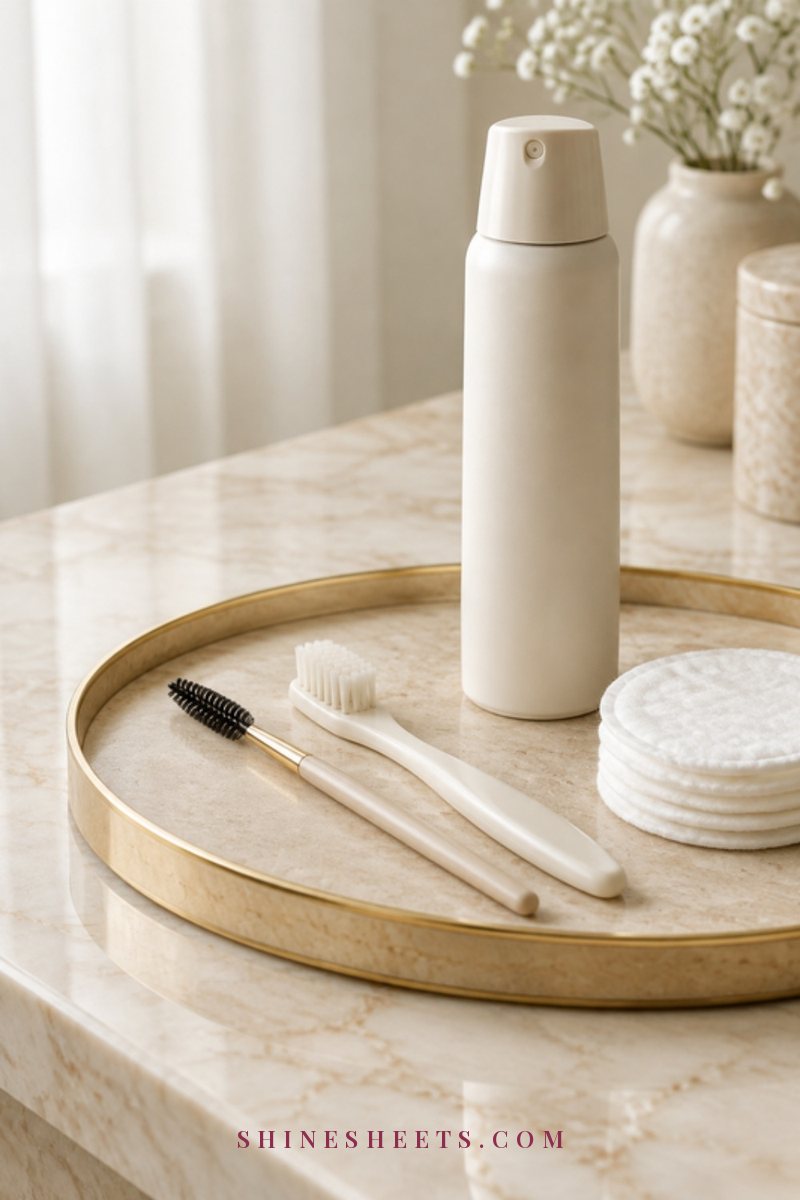
This step isn't optional, even if you've used onion on your hair before. Fresh juice varies from onion to onion, and skin changes from month to month.
- Make a teaspoon of strained juice (see the steps below).
- Dab a small amount on the skin behind your ear or on your inner forearm with a cotton swab.
- Leave it for about 15 to 20 minutes, the same time you'd leave it on your scalp, then rinse with lukewarm water.
- Watch the spot for 24 hours.
A faint pink flush that fades within minutes can be normal. Burning, itching, a spreading rash, bumps or redness that lasts are your sign to stop and skip onion juice entirely. You haven't failed at anything. Your skin just gave you very useful information.
A kind safety reminder: keep onion juice well away from your eyes. If it gets in, rinse with plenty of cool, clean water, and if the stinging doesn't settle, contact a doctor.
How To Use Onion Juice on Your Scalp: 7 Careful Steps

If your patch test went well, here is the careful way to do it. Keep everything small and short. More juice and longer time do not mean better results, only more chance of irritation.
- Make a small amount. Peel half of one onion (white or yellow both work), grate it finely or blend it with a spoonful of water. Half an onion gives enough for one scalp application.
- Strain it well. Press the pulp through a fine strainer or a clean piece of cheesecloth into a bowl. You want only liquid, no bits. Pulp is harder to rinse out and holds more smell.
- Dilute it if you like. Mixing the juice half and half with water makes it gentler, and I'd always start diluted for the first try.
- Use a nozzle, not your fingers. Pour the juice into an applicator bottle with a slim nozzle, then part your hair into sections and apply it directly to the scalp. Keep it off your lengths, which gain nothing from it.
- Massage lightly for one or two minutes. Use the pads of your fingers, never your nails, with small, soft circles.
- Leave it on for 15 to 20 minutes, no longer. Never overnight. A white reusable shower cap keeps drips off your neck and towels while you wait. If you feel burning at any point, rinse right away.
- Rinse thoroughly, then wash. Rinse with lukewarm water for a full minute, then shampoo once and condition your ends as usual.
Once or twice a week is plenty. Make it fresh each time and throw away leftovers rather than keeping them for days, since fresh juice spoils quickly and smells stronger as it sits. Give it six to eight weeks before you judge anything, and if you see no change by then, that's a perfectly fair moment to stop.
Red, White or Yellow Onion, and What To Mix In
Any common onion works. Red onions have a little more of certain plant pigments, but there is no evidence that one color helps hair more than another, so pick whichever you have. Shallots and very strong onions tend to sting more, which is a good reason to stick with an ordinary yellow or white one.
You'll see DIY mixes that combine onion juice with coconut oil, castor oil, honey or aloe. A spoonful of light oil or pure aloe gel can make the mixture feel softer and a little less harsh, and it doesn't hurt to try that version if plain juice feels too strong. What I wouldn't add: essential oils straight from the bottle, lemon juice, garlic, ginger or anything else that tingles. Stacking strong ingredients only raises the chance of irritation, and if your scalp reacts, you won't know which one caused it. Keep it simple, one new thing at a time.
How To Handle the Onion Smell

Let's be honest about the part nobody puts in the before-and-after photos. Onion juice smells strongly, and the smell can cling to your hair, your hands and your bathroom for longer than you'd expect, especially on humid days or when your hair gets damp again.
A few things make it easier:
- Strain thoroughly. Liquid only, as above. Pulp is the main smell culprit.
- Keep the time short. Fifteen minutes smells noticeably less than forty.
- Rinse first with cool to lukewarm water before adding shampoo, so most of the juice leaves your scalp before you lather.
- Wash with a mild shampoo. A gentle sulfate-free shampoo cleans well without stripping a scalp that just had something acidic on it. One thorough wash is better than three harsh ones.
- Try a light rinse afterwards. A cup of water with a spoonful of apple cider vinegar, or a few drops of a hair-safe rosemary or lavender oil in your conditioner, can soften what's left. Skip both if your scalp is already feeling tender.
- Dry with a dedicated towel. Wrap your hair in a soft cream microfiber hair towel that you can toss straight in the wash, so the smell doesn't move into your bath towels.
- Time it well. Do it the evening before a day at home, never right before a date, a meeting or a long day with your hair down.
Wash your hands with soap after applying, and rub them on stainless steel under running water if the smell lingers (it's an old kitchen trick and it does help a little).
4 Gentle Basics That Support Healthy Growth
Here is the part that matters more than any single remedy. Hair grows from the follicle at its own pace, and the most reliable thing you can do at home is protect the length you grow and keep your scalp comfortable. These four basics aren't exciting, but they work quietly in the background whether you try onion juice or not.
1. Scalp Massage
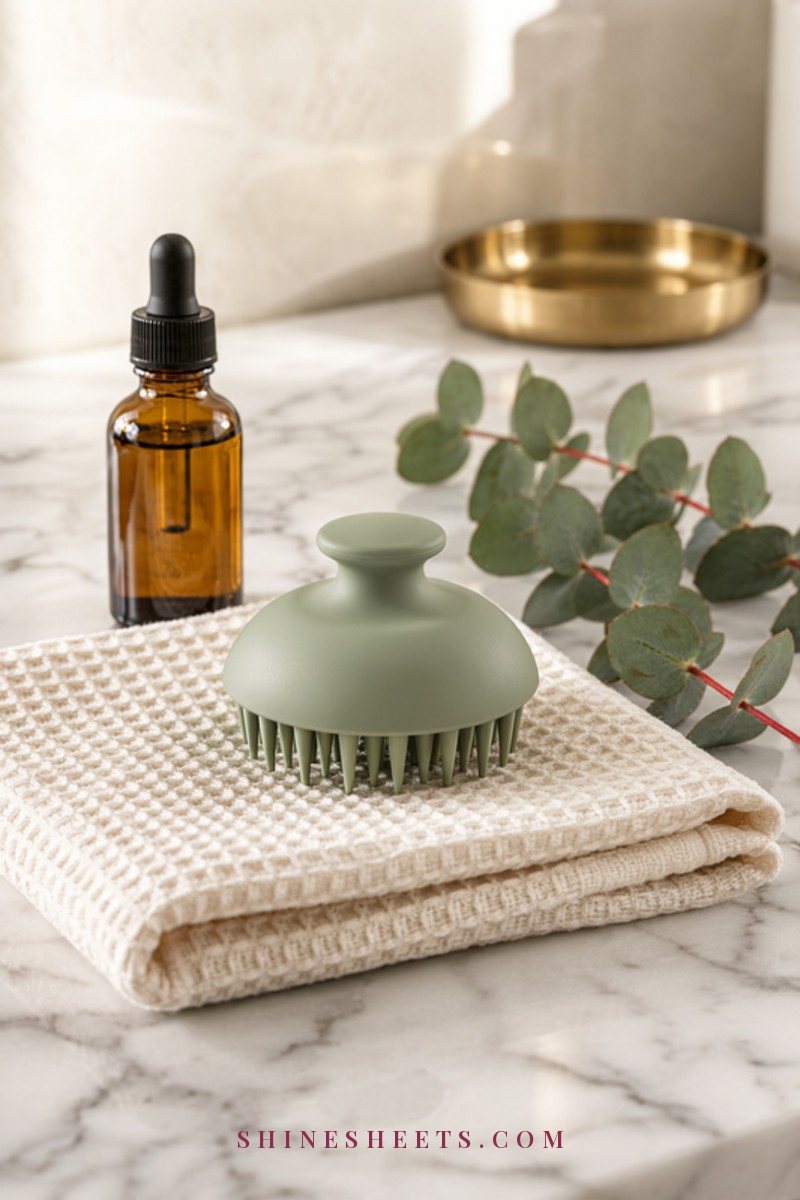
A few minutes of gentle scalp massage feels lovely, brings your attention to your scalp and may support circulation. There is some small research suggesting regular massage can help hair look a little thicker over months, though, like onion juice, it isn't a guaranteed fix.
How: four minutes a day, with your fingertips or a soft sage silicone scalp massager brush, in small circles from the hairline to the crown. Light pressure only. It should feel relaxing, never scratchy. My full guide to scalp massage has the step-by-step and what to realistically expect.
2. Gentle Washing
Your scalp is skin, and like your face it does best with regular, gentle cleansing. Build-up, harsh scrubbing and hot water can all leave it tight, itchy or flaky.
How: wash as often as your scalp needs (for many people that is every one to three days), with lukewarm water and a mild shampoo massaged into the roots, not the ends. Condition your lengths, rinse well and pat dry instead of rubbing. A simple weekly scalp care routine is a calm way to keep this consistent.
3. Less Heat and Tension
Hot tools and very tight styles don't change how fast hair grows, but they break it, and broken hair never looks like it's getting longer. Constant pulling at the roots can also stress the follicles over time.
How: air-dry when you can, use the lower heat settings, always add a heat protectant and give your hair two or three heat-free days a week. Loosen anything that pulls at your hairline, swap tight elastics for soft scrunchies, and change where you place ties so the same spot isn't stressed every day.
4. Patience With Growth Cycles
Every hair on your head is in its own stage: growing, resting or shedding. Losing a few dozen hairs a day is a normal part of that cycle, and new growth is slow, roughly a centimeter a month for most people. That means any change, from any remedy, takes months to show.
How: take one photo of your parting and hairline in the same light today, and another in three months. Comparing photos is far kinder than checking the mirror every morning (I know how tempting that is when you're anxious about your hair). Stress, illness and big life changes can trigger extra shedding a few months later, and that usually settles with time.
When To See a Dermatologist
Home remedies are for curiosity and comfort, not for diagnosing hair loss. Please book an appointment with a doctor or dermatologist if you notice:
- sudden or heavy shedding, like handfuls in the shower,
- round bald patches or patchy loss in your brows or lashes,
- a widening part or a receding hairline that's getting worse,
- itching, burning, pain, scaling, redness or pustules on your scalp,
- hair loss along with other symptoms like tiredness or changes in your cycle.
Many causes of hair loss are very treatable, and the earlier you start, the better. A dermatologist can also tell you whether a home remedy is safe alongside any treatment they recommend. My guide on what to do if you're trying to stop hair loss covers the practical first steps and the questions worth asking at that appointment.
Final Thoughts
Onion juice is a curious little remedy with a believable theory and very thin proof. If you have a healthy, calm scalp and want to try it, patch test, keep it short and diluted, rinse well and give yourself permission to stop the moment it stings or the smell isn't worth it to you.
And whatever you choose, the quiet basics will always be doing the real work: a gentle wash, a few minutes of massage, less heat and a lot of patience. Your hair is growing on its own timeline, and treating it kindly is never wasted.