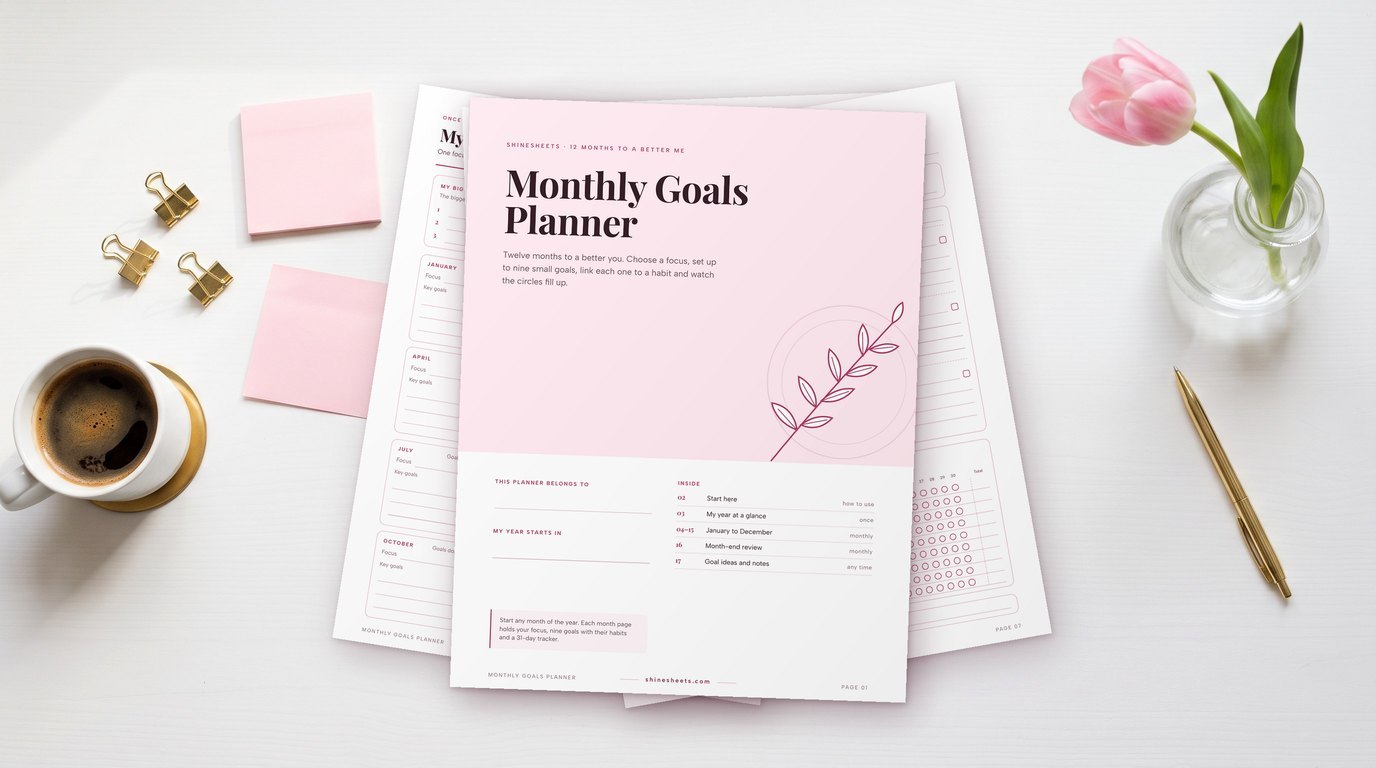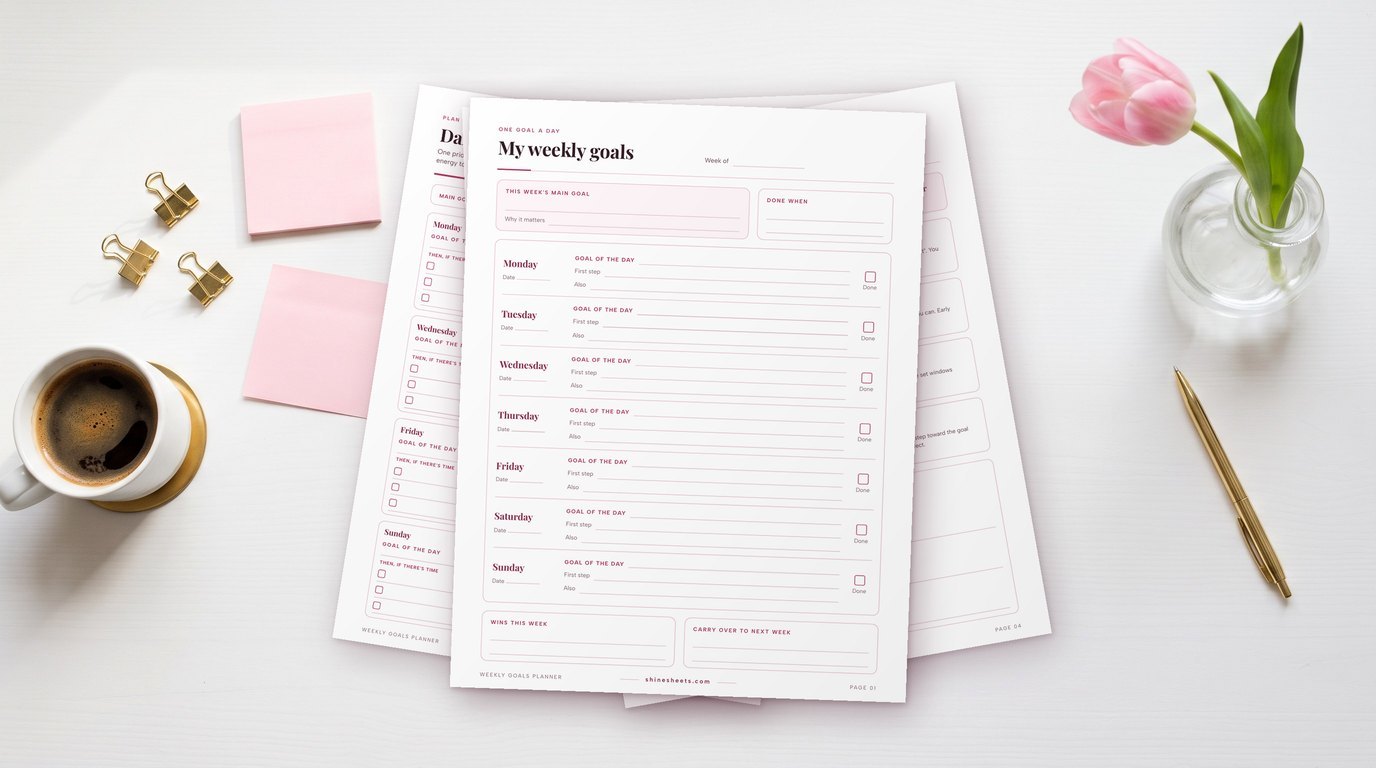
A month is the sweet spot for goals. A year is so long that a goal can drift for weeks before you notice, and a week is so short that one busy Tuesday can wipe it out. Thirty-ish days is long enough to make real progress and short enough that the finish line always feels close.
Monthly goals also forgive you in a way yearly goals never do. If this month was messy, the first of next month is a clean page, no drama required. That small, regular fresh start is exactly what keeps motivation alive when the big-picture plans start to feel heavy.
This guide is full of monthly goals ideas you can actually finish: why they work, how to choose two to four per month, 60 small goals sorted by life area, a month-at-a-glance goal card, a simple way to track everything and a ten-minute month-end reflection. Grab an undated monthly planner or any notebook you like and keep it open while you read.
One gentle promise before we start: none of these goals are about shrinking yourself or proving anything. They're about making each month feel a little more like yours.
Why Monthly Goals Work So Well

Big goals are wonderful for direction, but they are terrible at telling you what to do on a random Wednesday. Monthly goals translate the big picture into something your brain can hold. "Get healthier" becomes "walk after lunch three times a week this month." That's a goal you can see, start and finish.
A few reasons the monthly rhythm works so nicely:
- The deadline is real but kind. Four weeks creates gentle urgency without panic.
- You get frequent wins. Twelve small finish lines a year feel much better than one huge one you might not reach.
- You can adjust quickly. If a goal doesn't fit your life, you find out in weeks, not in December.
- Seasons are built in. A goal for a cold, slow month can be different from one for a busy, bright month, and that's exactly how it should be.
If you already have bigger dreams written down, your goals for the new year are the perfect starting point. Monthly goals are simply the bite-sized pieces you take from them.
How To Choose 2–4 Goals for the Month
The most common reason monthly goals fail is that there are too many of them. Ten goals is a to-do list wearing a costume. Two to four goals, spread across different parts of your life, is a month you can actually enjoy. Here's the simple way I'd choose them:
- Look at the month first. Before picking anything, glance at what's already coming: travel, deadlines, birthdays, a heavy work stretch. A packed month gets two goals. A quiet month can hold four.
- Pick one "feel good" area. Ask yourself where you most want to feel better by the end of the month: rested, organized, connected, calmer with money. That area gets your first goal.
- Add one "keep it running" goal. Something practical for your home, money or work that will make next month easier.
- Add one fun goal. Yes, on purpose. A month with only serious goals feels like homework.
- Shrink each goal until it feels slightly too easy. If your first reaction is "I could definitely do that," it's the right size.
- Write each one with a number or a date. "Read more" becomes "finish one novel by the 28th." Specific goals are much easier to check off.
A small honest admission: I tend to get excited and write down six goals on the first of the month. By the tenth, my anxiety is quietly listing everything I'm behind on. Keeping it to three has made the whole thing feel calm instead of like a test.
60 Monthly Goals Ideas by Life Area
Below are 60 small goals across nine areas of life. Read through, star the ones that make you think "oh, I'd love that," and pick two to four for this month. Save the rest for later months – this list can carry you through a whole year.
7 Self-Care Goals for the Month
- Take one long, unhurried bath or shower a week. Put it in your planner like an appointment so it doesn't get bumped.
- Go to bed 20 minutes earlier on weeknights. Set a gentle evening alarm as your cue to start winding down.
- Do a five-minute skincare routine every night. Cleanse, moisturize, done – consistency beats a ten-step routine you skip.
- Have a no-plans evening once a week. No errands, no catching up, just whatever feels restful.
- Drink a glass of water before your morning coffee. Keep a glass on the counter overnight so it's waiting for you.
- Book one appointment you've been putting off. Dentist, haircut, eye exam – one call, one finished task.
- Spend ten minutes outside every day. A walk, the balcony, the front step with tea. Fresh air counts in any form.
7 Health and Movement Goals
- Walk for 20 minutes three times a week. After lunch or after work, whichever time you can protect.
- Stretch for five minutes every morning. Neck, shoulders, hips and a long reach overhead before you check your phone.
- Try one new kind of movement. A beginner yoga class, a dance video, a swim – just once, for curiosity.
- Add a vegetable to one meal a day. No rules, no counting, just one more color on the plate.
- Take the stairs whenever it's three floors or fewer. A tiny rule that adds up over a month.
- Do two short strength sessions a week. Fifteen minutes of squats, wall push-ups and glute bridges is plenty to start.
- Keep a consistent wake-up time on weekdays. Within 30 minutes either way, even after a late night.
7 Home Goals

- Declutter one drawer or shelf a week. Four small spaces by the end of the month, about 15 minutes each.
- Do a ten-minute reset every evening. Dishes in, surfaces clear, cushions plumped, done.
- Organize your linen closet. Fold everything the same way, group sets together and donate anything thin or stained.
- Fix one small annoying thing. The squeaky door, the burnt-out bulb, the wobbly chair leg.
- Add one small cozy touch. A new throw, fresh flowers on the table or a candle on the nightstand.
- Wash your pillows and change your mattress side. Once a month is a nice rhythm for both.
- Clear your entryway. One spot for keys, one for bags, and shoes that actually go away.
If you like the idea of a full refresh rather than one goal at a time, my monthly reset checklist walks through the whole home, money and mind reset in one go.
7 Money Goals
- Track every purchase for one month. No judging, just writing it down. The awareness alone changes habits.
- Cancel one subscription you don't use. Look at last month's statement and pick the obvious one.
- Move a set amount to savings each payday. Even a small amount, automated, builds the habit.
- Have three no-spend days a week. Mark them in your planner so they feel like a game, not a punishment.
- Make a 24-hour rule for non-essentials. Put it in the cart, close the tab and decide tomorrow.
- Check your accounts every Sunday. Five minutes with tea, looking at balances and upcoming bills.
- Sell or donate five things you no longer use. Clothes, books, the kitchen gadget from three birthdays ago.
6 Mind Goals

- Journal for five minutes three nights a week. I like doing mine after evening tea, when the day finally feels quiet.
- Keep your phone out of the bedroom. Charge it in the kitchen and use a simple alarm clock instead.
- Write down three good things every Friday. A tiny weekly gratitude habit that makes the month feel fuller.
- Practice one calming breath a day. Breathe in for four, out for six, five times, whenever your shoulders rise.
- Have one screen-free morning a week. No news, no messages until after breakfast.
- Notice and rewrite one harsh thought a day. Swap "I'm so behind" for "I'm doing what I can today."
7 Relationship Goals
- Call one friend a week instead of texting. Even a ten-minute voice call feels different from a message thread.
- Send one handwritten note this month. A thank-you, a birthday card or a "thinking of you" for no reason.
- Plan one real get-together. Pick the date, send the invite, don't wait for someone else to organize it.
- Check in on a family member every week. Same day each week makes it easy to remember.
- Put your phone away during meals with others. Face down in a bag, not on the table.
- Say one honest compliment a day. Specific is best: "You explained that so clearly."
- Reconnect with one person you miss. A simple "I was just thinking about you" is enough to open the door.
7 Learning and Hobby Goals
- Finish one book this month. Ten pages before bed gets most novels done in four weeks.
- Learn ten words in a new language. Two or three a week, written on a sticky note by the mirror.
- Start one small creative project. A watercolor postcard, a knitted coaster, a candle – something you can finish.
- Watch one documentary on a topic you know nothing about. Curiosity is a lovely thing to practice.
- Take one class or workshop. Online or local, beginner level, just for fun.
- Cook one dish you've never made before. Any dish, any night, purely for the joy of trying.
- Spend one hour a week on a hobby with no goal. Doodling, puzzles, gardening – no output required.
6 Career Goals
- Clear your inbox to under 20 emails. Archive, answer or schedule, in two or three focused sessions.
- Learn one skill that makes work easier. A spreadsheet shortcut, a better note system, a presentation trick.
- Update your résumé or professional profile. Add what you've done in the last year while you still remember it.
- Protect one focus block a week. Two hours, notifications off, one important task.
- Ask for feedback once this month. One specific question to one person you trust.
- Organize your digital files. One folder per project, a clear desktop and anything old moved to an archive.
6 Just-for-Fun Goals
- Visit one place in your town you've never been. A café, a museum, a park on the other side of the city.
- Have one themed movie night. Old Hollywood glamour, a favorite director, or a childhood classic.
- Take one photo a day. Anything that made you smile, collected into a little album at the end of the month.
- Plan one solo date. Lunch, a bookshop and a walk, all on your own.
- Dress up for no reason once. Your nicest outfit on an ordinary Thursday.
- Say yes to one new invitation. Something slightly outside your usual routine.
If you want even more ideas sorted by timeline, these short-term goals examples are great for the weeks ahead, and these life goals examples help you see where your monthly goals are quietly leading.
Your Month-at-a-Glance Goal Card

This is the one asset I'd copy into every planner. It fits on a single page, it turns each goal into one tiny weekly step, and it gives you a place to tick things off without needing a complicated system. Copy it onto paper or screenshot it as a reference.
| Area | Goal for the month | Tiny weekly step | Week 1 | Week 2 | Week 3 | Week 4 | Done? |
|---|---|---|---|---|---|---|---|
| Self-care | Go to bed 20 minutes earlier | Evening alarm at 9:45 pm on 4 weeknights | ☐ | ☐ | ☐ | ☐ | ☐ |
| Home | Declutter four small spaces | One drawer or shelf every Saturday | ☐ | ☐ | ☐ | ☐ | ☐ |
| Money | Track every purchase | Write down spending each Sunday evening | ☐ | ☐ | ☐ | ☐ | ☐ |
| Fun | Visit one new place in town | Week 1 choose it, week 3 go | ☐ | ☐ | ☐ | ☐ | ☐ |
How to fill it in:
- Area: the part of life the goal belongs to. Keep each goal in a different area so the month feels balanced.
- Goal for the month: one sentence, with a number or date.
- Tiny weekly step: the smallest action you'll repeat each week. This is the most important column.
- Week boxes: tick each week you did the step. Missing one is completely fine.
- Done?: fill this in at the end of the month, during your reflection.
A clear acrylic desk calendar next to your card is a sweet visual reminder, since you can see the whole month and the days you've set aside for each step.
How To Track Monthly Goals Simply
Tracking should take less than two minutes a day. The moment it starts to feel like a second job, it stops happening. Here are four easy options – pick the one that matches your personality:
- The tick box. Use the goal card above and tick weekly. Ideal if you like minimal and calm.
- The sticky note. Write each goal on a separate pastel sticky note and stick them inside your planner cover or on your mirror frame. Move a note to the "done" side when you finish.
- The color dot. Give each goal a color from a soft gel pen set and put a small dot in your planner on every day you work on it. At the end of the month, the colors show you exactly where your energy went.
- The washi line. Run a strip of pastel washi tape down the side of your monthly page and mark progress along it like a little thermometer.
Pair your tracking with your weekly planning, too. On Sunday, look at your goal card and drop each tiny step into a specific day. My guide on how to plan your week shows how to do this in about 20 minutes so your goals actually have a home in your calendar.
And if a week goes sideways, just pick up the next one. A goal that was done three weeks out of four is a goal that worked.
Common Monthly Goal Mistakes
These are the small traps that quietly make monthly goals feel heavy. Gently avoiding them makes a huge difference:
- Choosing goals that depend on other people. "Get promoted" isn't fully in your control. "Ask my manager for one growth conversation" is.
- Making every goal a stretch goal. One challenging goal is motivating. Four is exhausting.
- Restarting from zero after a missed week. Just continue where you are. No need to wait for the next first of the month.
- Choosing goals you think you should want. If it doesn't make your life feel better, it doesn't belong on the card.
- Skipping the reflection. Without looking back, every month blurs into the next and you miss your own progress.
A 10-Minute Month-End Reflection

On the last evening of the month, make a cup of tea, light a candle and give yourself ten quiet minutes with your goal card. Answer these five questions in a few words each:
- What did I finish? List every goal you completed, plus anything good that happened outside your goals.
- What did I almost finish? Progress counts. Write down how far you got.
- What got in the way? Time, energy, a goal that was too big? Be honest, not harsh.
- What felt best this month? This tells you what to keep doing.
- What's one goal for next month? Choose it now, while the reflection is fresh. Then add one or two more on the first.
I keep my reflections in the back of my journal, so at the end of the year I can flip through twelve little snapshots of how my life slowly changed. It's one of the most encouraging things to read on a gray evening.
Final Thoughts
Monthly goals aren't about squeezing more productivity out of every day. They're about choosing, twelve times a year, what you'd like a little more of in your life – and then giving it a gentle, realistic chance to happen.
Start with two or three goals from the list, fill in your goal card and let this month be a small, kind experiment. You don't need a perfect month. You only need a month that feels a bit more like the one you wanted.