Big decisions rarely feel hard because we lack information. They feel hard because we haven't yet asked ourselves the right questions. Once you know what you value, what you're actually afraid of and what your future self would want, the answer often becomes clearer than you expected.
This guide gives you 25 questions to ask yourself before a big decision, grouped into five areas: your values, fear vs. intuition, practical details, your future self and the people involved. You'll also find a simple "decision page" you can copy into your journal, and a three-step plan for the moments when you're still stuck.
You don't need to answer all 25 in one sitting. Pick the group that feels most tangled and start there.

Before You Start: Give Yourself Room To Think
Big choices deserve a calm setting. Answering these questions in a rush, at midnight or right after an emotional conversation tends to make everything feel more urgent than it is.
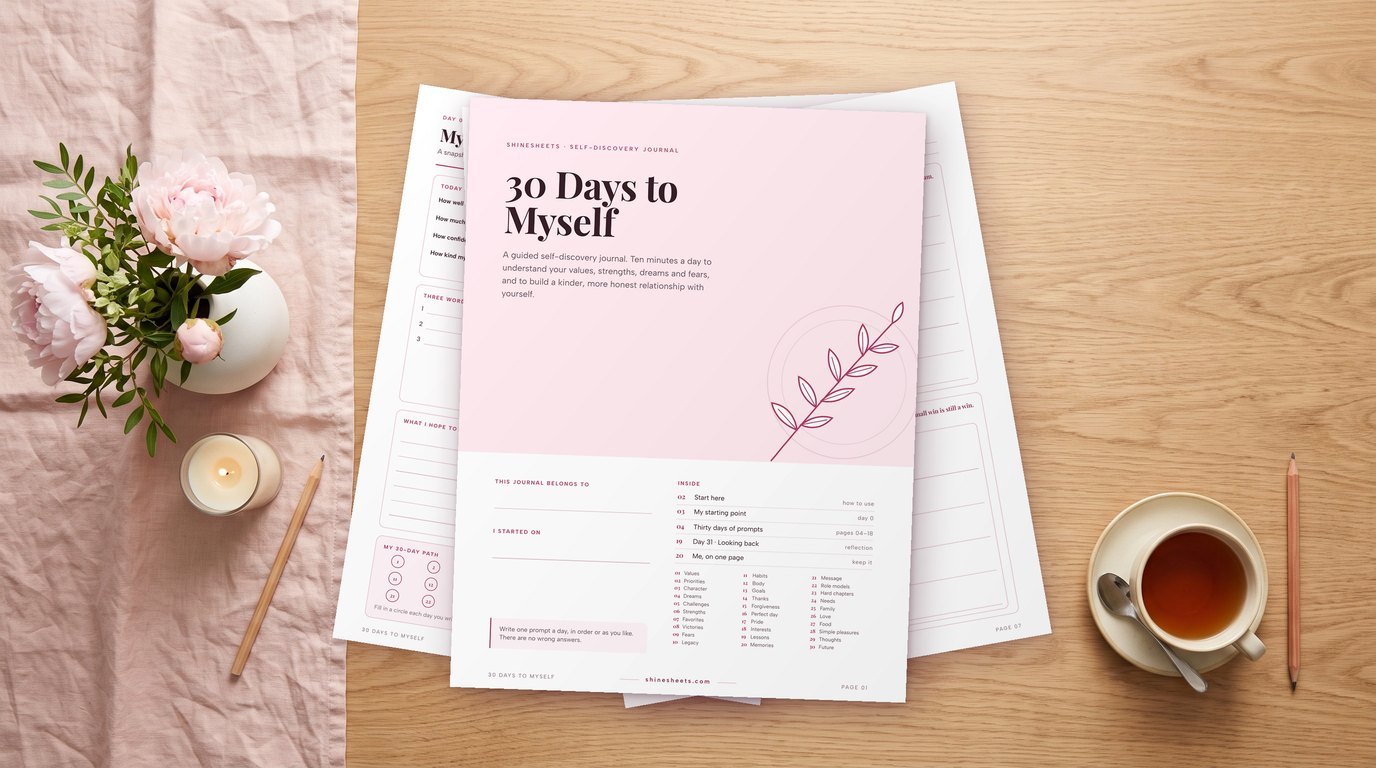
Set aside 30 to 45 minutes when you won't be interrupted. Make a mug of something warm (a pretty tea mug makes it feel a bit more like a ritual), put your phone in another room and grab a notebook. It took me a while to admit it, but my clearest decisions have always been made on paper, never in my head at 2 a.m.
Writing slows your thoughts down enough to actually look at them. If you've never journaled before, my journaling ideas are a gentle place to begin. A smooth nice pen doesn't hurt either. Small comforts make hard thinking easier.
One more thing: these questions are for personal clarity. For decisions involving major money matters, health or legal issues, please also talk with a qualified professional who knows your situation.
25 Questions To Ask Yourself Before a Big Decision
Read through all five groups first, then circle the questions that make you pause. Those are usually the ones worth answering in depth.
Questions About Your Values
Values are the quiet compass under every big choice. When a decision feels impossible, it's often because two things you care about are pulling in different directions. Naming them makes the pull easier to see.
1. What matters most to me right now?
Not forever, just in this season of life. Maybe it's stability, maybe it's adventure, maybe it's rest. Write your top three in order. If an option clearly serves your number one, that's important information.
Try this: Try finishing the sentence "Right now, more than anything, I need…" without editing yourself.
2. Which option fits the person I want to be?
Picture the version of you that you're slowly growing into: kinder, braver, calmer, more honest. Which choice would she make? This question isn't about perfection. It's about direction.
Try this: Write three words that describe her, then check each option against them.
3. Am I choosing this for me or for someone's approval?
A lot of big decisions are quietly shaped by parents, friends or an imaginary audience. There's nothing wrong with caring what people think, but it shouldn't be the deciding vote on your own life.
Try this: Ask yourself: if nobody would ever know which option I picked, would my answer change?
4. What would I regret not trying?
Regret tends to stick around longer for the things we didn't do than for the things we tried and got wrong. This question cuts through a lot of noise, especially when one option feels safer but smaller.
Try this: Imagine telling a close friend, years from now, the story of this moment. Which ending would you rather tell?
5. Does this choice protect what I won't compromise on?
Everyone has a few non-negotiables: your health, your peace, time with people you love, your sense of integrity. A good option might stretch you, but it shouldn't cost you one of these.
Try this: List two or three non-negotiables and cross out any option that breaks one.
Values work deserves a bit of quiet. A guided reflection journal with prompts already on the page is lovely if a blank notebook feels intimidating.
Questions About Fear vs. Intuition
Fear and intuition can feel almost identical in the body. Both create a tight, urgent feeling. The difference is in the message: fear usually shouts about what might go wrong, while intuition quietly points toward what feels true. These questions help you tell them apart.
6. Is this feeling a warning or just unfamiliarity?
New things often feel scary simply because they're new. That's not the same as something being wrong. A real warning usually has a specific reason behind it. Unfamiliarity is a vague, general unease.
Try this: Try naming the exact thing you're afraid of. If you can't, it may be the newness talking.
7. What am I actually afraid will happen?
Fear loves to stay blurry. Pull it into focus by writing the worst realistic outcome in one sentence. Then write what you'd do if it happened. Most fears shrink when they have a plan attached.
Try this: Finish the line "If the worst happens, I would…" and see how capable you actually are.
8. If fear weren't part of this, what would I choose?
This doesn't mean ignoring fear forever. It means hearing what you want first, before fear starts negotiating. Your answer here is often the truest one.
Try this: Close your eyes, take three slow breaths and answer in under five seconds.
9. Does my body feel calm or tight when I imagine each option?
Your body often reacts before your mind catches up. Picture yourself a week into each option. Notice your shoulders, jaw and stomach. Ease and a sense of expansion usually point toward a good fit.
Try this: Spend one full minute imagining each option, then jot down the first physical sensation you noticed.
10. Am I running toward something or away from something?
Both can be valid, but they lead to different results. Running away from a bad situation brings relief, and relief can disguise itself as excitement. Running toward something tends to feel steadier.
Try this: Write one sentence that starts with "I'm moving toward…" If it's hard to finish, look a little closer.
Practical Questions
Feelings matter, and so do logistics. Practical questions keep you grounded and make sure a beautiful choice is also a workable one. They're also wonderfully calming for anxious brains, because they turn a big cloud of worry into a few concrete answers.
11. What do I actually know, and what am I assuming?
Split a page in two. On one side, write facts you've confirmed. On the other, write things you're guessing. You'll often find the scary parts live mostly on the guessing side, and that some of them can be checked with one email or phone call.
Try this: Pick one assumption and find out the real answer this week.
12. What will this cost me in time, energy and money?
Every choice costs something, even the "safe" one. Be honest about the time it takes, the energy it drains or gives, and the budget it needs. For larger money decisions, a qualified professional can help you see the full picture.
Try this: Rate each option's cost from 1 to 5 in each of the three areas.
13. Is this decision reversible?
Some choices are doors you can walk back through (a new class, a new routine, a short trip). Others are harder to undo. Reversible decisions deserve less agonizing. Save your deep thinking for the ones that truly lock in.
Try this: Label each option "easy to undo," "hard to undo" or "permanent."
14. What is the smallest next step I could take?
You rarely need to decide everything at once. Often there's a tiny test step: a conversation, a trial week, a visit, an application you can withdraw. Small steps give you real information, which beats endless thinking.
Try this: Write one step you could take in under 30 minutes.
15. Do I have enough information, or am I hiding in research?
Research is useful until it becomes a way to avoid choosing. If you've read the same advice ten times, you probably know enough. Waiting for perfect certainty can be a decision in itself.
Try this: Set a gentle deadline: "I'll decide by Sunday evening with what I know."
For the practical questions, I'd keep a simple cream desk notepad right next to you. Lists feel lighter on paper than in your head, and crossing off assumptions you've checked is deeply satisfying.
Questions for Your Future Self
Your future self is the one who will live with this choice, so it's only fair to bring her into the conversation. These questions stretch your view beyond today's feelings.
16. How will I feel about this in 10 minutes, 10 months and 10 years?
This is the 10-10-10 approach, and it's simple and surprisingly powerful. Ten minutes from now, you might feel nervous. Ten months from now, you might feel proud. Ten years from now, it might barely register, or it might be the turning point.
Try this: Write one sentence for each time frame, for each option.
17. What would my future self thank me for?
Think of the version of you a few years ahead, looking back. What would she be grateful you did now? Often it's the choice that took a bit more courage or patience in the moment.
Try this: Write a two-line thank-you note from her to you. My guide to writing a letter to your future self is lovely for this.
18. Which choice gives me more options later?
When everything else is equal, the option that keeps more doors open is often the wiser one. It lets you change course as you learn more about yourself.
Try this: Ask: which option makes my world a little bigger, and which makes it smaller?
19. What story do I want to tell about this chapter?
We all narrate our lives in chapters. Imagine this one has a title. Is it "The Year I Played It Safe," "The Year I Finally Tried" or "The Year I Chose Peace"? None of these is wrong, but one probably feels more like you.
Try this: Give each option a chapter title and notice which one makes you smile.
20. If this doesn't work out, will I still be okay?
This is the safety-net question. Most of the time, the honest answer is yes: you'll be disappointed, maybe embarrassed, but okay. Knowing that makes it much easier to move forward.
Try this: List three things (people, skills, resources) that would support you if it didn't go to plan.

Questions About the People Involved
Big decisions rarely affect only us. Partners, family, friends and colleagues are part of the picture. These questions help you care about them without handing over the wheel.
21. Who will this decision affect, and have I talked to them?
Make a short list of the people your choice touches directly. Then check whether you've actually had a conversation with them, or just imagined how they'd react. Real conversations are often kinder than the ones in our heads.
Try this: Pick one person on the list and set up a chat this week.
22. Whose opinion am I giving too much weight?
Sometimes one voice (a critical parent, a confident friend) gets louder than your own. Their view can still be useful, but it's one input, not the final answer.
Try this: Write down whose voice you hear most when you think about this choice. Ask whether they'll live with the outcome.
23. Who in my life has made a similar choice, and what did they learn?
Talking to someone who's already walked a similar path is one of the fastest ways to get real information. Ask what surprised them, what they'd do differently and what they're glad they did.
Try this: Send one message asking someone for 15 minutes of their time.
24. Would I give a friend the same advice I'm giving myself?
We're often wiser and kinder with our friends than with ourselves. Imagine your best friend described your exact situation. What would you tell her?
Try this: Write your advice as if it's a text to her, then read it back to yourself.
25. Can I make this choice and still honor my relationships?
Choosing for yourself doesn't mean abandoning anyone. Often the question isn't "me or them" but "how do I do this in a way that's kind to everyone, including me?"
Try this: Write one way you could share your decision that feels caring and clear.
Your Decision Page
Once you've worked through the questions, bring everything together on a single page. Copy this layout into your journal (or screenshot it) and fill in a short answer for each row. Seeing both options side by side, in your own handwriting, is often the moment things click.
| Prompt | Option A | Option B |
|---|---|---|
| Best case | What's the happiest realistic outcome? | What's the happiest realistic outcome? |
| Worst case | What's the worst realistic outcome, and what would I do then? | What's the worst realistic outcome, and what would I do then? |
| Cost | Time, energy and money it will take | Time, energy and money it will take |
| Gut feeling | One word for how my body reacts | One word for how my body reacts |
| 10-10-10 view | How I'll feel in 10 minutes, 10 months, 10 years | How I'll feel in 10 minutes, 10 months, 10 years |
A few tips for filling it in:
- Keep answers short. One or two lines per box. If you need a paragraph, the question probably needs more thought before it goes on the page.
- Write the gut feeling first. Before you fill in anything logical, jot down your instinct. It's easier to be honest before the reasoning starts.
- Don't add up a score. This isn't a math problem. Look at the page as a whole and notice which column you keep glancing back at.
- Color-code what you learn. Mark facts in one color and assumptions in another. A small pack of pastel sticky notes works nicely for adding thoughts as they come up over a few days.
- Add a third column if you need it. Sometimes the real answer is an Option C you haven't considered, like a smaller version of one choice, or waiting a set amount of time.
If You're Still Stuck: A 3-Step Card
Sometimes you answer every question, fill in the decision page and still feel torn. That's okay. It usually means both options are genuinely good (or genuinely hard). When that happens, try these three steps in order:
- Sleep on it. Give yourself at least one full night, ideally two. Don't revisit the decision before bed. In the morning, notice which option you're leaning toward before you've had time to argue with yourself.
- Talk it out. Explain the choice out loud to one trusted person. You're not asking them to decide. Often you'll hear yourself say "but I really want…" and the answer slips out on its own.
- Pick a test step. Choose the smallest, most reversible action toward one option (a call, a trial week, a visit) and take it within seven days. Then check in with how it feels. Real experience beats more thinking.
If indecision is a pattern for you, not just this one time, my guide on how to stop being indecisive goes deeper into why it happens and how to build trust in your own choices. And if your thoughts keep spinning in circles, how to stop overthinking has a few simple ways to step out of the loop.
Things To Remember While You Decide
- There's rarely one perfect choice. Most big decisions have two or three good paths. You're choosing between options, not between right and wrong.
- Not deciding is also a decision. Waiting can be wise, but endless waiting has a cost too.
- You can adjust as you go. Very few choices are truly final. You'll keep learning, and you're allowed to change course.
- Your feelings are data, not orders. Listen to them, but let them inform the choice rather than run it.
- Be kind to yourself afterward. Whatever you choose, you made the best decision you could with what you knew at the time.
Final Thoughts
Big decisions can feel heavy, but you don't have to carry them all at once. A few honest questions, a quiet half hour and one page in your journal can turn a cloud of worry into something you can actually see.
Trust the work you've done, take one small step, and know that you're far more capable of handling what comes next than your nerves would have you believe.