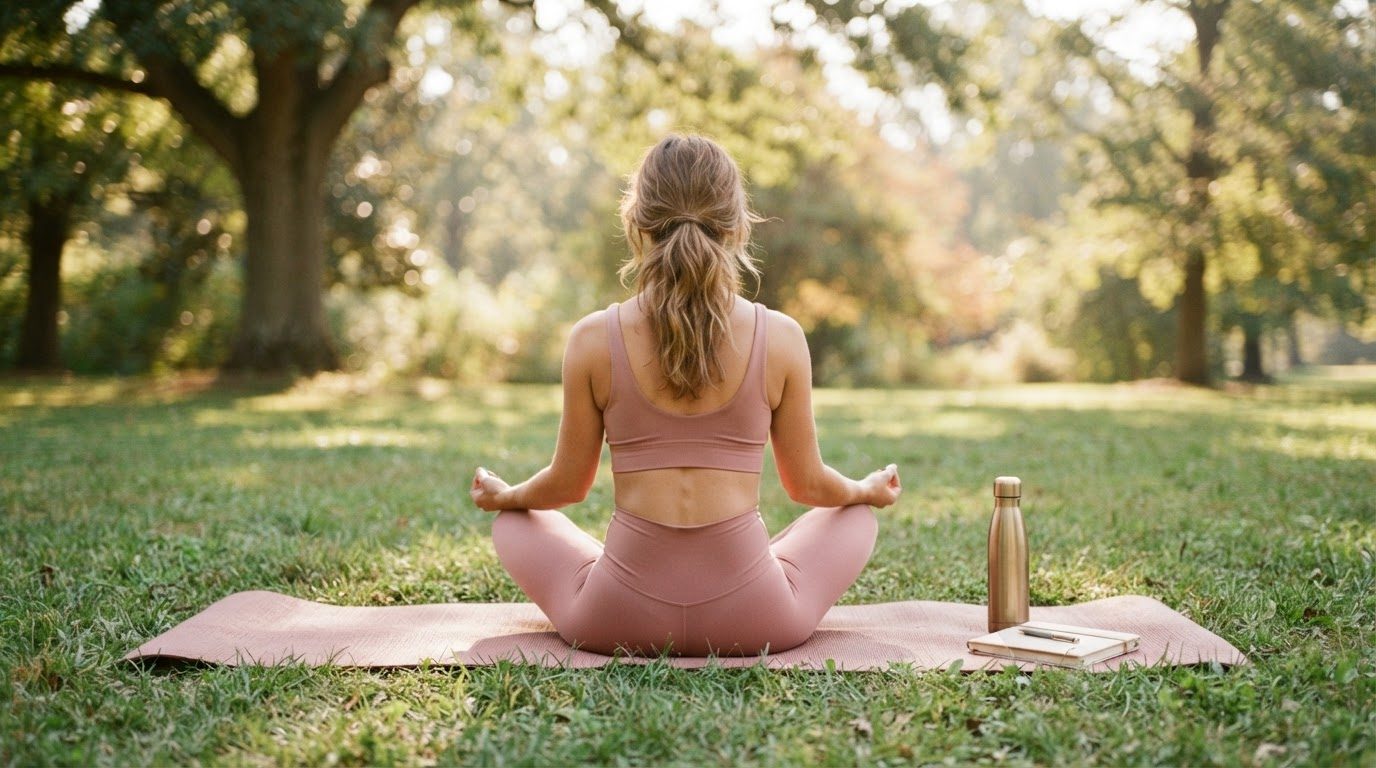
Most of us live from the neck up. We think, plan, replay and worry, and the body just carries the head around from one task to the next. A body scan meditation gently reverses that for a few minutes: instead of thinking about your body, you simply notice it, one area at a time, without needing to fix anything.
That last part is what makes it so approachable. You don't have to empty your mind, sit perfectly still or feel deeply relaxed for it to "count." You only have to keep coming back to the next part of your body, with a little curiosity, as many times as it takes.
This guide is a gentle introduction to body scan meditation for beginners: what it is, how to prepare, a full feet-to-head script you can read slowly or record in your own voice, a timing table, a five-minute version for busy days, a version for falling asleep, and what to do if the practice feels uncomfortable. Take what helps and leave the rest.
What Is a Body Scan Meditation?

A body scan is a mindfulness practice where you move your attention slowly through your body, usually from the feet up to the head (or the other way around). At each area you pause and notice whatever is there: warmth, coolness, tingling, pressure, tightness, heaviness, the touch of fabric, or nothing much at all.
The key word is notice. You're not trying to relax each muscle on command, and you're not judging what you find. If your shoulders are tight, the practice is simply "tight shoulders, noticed." Sometimes they soften on their own once they get a little attention. Sometimes they don't, and that's fine too.
Body scans became widely known through mindfulness programs in hospitals and universities, and they're now a staple of meditation apps and yoga classes. If you're completely new to meditation in general, my beginner's guide to meditation covers the basics, but you really don't need any experience to start here. A body scan is one of the friendliest first practices because it gives your mind something concrete to do.
Why Try a Body Scan?
People come to body scans for different reasons, and the effects are personal, so I'll keep this honest and general. Many people find that a regular practice helps them:
- Feel calmer. Slowing down and shifting attention away from racing thoughts can take the edge off a tense day.
- Notice stress earlier. You start catching a clenched jaw or raised shoulders before they turn into a headache.
- Wind down for sleep. A slow scan in bed gives an overactive mind a quiet, repetitive task.
- Reconnect with the body. If you tend to push through tiredness or hunger, it builds a habit of checking in.
- Practice kindness toward yourself. Noticing without judging is a skill that spills into the rest of life.
A body scan is a wellbeing practice, not a treatment. It can sit beautifully alongside other support, but it isn't a replacement for medical or mental health care. As someone prone to anxiety, I think of it as one of several small tools I can reach for, along with simple breathing exercises and a cup of evening tea.
How To Prepare

Preparation takes about a minute. The goal is to remove the small distractions that would otherwise pull you out of the practice.
Choose Your Position
You can do a body scan lying down, sitting or even standing. Lying on your back is traditional and lovely for rest: legs stretched out or knees bent with feet flat, arms a little away from your sides, palms up or down. A thick, soft yoga mat or a rug gives you support without being so soft you sink into sleep straight away (unless that's the goal).
If lying down makes you sleepy or feels too exposed, sit in a chair with both feet on the floor and your hands resting on your thighs. Sitting on a round meditation cushion works well too, with your hips slightly higher than your knees so your back stays comfortable.
Choose Your Time
A body scan can take anywhere from five to forty-five minutes. For beginners, 10–20 minutes is a lovely sweet spot: long enough to settle, short enough to stay with. Set a gentle timer so you're not checking the clock, and if you're using a phone, turn on do-not-disturb first.
Eyes Closed or Soft Gaze
Many people close their eyes, but it's completely optional. You can also keep them open and let your gaze rest softly on one spot – the ceiling, the floor a few feet ahead, a candle flame. Keeping your eyes open is a perfectly good way to practice, especially if closing them feels uneasy.
A few extra comforts: a light blanket (body temperature drops as you relax), loose clothing, and a dim room. Some people like an eye pillow resting gently over their eyes while lying down – the light weight can feel soothing, but skip it if it doesn't feel good.
A Full Body Scan Meditation Script

Read this slowly, pausing between lines, or record it in your own voice and play it back. Pauses matter more than the words, so leave plenty of silence. In each section, aim for about one to two minutes. If a line doesn't fit your body, skip it or change it.
Settling In
Let your body be supported by the floor, the bed or the chair. Notice the places where you're touching it: the back of your head, your shoulder blades, your hips, your heels.
Take three slow breaths. Breathe in through your nose, and let the out-breath be a little longer than the in-breath. Then let your breathing return to its own rhythm. You don't need to control it.
Remind yourself: there's nothing to achieve here. You're just going to notice.
Feet and Ankles
Bring your attention down to your feet. Start with the toes. Can you feel each one, or do they feel like one group? Notice any warmth, coolness or tingling.
Move to the soles of your feet, then the heels, where they rest on the surface. Notice the tops of your feet and your ankles. If you can't feel much, that's fine. "Not much" is a sensation too.
Legs and Hips

Let your attention drift up into your lower legs: your shins, your calves. Notice the weight of them. Move to your knees, the front and the back.
Now your thighs. Feel how heavy they are, resting where they are. Notice your hips and the place where your body meets the floor or the chair. If you find tension, you can breathe toward it, imagining the breath reaching that spot. Then let it go and move on, whether or not anything changed.
Belly, Chest and Back
Bring your attention to your belly. Notice it rising as you breathe in and falling as you breathe out. You don't need to deepen the breath – just watch it.
Move up to your chest. Notice the movement of your ribs, maybe your heartbeat. Then shift to your back: the lower back, the middle, the upper back between your shoulder blades. Notice where it's touching the surface and where it isn't.
Hands, Arms and Shoulders
Move your attention to your hands. Notice your fingertips, your palms, the backs of your hands. Notice any pulsing, warmth or air on your skin.
Travel up through your wrists, forearms, elbows and upper arms. Then rest your attention on your shoulders – a place where many of us carry stress. If they're lifted, see if they want to drop even a tiny bit. If not, simply notice them as they are.
Neck, Face and Head
Bring your attention to your neck and throat. Then your jaw: is it clenched? Let your teeth part slightly if that feels comfortable. Notice your lips, your tongue resting in your mouth.
Move to your cheeks, your nose, the cool air at your nostrils as you breathe in. Notice your eyes and the small muscles around them, your forehead, your eyebrows. Finally, the top and back of your head.
Closing
Now widen your attention to your whole body at once, from your toes to the top of your head, breathing. Rest here for a few breaths.
When you're ready, start to wiggle your fingers and toes. Stretch gently. If your eyes were closed, open them slowly and look around the room. Take a moment before you get up.
Body Scan Timing Table
If you like structure, here's how a 15-minute body scan could be paced, with a short cue phrase for each area. Screenshot it and keep it nearby until the order becomes familiar.
| Body area | Time | Cue phrase |
|---|---|---|
| Settling in and breath | 2 minutes | "Supported. Nothing to achieve." |
| Feet and ankles | 1.5 minutes | "Toes, soles, heels." |
| Lower legs and knees | 1.5 minutes | "Heavy and resting." |
| Thighs and hips | 1.5 minutes | "Notice the weight." |
| Belly and lower back | 1.5 minutes | "Rising and falling." |
| Chest and upper back | 1.5 minutes | "Ribs moving, back held." |
| Hands and arms | 1.5 minutes | "Fingertips to elbows." |
| Shoulders and neck | 1.5 minutes | "Notice, allow, soften if it wants to." |
| Face and head | 1.5 minutes | "Unclench the jaw." |
| Whole body and closing | 1 minute | "All of me, breathing." |
For a 20-minute version, add about 30 seconds to each area. For a 10-minute version, combine neighboring rows (feet and legs together, belly and chest together, and so on).
A 5-Minute Body Scan

On busy days, a short scan still helps. You can do this at your desk, in the car before going inside (parked, of course), or sitting on the edge of your bed.
- 30 seconds: Three slow breaths, longer out-breath.
- 1 minute: Feet and legs. Feel your feet on the floor and the weight of your legs.
- 1 minute: Belly, chest and back. Notice your breath moving.
- 1 minute: Hands, arms and shoulders. Let your shoulders drop if they want to.
- 1 minute: Neck, jaw and face. Unclench the jaw, soften the forehead.
- 30 seconds: Whole body at once, then open your eyes or lift your gaze.
Even this tiny version tells your body that it's allowed to pause, which is sometimes all a frazzled afternoon needs.
When Your Mind Wanders
Your mind will wander. Mine wanders to grocery lists, conversations from three days ago, and whether I replied to that message. This is not a sign you're doing it wrong; it's the practice itself. Every time you notice you've drifted and come back, that's the "rep," like a gentle workout for attention.
When it happens, try this:
- Silently label it: "thinking" or "planning."
- Notice where you were in your body.
- Return to that spot, or just move on to the next area.
- Skip the scolding. A kind "back we go" works better than frustration.
If your mind is very busy, it can help to whisper the name of each body part in your head ("left heel... right heel...") or to place a hand on the area you're focusing on.
When You Notice Discomfort
Paying close attention to the body sometimes means noticing aches, itches or restlessness you'd usually ignore. A few gentle options:
- Get curious first. Is it sharp, dull, warm, pulsing? Is it the same the whole time or does it change?
- Move if you need to. Shifting position, scratching an itch or stretching is completely allowed. Do it mindfully and carry on.
- Rest attention somewhere neutral. If one area feels too intense, move to a place that feels okay – your hands, your feet, the support beneath you – and breathe there for a while.
- Skip areas. You're always allowed to leave a part of the body out.
If you have ongoing or unexplained pain, mention it to your doctor rather than trying to "meditate it away."
Body Scan for Sleep

A body scan is one of my favorite ways to quiet a busy mind at bedtime. The slow pace and the repetitive focus make it a natural bridge into sleep, and you don't need to finish it – if you drift off around your knees, wonderful.
For a sleep scan:
- Do it in bed, lying in your usual sleeping position or on your back.
- Dim the lights and set your phone face down out of reach.
- Go slower than usual and make the out-breaths long and lazy.
- Use softer cues like "heavy" and "warm" for each area.
- When you reach the top of your head, start again at your feet if you're still awake.
Some people find the gentle pressure of a soft weighted blanket calming during a sleep scan. Choose one that feels comfortable rather than heavy, and skip it if it feels restrictive. A warm, caffeine-free drink beforehand helps too: a box of chamomile and lavender tea is a soothing pick if you like an evening cup. For more ideas, I've gathered things that help you fall asleep faster.
If a Body Scan Feels Uncomfortable

For some people, focusing closely on the body feels uncomfortable or even distressing, especially after difficult or traumatic experiences, or during periods of high anxiety. If that's you, there's nothing wrong with you, and you don't have to push through it. You get to adapt the practice:
- Keep your eyes open and look around the room every so often to remind yourself where you are.
- Sit up instead of lying down if lying down feels too vulnerable.
- Shorten it. Two or three minutes is enough.
- Focus on neutral or pleasant areas like your hands or feet, and skip any area that feels hard.
- Anchor outward. Notice sounds in the room or the texture of a blanket under your fingers.
- Stop anytime. Stopping is always an option. It's not failing.
Gentle, grounding practices can be a better fit on hard days – my list of self-soothing techniques has some calm alternatives. And if body-focused practices regularly bring up strong feelings, a trauma-informed therapist can help you explore them safely, at your own pace.
How To Make It a Habit

Like any practice, the benefits of a body scan tend to grow with gentle repetition. A few ways to make it stick:
- Attach it to something you already do. After brushing your teeth at night, or right after your morning coffee.
- Start smaller than you think. Five minutes, four times a week, beats a heroic 45 minutes once.
- Create a small ritual. Light a glass jar candle, pull up a blanket, and let those cues tell your body what's coming. (Never leave a candle burning if you might fall asleep.)
- Use a recording. Record the script above in your own voice, or try a guided track.
- Note how you feel. One line in your journal afterward – "calmer," "restless," "sleepy" – helps you notice patterns over a few weeks.
Over time, you may find yourself doing mini scans without meaning to: noticing your shoulders in a meeting, unclenching your jaw at a red light. That quiet awareness is a lovely part of supporting your nervous system day to day.
Final Thoughts
A body scan is a small, kind way of coming home to yourself. You don't need special equipment, a perfectly quiet house or a calm mind to begin – just a few minutes and the willingness to notice what's there.
Some days it will feel peaceful, some days restless, and both are part of it. Keep it gentle, keep it short if you need to, and let it be one of the quiet moments in your day that belongs only to you.