Multitasking feels productive because it feels busy. Three tabs open, a message half-typed, a report in the background and a mental note to call the dentist: your brain is buzzing, so surely a lot is getting done. The surprising part is that for most thinking work, it isn't. What feels like doing two things at once is usually doing two things badly, one after the other, very fast.
That's not a character flaw, and it's not something to feel guilty about. Modern days are built for interruption, and almost everyone switches tasks dozens of times an hour without noticing. The good news is that focus is less about willpower and more about setting up your day so that one thing at a time becomes the easy option.
This guide compares single-tasking vs multitasking honestly: what multitasking really is, what switching costs you, when doing two things at once is perfectly fine, and a side-by-side table that shows which approach works best for different kinds of tasks. Then you'll find seven gentle habits for single-tasking, plus ideas for working in shared or noisy spaces.
No productivity shaming here. Just a calmer, kinder way to get your work done.
What Multitasking Really Is

When most of us say "multitasking," we picture doing two things at the same time. For simple, automatic activities, that can be true. But for anything that needs real thinking (writing, reading carefully, planning, solving a problem, having a meaningful conversation), the brain can't truly run both at once. What it does instead is switch: a few seconds on the email, a few seconds on the report, back to the email, a quick look at a message.
Researchers often call this task switching, and it happens so quickly that it feels simultaneous. But each switch asks your brain to drop one set of rules ("I'm writing a careful reply to a client") and load another ("I'm checking numbers in a spreadsheet"). That small reloading moment is where the trouble starts.
A simple way to think about it: your attention is a spotlight, not a floodlight. You can move it very fast, but it only shines brightly in one place at a time.
The Hidden Cost of Switching Tasks

Every switch feels tiny. A glance at a notification takes two seconds, so how could it matter? The cost isn't in the glance itself. It's in everything that happens around it. Research summarized by the American Psychological Association suggests that frequent switching can eat up a large share of productive time. Here's where that time and energy quietly go.
Lost Time
After every switch, your brain needs a moment to find its place again: Where was I? What was I about to write? Which number was I checking? Those "getting back in" moments are short, but they add up. If you switch every few minutes, a surprising chunk of your day goes to warming up instead of actually working.
This is why a task that "should" take an hour sometimes swallows a whole afternoon. It wasn't the task. It was the twenty little restarts.
More Small Mistakes
When attention is split, details slip. A typo in an important email, a missed attachment, the wrong date in a calendar invite, a sentence you read three times without taking in. None of these are dramatic, but fixing them takes more time (and a little self-criticism you don't need).
Mental Fatigue
Switching is tiring. Even if you've only done light work, a day of constant switching can leave you feeling fried and foggy by mid-afternoon. As someone prone to anxiety, I've noticed that a scattered morning often turns into a jittery, restless evening. That's not a coincidence. A brain that's been pulled in ten directions has a hard time settling down.
Attention Residue
This one is fascinating. Researcher Sophie Leroy described something she called attention residue: when you move from Task A to Task B before A is finished, part of your mind stays stuck on A. You're technically working on B, but a thin layer of your attention is still wondering about the unanswered email or the unfinished paragraph.
That residue is why you can sit in a meeting and still be mentally writing the message you abandoned. It's also why closing loops (more on that in habit seven) makes such a difference.
When Multitasking Is Actually Fine

Here's the honest part that most productivity advice skips: multitasking isn't always bad. It works well when one task is automatic and only one needs your thinking brain. Your hands or body handle the familiar task on autopilot, which leaves your attention free for the other.
Pairings that usually work well:
- Folding laundry while listening to a podcast or audiobook.
- Walking while talking on the phone with a friend.
- Washing dishes while listening to music.
- Stretching on the floor while watching a show you've seen before.
- Tidying the kitchen while a voice note plays.
Where it falls apart is when both tasks need thinking. Listening to a complex podcast while writing an email, texting during a serious conversation, reading a contract while on a call. Those pairings force your brain into the switching cycle again, and something (usually the more important thing) gets less of you.
One quick test: if you could do the first task with your eyes half-closed, it's probably automatic enough to pair with something else. If you'd need to pause the second task to do the first one well, it isn't.
What Single-Tasking Means

Single-tasking simply means giving one task your full attention until you reach a natural stopping point, then moving on deliberately. It doesn't mean working for hours without a break, and it doesn't mean ignoring everything else forever. It means choosing what has your attention right now, on purpose.
Think of it as the difference between snacking on your work all day and sitting down to a proper meal. Same total time, much more satisfying result.
Single-tasking also isn't a personality type you either have or don't. It's a set of small setup choices: what's open, what's nearby, what's on your list, how long the block is. Change the setup and focus gets easier, even for people who describe themselves as "easily distracted."
The Benefits of Single-Tasking
When you give one thing your full attention, a few lovely things tend to happen:
- Tasks finish faster. Without the constant restarts, you move through work in fewer, cleaner steps.
- Quality goes up. Fewer typos, fewer missed details, more thoughtful ideas.
- Your energy lasts longer. Focused work can be tiring, but it's a satisfying tired, not a frazzled one.
- Finishing feels good. Crossing off one whole task beats having five tasks each 60% done.
- Your evenings feel calmer. Less attention residue means less mental replaying when you're trying to relax.
- People feel heard. Single-tasking in conversations (phone down, eyes up) is one of the kindest things you can offer someone.
If you'd like to go further, single-tasking is the foundation of longer focus sessions. My guide to deep work for beginners shows how to build up to an hour or more of distraction-free focus once short blocks feel comfortable.
Single-Tasking vs Multitasking: The Side-by-Side Verdict

Which one actually gets more done? It depends on the kind of task. Use this table as a quick reference (screenshot it if it helps) whenever you're deciding whether to pair things up or give one task the stage.
| Task type | Multitask okay? | Better approach | Example |
|---|---|---|---|
| Deep thinking work | No | Single-task in a 25–90 minute block | Writing a report, studying, planning a budget |
| Careful reading | No | Single-task, phone out of reach | Reading a contract or an important email thread |
| Meaningful conversations | No | Single-task, devices face down | A heart-to-heart with a friend, a performance review |
| Email and messages | Not alongside other work | Batch them two or three times a day | Answering all replies at 11 a.m. and 4 p.m. |
| Routine admin | Sometimes | Group similar small tasks together | Paying bills, booking appointments, filing receipts |
| Creative brainstorming | Lightly | Single-task, but let a walk or shower help | Thinking up gift ideas or a project name |
| Automatic chores | Yes | Pair with one listening task | Folding laundry with a podcast |
| Light movement | Yes | Pair with a call or audio | Walking while catching up with your sister |
| Waiting time | Yes | Use it for something small and easy | Tidying a drawer while the kettle boils |
The pattern is simple: the more thinking a task needs, the more it deserves your whole attention. The more automatic it is, the more freely you can pair it.
How To Single-Task: 7 Habits That Make It Easier
You don't need all seven at once. Pick one or two that feel easy, try them for a week and add another when they feel natural.
1. Keep One Tab or App Open at a Time
Every open tab is a tiny invitation to switch. Before you start a task, close everything that isn't needed for it. Writing a document? Only the document. Researching? Only the tabs for that one question, closed the moment you're done.
A tidy physical desk helps too. A soft felt desk mat with only today's notebook and a pen on it makes the space feel like it's meant for one thing. If you notice yourself reaching for a new tab "just to check," pause and write the thought down instead (habit six).
2. Batch Email and Messages
Email and chat are the biggest switch-makers for most people. Instead of answering everything the moment it arrives, choose two or three set times a day, for example 9:30 a.m., 1 p.m. and 4:30 p.m., and handle all messages then. Between those times, close the inbox completely.
If that feels scary, start with one 45-minute block a day where messages wait. Most things that feel urgent can wait 45 minutes perfectly well. If you'd like a structure for the whole day, time blocking for beginners walks you through giving each kind of task its own home on the calendar.
3. Keep a Visible "Now" List of One Item

Your to-do list might have thirty things on it, and looking at all thirty is a recipe for jumping between them. So add a second, much shorter list: the "now" list, with exactly one item on it. Write it on a sticky note or the top of the day's page and keep it where your eyes land.
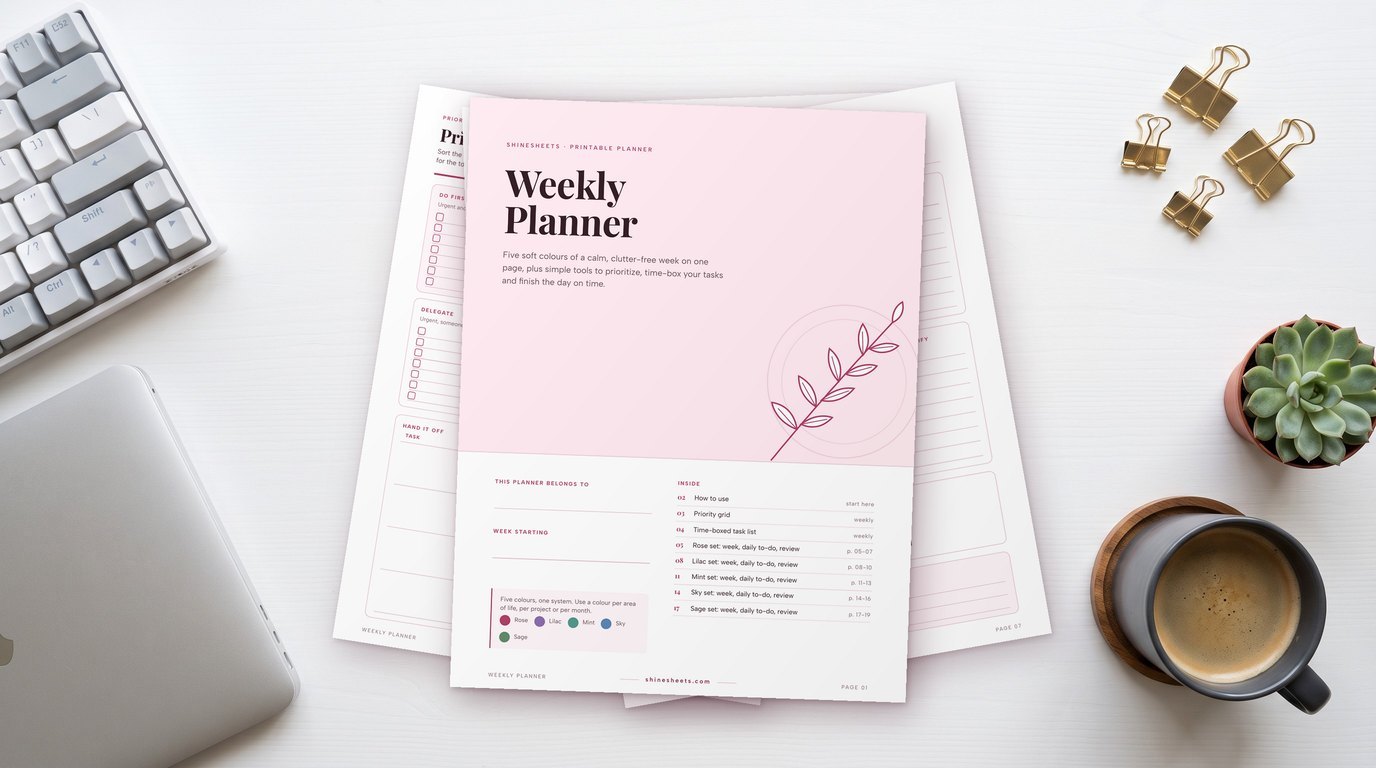
An undated daily planner works nicely here, because you can start any day without wasting pages. Write your big list once in the morning, then copy just one task to the "now" line. When it's done, cross it off and choose the next. That one line answers the question your brain keeps asking: "What am I supposed to be doing right now?"
4. Work in Timer Blocks
A timer turns "focus forever" into "focus for 25 minutes," which feels far more doable. Set it, work on your one item until it rings, then take a five-minute break. A flip timer cube is a sweet option because you just turn it to the side you want, with no phone needed (phones are where focus goes to disappear).
Start with whatever feels comfortable: 15 minutes is perfectly fine. If you like structure, the Pomodoro Technique uses 25-minute sprints with short breaks and a longer rest after four rounds.
5. Put Your Phone in Another Room

Even a silent phone on the desk pulls at your attention. Part of your brain stays alert to it, waiting for the buzz. The simplest fix is distance: put it in another room for one focus block. If you need it for emergencies, keep the ringer on for calls from a few favorite contacts only.
If another room isn't practical, a white phone lockbox with a timer adds a gentle bit of friction. You can still see it, but you can't pick it up on autopilot. Honestly, the first ten minutes feel strange. After that, most people find it a relief.
6. Use a Parking-Lot Note for Stray Thoughts
The moment you start focusing, your brain will helpfully remind you about the dentist, the birthday gift, the email you forgot. Instead of acting on each thought (switch!) or trying to ignore it (it'll keep tapping you), park it. Keep a note next to you and jot every stray thought there in two or three words.
Pastel sticky notes are perfect for this: one note, one thought, stuck on the side of your desk. When your block ends, look at the parking lot and decide what to do with each item. Your brain relaxes because it knows nothing will be lost. If the thoughts keep piling up, a ten-minute brain dump before you start can clear a lot of them in one go.
7. Close the Loop Before You Switch
Because of attention residue, the way you leave a task matters as much as how you start it. Before you switch, take 60 seconds to close the loop: finish the sentence, save the file, and write one line about the next step ("Next: add the numbers to section 3"). That tiny note tells your brain the task is safely paused, not abandoned.
The same idea works for whole categories. If there are habits that keep dragging you into switching, like checking the news "for a second" or replying to group chats mid-task, add them to a not-to-do list. Sometimes deciding what you won't do is the clearest way to protect what you will.
Single-Tasking in Shared or Busy Settings

Not everyone has a quiet office with a door. Open-plan workplaces, shared apartments, cafés and busy homes all make focus harder. You can still single-task; you just need a few signals and buffers.
- Use sound as a wall. A pair of noise-cancelling headphones in a soft neutral color blocks chatter and quietly tells people you're focusing. Play gentle instrumental music, brown noise or nothing at all.
- Agree on a signal. Headphones on, a small card on your desk or a closed door can mean "come back in 30 minutes unless it's urgent." Tell the people around you what it means so it doesn't feel rude.
- Choose your quiet hours. Most shared spaces have calmer moments, early in the morning or after lunch. Save your thinking work for those and leave shallow tasks for the busier hours.
- Use shorter blocks. In a noisy place, 15–20 minute blocks are more realistic than an hour. That's still single-tasking.
- Be kind about interruptions. When someone does interrupt, write your next step on the parking-lot note before turning to them. Then give them your full attention. Coming back will be much easier.
When Distraction Is More Than a Habit
Being easily distracted is normal. Tiredness, stress, hunger, a hard week or a lot on your mind can all make focus slippery, and none of that means something is wrong with you. Start with the basics: sleep, water, short breaks and fewer open tabs.
But if focus problems are constant, if they've been there for a long time, or if they're making work, studies or relationships genuinely hard, it's worth talking to a doctor. Attention can be affected by many things, from sleep and stress to anxiety, hormones or ADHD, and a professional can help you understand what's going on. My article on trouble focusing also covers everyday reasons concentration slips and simple ways to support it.
Final Thoughts
Multitasking isn't a villain, and single-tasking isn't a strict rule you have to follow perfectly. Pair the automatic stuff freely, and give your thinking work the gift of your whole attention.
Start small: one tab, one item on your "now" list, one short timer block. Notice how it feels to finish something completely. That quiet, satisfied feeling is the best reason to keep going, one task at a time.