
Switching off after work rarely happens by itself. Your laptop closes, but your mind keeps the tabs open: the email you meant to answer, the meeting tomorrow, the task that's half-done. What helps isn't more willpower in the evening. It's a clear ending to the workday, a short ritual that tells your brain, "Everything is written down, and it will be handled tomorrow."
That's what a shutdown ritual is. Ten to fifteen minutes at the end of the day where you close loops, make a small plan and mark the finish line, so your evening actually belongs to you. It's calm, it's repeatable, and it doesn't ask you to be more productive. If anything, it asks you to stop on purpose.
In this guide to the shutdown ritual, you'll find why it works (in simple words), the six steps, a table with how long each one takes, how to adapt it if you work from home, what counts as real rest afterwards and what to do when work keeps spilling over no matter what. If you've ever lain awake mentally rewriting tomorrow's to-do list, this one is for you.
What a Shutdown Ritual Is and What It Isn't

A shutdown ritual is a short, repeatable set of actions you do at the end of every workday. The idea was popularized by the author and computer science professor Cal Newport, who describes going through his open tasks, making a plan for them and then saying a set phrase to mark that work is over for the day. The phrase sounds a little silly, and that's part of the point: it's a clear signal, not a vague hope.
It is:
- Short. Ten to fifteen minutes is plenty.
- The same every day. Repetition is what turns it into a cue your mind recognizes.
- About closing, not finishing. You don't need to clear your list. You need to know where everything is.
It isn't:
- A second shift where you squeeze in "just one more thing."
- A productivity test you can fail.
- A fix for a job that genuinely asks too much of you (more on that later).
If you already have a gentle way to begin the day, the shutdown ritual is its natural partner. My guide to a starting ritual for the workday covers the other end.
Why a Shutdown Ritual Helps Your Mind Switch Off
There's a well-known observation in psychology called the Zeigarnik effect: unfinished tasks tend to stay more active in our minds than finished ones. It's why an unanswered message can pop into your head while you're brushing your teeth, and why a half-done project can follow you into the weekend.
The encouraging part is what later research suggested about it. Studies have linked making a specific plan for an unfinished task with easing that mental pull, even when the task itself isn't done yet. In other words, your brain seems to relax a little once it trusts that the task has a time and a place. You don't have to finish everything to feel finished. You have to write it down and decide when it happens.
I won't pretend that a ritual makes every worry disappear. I'm prone to anxiety, and some evenings my thoughts still wander back to work. But having a set routine gives me something to point to: "I already wrote that down. It's on tomorrow's list." That small sentence works more often than you'd expect.
If you recognize yourself in the feeling of never being able to rest, my article on toxic productivity and the signs you can't switch off explains the why. This guide is the how.
The 6-Step Shutdown Ritual
Here's the whole routine. Do the steps in this order, because each one clears space for the next. Plan for about 10 to 15 minutes, and set a reminder for the same time each day until it feels automatic.
1. Check Messages One Last Time

Open your inbox and work chat once, with a timer for five minutes. You're not trying to reach inbox zero. You're scanning for anything that truly needs an answer today, and for anything that will need action tomorrow.
- Answer anything that takes under two minutes and can't wait.
- Note anything bigger on your list (step 2), with a quick reply like "Got it, I'll look at this tomorrow morning" if someone's waiting.
- Leave everything else. It will still be there.
When the timer goes off, close the inbox. This is the last check of the day, and knowing that is what makes it calming instead of stressful.
2. Capture Every Open Loop on Paper

This is the heart of the ritual. Take a notepad and write down everything that's still on your mind: half-finished tasks, things you promised someone, ideas, worries, the call you need to make. Don't sort yet. Just empty your head onto the page.
Paper works especially well here, because it feels like a separate place from your screen. A simple cream desk notepad that lives on your desk becomes the "parking spot" for work thoughts, and a set of lavender gel pens makes the two minutes feel a little more pleasant than a chewed-up ballpoint does.
Next to each item, add a tiny next step and, if you can, a when: "Reply to Anna – tomorrow 10 a.m." or "Draft report intro – Thursday." That small decision is what tells your brain the task is handled.
3. Choose Tomorrow's Top 3
From your list, circle the three things that matter most tomorrow. Not ten. Three. These are the tasks that, if they get done, will make tomorrow feel like a good day.
A quick way to choose: one task that moves an important project forward, one task someone is waiting on, and one small task that's been nagging you. Write them at the top of tomorrow's page so they're the first thing you see in the morning. If you end up doing more, wonderful. If you only do those three, it was still a solid day.
4. Glance at the Calendar
Look at tomorrow (and quickly the rest of the week). Are there early meetings? A deadline? A gap where your top 3 can actually fit? This takes a minute and saves you from that sinking "I forgot I had a 9 a.m." feeling.
If you notice the week is overloaded, this is the moment to move something, block time for focused work or make a note to ask for help. On Fridays, you can stretch this step into a short weekly review so Monday starts calmer too.
5. Tidy the Desk
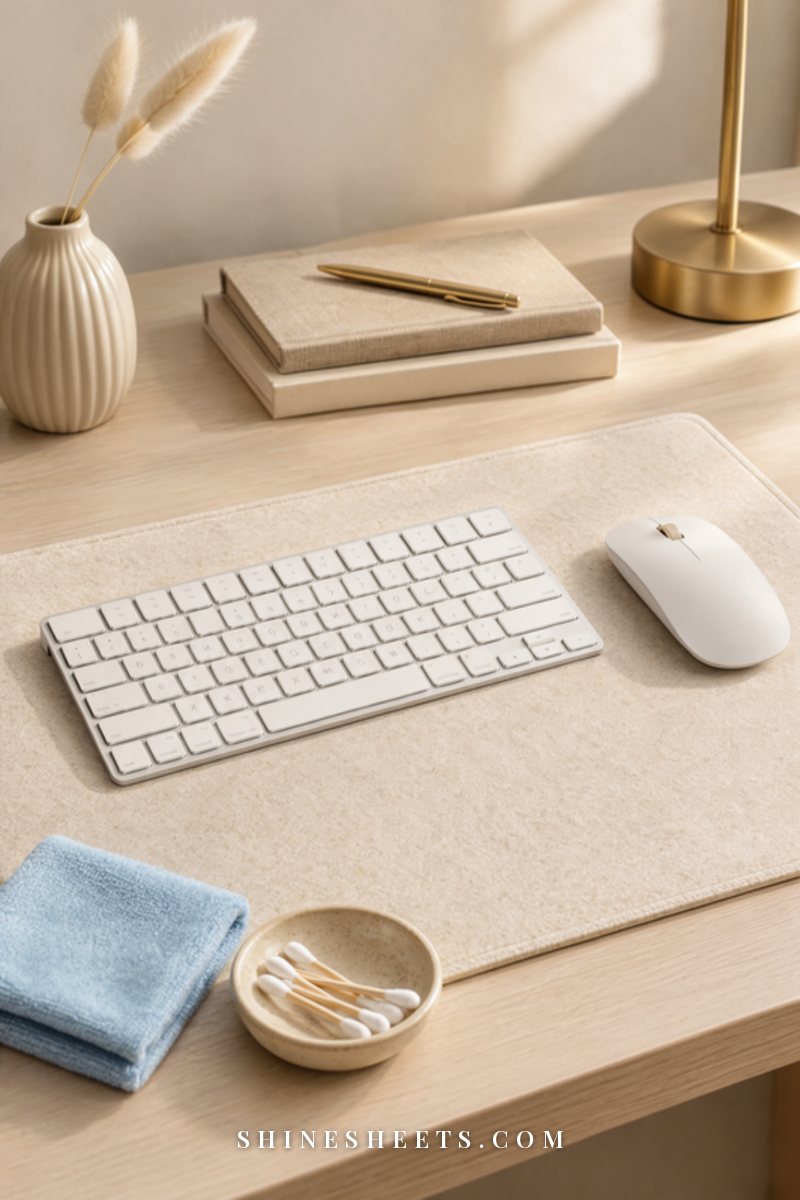
Spend two or three minutes putting things back: pens in their place, cups to the kitchen, papers in a tray, cables tucked away. A sage desk organiser tray gives everything a home, so tidying is just "put it in the tray," not a big decision.
A clear desk does two things. It makes tomorrow morning easier, because you sit down to calm instead of clutter. And it's a physical way of closing the day, the same way you'd make the bed in the morning.
6. Say a Closing Phrase or Do One Physical Cue
The last step is a signal. Choose one, and keep it the same every day:
- A phrase. Newport famously says "shutdown complete." You could say "Done for today" or "That's work handled." Say it out loud if you can.
- A physical cue. Close the notebook and put the pen on top. Switch off the desk lamp. Light a candle in another room. Push in your chair.
It might feel a little silly at first. That's okay. Over a couple of weeks, the cue becomes connected with "work is over," and that connection is what helps when a stray thought shows up at 8 p.m. You can answer it with, "I already did my shutdown. It's on the list."
Your Shutdown Ritual at a Glance
Here's the full routine in one table. Screenshot it and keep it near your desk until you know it by heart.
| Step | What to do | Why it helps | Minutes |
|---|---|---|---|
| 1. Check messages | One timed scan; answer only what can't wait, note the rest | Stops the "did I miss something?" worry later | 3–5 |
| 2. Capture open loops | Write every unfinished task and worry on paper, with a next step | A plan for unfinished tasks is linked to easing their mental pull | 3–4 |
| 3. Choose top 3 | Circle tomorrow's three most important tasks | Tomorrow starts with a clear focus instead of a long list | 1–2 |
| 4. Glance at calendar | Check tomorrow's meetings and deadlines | No surprises in the morning | 1 |
| 5. Tidy the desk | Put things back, clear cups and papers | A physical close and a calm start tomorrow | 2–3 |
| 6. Closing cue | Say your phrase or do your physical cue | Teaches your mind that work is over | Under 1 |
| Total | 10–15 |
If you're short on time, steps 2 and 6 are the two not to skip. Even a three-minute version (write down what's open, then say your phrase) is better than none.
Adapting the Ritual for Remote Work

When your office is your kitchen table or a corner of the bedroom, the end of work can blur into everything else. There's no commute to separate the two. That's why remote workers often need one or two extra cues after the six steps:
- Change your clothes. Swap work clothes for something soft, even if your "work clothes" were already comfortable. It's a small costume change that tells your body the role has changed.
- Take a short walk. Ten minutes around the block works as a "fake commute." Fresh air, a bit of movement and a change of scene help a lot of people leave the workday behind.
- Put the laptop away. Out of sight really does help. Slide it into a baby blue laptop sleeve and put it in a drawer, a cupboard or on a shelf, not on the sofa or the dining table you'll use tonight.
- Change the light. Turn off the bright desk lamp and switch on a softer one. Some people like lighting a blush scented candle in the living room as the very last cue (keep it away from curtains, and never leave it burning unattended).
- Quiet work notifications. If work apps live on your phone, set them to silent after your shutdown time, or log out until morning.
You don't need all five. Pick one or two that feel natural and add them to the end of your ritual, right after your closing phrase.
After the Ritual: What Counts as Real Rest
The ritual opens the door to your evening, but what you do next matters too. Real rest is anything that leaves you feeling a bit more like yourself afterwards. It doesn't have to be productive or impressive.
Some kinds of rest worth noticing:
- Body rest: a bath, gentle stretching, lying down with your legs up for ten minutes.
- Mind rest: a walk without a podcast, sitting with a cup of tea, looking out of the window.
- Connection: a real conversation, a call with a friend, dinner without phones.
- Play and creativity: reading for fun, a puzzle, a hobby you do just because you like it.
Checking work email "just to see" doesn't count, and neither does reorganizing a to-do app out of guilt. Evening tea followed by a few lines in my journal is my favorite reset, but yours might look completely different. For gentle ideas, I wrote about wholesome ways to spend your evening after work. And if resting itself makes you feel guilty, my list of reminders on how to stop feeling guilty for resting might be exactly what you need tonight.
How To Make the Ritual Stick
Like any new habit, a shutdown ritual feels clunky for the first week or two. A few small things make it much easier to keep:
- Pick a fixed time. Choose a shutdown time that matches your real workday, say 5:15 for a 5:30 finish, and set a gentle phone reminder for it. The reminder does the remembering so you don't have to.
- Keep everything in one place. Leave the notepad and pens on your desk, always in the same spot. If you have to hunt for a pen, the ritual already feels like effort.
- Attach it to something you already do. Many people start the ritual right after their last meeting or right before they make an evening cup of tea. Linking it to an existing moment gives it an anchor.
- Track it lightly. A small tick in the corner of the notepad each day is enough. After ten ticks, you'll notice it has started to feel normal.
- Be flexible on odd days. Late meeting? Travel day? Do the short version (open loops plus closing cue) wherever you are, even on the back of a receipt. Consistency matters more than doing it perfectly.
Give yourself two full weeks before you judge whether it works. Most of the calm comes from repetition, from your mind slowly learning that the closing cue means what it says.
Common Shutdown Ritual Mistakes
A few things tend to trip people up in the first weeks:
- Making it too long. If your ritual takes 40 minutes, it becomes another task you dread. Keep it to 15 at most.
- Turning it into extra work. Step 1 is a scan, not a chance to answer every email. Trust the list.
- Skipping it on busy days. Busy days are exactly when it helps most. Do the three-minute version.
- Breaking the shutdown "just once." Checking email at 9 p.m. tells your brain the ritual doesn't really mean anything. If something truly urgent happens, deal with it, then do a mini shutdown again.
- Expecting perfection. Some evenings your mind will wander back to work. That's normal. Gently remind yourself it's on the list, and turn back to your evening.
When Work Keeps Spilling Over
Here's the honest part. A shutdown ritual helps you close a reasonable workday. It can't make an unreasonable one fit. If you do every step and still can't stop because there's simply too much, that's not a willpower problem. It's a workload problem, and it deserves a real conversation.
A few gentle next steps:
- Notice the pattern. For two weeks, write down what time you actually stop working and what pulled you back in. Facts make conversations easier.
- Talk to your manager. Bring your list and ask for help prioritizing: "I have these five projects. Which two matter most this week?" Most managers would rather know than see you burn out quietly.
- Set clearer boundaries. Share your working hours, turn on an away message after a set time and let people know when to expect a reply.
- Look at the bigger picture. My guide to achieving a healthy work-life balance covers the wider changes that can help.
And if work stress is keeping you up at night, affecting your mood or making it hard to enjoy anything, please be kind to yourself and talk to a doctor or therapist. You don't have to carry it alone.
Final Thoughts
A shutdown ritual is a small daily promise to yourself: work gets your full attention during the day, and your evening gets the rest of you. Write down what's open, choose tomorrow's three, tidy the desk and say your phrase.
It won't feel natural on the first day, and that's perfectly fine. Give it two weeks of gentle repetition, and you may find that closing the laptop finally feels like closing the day.