Mascara smudging is almost never about the mascara alone. It's about what's happening around your lashes: the oil on your lids, the cream you patted on twenty minutes earlier, the concealer sitting right under your lash line, and the way your lashes brush against skin every time you blink. Fix the surroundings, and even a basic tube suddenly behaves.
That's good news, because it means you don't have to keep buying new formulas and hoping. Most of those gray shadows under your eyes by lunchtime come from a small handful of causes, and each one has a simple, specific fix.
This guide is all about mascara smudging and only that (if you're after length and volume, my mascara tips for longer, fuller lashes cover the pretty part). Here you'll find the seven reasons mascara transfers under your eyes, a cause-and-fix table you can screenshot, a smudge-proof application routine, the difference between tubing and waterproof formulas, gentle removal, and when it's time to toss a tube.
It took me far too long to realize my shiny T-zone extends right up to my eyelids. Once I stopped blaming my mascara and started treating my lids like the oily skin they are, the raccoon look mostly disappeared.
Why Mascara Smudges Under Your Eyes
Traditional mascara is made of pigment, waxes and film formers that dry on your lashes. Anything that softens those waxes again (skin oil, emollient creams, warmth, tears) makes the formula a little sticky and movable. Every blink then presses your upper lashes against your lower lid or brow bone, and a tiny bit of color transfers each time.
That's why smudging is usually slow. You look fine at 9 am, slightly smoky at noon, and properly shadowed by the evening. It isn't a sudden failure; it's hundreds of blinks moving softened mascara a fraction at a time.
Under-eye skin also tends to be the place where you layer the most product: eye cream, concealer, maybe a hydrating primer. All of that sits exactly where your lashes land. The more slippery that area is, the faster mascara slides into it and stays there.
The fix, then, is two-sided: make the formula on your lashes more stable, and make the skin around your eyes less slippery. Every tip below does one or both.
7 Reasons Your Mascara Smudges
Read through these and notice which ones sound like you. Most people have two or three working together, which is why one fix alone sometimes doesn't seem to help.
1. Oily Lids or Under-Eyes
If your forehead and nose get shiny during the day, your eyelids and the skin under your eyes often do too. That natural oil slowly dissolves the waxes in regular mascara. Signs this is your main cause: smudges get worse in the afternoon, worse on warm days, and your eyeshadow tends to fade or crease as well.
What helps: oil-control prep around the eyes (a light, gel-textured eye product instead of a rich one), a thin layer of powder on the lids and under-eyes, and a formula that doesn't rely on wax. My guide to makeup for oily skin goes deeper into prep for the rest of the face.
2. Rich Eye Cream Near the Lash Line
Eye cream is lovely, but a thick, buttery one applied right up to your lashes is basically a mascara remover waiting to happen. Many rich creams contain oils and emollients that melt the formula the moment your lashes touch them.
What helps: in the morning, keep eye cream on the orbital bone (the bony ring around your eye), roughly a fingertip's width away from the lash line. Let it sink in for at least five minutes before any makeup. Save the richer cream for night, when you're not wearing mascara at all.
3. An Oily or Creamy Concealer
Very emollient concealers stay soft on the skin for hours, which feels comfortable but gives mascara a tacky surface to stick to. If your smudges look like little dots or lines exactly where your concealer is, this is probably part of it.
What helps: use a thin layer of concealer and keep it a few millimeters below the lower lash line, then press a small amount of powder on top. A longer-wear liquid concealer usually stays put better than a thick, balmy stick.
4. Lashes That Touch Your Brow Bone or Skin
Some lashes grow straight out or slightly down, and some eyes are a little more hooded. Either way, the upper lashes keep tapping the brow bone or the lower lid, and every tap leaves a mark. You'll see this as small dots on the lid just under your brow, or a gray line right below your lower lashes.
What helps: curling. A gentle curl lifts the lashes up and away from the skin so they simply have less contact. If you've never quite gotten the hang of it, my step-by-step guide on how to curl your lashes covers pressure, timing and how to avoid that crimped look.
5. Too Many Coats
Three or four thick coats make lashes look dramatic for about an hour. After that, all that extra product has more surface to soften, flake and transfer. Thick layers also take longer to dry, and wet mascara smudges at the first blink.
What helps: one or two thin coats, applied while the first one is still slightly damp so they bond without clumping. If you want more drama, wiggle at the root rather than loading up the tips.
6. Old, Dried-Out Mascara

This one surprises people. Old mascara gets thick and dry, so you need more pressure and more coats to get color on your lashes. It also breaks apart into flakes during the day, and those flakes land under your eyes looking exactly like smudges.
What helps: replacing the tube regularly (more on timing below). If your mascara is clumping, stringy or smells different from when you opened it, that's your answer.
7. Watery Eyes
Wind, cold air, allergies, contact lenses, laughing until you cry: any extra moisture around the eyes loosens water-soluble formulas, and tubing mascaras in particular can soften with tears. If your smudging happens mostly outdoors or on certain days, moisture is the likely culprit.
What helps: a waterproof formula on the days you know your eyes will water, and skipping the lower lashes completely. If your eyes water often and you're not sure why, that's worth mentioning to a doctor too.
Mascara Smudging Fixes: Cause-by-Cause Table
Here's the whole thing at a glance. Find your cause in the first column and match it across:
| Cause | Fix | Mascara type | Best for |
|---|---|---|---|
| Oily lids or under-eyes | Light gel eye product, thin powder on lids and under-eyes | Tubing | Combination and oily skin, warm days |
| Rich eye cream | Keep cream on the orbital bone, wait 5 minutes, richer cream at night only | Any, but tubing is most forgiving | Dry under-eyes that still need moisture |
| Oily or creamy concealer | Thin layer, set with powder, keep it below the lash line | Tubing or water-resistant | Anyone who wears concealer daily |
| Lashes touching skin | Curl first, then apply mascara from the root | Lightweight, curl-holding formula | Straight lashes, hooded eyes |
| Too many coats | One or two thin coats, wipe the wand first | Any | Everyone, especially for long days |
| Old mascara | Replace about every three months | A fresh tube of your usual | Anyone with flaking or clumping |
| Watery eyes | Skip lower lashes, choose a formula that resists moisture | Waterproof | Windy days, cold weather, emotional events |
If more than one row fits, start with the fix that's easiest for you (usually moving your eye cream and wiping the wand) and add the next one after a few days. That way you'll know what actually made the difference.
How To Apply Mascara So It Stays Put

This is the routine that works for most smudge-prone eyes. It takes maybe two extra minutes, and you can drop any step you don't need.
- Keep the lash line clear. Apply moisturizer and eye cream at least five minutes before makeup, and keep both a fingertip's width away from your lashes. If anything feels slippery right at the lash line, press a clean tissue there for a second.
- Set your lids and under-eyes. Dip a small, fluffy brush into a finely milled translucent setting powder, tap off the excess, and press (don't sweep) a very thin layer onto your lids and just under your lower lashes. You want the skin to feel smooth and dry, not dusty.
- Curl first. Use a gentle eyelash curler with a soft silicone pad on clean, dry lashes. Squeeze softly at the base for about five seconds, then move halfway up and squeeze again for a few seconds. Never curl after mascara; that's when lashes snap.
- Wipe the wand. Pull the wand out without pumping it, then wipe the tip and sides once against the rim of the tube or a tissue. Most smudges start with a blob of excess product on the very end of the brush.
- Apply one thin coat from the root. Place the brush at the base of your lashes, wiggle gently side to side for a second, then pull up and out. Look down into a hand mirror while you do this so your lashes are pulled away from your lid.
- Add a second coat only if you need it. Do it within about thirty seconds, while the first coat is still slightly tacky. Then stop.
- Let it dry with your eyes open. Give it a full minute before you blink hard, look up, or do anything near your eyes. Keep your gaze slightly downward while it sets.
One small honest admission: for years I skipped the "let it dry" step because it felt silly to stand there doing nothing. It turns out those sixty seconds prevent a good half of my smudges.
Tubing vs Waterproof Mascara: Which One You Need
These two formulas solve different smudging problems. Picking the right one for the day is often the biggest single fix.
Tubing Mascara for Oily Skin
Tubing mascara works differently from traditional formulas. Instead of painting lashes with wax and pigment, it wraps each lash in tiny polymer "tubes" that set firmly. Skin oil and creams don't dissolve them, which is why tubing formulas are usually the best choice for oily lids, a shiny T-zone and long, warm days.
If you want to try one, a pick for oily lids would be a smudge-proof tubing mascara: look for "tubing" or "film-forming" in the description, a slim brush for control, and a formula that comes off with warm water. Tubing formulas tend to give a softer, more natural length than very volumizing mascaras, so expect elegance rather than drama.
The trade-off: they can loosen with lots of tears or heavy rain, because warm water is exactly what removes them.
Waterproof Mascara for Watery Eyes
Waterproof mascara uses water-repelling ingredients that hold up well against tears, wind and humidity. If your smudges happen on blustery walks, at weddings, or when your eyes water from contact lenses, this is the formula for those days.
For watery eyes, I'd choose a waterproof lengthening mascara with a slim or medium brush, since thinner layers dry faster and hold curl better. Waterproof formulas are also wonderful for keeping straight lashes curled all day.
The trade-off: they're harder to remove, and many waterproof formulas can still soften with skin oil. That's why they're not automatically the answer for oily lids. Also, daily waterproof mascara with rough removal can be hard on lashes, so many people save it for the days that truly need it.
A simple rule of thumb: oily skin, choose tubing. Watery eyes, choose waterproof. Both, choose tubing on the top lashes and skip the bottom ones.
Bottom Lashes: Only If You Need Them
Lower lashes sit right against the most product-heavy, most oily, most blink-pressed area of your face. Mascara there is the number one source of under-eye shadows for many people.
Here's my gentle permission: you don't have to coat them. Most eye looks look fresh and open with mascara on the top lashes only. If you love a defined lower lash line, try these softer options:
- Tip only. Hold the wand vertically and touch just the tips of the lower lashes with the very end of the brush, using whatever little product is left after your top lashes.
- Outer corners only. Coat just the outer third, where lashes are longer and less likely to touch skin.
- Tubing on the bottom, always. Even if you wear waterproof on top, a tubing formula on the lower lashes is less likely to transfer.
- Powder first. Press a tiny bit of powder right under the lower lashes before mascara so there's nothing sticky waiting for them.
How To Remove Tubing and Waterproof Mascara Gently
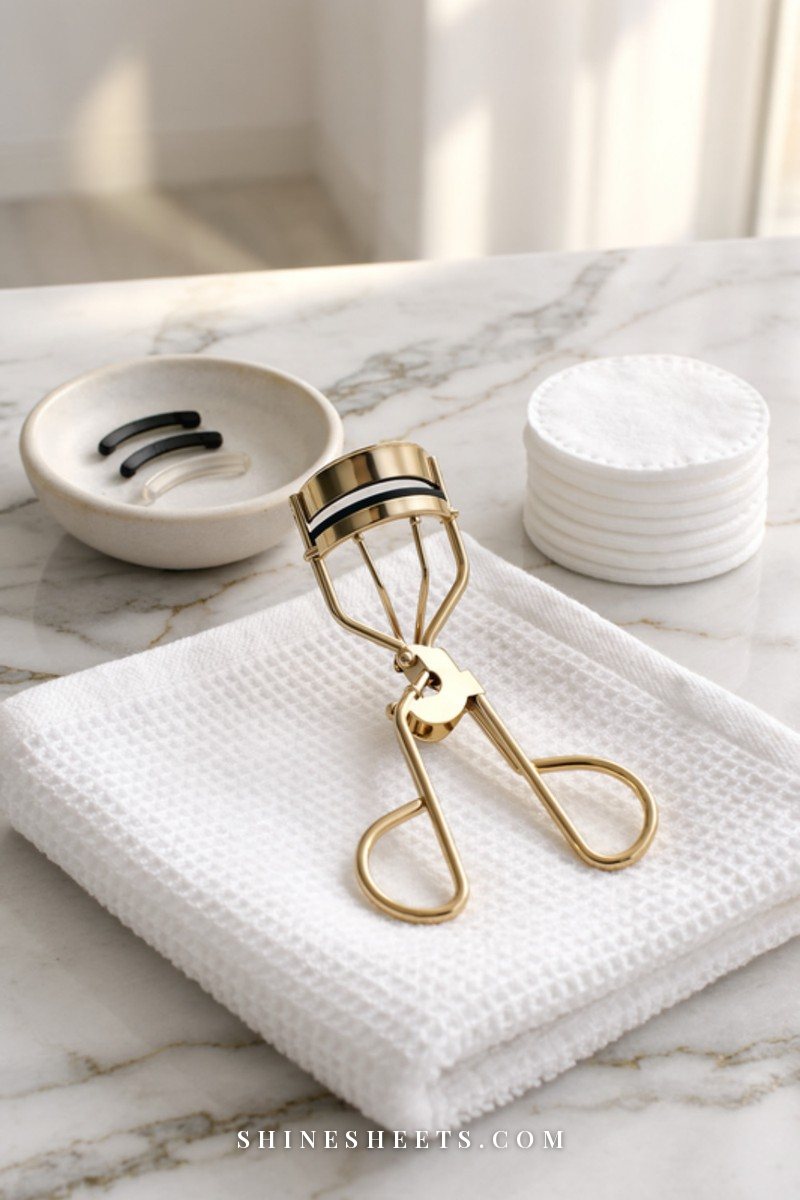
Smudge-proof mascara is only a good idea if you can take it off without rubbing your lashes out. The two formulas come off in opposite ways.
Tubing mascara: splash your closed eyes with comfortably warm water, then hold a warm, damp cotton pad or soft washcloth against your lashes for about thirty seconds. The tubes loosen and slide off in little pieces. Gently pinch them down the lashes; don't scrub. Follow with your usual cleanser.
Waterproof mascara: it needs oil or a bi-phase remover. Soak a cotton pad, hold it on your closed eye for twenty to thirty seconds, then press and slide downward. Repeat with a fresh pad rather than rubbing harder. My full guide on how to remove waterproof mascara walks through three gentle methods.
For a light everyday formula, a gentle micellar water for sensitive skin on a cotton pad usually does the job. Look for a fragrance-light formula and rinse afterward if your skin is sensitive like mine.
Two more small habits help: never sleep in mascara (it breaks lashes and can irritate your eyes), and if you sleep on your side, a blush silk sleep mask keeps your freshly cleansed lashes from rubbing against the pillowcase all night.
When To Replace Your Mascara
Mascara is one of the shortest-lived products in your makeup bag. A common guideline is to replace it about every three months after opening. Every time you pump the wand, air goes in, the formula dries a little faster, and the tube can pick up bacteria from your lashes.
A few easy habits keep this on track:
- Write the opening date on a small sticker on the tube, or note it in your phone.
- Don't pump the wand. Twist it gently inside the tube instead.
- Don't add water to a dried-out mascara to revive it. Replace it.
- Never share mascara, even with your closest friend, and don't use testers directly on your lashes.
- Toss it after an eye infection, and start fresh once your eyes are fully better.
If you'd like a simple timeline for the rest of your makeup bag too, I put one together in how often you should replace your makeup.
When To See a Doctor
Most smudging is just cosmetic. But if your eyes are red, itchy, stinging, swollen, crusty or watering a lot, especially after starting a new mascara, stop using it and remove all eye makeup. Persistent eye irritation, pain, changes in your vision, or a bump on the eyelid that doesn't go away deserves a visit to a doctor or eye specialist rather than another product swap. Your eyes are worth the appointment.
Final Thoughts
Mascara smudging feels like a mystery until you see it as a little chemistry problem: soft formula, slippery skin, lots of blinking. Move your eye cream, set the area with a touch of powder, curl, wipe the wand, keep the coats thin, and pick tubing or waterproof for the day you're actually having.
Start with one or two changes this week. Your lashes can stay lifted and defined from your morning tea to your evening one, with nothing but clean, bright skin underneath.