Toxic positivity is what happens when "look on the bright side" becomes the only allowed response to pain. It usually comes from love. People want you to feel better, quickly. But when sadness, fear or frustration get brushed aside with a cheerful phrase, the feeling doesn't disappear. It just goes underground, often joined by a new one: the sense that you're wrong for feeling it at all.
Real support works the other way around. It makes room for the hard feeling first and only then, if at all, looks for hope. As someone prone to anxiety, I've learned that being told "don't worry about it" has never once stopped me worrying, while hearing "that sounds stressful" has calmed me down more times than I can count.
This guide explains toxic positivity gently and clearly: what it is and how it differs from healthy optimism, the common phrases that tend to hurt, signs you might be doing it to yourself, a table of 15 supportive alternatives to say instead, how to respond when someone does it to you and simple steps for making room for hard feelings.
No guilt here, by the way. Almost all of us have said "everything happens for a reason" at some point. This is about learning, not blaming.
What Is Toxic Positivity?

Toxic positivity is the belief, spoken or unspoken, that we should stay positive no matter what, and that negative emotions are a problem to be fixed fast. It shows up as forced cheerfulness that dismisses, minimizes or rushes past real feelings.
The word "toxic" sounds strong, and it's worth being clear: positivity itself isn't the problem. Hope, gratitude and optimism are wonderful. They become unhelpful when they're used to shut a feeling down rather than to hold it with kindness. It's the difference between "this is hard and we'll get through it" and "don't be so negative."
A few things toxic positivity tends to do:
- Skips the feeling. It jumps straight to a lesson, a silver lining or a solution.
- Compares pain. It points out that others have it worse, as if suffering has a ranking.
- Shames the emotion. It implies that feeling sad, angry or scared means you're ungrateful or weak.
- Ends the conversation. A quick cheerful phrase signals "let's not talk about this anymore."
Toxic Positivity vs Healthy Optimism

Healthy optimism and toxic positivity can use similar words, so the difference lies in what comes first and how the other person is left feeling.
- Healthy optimism acknowledges reality. "This is really painful. I also believe you'll find your way through it." Toxic positivity denies it: "It's not that bad."
- Healthy optimism leaves room. It allows sadness and hope to exist at the same time. Toxic positivity insists on one emotion only.
- Healthy optimism follows the person's pace. It doesn't rush anyone to the lesson. Toxic positivity wants the hard part over with quickly.
- Healthy optimism is offered, not imposed. "Would it help to think about what's next, or do you just need to vent?" Toxic positivity decides for them.
- Healthy optimism leaves people feeling seen. Toxic positivity often leaves them feeling alone, even when the words were kind.
A simple self-check: after you've spoken, does the other person seem more open or more closed? If they go quiet, change the subject or say "yeah, you're right" in a flat voice, the positivity may have landed as dismissal.
Common Toxic Positivity Phrases and Why They Hurt

Below are examples of phrases that are usually meant kindly but can land badly, especially in the middle of pain. They aren't forbidden words. Context matters, timing matters and sometimes a person asks for exactly this kind of encouragement. But when they're the first response, they tend to hurt.
- "Everything happens for a reason." It can suggest the pain was deserved or necessary, and it asks the person to find meaning before they've even had time to grieve.
- "Just stay positive." It turns a feeling into a choice, implying they're doing sadness wrong.
- "It could be worse." It compares instead of comforting. Someone else's bigger problem doesn't shrink this one.
- "Look on the bright side." It skips straight past the dark side, which is where the person currently is.
- "Good vibes only." It quietly tells people their difficult moments aren't welcome.
- "Don't cry." Crying is often how the body releases stress. Stopping it can feel like being told to hide.
- "At least…" Almost any sentence that starts with "at least" minimizes.
- "Other people have it so much worse." It adds guilt to pain.
- "You'll get over it." Probably true, but it skips the part where they actually have to go through it.
- "Happiness is a choice." It ignores circumstances, health, grief and the very real limits on what we can choose.
When someone is grieving, these phrases can feel especially sharp. My guide on what to say to someone grieving offers gentle words for those tender moments.
Signs of Toxic Positivity in Everyday Life
Toxic positivity isn't only something other people do to us. Very often, it's how we talk to ourselves.
Signs Someone Else Is Doing It
- You share something hard and immediately get a silver lining instead of a "that sounds tough."
- You feel you have to cheer them up after you tell them your bad news.
- Your feelings are compared to someone else's, usually unfavorably.
- You leave the conversation feeling more alone than before.
- You start holding back with this person because it never feels safe to be anything but fine.
Signs You Do It to Yourself

- You feel guilty for being sad when "nothing that bad" has happened.
- You say "I'm fine" automatically, even to people you trust.
- You rush to find the lesson in every difficult experience before you've felt it.
- You tell yourself "others have it worse" whenever you struggle.
- You rush past your own emotions by staying busy, distracted or productive.
- You feel like a failure on days you can't be grateful.
- You hide your bad days, even in your own journal.
If several of these feel familiar, please be gentle with yourself. Self-directed toxic positivity is often a coping skill you learned for good reasons. Practicing self-compassion is a kind place to begin unlearning it.
Why We Fall Into Toxic Positivity
Understanding why it happens makes it much easier to change.
- Discomfort with someone else's pain. Watching a friend hurt is hard. A quick fix eases our discomfort, even if it doesn't ease theirs.
- Not knowing what to say. Silver linings are what most of us were taught. Many people never learned another script.
- Cultural messages. We're surrounded by messages that praise constant happiness and productivity, and that frame struggle as a mindset problem.
- Old family rules. If you grew up in a home where certain feelings weren't welcome, positivity may have been the safe option.
- Fear of feelings. Sometimes we worry that if we let sadness in, it will never leave. In reality, feelings that are allowed tend to move through faster.
What To Say Instead

The best alternatives have three ingredients: they name or reflect the feeling, they show you're staying, and they offer (not impose) support. You don't need to fix anything. Often, simply being there is the help.
Here are 15 supportive alternatives for the moments when a cheerful phrase is on the tip of your tongue. Screenshot it if you'd like to keep it handy.
| Instead of this | Try this | Why it helps |
|---|---|---|
| "Everything happens for a reason." | "I'm so sorry this happened. It doesn't seem fair." | Acknowledges the pain without demanding meaning |
| "Just stay positive." | "It makes sense that you feel this way." | Validates the feeling as reasonable |
| "It could be worse." | "This is really hard, and I'm here." | Comforts without comparing |
| "Look on the bright side." | "Do you want to talk it through, or would a distraction help more?" | Lets them choose what they need |
| "Good vibes only." | "All feelings are welcome here." | Creates safety for honesty |
| "Don't cry." | "Take your time. I'm not going anywhere." | Gives permission to release emotion |
| "At least you…" | "That must be so disappointing." | Names the feeling instead of minimizing it |
| "Other people have it worse." | "Your feelings matter, even if others are struggling too." | Removes guilt from the pain |
| "You'll get over it." | "This will take time, and that's okay." | Respects the process |
| "Happiness is a choice." | "Some days are just heavy. You don't have to force it." | Accepts limits without judgment |
| "Don't worry about it." | "What's worrying you most right now?" | Invites them to share instead of dismissing |
| "Think about all the good things in your life." | "You can be grateful and still be hurting." | Allows both feelings to exist |
| "Failure isn't an option." | "Whatever happens, you're not alone in it." | Offers support without pressure |
| "Just let it go." | "It's understandable that this is still on your mind." | Normalizes lingering feelings |
| "Smile, it's not that bad." | "You don't have to pretend with me." | Invites authenticity |
Once someone feels heard, encouragement often becomes welcome. That's the moment for warm words of hope, and my list of encouragement messages has plenty of gentle ones to choose from.
How To Respond When Someone Does It to You

When someone answers your pain with a silver lining, it can sting, even when you know they mean well. You have a few kind options, depending on the relationship and how much energy you have.
- Gently name what you need. "I know you're trying to help. Right now I don't need a solution, I just need to vent for a few minutes."
- Ask for listening specifically. "Could you just listen for a bit? That would really help."
- Acknowledge their intention. "I appreciate you wanting me to feel better. I'm not there yet, and that's okay."
- Set a light boundary. "I'd rather not hear the bright side today. Can we talk about something else?"
- Choose a different person for this. Some friends are wonderful for fun and distraction but not for deep feelings. That's fine. You can share hard things with someone who's better at holding them.
And if you need words for a longer, more honest conversation, my guide to processing your emotions can help you understand what you're feeling before you explain it to someone else.
How To Make Room for Hard Feelings

The antidote to toxic positivity isn't negativity. It's validation: letting a feeling be real long enough for it to move. Here's a simple sequence you can use for yourself or offer to someone else.
- Pause. Notice that a feeling is present. Take one slow breath before you try to change anything.
- Name it. "I feel disappointed." "I feel scared." Naming an emotion often makes it feel a little less overwhelming.
- Locate it. Where is it in your body? Tight chest, heavy shoulders, knot in the stomach? Just notice.
- Validate it. Tell yourself, "It makes sense that I feel this way because…" and finish the sentence honestly.
- Allow it a little time. Give it five or ten minutes without fixing, distracting or judging. Cry, rest, breathe or write.
- Ask what you need. Comfort? Rest? A conversation? A walk? Action? Let the answer come from the feeling, not from what you think you should do.
- Then, and only then, look for hope. If it feels right, ask, "What might help, even a little?" Hope that comes after validation feels real instead of forced.
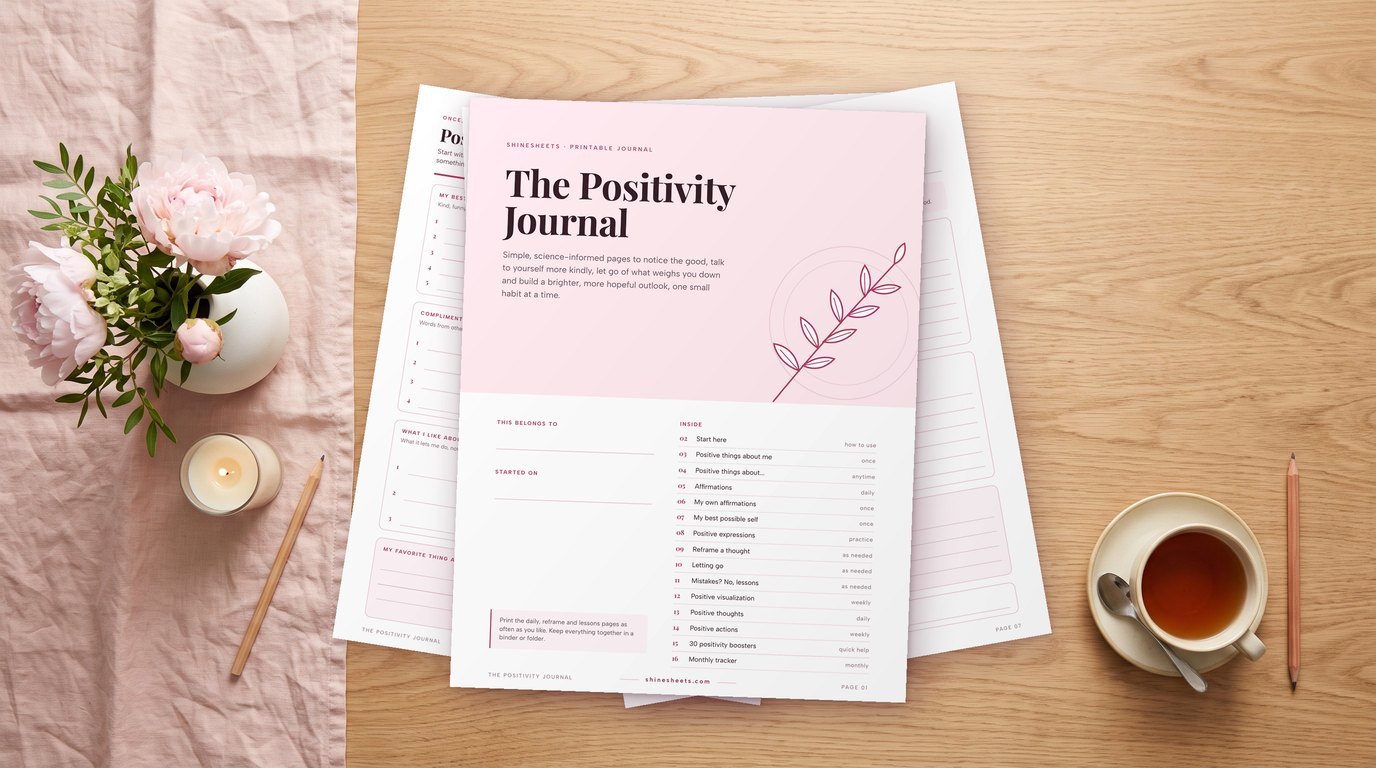
Writing it down helps many people. A guided reflection journal gives you gentle prompts when your thoughts feel tangled, or a simple cream notebook and a smooth gold pen work beautifully for free writing. For more on calming the body during strong emotions, my guide to emotional regulation walks through practical tools.
Toxic Positivity at Work and Online
Toxic positivity isn't limited to close relationships. It often shows up in two other places where it can be harder to spot.
At work, it can sound like "we're a family here, so no complaining," "just push through" or a team culture where raising a problem gets you labeled as negative. Over time, people stop flagging issues, burnout grows quietly and trust wears thin. If you lead or support others, try replacing "let's stay positive" with "what's getting in the way right now?" It keeps the tone hopeful while still letting real problems surface.
Online, it often looks like highlight reels and quotes insisting that a good mindset fixes everything. Seen often enough, these messages can make ordinary sadness feel like a personal failure. A good reminder: you're comparing your full, unedited life to someone else's carefully chosen moments.
In both places, the gentle fix is the same. Allow honesty, notice when cheerfulness is being used to avoid a conversation, and remember that acknowledging a problem is the first step toward solving it, not a sign of a bad attitude.
How To Support Someone Without Trying To Fix It
When someone you love is struggling, the urge to fix things can be overwhelming. Here's a simple way to stay supportive instead:
- Listen more than you speak. Aim for the other person to do most of the talking. Short responses like "mm," "that makes sense" or "tell me more" keep them going.
- Reflect what you hear. "It sounds like you felt invisible in that meeting." Reflection shows you were really listening.
- Ask before advising. "Would ideas help, or do you just want me to listen?" Respect the answer.
- Sit with the silence. Pauses aren't awkward to someone who's processing. Let them be.
- Follow up later. A quick "I've been thinking about you, how are you today?" a few days later often means more than anything you said in the moment.
Gentle Practices for Balanced Positivity

You don't have to give up optimism to let go of toxic positivity. These small practices help you hold both hope and honesty:
- Use "and" instead of "but." "I'm grateful for my job and I'm exhausted" feels very different from "I'm exhausted, but I should be grateful."
- Keep an honest journal. Write the hard days down too. A journal that only holds good days isn't the full story.
- Make a feelings ritual. A cup of chamomile tea and a glass jar candle in the evening can become a quiet signal to yourself: now is the time to check in. That's my favorite part of the day.
- Practice gratitude without pressure. Gratitude is lovely when it's added to your feelings, not when it's used to replace them.
- Curate your feeds. Notice accounts that make you feel like you're failing at happiness, and give yourself permission to mute them.
- Let your people see you. Share a small "not great today" with one trusted friend this week. It often invites them to be honest too.
When To Reach Out for Support
Making space for hard feelings is healthy. But if sadness, worry or numbness last for weeks, interfere with sleep, work or relationships, or feel too heavy to carry alone, please reach out. A therapist or doctor can help you understand what's going on and find support that fits you. Asking for help isn't a failure of positivity. It's one of the bravest, most hopeful things a person can do.
If you ever have thoughts of harming yourself, contact local emergency services or a crisis line right away. You deserve immediate support.
Final Thoughts
Toxic positivity tells us to hurry past our feelings. Real kindness, toward others and toward yourself, slows down, listens and says "this is hard, and I'm here."
You can still be a hopeful person. You can still believe things will get better. The difference is that your hope will come after the feeling has been heard, and that kind of hope is the one that actually holds.