You don't have to win an argument with an anxious thought to stop it from running your evening. Most of us were taught to fight worry with logic, or to drown it out with positive thinking. Both can help sometimes. But when a thought is sticky and loud, there's a gentler move that often works better: you stop arguing, take one small step back and see the thought for what it is. A string of words your mind just produced.
That small step back has a name. It's called cognitive defusion, and it comes from acceptance and commitment therapy (ACT). In this guide to cognitive defusion, you'll find what it actually means, how it differs from positive thinking or challenging your thoughts, 8 simple techniques with a how-to for each, a table that turns hooked thoughts into calmer next steps, and the moments when it helps most.
I'm prone to anxiety myself (mostly well managed, with the occasional wobbly week), and learning to unhook instead of wrestle was one of the kindest changes I made. It doesn't make thoughts disappear. It makes them lighter to carry.
What Is Cognitive Defusion?

Cognitive defusion is an idea from acceptance and commitment therapy, an approach developed by psychologist Steven Hayes and colleagues. The word "fusion" describes the moment you're glued to a thought: the thought "I'm going to mess this up" stops feeling like a thought and starts feeling like the truth, a prediction and an order all at once.
Defusion is the opposite. You notice the thought as a thought. Words and pictures passing through your mind, like weather. Some are useful, some are old habits, some are your nervous system being extra careful. None of them are facts just because they showed up, and none of them are instructions you have to follow.
A simple way to picture it: imagine holding a page of writing right up against your eyes. You can't see anything else. Now hold the same page at arm's length. The words haven't changed, but you can see the room again, and you can choose where to walk. That arm's length is defusion.
A quick note before we go on: this is a self-help skill, not a diagnosis or a treatment plan. If anxiety is heavy for you right now, these ideas can sit alongside real support, never instead of it.
How Defusion Differs From Positive Thinking and Challenging Thoughts
These three get mixed up a lot, so here's the short version:
- Positive thinking tries to swap the thought for a nicer one ("I'm going to mess this up" becomes "I'm going to be amazing"). If you don't believe the new thought, it can feel hollow, and your mind may push back with even more reasons to worry.
- Challenging thoughts (the classic approach from cognitive behavioral therapy) asks you to check the evidence and find a more balanced version. It's a genuinely useful skill, and I wrote about the patterns it targets in my guide to common thinking traps and how to spot them.
- Defusion doesn't change the content of the thought at all. It changes your relationship to it. You don't need to prove the thought wrong. You only need to see it, name it and decide what you'll do next.
That last part is why defusion is so handy on tired days. When you're exhausted, building a careful counter-argument can feel impossible. Saying "Ah, there's that thought again" takes about two seconds.
Why Fighting Anxious Thoughts Often Makes Them Louder

Try this: for the next ten seconds, do not think about a pink elephant. Most people find the pink elephant arrives immediately. Psychologists have studied this rebound effect for decades. Trying hard to push a thought away keeps your brain scanning for it, which keeps it close.
Anxious thoughts work the same way, with an extra twist. When you argue with a worry, you're treating it as an important message that deserves a full response. Your mind takes the hint: "Oh, this one matters. Better keep bringing it up." The thought gets louder, the argument gets longer and somehow it's midnight.
Defusion takes away the fuel without a fight. You're not ignoring the thought or pretending it isn't there. You're simply declining the invitation to debate it. Over time, many people find the thought shows up less dramatically, because it's no longer getting the VIP treatment.
This is also the difference between useful reflection and going round in circles. If you often wonder which one you're doing, my post on rumination vs reflection walks through the signs with a lot of kindness.
8 Cognitive Defusion Techniques To Try
You don't need all eight. Read through, notice which one makes you smile or feel a tiny bit lighter, and start with that one. Practice when you're calm first (two or three minutes is plenty), so the skill is ready when you actually need it.
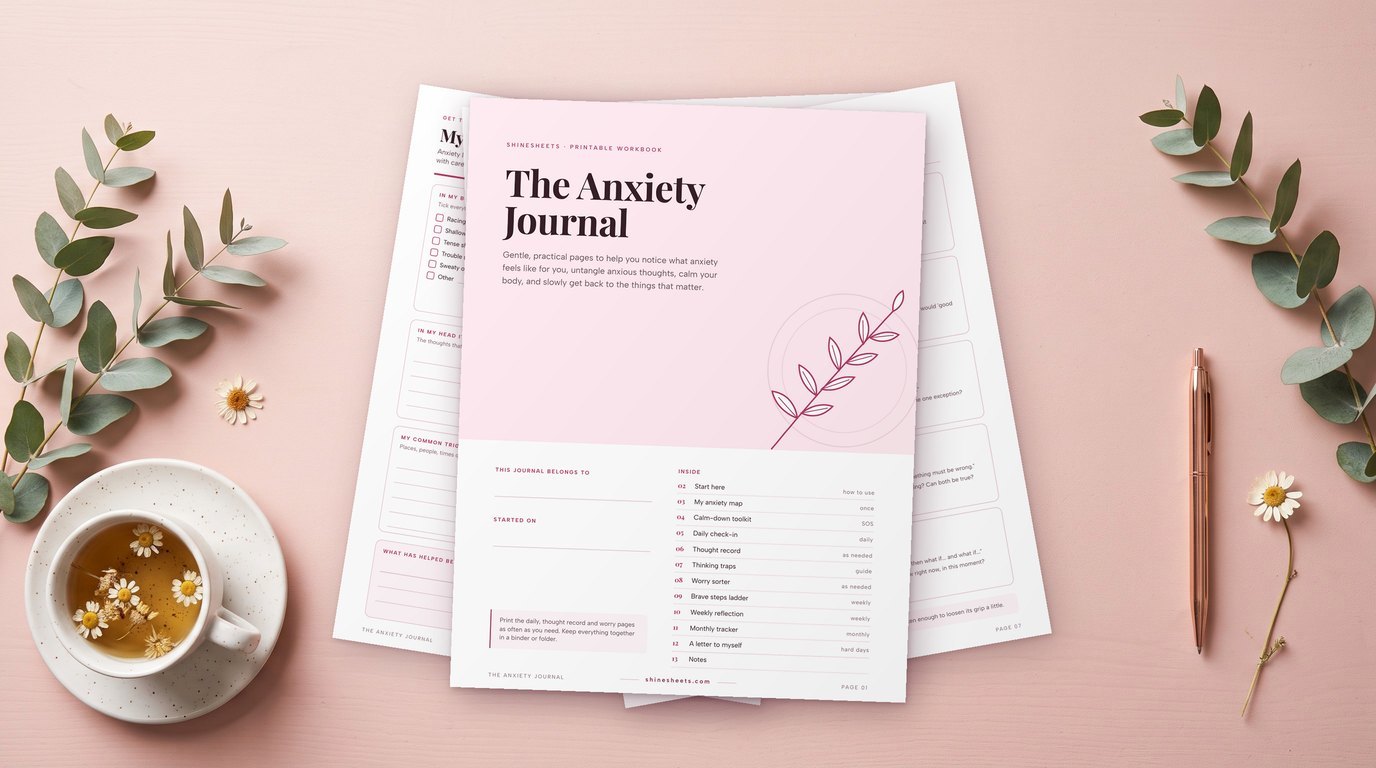
If you like having everything in one place, a guided anxiety journal with space for daily check-ins is a nice home for these practices. Any plain notebook works just as well.
1. "I'm Having the Thought That..."

This is the classic, and for good reason. Take the anxious thought and add a short phrase in front of it.
- Original: "I'm going to fail this interview."
- Step one: "I'm having the thought that I'm going to fail this interview."
- Step two: "I notice I'm having the thought that I'm going to fail this interview."
How to do it: say each version slowly, out loud or in your head, and pause for one breath between them. Notice how each layer puts a little more space between you and the words. The thought is still there. You're just standing slightly further back from it.
2. Name the Story
Anxious minds tend to repeat the same few plots. Maybe yours is the "everyone is secretly annoyed with me" story, or the "something bad is about to happen" story, or the "I'm always behind" story.
How to do it: give your most common worry pattern a short, slightly playful title. When it starts up, say: "Ah, it's the 'Everyone's Annoyed' story again." You don't need to listen to the whole episode. You already know how it goes.
Naming the story works because it zooms out from the details (this email, this friend, this tone of voice) to the pattern. Patterns feel much less urgent than emergencies.
3. Say It Slowly or in a Silly Voice
This one sounds odd, and it's meant to. Thoughts carry a serious, official tone in our heads. Change the tone and the spell weakens.
How to do it: take the thought and say it out loud very, very slowly, stretching each word for about two seconds. Or say it in a cartoon voice, or sing it to the tune of "Happy Birthday." Do this for thirty seconds.
Gentle caveat: this works best for everyday worries, not for painful memories or anything that feels deeply raw. If a thought touches something tender, skip the silly voice and choose a softer technique, like thanking your mind or returning to your senses.
4. Leaves on a Stream

This is a well-known ACT visualization, and it's lovely for quiet moments.
How to do it:
- Sit or lie comfortably and close your eyes if that feels okay.
- Picture a slow stream with leaves floating on the surface.
- Each time a thought appears (a worry, a plan, a memory, even "this isn't working"), place it on a leaf and watch it float away.
- If you get pulled into a thought, that's completely normal. Gently notice it and put that one on a leaf too.
- Keep going for three to five minutes.
The point isn't to empty your mind or make the stream go faster. The point is practicing the moment of noticing, again and again. Every time you catch yourself drifting and come back, that's the skill getting stronger. Settling in with a soft weighted lap pad across your legs can make this feel even more grounding.
5. Thank Your Mind
Your anxious mind is trying to protect you. It's clumsy and dramatic about it, but the intention is care. Thanking it acknowledges that without obeying it.
How to do it: when a worry shows up, say (out loud or silently): "Thanks, mind. I know you're looking out for me." If it keeps repeating, you can add: "Got it. I heard you the first time."
Keep the tone warm, like talking to a nervous friend, not sarcastic. You're not shutting the thought down. You're letting it know the message has been received, so it doesn't need to shout.
6. Write It on a Card and Carry It

This exercise shows, quite literally, that you can carry a thought with you and still do what matters.
How to do it: write your sticky thought on a small card. A set of pastel index cards is perfect for this. Fold it, pop it in your pocket or bag, and take it along for the day. When you feel it there, remind yourself: "I can bring this thought with me and still go to the meeting, still call my sister, still take my walk."
Many people find the thought feels smaller by evening, simply because it went everywhere with them and nothing terrible happened. At the end of the day, you can keep the card, throw it away or tuck it into your journal. Your choice.
7. Label the Thought: Worry, Planning, Judging
Not every thought needs a full name or story. Sometimes a quick category is enough.
How to do it: when you notice a thought, label it with one word, softly, in your head:
- "Worrying" for what-ifs about the future.
- "Planning" for to-do lists running on a loop.
- "Judging" for harsh opinions about yourself or others.
- "Remembering" for replays of the past.
Then return to what you were doing. Labeling turns a flood of content into a few calm categories, and it helps you notice which type of thinking takes up most of your day. Keep a stack of pastel sticky notes near your desk and jot a tally for each label for one week if you're curious.
8. Come Back to Your Senses and Your Values

Defusion creates space. This last technique is about what you do with that space.
How to do it: after you've unhooked a little, gently bring your attention to your senses. Name five things you can see, four you can feel, three you can hear. Wrap your hands around a warm cream ceramic mug and notice the heat. Then ask one question: "What matters to me right now, and what's one small step toward it?"
That step might be replying to one email, texting a friend back or going to bed. ACT calls this acting on your values, and it's the real goal. Defusion isn't about feeling perfectly calm first. It's about being able to move toward what you care about, even with the thought along for the ride. For more ways to anchor in your body, my list of grounding techniques to calm anxiety fast pairs beautifully with this one.
The Unhooking Table: From Hooked Thought to Next Small Step
Here's the heart of this guide. Each row shows a common anxious thought, what being "hooked" by it usually looks like, a defused version and one small action you can take next. Screenshot it, or copy the rows that sound like you into your journal.
| Anxious thought | Hooked response | Defused version | Next small action |
|---|---|---|---|
| "I said something stupid at dinner." | Replaying the conversation for an hour | "I'm having the thought that I said something stupid." | Write one line about it, then read two pages of a book |
| "What if I get sick?" | Searching symptoms late at night | "There's the 'What If' story again." | Put the phone in another room and do a 3-minute body scan |
| "My friend hasn't replied, she must be upset with me." | Checking messages every few minutes | "Thanks, mind. You're worried about the friendship." | Set a time to check once, later in the day |
| "I'll never get all this done." | Freezing and doing nothing | "That's a planning thought, dressed up as a disaster." | Pick the one task that matters most and do 10 minutes |
| "I'm not good enough for this job." | Avoiding the project, overpreparing | "I notice the 'Not Enough' story is playing." | Send the draft as it is, with one sentence of context |
| "Something bad is going to happen." | Tense shoulders, scanning for danger | Place the thought on a leaf and watch it float | Five slow breaths, then name 5 things you can see |
| "Everyone will notice I'm nervous." | Canceling plans at the last minute | Say the thought in a slow, silly voice for 30 seconds | Go for 20 minutes, with a kind exit plan if needed |
| "I should be further along by now." | Comparing yourself to others online | "Judging." (label and return) | Write down one thing you did well this week |
Notice the last column. The action is always small, always doable and always pointed toward something you value: rest, connection, progress, presence. That's the whole idea in one table.
When Cognitive Defusion Helps Most
Defusion is useful any time, but there are a few moments where it really shines.
Bedtime Loops

Nighttime is when thoughts get loudest, partly because there's nothing else competing for your attention. Arguing with a worry at 11 p.m. tends to wake you up even more.
Try this instead: when you notice a loop, label it ("planning" or "worrying"), place it on a leaf and let your attention rest on the feeling of your pillow. A light spritz of lavender pillow mist can become a small cue that tells your body it's time to switch off (spray the pillowcase, not your face, and skip it if scents bother your skin or breathing). For a full evening routine, my calm plan for how to stop overthinking at night goes step by step.
What-If Spirals
"What if" thoughts multiply fast. One becomes three, three become ten. The key is to catch the first one and name the pattern before it builds: "I'm having a what-if thought." You don't need to answer the question. A what-if is a question, not a forecast.
Before Something You Care About
Interviews, first dates, hard conversations, a presentation. Nerves before something important are normal and often a sign it matters to you. Defusion lets you bring the nerves along instead of waiting for them to vanish. The card technique works especially well on these days.
A Gentle 5-Minute Daily Defusion Practice

Skills grow with small, regular practice, ideally on calm days. Here's a short routine you can fit into a morning or an evening tea break:
- Minute 1: Sit comfortably and take three slow breaths.
- Minute 2: Notice whatever thought is around and add "I'm having the thought that..." in front of it.
- Minutes 3 to 4: Do leaves on a stream, placing each new thought on a leaf.
- Minute 5: Ask, "What matters to me today?" and write one small action in your journal.
That's it. If you want more variety, rotate in exercises from my list of mindfulness activities for anxious moments. Mindfulness and defusion are close cousins, and they support each other well.
Common Mistakes With Defusion (and What To Do Instead)
- Using it to get rid of thoughts. If you're secretly hoping the technique will make the thought vanish, and it doesn't, it can feel like failure. The goal is space, not silence.
- Making fun of yourself. Silly voices are about the thought, never about you. If it starts to feel mean, switch to thanking your mind.
- Only trying it in a crisis. Practice on small, everyday worries first, so the skill feels familiar when a big one arrives.
- Skipping the action step. Unhooking is half the job. The other half is gently moving toward something you value.
- Expecting it to replace support. Defusion is a tool, not a cure, and it works best as part of a wider circle of care.
When To Talk to a Therapist
If anxious thoughts keep coming back no matter what you try, or they're affecting your sleep, work, relationships or how much you enjoy your days, please reach out to a therapist or your doctor. Anxiety is very common and very treatable, and the National Institute of Mental Health has clear information about the kinds of support available.
Many therapists are trained in acceptance and commitment therapy specifically, so you can ask about it directly if this approach speaks to you. A professional can tailor these exercises to your life and help with anything that feels too heavy to carry alone.
Final Thoughts
Your thoughts don't need to be perfect, positive or quiet for you to live a full, kind, meaningful day. They just need a little room. Every time you say "I'm having the thought that..." or place a worry on a leaf, you're practicing that room.
Start with one technique this week, keep it small and be gentle with yourself when you forget. The thoughts will still visit. You'll simply be the one holding the page at arm's length, able to look up and choose your next step.