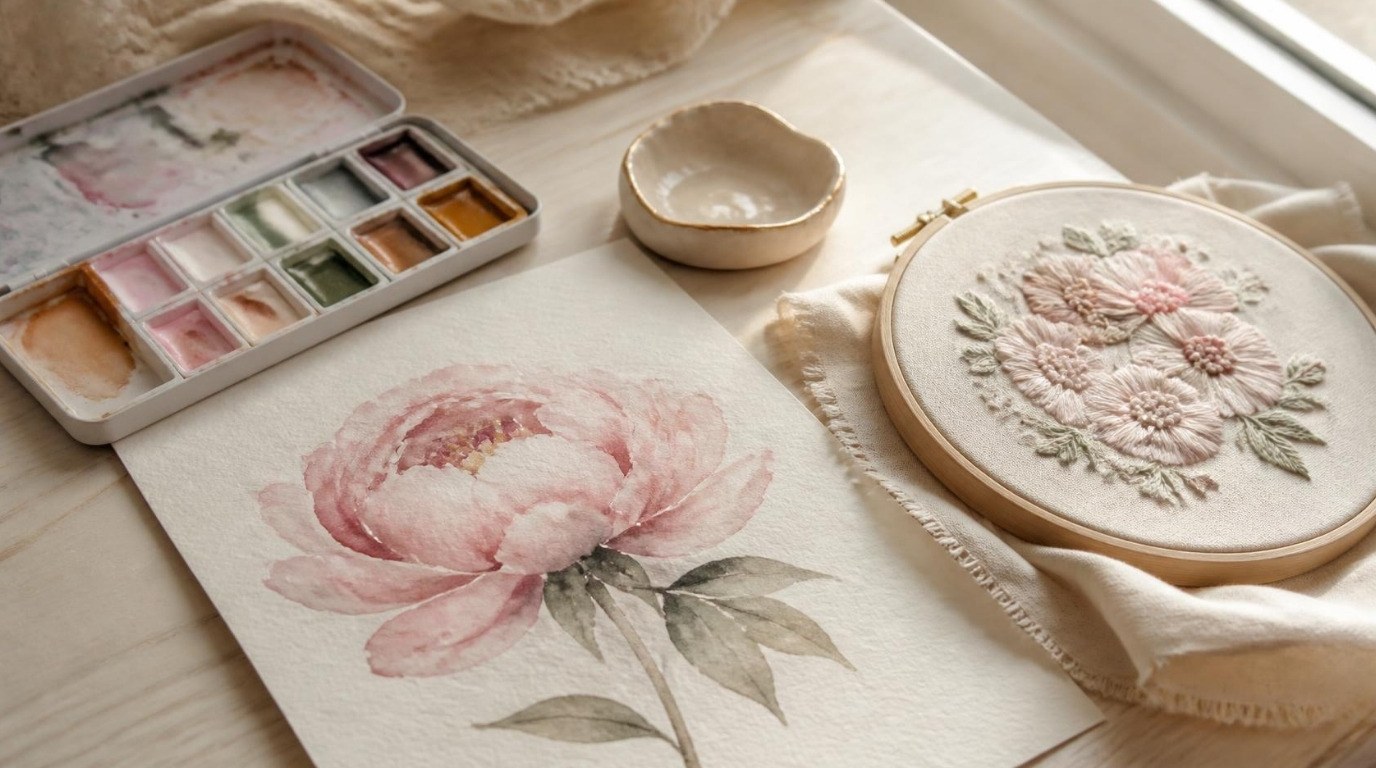
Shiny object syndrome isn't a lack of discipline. It's a very human reaction to the difference between how a new idea feels and how the middle of an old one feels. A fresh idea is all possibility. A half-finished project is all evidence, the messy drafts, the parts you haven't figured out, the proof that it's harder than you hoped. Of course the new thing looks prettier.
The good news is that you don't have to stop having ideas (please don't, they're one of the best parts of you). You only need a kinder system for deciding which ones get your time right now, which ones wait, and which ones you can let go of without guilt.
This guide is all about shiny object syndrome: what it actually is, why it happens, seven signs you might recognize, eight gentle ways to stop starting and start finishing, and a simple cooling-off table you can use the next time a brand-new idea taps you on the shoulder. Grab an undated project planner or any notebook you like, and let's make finishing feel a little more possible.
What Is Shiny Object Syndrome?

Shiny object syndrome is the habit of jumping to a new idea, hobby or project before you've finished the last one. It isn't a medical term or a diagnosis, just a nickname for a pattern most of us know well. You start a new class with real excitement, buy the supplies, plan the whole thing out, and then, somewhere around week three, something else catches your eye and the first project quietly slides into the drawer.
It shows up everywhere: side projects, hobbies, fitness plans, home makeovers, books you're reading, even apps you sign up for. The pattern is always similar. Excitement at the start, a dip in the middle, and a new spark that promises to feel as good as the beginning did.
Here's the part I want you to hear: being drawn to new things is not a flaw. Curiosity is lovely. The problem only starts when the jumping means you never get to enjoy the deeper satisfaction of finishing anything, and you start to believe you're "just not someone who follows through." You are. You just haven't had a system that works with your curiosity instead of against it.
This is a little different from general productivity. If your struggle is getting through your everyday to-do list, my guide on how to get things done and finish tasks more easily is a better starting point. This article is about the pull of the new and choosing what to finish.
Why New Ideas Feel So Irresistible

Understanding why the pull is so strong takes a lot of the shame out of it. There are usually a few reasons working together.
Novelty Feels Good
Your brain loves new things. A new idea brings a little rush of anticipation, the same pleasant buzz you feel when you open a fresh notebook or plan a trip. Nothing has gone wrong yet, so it's all upside. The project you're already in the middle of can't compete with that, because you already know its problems.
The Messy Middle Feels Hard
Every project has a beginning (exciting), an end (satisfying) and a long middle (repetitive, slow, a bit boring). The middle is where most projects die. It's where the work stops feeling like a fun idea and starts feeling like, well, work. A new idea offers a way to skip the middle and go back to the exciting beginning.
Fear of Failing
This one is sneaky. As long as a project is unfinished, it can't be judged. If you never finish the course, you never find out whether you were good at it. Starting something new can be a quiet way to protect yourself from the risk of finishing and having it not be perfect. If you notice this in yourself, be gentle. It's a very common way to feel safe.
Too Many Inputs
Every feed, newsletter, podcast and video brings another idea, another "you should try this." When you're taking in new ideas all day, your attention never gets the quiet it needs to stay with one thing. I'm prone to anxiety, and I've noticed that on my most input-heavy days I start the most things and finish the fewest. The ideas weren't the problem. The volume was.
7 Signs You Have Shiny Object Syndrome
You don't need to recognize all of these. Even two or three can be a sign that the new keeps winning over the almost-done.
- You have a drawer (or a folder) of half-finished projects. Craft kits, drafts, notebooks with the first five pages filled in.
- You buy the supplies before you've started. The planning and shopping stage is your favorite part, sometimes the only part.
- Your excitement drops sharply after a few weeks. You notice a pattern of losing interest right around the point where things get repetitive.
- A new idea feels urgent. It feels like you have to start it today, or the moment will pass.
- You sign up for courses, apps and challenges you never finish. Your inbox is full of welcome emails for things you tried once.
- You compare your messy middle to someone else's highlight. Their project looks easier, so you switch to something similar.
- You feel a little guilty when you think about your old projects. And that guilt makes it even harder to go back to them.
If you saw yourself in this list, take a breath. Nothing here means you're lazy. It means you're curious, a bit overwhelmed and ready for a gentler way to choose.
8 Ways To Stop Starting and Start Finishing
Pick one or two of these to try first. You don't need a full overhaul, just a few small guardrails between "ooh, new idea" and "I've started yet another thing."
1. Keep an Idea Parking Lot

The biggest reason new ideas feel urgent is the fear that you'll lose them. An idea parking lot solves that. It's one single place where every new idea goes the moment it shows up, so your brain can relax: it's saved, it's safe, you can come back to it.
I'd choose a pastel yellow idea notebook that lives only for this, or one note on your phone if you prefer. Write the idea, the date, and one line on why it excites you. That's it. No planning, no research, no buying anything yet.
Something lovely happens when you do this for a month. You'll look back through it and notice that many of those "must-do" ideas don't feel exciting at all anymore. The ones that still glow are the ones worth considering.
2. Follow the One Main Project Rule

Give yourself one main project at a time, outside of your everyday responsibilities. Just one. You can have small hobbies on the side (reading, a daily walk, a casual playlist you're building), but only one thing gets the label "the project I'm finishing."
Write it at the top of your planner page every week. When you sit down with spare time, the main project gets the first 30 minutes before anything new. If you finish the session and still want to browse new ideas, go for it, but the main project goes first.
If you have several projects already in progress, pick the one that is closest to done or matters most to you, and put the others on pause on purpose. The Eisenhower Matrix for prioritizing can help when everything feels equally important.
3. Define What Done Looks Like
A lot of projects never end because they never had a finish line. "Learn watercolor" is endless. "Paint five small botanical pieces and frame my favorite" can be finished.
Before you start (or restart) a project, write one sentence: "This is done when ___." Make it concrete enough that you'd know it the moment it happens. A few examples:
- "The closet project is done when everything fits and the donation bag is out of the house."
- "The course is done when I've finished all six modules and made one small thing with what I learned."
- "The blog idea is done when ten posts are written and published."
Stick that sentence on a blush sticky note where you'll see it. On the hard days in the middle, it reminds you the work has an end.
4. Give Every New Idea a Two-Week Cooling-Off Period

This is the one that changed the most for me. When a new idea arrives, it goes into the parking lot with a date exactly two weeks away. Until that date, you're not allowed to start it, buy for it, or research it for hours. You're allowed to think about it and add notes.
On the cooling-off date, ask yourself three questions:
- Do I still want this as much as I did two weeks ago?
- Does it fit my life right now, or would it squeeze out something I care about?
- Am I excited about doing it, or just about starting it?
If it still feels right, it becomes a candidate for your next main project, once the current one is done or paused on purpose. If the excitement faded, you've just saved yourself weeks of starting and stopping. You'll find a table for this a little further down.
5. Shrink the Project
Big projects invite shiny objects because they take so long that something new is guaranteed to show up before the end. Shrink the project until it fits into a few weeks.
Instead of "redo the whole apartment," try "finish the entryway." Instead of "write a book," try "write the first chapter." Instead of "get really good at baking bread," try "take one class and practice twice." A smaller finish line means you reach it before the next idea has a chance to take over, and each finish builds trust in yourself.
If you've abandoned bigger goals before, my article with ways to stop abandoning your goals goes deeper into keeping going after the first burst of motivation fades.
6. Plan the Boring Middle

Most of us plan beginnings beautifully and leave the middle to chance. Flip it. When you start a project, decide ahead of time what you'll do when it gets boring, because it will, and that's normal.
A few ideas that help:
- Use short, timed sessions. A simple white desk timer set for 25 minutes makes the middle feel manageable. You only have to show up for one round.
- Keep the next step tiny and written down. End each session by writing the next small action, so you never sit down wondering where to begin.
- Batch the dull tasks. Group the repetitive parts into one session a week, with tea and your favorite playlist.
- Keep the pieces together. Gold binder clips are a pretty, practical way to keep drafts, notes and loose papers for one project in a single stack, so nothing gets scattered between ideas.
If the middle feels hard because you can't focus for long, my guide to deep work for beginners has gentle ways to build longer stretches of attention.
7. Limit Your Inputs
You can't hold onto one project while a hundred new ideas are flowing in every day. You don't need to quit everything, just turn the volume down for a while.
- Courses: one at a time. No new course until the current one is finished or consciously dropped.
- Apps: before you sign up for a new tool, ask if you'd actually use it this week. Most shiny apps get opened twice.
- Feeds: mute or unfollow accounts that leave you feeling like you should be starting something new. Keep the ones that inspire you to finish.
- Newsletters: unsubscribe from anything you haven't opened in a month.
Try a two-week input diet while you're in the middle of a project. You'll probably notice the urge to jump gets quieter on its own.
8. Celebrate Finishing

We celebrate starts all the time: the new notebook, the first day, the announcement. Finishing often passes with a shrug, and then we wonder why it doesn't feel rewarding. Give the end of a project its own little moment.
It doesn't need to be big. Light a candle and write a few lines about what you made and what you learned. Buy yourself flowers. Tell a friend. Put a small mark next to it in your planner. The point is to teach your brain that finishing feels good too, so the satisfaction of the end can start to compete with the sparkle of the beginning.
And only then, open the parking lot and choose what comes next. That order matters.
The Shiny Idea Cooling-Off Table
Here's the table I'd use alongside the parking lot. Copy it into your planner or screenshot it. Every time a new idea arrives, give it a row. Fill in the decision only on the cooling-off date, not before.
| New idea | Why it pulls you | Cooling-off date | Decision |
|---|---|---|---|
| Start a pottery class | Looks calming, wants something hands-on | Two weeks from today | Next main project, after the closet is done |
| Start a podcast | Saw someone else's success, felt behind | Two weeks from today | Let go, it was comparison, not desire |
| Learn a new language app | Trial offer email, sounded exciting | Two weeks from today | Park until the current course ends |
| Repaint the bedroom | Bored with the middle of my current project | Two weeks from today | Shrink it: one accent wall, next month |
| Your idea here | Be honest, one line is enough | Today + 14 days | Start next / park / shrink / let go |
The "why it pulls you" column is the quiet hero here. When you write the real reason, patterns show up fast. If most of your ideas arrive on days you're bored, stressed or comparing yourself to someone else, that tells you the idea isn't really the point. It's a feeling looking for an exit.
There are only four possible decisions, and every one of them is a good outcome: start next (it earned its place), park (good idea, wrong time), shrink (good idea, too big) or let go (it was a passing spark, and that's okay).
What To Do When the Pull Is Strong Right Now
Sometimes a new idea arrives in the middle of a work session and it feels impossible to ignore. When that happens, try this quick reset:
- Name it. Say to yourself, "Oh, that's a shiny object." Naming the pattern takes away some of its urgency.
- Park it in under a minute. Write the idea and today's date in your parking lot. No research.
- Do ten more minutes. Go back to your main project for just ten more minutes. Often the pull fades once you're back in motion.
If you notice that the urge to jump shows up mostly when a task feels hard or scary, that might be procrastination wearing a pretty outfit. My list of tricks for when you feel stuck and keep procrastinating can help with that side of it.
When It's Okay To Let Something Go

Here's a gentle truth: not every unfinished thing needs to be finished. Some projects were meant to teach you something in the first few weeks and then step aside. Some hobbies were fun for a season. Some ideas made sense for who you were last year and don't fit now.
The difference between shiny object syndrome and healthy letting go is choice. Drifting away from a project because something new appeared leaves a little cloud of guilt behind. Deciding, on purpose, that you're done with it feels lighter.
Try this with your old projects: go through your drawer or folder once, and for each one write a single line, "I'm finishing this," "I'm parking this until ___," or "I'm letting this go because ___." Then actually let it go. Donate the supplies, delete the files, close the tabs. You're not quitting, you're clearing space for the things you really want to finish.
And if you find that jumping between things is affecting your work, sleep or relationships in a way that feels bigger than a habit, it's completely okay to talk to a doctor or a therapist about it. Sometimes a little outside support makes everything easier.
Final Thoughts
Your ideas aren't the enemy. They're proof that you're curious, creative and still excited about life, which is a beautiful thing to protect. All you need is a little space between the spark and the start: a parking lot, one main project, a clear finish line and the patience to let new ideas wait two weeks.
Choose one project this week, write down what done looks like and give it your first 30 minutes. The next idea will still be there when you've finished, and you'll meet it as someone who knows she can follow through.