
Most chore arguments aren't really about the dishes. They're about feeling unseen, feeling like the only one who notices the empty soap bottle, or feeling criticized for doing something "wrong" when you were trying to help. The good news is that when you fix the system, a lot of the tension quietly disappears with it.
That's what this guide is about: sharing chores as a couple in a way that feels fair to both of you, without score-keeping, nagging or anyone playing the household manager. You'll find why chores cause so much conflict, why fair isn't always 50/50, a calm script for the chores talk, a step-by-step way to divide everything (yes, including the invisible jobs), a chore ownership table you can fill in together, and what to do when your standards or schedules don't match.
Nothing here assumes who "should" do what. Every couple is different, and the best system is the one that works for your two lives.
Why Chores Cause So Many Arguments

Chores are one of the most common things couples argue about, and it makes sense. They happen every single day, they're never truly finished, and they touch on bigger feelings like respect, fairness and being taken care of. A small pile of laundry can carry a lot of meaning.
Most chore conflict comes from three quiet sources.
Invisible Work Nobody Sees
Some chores are obvious: vacuuming, cooking, taking out the trash. Others are almost invisible. Noticing the shampoo is running low. Remembering a birthday card. Booking the plumber. Wiping the shower so it doesn't get moldy. Knowing which bin goes out on which day.
When one person does most of the invisible tasks, they can feel exhausted while the other honestly believes things are split evenly. Nobody is lying. One person just can't see half the work.
Different Standards of "Clean"
One of you might think a kitchen is clean when the dishes are done. The other might not feel relaxed until the counters are wiped, the stovetop is shining and the sponge is rinsed. Neither standard is wrong, but when they clash, one person starts to feel nagged and the other starts to feel ignored.
The Mental Load of Remembering
Even when tasks are shared, one person often carries the job of remembering, planning and reminding. That's the mental load, and it's tiring in a way that's hard to explain. "Just tell me what to do" sounds kind, but it keeps one person in the role of manager. If this feels familiar, my guide to the mental load goes deeper into why it's so draining and how to lighten it.
Fair Doesn't Always Mean 50/50

It's tempting to aim for a perfect half-and-half split, but in real life that often isn't the fairest option. One of you might work longer hours, travel for work, have a health condition, or be going through a stressful season. A rigid 50/50 can feel unfair in those moments.
A more useful goal is this: both of you feel the split is fair, and both of you have roughly the same amount of rest. That second part matters. If one person finishes the evening on the sofa while the other is still folding laundry at ten o'clock, something is off, even if the task list looks balanced on paper.
A few things that can make an uneven split feel completely fair:
- One partner does more daily tasks while the other handles bigger, less frequent jobs.
- One partner takes on more during a busy work season, and it switches later.
- One person cooks most nights, the other does all the cleaning up and grocery planning.
- One loves certain chores and happily does more of them.
Fair is a feeling you agree on together, not a number. And it's allowed to change.
How To Have the Chores Talk Calmly

Timing is half the battle. The chores talk goes badly when it happens in the middle of a mess, late at night, or right after someone has sighed loudly at the sink. Pick a calm moment, maybe a weekend morning with coffee, and let your partner know ahead of time: "Can we sit down on Sunday and figure out a chore system together? I think it would make us both happier."
Here's a gentle script you can adapt:
"I love our home and I want it to feel good for both of us. Lately I've been feeling a bit stretched with the household stuff, and I think part of it is that I'm keeping track of a lot in my head. I don't want to keep score or nag you. Could we make a list of everything that needs doing and decide together who owns what? I'd love to hear what feels unfair or annoying for you, too."
Notice what this script does: it starts with a shared goal, uses "I feel" rather than "you never," and invites your partner's side. That last part is important. Your partner may have frustrations you don't know about.
A few things to avoid during the talk:
- Listing every time they forgot something in the past.
- Comparing them to your parents, friends or exes.
- Saying "you always" or "you never."
- Trying to solve everything in one conversation.
If the talk starts to get heated, it's completely fine to pause and come back to it later. My guide to conflict resolution for couples has some lovely tools for keeping these conversations kind.
Step 1: List Every Task, Including the Invisible Ones

This step is the one most couples skip, and it's the one that changes everything. Sit down together with a weekly planner notebook or a shared note and write down every single household task you can think of. Don't divide anything yet. Just list.
Go room by room, then add the invisible tasks. Here's a starting point:
- Daily: dishes, wiping counters, making the bed, tidying the living room, feeding pets, taking out trash when full.
- Weekly: laundry, changing sheets, vacuuming, mopping, cleaning the bathroom, grocery shopping, watering plants.
- Monthly: cleaning the fridge, dusting high places, washing throw blankets, checking supplies.
- Invisible: meal planning, keeping track of what's running low, paying bills, booking repairs, remembering birthdays and gifts, planning social plans, keeping the calendar.
Most couples are surprised by how long the list gets. That's the point. Once the invisible work is written down, it becomes real work that can be shared, instead of something one person quietly carries. If you'd like a ready-made rhythm for the cleaning part, my cleaning schedule breaks tasks into daily, weekly and monthly.
Step 2: Divide by Preference, Skill and Time
Now comes the fun part. Go through the list together and divide tasks using three questions:
- Preference: Which tasks do you actually like, or at least not mind? Some people find folding laundry relaxing. Some genuinely enjoy cooking. Start there.
- Skill: Who is naturally better at certain things? One of you might be great with budgets, the other with fixing things. Play to your strengths, but stay open to learning.
- Time: Who has more time and energy on which days? Someone who gets home earlier might take on evening tasks, while the other handles the weekend jobs.
Then split the tasks nobody likes. Every home has a few: cleaning the toilet, scrubbing the oven, taking the recycling out in the rain. You can take turns month by month, or trade them for something the other person dislikes.
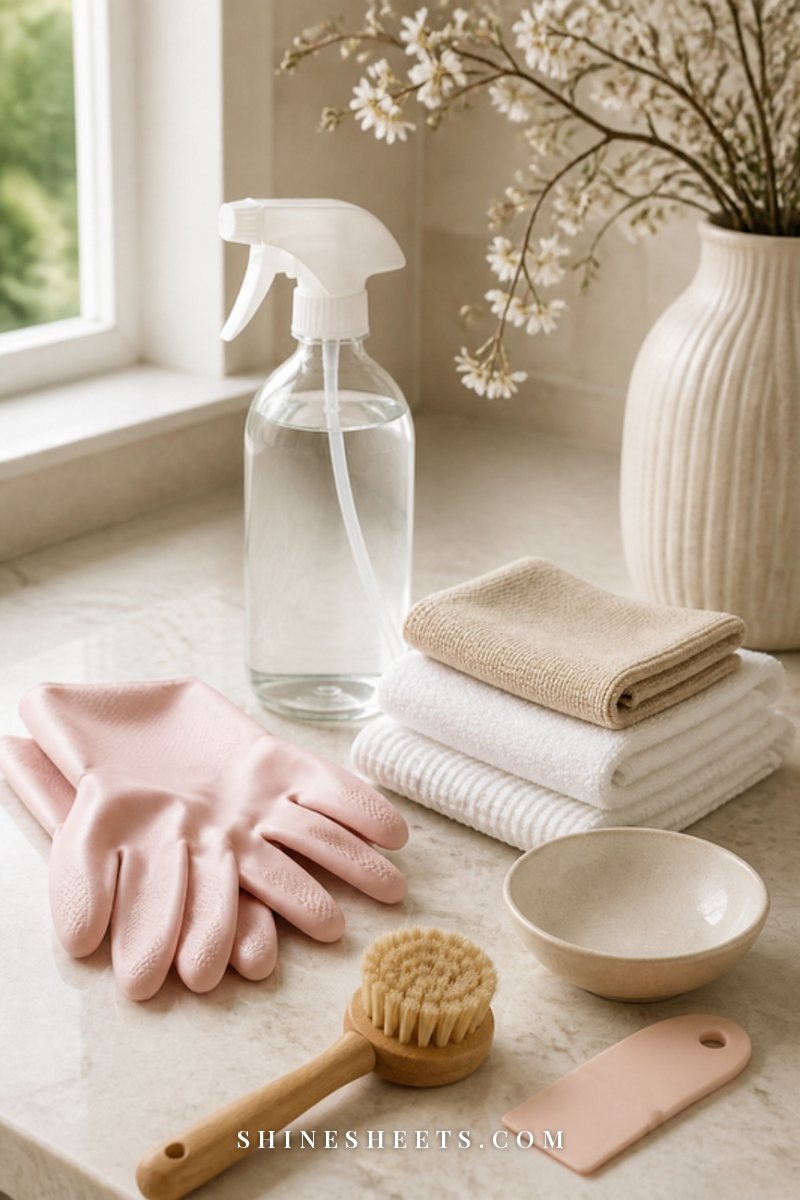
Small tools help make shared tasks easier to pick up. A cleaning caddy stocked with everything for the bathroom means either of you can grab it and go, and a stack of soft microfiber cloths in one easy spot means nobody has to hunt for supplies.
Keep it kind. This is a negotiation between teammates, not a trial. If you find yourselves stuck, my guide on how to compromise in a relationship has a few easy ways to meet in the middle.
Step 3: Own a Task Fully Instead of "Helping"
This is the shift that makes the biggest difference. "Helping" means one person is in charge and the other assists. Owning a task means you're responsible for the whole thing, from start to finish, including noticing when it needs doing.
Take laundry as an example. Helping looks like folding clothes when asked. Owning laundry looks like this:
- Noticing when the laundry basket is full.
- Washing, drying and folding.
- Putting clothes away.
- Knowing when detergent is running low and buying more.
- Remembering which items need special care.
When you own a task fully, the other person can genuinely let it go. No reminders, no checking, no mental space taken up. That's where real relief comes from.
One important rule: once someone owns a task, the other person doesn't redo it or criticize how it's done (within reason). If your partner folds towels in thirds and you prefer halves, let it be. Redoing their work tells them it isn't good enough, and it's the fastest way to make someone stop trying.
The Chore Ownership Table

Here's the heart of the system. Fill in this table together, one row per task. The last column is the secret ingredient: agreeing on what "done" looks like ends so many small arguments before they start.
| Task | Owner | How Often | What "Done" Looks Like |
|---|---|---|---|
| Dishes | Partner A | Every evening | Sink empty, dishes dried or in the rack, counters wiped |
| Laundry | Partner B | Twice a week | Washed, folded and put away within a day |
| Bathroom clean | Partner A | Weekly | Toilet, sink, mirror and shower cleaned, towels swapped |
| Groceries and meal planning | Partner B | Weekly | List made, shopping done, basics restocked |
| Vacuuming and mopping | Partner A | Weekly | All rooms, including under the sofa cushions |
| Changing sheets | Partner B | Every 1–2 weeks | Fresh sheets on, old ones washed |
| Trash and recycling | Partner A | When full and on collection day | Bins out on time, new bags in |
| Bills and household admin | Partner B | Monthly | Bills paid on time, receipts filed |
| Plants and pets | Shared, alternating weeks | Daily / weekly | Fed, watered, litter or bedding refreshed |
| Birthdays and gifts | Each owns their own family | As needed | Card or gift sent on time |
Screenshot it, copy it into your notebook or write your own version on a piece of paper and stick it inside a cupboard door. Your version will look different, and that's exactly how it should be.
Keep things like supplies tidy and shared, too. A few woven storage baskets for cloths, sponges and spare bags mean whoever owns a task always knows where everything lives.
The Weekly 10-Minute Check-In

No system works perfectly from day one, and that's fine. What keeps it working is a short, regular check-in. Once a week, maybe Sunday evening with tea, spend ten minutes going over how things went.
Keep it light with these four questions:
- What went well with the house this week?
- Was anything harder than expected?
- Is there anything coming up next week that changes the plan?
- Does anything need to swap, even just for a week?
That's it. Ten minutes, no lectures. You can also say thank you here, which matters more than it seems. "Thank you for doing all the laundry this week, I noticed" is a small sentence that makes someone want to keep going.
If you live together for the first time, this check-in is especially helpful in the early months. My moving in together guide has more ideas for setting up a shared home from the start.
What To Do When Your Standards Differ
This is the tricky one. If one of you is a tidy person and the other is more relaxed, you'll probably never see clean the same way. And honestly, you don't need to. A few ideas that help:
- Agree on the basics. Decide together on a shared minimum, like dishes done before bed and no clothes on the floor. That's the non-negotiable level.
- Let the tidier person own "extra" jobs they care about. If you love a sparkling stovetop and your partner doesn't notice, that might be your task, chosen because it matters to you.
- Explain the why. "When the counters are cluttered, I feel stressed and can't relax" lands much better than "you're messy."
- Use the "done" column. Defining done together is the gentlest way to close the gap between standards.
- Pick your battles. If something small doesn't really affect your life, consider letting it go.
And try to remember that your partner's standards come from somewhere, too, often from how they grew up. Curiosity goes much further than criticism here.
Sharing Chores During Busy Seasons

Life won't always cooperate with your beautiful table. Work deadlines, illness, travel, family visits and tough emotional seasons all throw the balance off. That's when flexibility matters most.
A few ways to keep things fair when life gets busy:
- Name the season. Saying "I've got a big deadline for the next two weeks, could you take dishes and groceries until then?" is much kinder than silently dropping tasks.
- Lower the bar together. In a hard week, done might mean "dishes washed" rather than "kitchen spotless." Agree on a temporary minimum.
- Swap back afterward. When the busy season ends, the other person gets a lighter stretch. This keeps it fair over time.
- Get outside help if you can. A cleaner once a month, a grocery delivery or simpler meals can take pressure off both of you.
- Be extra generous with thanks. The person carrying more during a busy season needs to hear that it's noticed.
Over the long run, fairness is measured across months and years, not single days. Some weeks you'll carry more, some weeks they will.
Small Habits That Keep Chores Feeling Shared
A good system does most of the work, but a few small daily habits make the whole thing feel warmer. These take almost no time and quietly change the mood at home:
- The ten-minute evening tidy. Set a timer and both reset the living room and kitchen at the same time. Doing it together feels more like teamwork and less like a chore list.
- Finish what you start. If you take the last of something, add it to the shopping list. If you empty the dryer, fold it then and there. Half-done tasks are what usually create friction.
- Say what you see. "I noticed you cleaned the shower, thank you" takes three seconds and makes invisible work visible.
- Ask before you assume. "Are you still okay doing the bathroom this week?" is gentler than quietly getting annoyed when it isn't done yet.
- Don't keep a secret tally. If you notice yourself counting, that's a sign to bring it up in your check-in instead of letting it build.
- Make one chore pleasant. Put on a playlist, light a candle, make tea first. A little ritual turns a dull job into a small break.
It also helps to talk about chores as "ours" rather than "yours" or "mine." The home belongs to both of you, and so does looking after it. Even small language shifts, like "what does the house need this week?" instead of "what do you need me to do?", move you away from manager-and-helper and back toward teammates.
And when one of you slips (because you both will), go easy. A forgotten trash day isn't a sign that your partner doesn't care. It's just a forgotten trash day. Mention it kindly, fix it together and move on. The goodwill you protect is worth far more than a perfectly run house.
Final Thoughts
Sharing chores fairly isn't about perfect balance. It's about both of you feeling seen, trusted and rested in your own home. Write everything down, own your tasks fully, check in once a week and be kind when life gets messy. The house will never be finished, but it can be shared, and that makes it feel like a home you built together.