
Reinventing yourself rarely looks like a movie montage. It looks like small, kind choices repeated quietly until one day you notice you feel more like yourself than you have in years. The dramatic overnight version makes for good stories, but the slow version is the one that lasts.
This guide is a gentle, step-by-step plan for how to reinvent yourself without burning your life down first. You'll find seven ordered steps, from a short life review to a monthly check-in, plus a table that shows who you are now next to who you're becoming, and honest help for the wobbly parts: doubt, other people's reactions and old habits creeping back.
If you're looking for a long list of inspiration, my ways to restart your life article has fifty ideas to browse. This one is different: one calm plan, in order, that you can start this week.
What Reinvention Really Means

Reinvention is growing into a version of yourself that fits your life and values better than the old one did. It can mean a new rhythm to your days, new habits, a new way of speaking to yourself, a different home atmosphere or a fresh relationship with your free time.
It's less about becoming someone new and more about becoming more of who you already are, with the layers that no longer fit gently set aside. You keep your history, your humor and the people you love. You just stop carrying the things that were never really yours.
And it doesn't need a big trigger. Some people reinvent themselves after a move, a breakup or a loss. Others simply wake up one season and feel that the old routines are a coat that's gotten too tight. Both are good reasons.
What Reinvention Is Not
Before the steps, a few gentle reality checks, because the popular version of reinvention can do more harm than good:
- It's not changing everything at once. New job, new city, new body, new wardrobe and a 5 a.m. routine all in the same month is a recipe for exhaustion and a quick return to old patterns.
- It's not becoming someone you're not. If you're an introvert, your new self doesn't have to love parties. If you're sensitive, your new self doesn't have to toughen up. Growth works with your nature, not against it.
- It's not a rejection of your past. The version of you who got you here did her best with what she knew. She deserves thanks, not shame.
- It's not a performance. You don't need to announce it, post about it or prove it to anyone. Quiet change counts just as much.
Signs You're Ready for a Gentle Reinvention
You don't need permission to change, but it can help to name the feeling. These are some common signs that a quiet reinvention might be calling you:
- Your days run on autopilot, and weeks blur together.
- You catch yourself saying "that's just how I am" about habits you don't actually like.
- Things that used to excite you now feel flat or obligatory.
- You feel a little jealous of people who seem to live by their own rules (jealousy is often a clue about what you want).
- Your home, routines or wardrobe feel like they belong to an earlier version of you.
- You've been through a big change, and the old way of living no longer fits the new circumstances.
If a few of these feel familiar, that's not a crisis. It's information. It simply means some part of you is ready to grow, and the steps below give that part a gentle, practical place to start.
How To Reinvent Yourself in 7 Gentle Steps
Take these steps in order. Each one makes the next one easier. Give yourself about a week for each of the first four steps, then let steps five to seven become an ongoing rhythm.
Step 1: Pause and Notice What No Longer Fits

Before you change anything, take stock. A short life review helps you see clearly instead of reacting to a vague feeling of "something's off."
Set aside 30 minutes with a notebook and answer three questions for each main area of your life (home, health, work or daily tasks, relationships, free time, inner life):
- What feels good here and should stay?
- What feels heavy, tight or outdated?
- What do I quietly wish were different?
Write fast and don't edit. A linen-bound journal makes this feel a little more like a ritual and less like homework; look for one with thick, lay-flat pages so you can write comfortably in bed or on the sofa. I like doing this kind of writing in the evening, after a cup of tea, when the day has gone quiet.
If you'd like a more thorough version, my life audit guide walks you through a full review area by area.
Step 2: Get Clear on Your Values
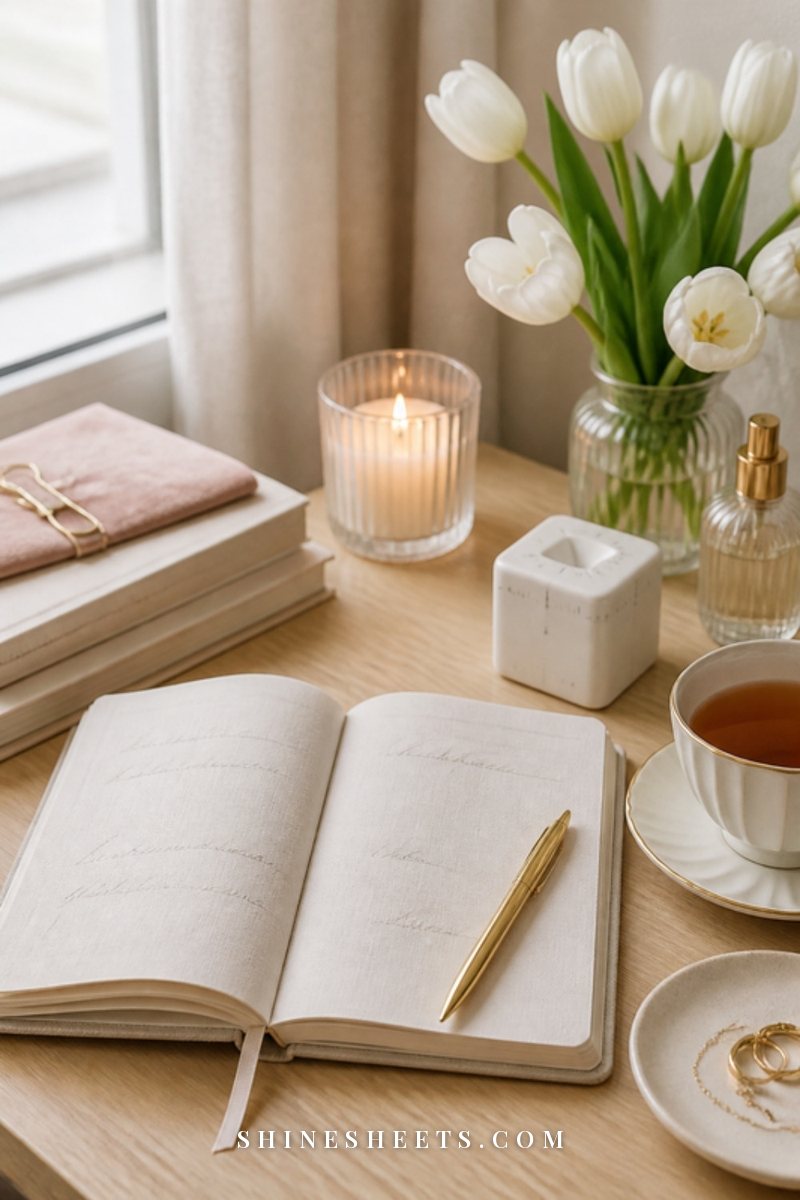
Values are your compass. Without them, reinvention easily turns into copying someone else's life. With them, every choice gets simpler.
Look at your life review and ask: What did the "feels good" parts have in common? What was missing from the heavy parts? You might notice words like calm, creativity, connection, freedom, beauty, honesty or learning.
Choose your top three to five values and write a one-line meaning for each, in your own words. For example: "Calm: my days have breathing room, and I don't rush from one thing to the next." A nice gold pen set is a small treat for this kind of writing; look for smooth-writing gel or ballpoint refills so the pen is a pleasure to use every day.
Stuck on words? My core values list has a hundred to choose from and a simple way to narrow them down to your top five.
Step 3: Imagine the Person You're Growing Into

Most goals focus on what you'll have: the job, the body, the apartment. Reinvention works better when you focus on who you'll be. A "who" is something you can practice today, while a "what" often sits years away.
Try this short exercise. Close your eyes and picture an ordinary Tuesday about a year from now, lived by the person you're growing into. How does she wake up? How does she talk to herself when she makes a mistake? What does her evening look like? How does she spend a free Saturday? Write down a few sentences in the present tense: "I am someone who…"
If you're visual, a cream corkboard can hold that picture: a fabric swatch in a color that feels like her, a pressed flower, a postcard, a handwritten line. Keep it about feelings and qualities, not things to buy. For a deeper version of this step, my guide on how to make a vision for your life goes beyond goals into how you want life to feel.
Step 4: Pick One Area To Start
This is where most reinventions either stick or fall apart. You'll probably feel the urge to start everywhere at once. Please don't.
Look at your life review and your "I am someone who…" sentences and choose one area that would make the biggest difference to how you feel day to day. Often it's the area that touches everything else: sleep, your mornings, your home, your evenings or how you speak to yourself.
Give that one area your attention for at least four to six weeks. The other areas will still be there, and many of them will shift on their own once one part of life feels steadier. One well-chosen change creates momentum that ten half-started ones never do.
Not sure which area to choose? Ask yourself: "If this one part of my life felt better, what else would get easier?" Better sleep makes patience easier. A calmer home makes evenings easier. Kinder self-talk makes almost everything easier. Pick the area with the longest list of "easier" answers, write it at the top of a fresh journal page, and let that be your focus for now.
Step 5: Choose Identity-Based Tiny Habits

Now turn the "who" into tiny, daily actions. The idea is simple: every small action is a vote for the kind of person you're becoming. You don't have to win every vote, only enough of them.
Use this little formula: "I'm becoming someone who [identity], so today I'll [tiny action]."
- "I'm becoming someone who reads, so today I'll read two pages before bed."
- "I'm becoming someone who moves her body, so today I'll walk for ten minutes after lunch."
- "I'm becoming someone who keeps a calm home, so today I'll clear the kitchen counter after dinner."
- "I'm becoming someone who speaks kindly to herself, so today I'll name one thing I did well."
Keep each habit almost too small to skip, around two to five minutes. Start with one or two habits in your chosen area. When they feel automatic (usually after a few weeks), add the next one. My identity-based habits guide explains this approach in more detail.
Step 6: Adjust Your Space and Routines To Support the New You

Willpower runs out. Surroundings don't. If you want the new habits to stick, make them the easiest option in your home and your day.
- Make the new habit visible. Book on your pillow, walking shoes by the door, journal on the nightstand.
- Make the old habit a little harder. Phone charging in another room overnight, snacks you're cutting back on out of sight, streaming apps logged out on weeknights.
- Create a small "new me" corner. A chair, a good light, a blanket, the things you need for your new habit. A sage green desk lamp with a warm bulb is a pick for an evening reading or journaling spot; look for a weighted base and a soft, glare-free shade.
- Anchor habits to existing routines. After my morning coffee, I'll… After I brush my teeth at night, I'll… Linking the new to the familiar takes away the need to remember.
Even small changes to your space send a quiet message: someone different lives here now, and her habits have a home.
Step 7: Review Monthly With Self-Compassion

Once a month, sit down for 20 to 30 minutes and look back. Not to grade yourself, but to learn. Ask:
- What felt good this month?
- Which tiny habit stuck, and which one kept slipping?
- What got in the way, and how can I make it easier next month?
- Where did I already act like the person I'm becoming?
An undated monthly planner works well for this because you can start any month and skip one without empty, guilty pages. Look for a simple layout with room for notes beside each month. Light a candle in a cream glass jar and make your review a small ritual you look forward to (blow it out before you leave the room).
Speak to yourself the way you'd speak to a friend who's trying something brave. If a habit didn't stick, shrink it or change the time of day. If an area feels steady, you might choose the next one. Slow progress is still progress.
Your Reinvention Table
This table puts the whole plan side by side. Use the examples as inspiration and fill in your own rows in your journal: one row per life area, starting with the area you picked in Step 4.
| Life area | Who I am now | Who I'm becoming | One tiny habit |
|---|---|---|---|
| Mornings | Wakes up rushed and reaches for the phone first | Starts the day slowly and on purpose | Drink a glass of water by the window before checking messages |
| Home | Lives with clutter that drains her | Keeps a calm, welcoming home | Clear one surface for five minutes every evening |
| Health | Moves only when she "has time" | Enjoys moving her body most days | Walk for ten minutes after lunch |
| Inner voice | Criticizes herself for small mistakes | Speaks to herself with kindness | Write one thing she did well before sleep |
| Free time | Spends evenings on her phone out of habit | Has hobbies that fill her up | Read, sketch or knit for 15 minutes after dinner |
| Relationships | Waits for others to reach out | Nurtures the connections she values | Send one warm message to a friend each week |
Screenshot it if it helps. You only need one row to begin.
Handling Doubt, Other People and Old Habits

Every reinvention has wobbly moments. They don't mean you're failing. They mean you're changing.
When Doubt Shows Up
Doubt usually sounds like "Who do you think you are?" or "You always quit." It's your mind trying to keep you safe in the familiar, even when the familiar no longer serves you.
When it shows up, don't argue with it for hours. Acknowledge it ("I hear you, this feels new and uncertain") and go back to the smallest possible action. Doing the tiny habit anyway is the best answer to doubt, because it gives your mind new evidence.
A small honest admission: I'm prone to anxiety, and change of any kind can stir it up. What helps me is keeping the steps so small that the anxious part of my brain doesn't treat them as a threat. If doubt or low mood starts to feel heavy and constant, talking to a therapist can be a very kind gift to yourself during a big season of change.
When Other People React
People who love you may not immediately understand the new you. Some may tease, some may worry, some may push you back toward the old version because it's familiar to them. Usually this isn't malice; it's their own discomfort with change.
You don't need to cut anyone off or defend every choice. A calm, simple line goes a long way: "I'm trying something new for me. It would mean a lot if you'd give it a little time." Share as much or as little as you like. Over time, consistent small changes speak louder than any explanation.
It also helps to find one or two people who are growing too: a friend, a sister, a class or a community around your new habit. Their encouragement makes the hard days lighter.
When Old Habits Creep Back
They will, especially during stressful weeks, holidays or illness. That's completely normal. Old habits have years of practice behind them; new ones have weeks.
Use the "never miss twice" idea: one skipped day is just a day, two in a row is the start of a new pattern. When you slip, start again with the smallest version of your habit the next day, without a long self-critique. One page instead of two. Five minutes instead of ten. A little is always better than none.
And if a habit keeps slipping month after month, that's useful information, not a character flaw. It might be the wrong time of day, the wrong size or simply not the right habit for the person you're becoming.
Final Thoughts
Learning how to reinvent yourself is less about a dramatic before-and-after and more about a thousand small, kind choices. Notice what no longer fits, get clear on what matters, picture who you're growing into, then start with one area and one tiny habit.
You don't have to become someone else. You only have to keep taking the next small step toward the version of you that feels like home, and trust that slow, steady change is still real change.