Most resolutions don't fail because the person making them lacks willpower. They fail because they were built for a perfect version of January – the one where you have endless energy, nothing goes wrong and every week looks exactly like the first one. Real life shows up around week three, and a resolution with no room for real life quietly slips away.
The good news is that keeping a resolution is far more about design than discipline. A small, specific promise with a plan for the messy weeks will outlast a big, shiny one almost every time. It took me a few new years of starting strong and fading fast to understand that the fading wasn't a character flaw. It was a planning problem.
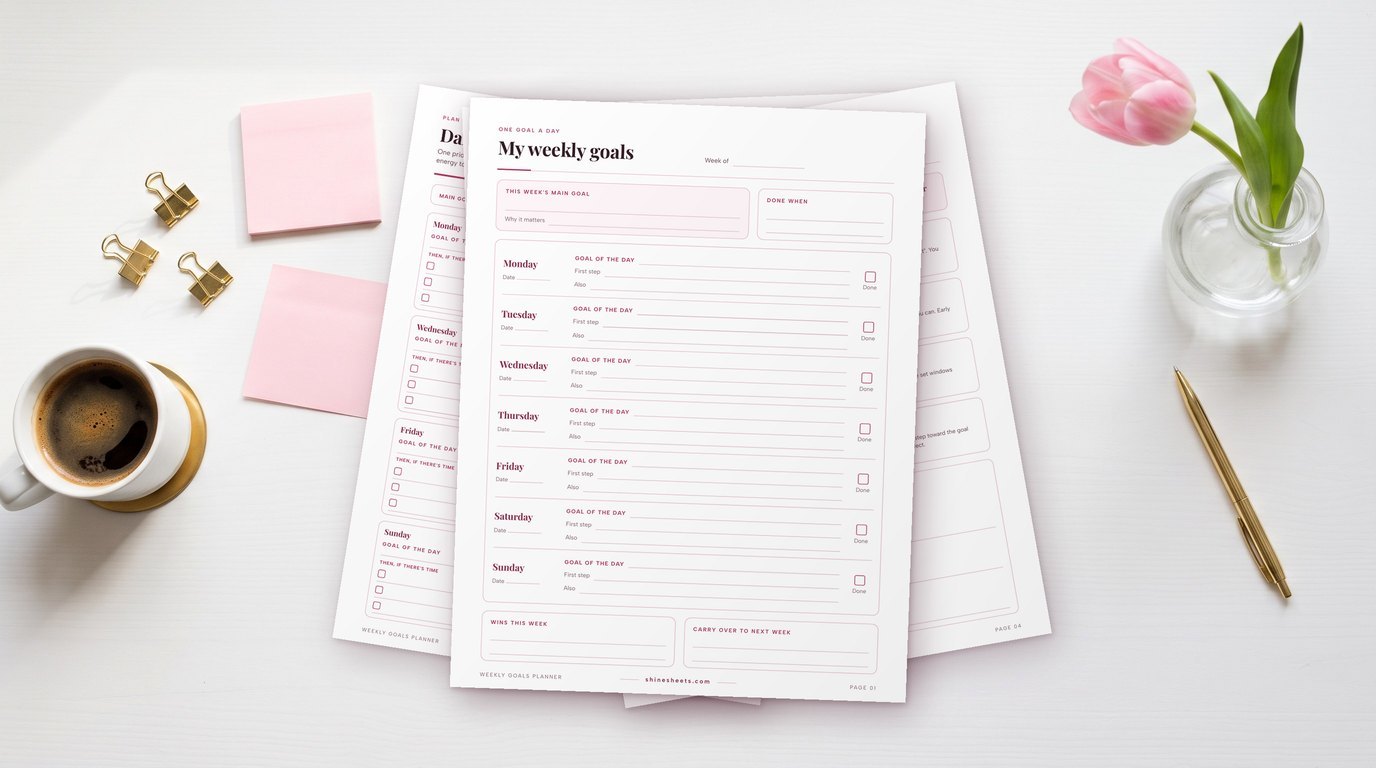
This guide is all about how to keep resolutions in a gentle, realistic way. You'll find why most of them fade by February, how to choose just one to three, how to turn each one into a tiny weekly action, how to track progress without perfectionism, a resolution rescue plan for the weeks you slip, the never-miss-twice rule and a simple monthly check-in. Grab a cream undated goal planner or any notebook you like, and let's make this the year your resolutions actually get to stay.
Why Most Resolutions Fade by February

Before we fix anything, it helps to see what usually goes wrong. Almost every abandoned resolution falls into one (or several) of these four traps. You'll probably recognize at least one from past years – I certainly recognize all four.
They're Too Big
"Work out every day." "Read 50 books." "Never eat sugar again." Big resolutions feel exciting on January 1 because they promise a whole new life. The problem is that they ask you to change everything at once, from a standing start, during the darkest and coldest stretch of the year. When the gap between where you are and where the resolution expects you to be is huge, every single day feels like a failure, and nobody keeps doing something that makes them feel like a failure.
They're Too Vague
"Be healthier." "Save more money." "Be more organized." These sound lovely, but they don't tell you what to actually do on a Tuesday evening. A vague resolution never gives you a clear moment to act, so it never really starts. You can't schedule "be healthier." You can schedule a 20-minute walk after lunch on Monday, Wednesday and Friday.
They're All-or-Nothing
This is the sneakiest one. You decide to journal every night, you miss two nights in a row, and suddenly the whole thing feels ruined. All-or-nothing thinking turns a small gap into a total collapse. In reality, journaling four nights a week for a year is wonderful – but if the only acceptable number is seven, four feels like losing.
They Don't Match Who You Are
Sometimes a resolution belongs to someone else. Maybe it came from a social media trend, a friend's goals or an old idea of who you "should" be. If you're a night person, a 5 a.m. routine will fight you every single day. If you hate running, a running resolution will always feel like punishment. Resolutions stick best when they fit your actual personality, schedule and values, not an imaginary one.
How To Choose 1–3 Resolutions That Fit Your Life
Here's my honest opinion: one resolution kept is worth more than ten resolutions abandoned. Your attention and energy are limited, especially in winter, and every new habit draws from the same small pool. Choosing fewer gives each one a real chance.
To narrow it down, write every resolution you're tempted to make on one page. Then ask yourself three questions about each one:
- Would this genuinely make my everyday life feel better? Not more impressive – better. Calmer, healthier, lighter, more joyful.
- Do I want this, or do I feel I should want it? Be honest. "Should" resolutions rarely survive February.
- Can I picture myself doing a small version of this next Tuesday? If the answer is no, the resolution needs to shrink or wait.
Circle the one to three that pass all three questions. Everything else can go on a "maybe later" list (it's not a failure to park an idea for spring). If you'd like a softer starting point, choosing a word of the year can help you pick resolutions that all point in the same direction, and my guide to setting new year goals walks through the bigger picture of what you want this year to feel like.
A small honest admission: I always want to choose five. Every single year. The years I actually stopped at two were the years I kept them.
7 Gentle Ways To Make Your Resolutions Stick
Once you have your one to three resolutions, these seven steps turn them from a wish into something your week can actually hold.
1. Turn Each Resolution Into a Tiny Weekly Action

Every resolution needs a "tiny version" – the smallest action that still counts. The tiny version should feel almost too easy, because its job isn't to transform your life in a week. Its job is to make showing up automatic.
- "Read more" becomes "read 10 pages before bed, four nights a week."
- "Move my body" becomes "a 15-minute walk on Monday, Wednesday and Saturday."
- "Save money" becomes "move a small fixed amount to savings every Friday."
- "Drink more water" becomes "one full glass before my morning coffee."
Think in weeks, not days. A weekly target ("three times this week") is far kinder than a daily one, because a busy Thursday doesn't break anything. You simply catch up on Saturday. Once the tiny version has felt easy for about four weeks, you can grow it a little – 10 pages become 15, three walks become four.
2. Give It a When and a Where
A resolution without a time and a place is just a nice thought. Research on habits keeps coming back to the same simple idea: when you decide in advance exactly when and where you'll do something, you're far more likely to do it. The formula is easy to remember:
"On [day], at [time], in [place], I will [tiny action]."
For example: "On Monday, Wednesday and Friday, at 12:30, from my office door, I will walk around the block twice." Write it down. Put it somewhere you'll see it. If you like paper planning, a blush desk calendar on your desk makes those little appointments with yourself feel as real as any other plan.
3. Stack It Onto a Habit You Already Have
Habit stacking means attaching your new action to something you already do every day without thinking. The existing habit becomes the reminder, so you don't have to rely on memory or motivation.
- After I pour my morning coffee, I'll write one line in my journal.
- After I brush my teeth at night, I'll read 10 pages.
- After I close my laptop for the day, I'll do five minutes of stretching.
- After I make my evening tea, I'll check my budget app... or, better, my paper budget page.
The best anchors are habits that happen at the same time every day and that you never skip. Evening tea is mine – journaling after tea has been one of the few habits that has stayed with me for years, precisely because the tea always happens. If you're also trying to stop doing something rather than start, the same trick works in reverse, and my guide on how to break bad habits goes deeper into swapping one routine for another.
4. Track It Without Turning It Into a Report Card

Tracking helps because it makes progress visible – and visible progress feels good. But tracking can also turn into a daily verdict on whether you're "good enough," which is the fastest way to give up. A few ways to keep it gentle:
- Track the tiny version, not the dream. Tick a box for "10 pages," not for "became a reader."
- Use weekly totals. "3 of 3 walks this week" feels better than a row of empty daily boxes.
- Keep it on paper and in sight. A pastel habit tracker notepad on your nightstand or desk takes ten seconds to fill in and doesn't come with notifications.
- Color the good days, ignore the blank ones. A set of pastel gel pens makes the ticking part a small pleasure rather than a chore.
- Never use red ink for misses. A blank box is information, not a crime.
Once a week, glance at the page and notice your average. If you're hitting your target about 80 percent of the time, you're doing beautifully.
5. Plan for the Missed-a-Week Moment
You will miss. A cold, a busy week at work, a family visit, a stretch of low mood – something will interrupt your new habit. This isn't a sign that the resolution isn't working. It's simply what happens to every habit that lasts longer than a month.
The difference between people who keep resolutions and people who don't is rarely that the first group never slips. It's that they decided in advance what they'd do when they slipped. Write your plan now, while you feel calm and motivated: "If I miss a week, I'll restart with the tiny version on the next Monday, no catching up, no guilt." You'll find a full rescue plan table further down.
6. Make It Pleasant on Purpose
We stick with things that feel good. If your resolution feels like a punishment, your brain will find a hundred reasons to skip it. Look for small ways to make the action itself more enjoyable:
- Pair your walk with a podcast you only listen to while walking.
- Read under a soft throw with a glass candle lit.
- Do your budget page with a favorite drink in a pretty cream ceramic mug.
- Lay out your workout clothes the night before so the morning version of you has one less decision.
This isn't being indulgent. It's being smart about how motivation actually works.
7. Tell One Person (Or Just Your Journal)
A little gentle accountability helps. That doesn't mean announcing your resolutions to everyone you know. It can be one friend who checks in now and then, a partner who walks with you on Saturdays or simply a weekly note in your journal: "This week I did 2 of 3 walks. Next week, same plan." Saying it out loud (or writing it) makes the commitment a little more real and a little easier to return to.
The Resolution Rescue Plan

This is the part most of us skip, and it's the part that matters most. For each resolution, fill in four things: the resolution itself, its tiny version, exactly when and where you'll do it, and what you'll do if you slip. Here are some examples to copy or adapt (screenshot it and fill in your own):
| Resolution | Tiny version | When / where | If I slip |
|---|---|---|---|
| Read more | 10 pages | In bed, after brushing my teeth, 4 nights a week | Read just 1 page the next night to restart the streak |
| Move my body | 15-minute walk | Mon, Wed, Sat after lunch, from my front door | Do one walk this week, no catching up, back to 3 next week |
| Save money | Small fixed transfer | Every Friday morning with my coffee | Transfer half the amount; never skip twice |
| Journal regularly | 3 lines | After evening tea, at the kitchen table | Write one sentence: "Today was..." |
| Drink more water | 1 glass before coffee | Glass waiting by the kettle every morning | Put the glass out the night before |
| Go to bed earlier | Lights out 15 minutes earlier | Phone charging outside the bedroom by 10 p.m. | Move bedtime back only 5 minutes, then build again |
Notice that the "if I slip" column always shrinks the action instead of punishing you. That's the whole secret. When you come back after a gap, you come back to something easy, so coming back feels possible. A punishing plan ("I'll do double next week") just makes the restart scarier.
The Never-Miss-Twice Rule
If you only remember one idea from this guide, make it this one. Missing once is normal and harmless. Missing twice is the beginning of a new habit – the habit of not doing it.
The never-miss-twice rule says: whenever you miss your action, the very next opportunity is non-negotiable, but only in its tiniest form. Missed your Monday walk? Wednesday's walk happens, even if it's five minutes around the block. Skipped journaling last night? Tonight you write one sentence. That's it.
What I love about this rule is how much pressure it takes away. You don't need a perfect streak. You don't need to "start fresh next month." You only need to protect the next time. A habit that looks like "do, do, miss, do, do, do, miss, do" is a thriving habit. Over a year, that adds up to far more than the perfect streak that broke on January 12 and never came back.
When you're tempted to let one miss become three, try this little script: "I missed. That's fine. What's the smallest version I can do today?" If self-discipline in general feels like a struggle, my gentle guide on how to be more disciplined has more ideas for building consistency without being harsh with yourself.
A 15-Minute Monthly Check-In

A resolution set in January and never looked at again is like a plant you never water. A short monthly check-in keeps it alive and lets you adjust before frustration builds. Pick the last Sunday of each month, make a cup of tea, and answer these five questions in your journal:
- What did I actually do this month? Count it honestly, without judgment. "Walked 9 times" is a fact, not a grade.
- What made it easier? A certain time of day, a friend, a podcast, the habit stack – write it down so you can do more of it.
- What got in the way? Look for patterns, not excuses. "Every time I worked late, I skipped" tells you to plan a backup for late days.
- Is the tiny version still the right size? If it feels effortless, grow it slightly. If you're constantly missing, shrink it.
- Does this resolution still matter to me? It's allowed to change. You're allowed to change.
Fifteen minutes, twelve times a year. It's one of the smallest commitments you can make, and it protects all the others.
Adjust Instead of Quitting
Somewhere around February or March, most people hit a moment where the resolution feels like it's not working. This is the moment to adjust, not to quit. Quitting says "this was a mistake." Adjusting says "this was a first draft."
Here are the most useful adjustments when a resolution starts to wobble:
- Shrink it. Three workouts a week became one? Make one the official target for a month and celebrate hitting it.
- Move it. If mornings keep failing, try lunchtime or evenings. The habit matters more than the time slot.
- Change the method. Hate the gym? Try walking, dancing in the kitchen or a gentle home workout. Same goal, different path.
- Pause it with a date. During a genuinely hard season, it's fine to pause – but write down when you'll restart, so the pause doesn't become an ending.
- Swap it. Sometimes you realize the resolution was never really yours. Replacing it with one that fits better isn't failing. It's learning.
If you notice a pattern of starting strong and letting things drift, you're not alone, and my guide on how to stop abandoning your goals looks at the reasons behind that cycle and how to break it kindly.
And please remember that a resolution kept "imperfectly" all year is a success. Reading 10 pages most nights, walking twice a week instead of three times, saving a little less than planned but saving every month – these are real changes. They count. Over twelve months, they add up to a genuinely different life.
Final Thoughts
Learning how to keep resolutions isn't about becoming a more disciplined, more perfect version of yourself overnight. It's about choosing fewer things, making them smaller than feels impressive and deciding ahead of time how you'll come back when life gets in the way.
Pick your one to three. Give each a tiny version, a time and a place. Fill in your rescue plan, remember never to miss twice, and check in once a month with a cup of tea. You don't need a perfect January. You need a kind plan that still works in March, and you're more than capable of making one.