
Consistency isn't a personality trait some people are born with. It's what happens when a habit is small enough to survive your worst days. The people who seem effortlessly consistent usually aren't more motivated than you; they've just made their habits so easy and so clearly planned that skipping takes more effort than doing.
That's freeing, because it means you don't need more willpower. You need a better setup: a smaller starting point, a clear cue, a plan for the days when life gets messy and a gentle way to get back on track when you slip (because you will, and that's completely normal).
This guide covers how to be more consistent, even when motivation fades: why consistency beats intensity, the real reasons we quit, a 10-step system you can apply to any habit, a "minimum version" card to fill in for your own goals, what to do when you fall off and a four-week plan to get started.
I've started and dropped more routines than I can count. What finally helped wasn't trying harder. It was making things smaller.
Why Consistency Beats Intensity

Intense bursts feel productive. A two-hour workout, a full-day closet clean-out, a brand-new routine with seven steps. But intensity is hard to repeat, and the results fade as soon as you stop.
Consistency works differently:
- Small efforts compound. Ten minutes of reading a day is more than 60 hours a year. Five minutes of stretching every evening adds up to a body that feels completely different after a few months.
- Repetition builds automaticity. The more often you do something in the same context, the less decision-making it takes. Eventually it just happens.
- It builds trust in yourself. Each time you show up, even in a tiny way, you collect proof that you're someone who follows through.
- It's kinder to your energy. You never have to recover from a habit that's sized for real life.
A walk you take four times a week for a year will always beat the intense plan you followed for nine days in January.
Why We Quit
Before building a new system, it helps to look honestly at what usually goes wrong. Most broken routines fall apart for one of these reasons:
- The habit was too big. It worked on a great day, but most days aren't great.
- All-or-nothing thinking. "I missed Monday, so this week is ruined." One slip becomes a full stop.
- No plan for bad days. You planned for the ideal version of your life, not for headaches, late nights or surprise deadlines.
- Relying on motivation. Motivation is a feeling, and feelings come and go. A habit that depends on feeling like it won't last.
- Too many changes at once. New workout, new skincare, new budget and new morning routine all on the same Monday is a lot for any brain.
- Invisible progress. When you can't see how far you've come, it's easy to feel like nothing is working.
If you recognize procrastination in that list too, my guide on how to stop procrastinating pairs well with this one.
A 10-Step System for Being More Consistent
This system works for almost any habit: moving your body, drinking more water, journaling, reading, saving money, studying a language. Go through it slowly, with one habit in mind.
1. Pick One Thing

Choose just one habit to focus on for the next month. Not three, not "a whole new lifestyle." One.
Pick the one that would make the biggest difference to how you feel, or the one that would make other habits easier (better sleep tends to help everything else). Write it as a clear action, not a vague wish: "read before bed," not "be more intellectual."
Not sure which one to choose? A few habits that tend to make everything else easier: a regular bedtime, a short daily walk, drinking a glass of water when you wake up, a five-minute evening tidy and writing down tomorrow's top three tasks. Pick whichever one you'd feel proudest of after a month, not the one you think you "should" do.
Once it runs almost automatically, usually after a few weeks to a couple of months, you can add the next.
2. Define Your Minimum Version
This is the heart of the whole system. For your habit, write two versions:
- The ideal version: what you'd do on a good day. A 30-minute walk, a full skincare routine, a chapter of your book.
- The minimum version (or bad-day version): the smallest possible action that still counts. Walking to the end of the street, washing your face, reading one page.
On hard days you only owe yourself the minimum. It sounds almost too small to matter, but it keeps the habit alive and the streak unbroken. And very often, once you've started, you'll do more than the minimum anyway.
3. Give It a Fixed Time and Cue
"Sometime today" usually means never. Give your habit a clear time or trigger:
- "After I pour my morning coffee, I'll write three lines in my journal."
- "When I get home from work, I'll change into my walking shoes."
- "At 9:30 p.m., I'll put my phone on the charger and read."
The more specific the cue, the less you have to think about it. Same time, same place, same trigger, as often as possible.
4. Stack It Onto an Existing Habit
You already have dozens of habits you never forget: brushing your teeth, making coffee, locking the door. Attaching a new habit to one of these gives it a ready-made reminder.
Use this formula: "After I [current habit], I will [new habit]." For example: "After I brush my teeth at night, I'll do five minutes of stretching." Or: "After I sit down at my desk, I'll write down my three priorities."
Habit stacking works best when the new habit fits naturally with the old one, in the same place and around the same time.
5. Make It Easy To Start
Every bit of friction you remove makes the habit more likely to happen. Put the book on your pillow, lay out your workout clothes the night before, keep your journal and pen right next to the kettle, fill your water bottle before bed.
A glass sand timer on your desk can be a lovely helper here. Turning it over is a clear, calm signal to start, and "just until the sand runs out" feels much less daunting than an open-ended task.
The reverse works too: make habits you want to drop a little harder to start. My guide on breaking bad habits explains how.
6. Track It Lightly
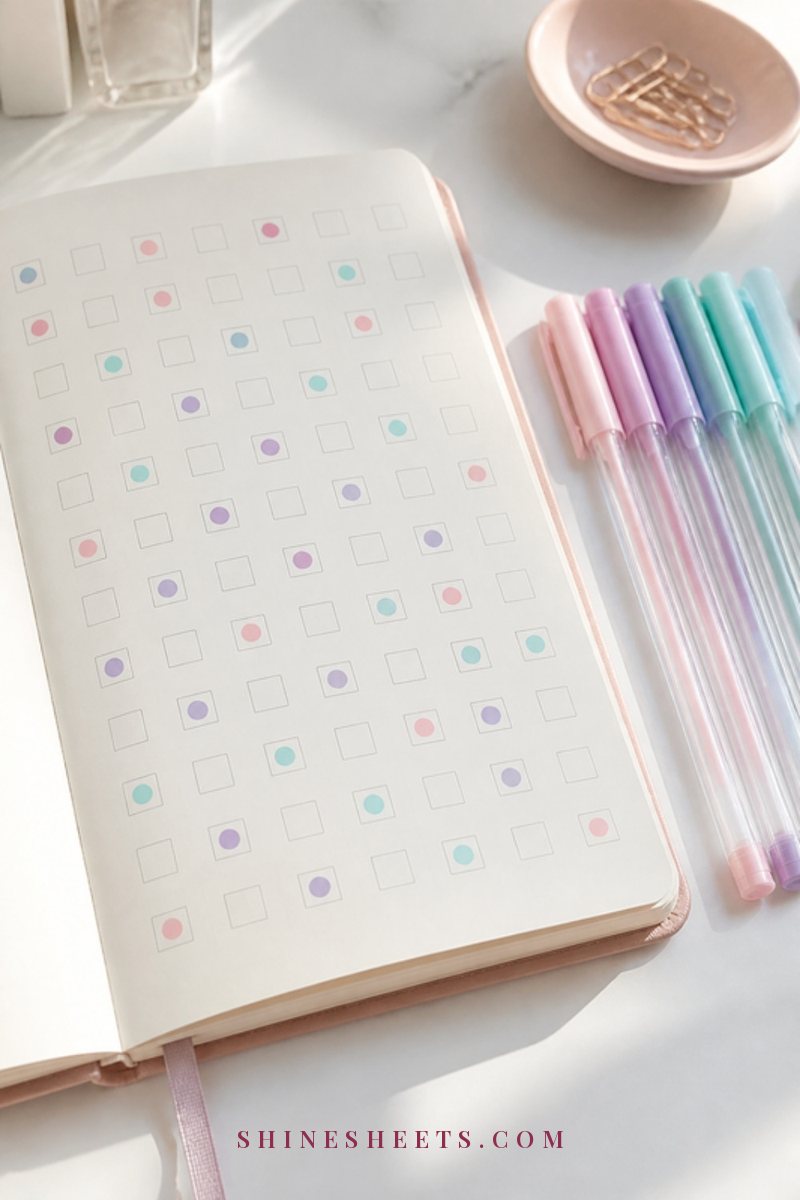
Tracking makes progress visible, which is incredibly motivating. But it should take seconds, not become another chore.
A simple habit tracker planner where you tick a box each day is enough. Some people love a set of pastel gel pens so that filling in the day feels like a tiny treat. Others prefer a mark on an acrylic desk calendar they see every morning.
Track only the one habit you're focusing on, and if you miss a day, leave the box empty without judgment. It's data, not a grade.
7. Never Miss Twice
Missing one day doesn't break a habit. Missing several in a row is what slowly turns "I'm someone who walks every day" into "I walked for a while, once." So keep one simple rule: you can miss once, but never twice in a row.
If yesterday was a miss, today's only job is the minimum version. That single rule protects against all-or-nothing thinking better than any amount of discipline.
8. Plan for Travel, Sick Days and Busy Weeks
Life will interrupt you. Instead of hoping it won't, decide in advance what your habit looks like when it does:
- Travel: a hotel-room version (ten minutes of stretching instead of the gym, a few pages on your phone instead of the book you left at home).
- Sick days: rest is the habit. Pause the tracker and write "rest" in the box. Your body comes first.
- Busy weeks: the minimum version only, guilt-free.
- Holidays: pick the two or three habits that keep you feeling like yourself and let the rest go until you're home.
A plan for disruption is what makes consistency possible over months, not just weeks.
9. Do a Weekly Review

Once a week, take ten minutes to look back. Sunday evening with a cup of tea works beautifully. Ask yourself:
- How many days did I show up, in any form?
- What made it easier on the good days?
- What got in the way on the hard days?
- Is my minimum version small enough?
- What's one small tweak for next week?
Write the tweak on a pastel sticky note and put it where you'll see it. The weekly review is what turns a routine into a system that improves over time instead of slowly fading.
10. Reward Yourself and Think in Identity
Habits that feel good get repeated. Build in small rewards: a favorite song during your walk, a nice tea after journaling, a little note in your planner when you hit a week.
And gently shift the way you describe yourself. Instead of "I'm trying to read more," try "I'm a reader." Instead of "I'm trying to work out," try "I'm someone who moves every day." Every time you do the minimum version, you cast a small vote for that identity. If you'd like to see how this fits into a bigger picture, these habits of successful women show what consistent small actions look like in real life.
Your Minimum Version Card
This is the tool of this guide. For each habit, write the ideal version, the minimum version and the cue that starts it. Here are some examples to get you going. Screenshot it, then make your own card with just one or two lines.
| Habit | Ideal version | Minimum version | Cue |
|---|---|---|---|
| Movement | 30-minute walk or workout | Walk to the end of the street and back | After I close my laptop |
| Reading | One chapter | One page | When I get into bed |
| Journaling | A full page | One sentence about today | After my evening tea |
| Skincare | Full evening routine | Wash face and moisturize | After brushing my teeth |
| Tidying | 15-minute reset | Clear one surface | Before I turn off the kitchen light |
| Water | A full bottle by lunch | One glass first thing | When I wake up |
| Learning | 20 minutes of practice | One lesson or flashcard round | While my coffee brews |
| Saving money | Weekly budget check | Check my balance once | Sunday after my review |
The minimum version should feel almost embarrassingly small. If you look at it and think "that's too easy to count," it's probably just right.
What To Do When You Fall Off
Everyone falls off. A busy month, an illness, a move, a sad season. Consistency isn't about never stopping; it's about how quickly and kindly you return.
- Skip the guilt spiral. Beating yourself up doesn't make you more likely to restart. Kindness does.
- Restart with the minimum version. Don't try to make up for lost time. One page, one walk, one glass of water.
- Look at what changed. Did your schedule shift? Did the cue disappear? Adjust the plan to your current life.
- Pick a fresh-start day if it helps. A Monday or the first of the month can feel like a clean page, but you're also allowed to restart on a random Thursday afternoon.
- Count the return as a win. Coming back after a break is the real skill of consistency.
If you'd like more on following through when motivation is low, my guide on how to be more disciplined has gentle strategies that pair well with this system, and this one on building discipline goes into the long-term mindset.
How To Stay Consistent When Your Schedule Changes Every Week
Fixed times are wonderful, but not everyone has the same Tuesday twice. Shift work, changing classes, caring for family or travel can make "every day at 7 a.m." impossible. If that's your life, anchor habits to events instead of clock times:
- Use "first and last" anchors. Almost every day has a first coffee, a first time you sit down and a moment you get into bed. These are reliable cues even when the hours move.
- Set a weekly target instead of a daily one. "Four walks this week" gives you flexibility while still keeping the habit in motion.
- Plan the week on Sunday. Look at what's coming and pencil in where your habit fits each day. It takes five minutes and removes daily decision-making.
- Keep a portable version. A small notebook in your bag, a stretching routine you can do anywhere, a book on your phone. Habits that travel survive changing schedules.
Flexibility isn't the opposite of consistency. For a busy, changing life, it's what makes consistency possible.
Small Signs Your Consistency Is Growing
Progress with habits is often quiet, so it helps to know what to look for. You're on the right track if you notice:
- You start the habit without debating it first.
- A missed day bothers you a little, in the way forgetting to brush your teeth would.
- You return after a slip within a day or two instead of a week or two.
- The minimum version now feels too small, and you naturally do more.
- You've stopped needing reminders or alarms for it.
- You catch yourself describing yourself differently ("I'm a walker," "I journal").
None of these need to happen fast. Notice them when they arrive, and let them be your quiet proof that the system is working.
4 Consistency Myths To Let Go Of
- "I need to feel motivated first." Action usually comes before motivation. Starting small creates the feeling, not the other way around.
- "A habit takes 21 days." It varies a lot from person to person and habit to habit. Some click in a few weeks, others take months. Keep going.
- "Missing a day ruins everything." It doesn't. Missing twice is what to watch for, and even that is fixable.
- "Consistent people never struggle." They struggle all the time. They just have a smaller fallback and a plan to return.
A 4-Week Starter Plan
If you want a gentle structure, here's how the first month can look:
- Week 1 – Set up: choose your one habit, write the ideal and minimum versions, pick your cue and prepare your space. Do only the minimum version every day this week, even if you feel like doing more.
- Week 2 – Show up: keep the same cue, start tracking with a simple tick and do the ideal version on days you feel good. Remember the never-miss-twice rule.
- Week 3 – Protect it: write your plan for travel, sick days and busy days. Do your first weekly review on Sunday.
- Week 4 – Reward and reflect: notice how many days you showed up, celebrate it and decide whether the habit feels steady enough to add a second one next month.
Final Thoughts
Being consistent doesn't mean being perfect. It means making your habits small enough to survive real life, giving them a clear place in your day and coming back gently whenever you drift away.
Start with one habit and one tiny minimum version. Show up in the smallest way, again and again, and you'll soon become someone who simply does the thing.