
The people we remember as wonderful to talk to are rarely the ones with the best stories. They're the ones who asked us something that made us think, then actually listened to the answer. A good question is a small act of attention, and attention is what makes people feel seen.
The lovely part is that this is a learnable skill, not a personality trait. You don't need to be extroverted, witty or especially confident. You need a little curiosity, a few simple shapes of questions you can reach for, and the patience to let the other person finish their thought before you jump in with yours.
This guide is all about how to ask better questions in everyday life – with friends, a partner, new people at work and family. You'll find the difference between closed, open and follow-up questions, six principles that make conversations deeper, a "flat vs better" question table, question ladders that move gently from light to meaningful, the most common mistakes, and why listening is truly half of asking.
No techniques for steering people, no interview energy. Just warmer, more genuine conversations.
Why Good Questions Make People Feel Seen

Most conversations stay on the surface not because people are shallow, but because nobody opens a door. "How was your weekend?" "Good, yours?" "Good." And that's it – two people who might have had a real conversation trade polite noises instead.
A better question opens the door just a little wider. It tells the other person: I'm interested in you, not only in the facts of your week. It gives them permission to share something real, and it lets them choose how much. When someone asks me a thoughtful question, I notice I relax. I'm not performing or making small talk anymore; I'm actually talking.
Good questions also help you. They take the pressure off having to be interesting yourself (if that's something you worry about, these ideas on how to be more interesting pair nicely with this guide). Being curious about someone is one of the most interesting things you can be.
Closed, Open and Follow-Up Questions

Before the principles, it helps to know the three basic shapes of questions. None of them is bad – each has a job.
Closed Questions
Closed questions can be answered in one word: yes, no, a name, a number. "Did you like the movie?" "Are you from here?" "How long have you worked there?" They're useful for facts, for getting started and for quick check-ins. On their own, though, they tend to end a thread rather than start one.
Open Questions
Open questions invite a story or a reflection. They usually begin with "what," "how" or "tell me about." "What did you think of the ending?" "How did you end up living here?" "What's that job actually like day to day?" They give the other person room to choose what matters to them.
Follow-Up Questions
Follow-up questions are where the magic quietly happens. They build on something the person just said: "Wait, you moved here for a job you'd never seen? What made you say yes?" A follow-up proves you were listening, and it usually takes the conversation one layer deeper than any prepared question could.
A simple formula to remember: open the door with an open question, then walk through it with a follow-up.
6 Principles for Asking Better Questions

These six ideas work in almost any conversation. You don't need to use all of them at once; even one or two will change how your conversations feel.
1. Be Genuinely Curious
The best questions come from real interest, not from a list. Before a conversation, try a tiny mindset shift: "What could I learn from this person?" Everyone knows something you don't – about their work, their hometown, a hobby, a hard season they got through.
If curiosity doesn't come naturally right now (it's hard to feel curious when you're tired or anxious), start small. Pick one detail they mention and wonder about it for a second. My guide on how to be more curious has more gentle ways to build the habit.
2. Ask Open Questions
Swap one closed question for an open one and the whole conversation changes. Instead of "Was the trip fun?" try "What was the best part of the trip?" Instead of "Did you have a good day?" try "What was that like?" or "How did it go?"
A handy trick: if your question can be answered with "yes" or "no," add "what" or "how" to the front and see if it still works. Usually it works better.
3. Follow Up Instead of Switching Topics
It's tempting to move on to the next question when there's a pause, especially if you're nervous. But the richest part of a conversation is usually one or two follow-ups deep. When someone says "Work's been a lot lately," don't jump to "So, any plans for the weekend?" Stay with it: "A lot in a good way or a draining way?"
A rule I like: two follow-ups before a new topic. It feels slow at first. It's actually the opposite of awkward.
4. Ask About Feelings and Reasons, Not Just Facts
Facts tell you what happened. Feelings and reasons tell you who someone is. "Where did you go to school?" is a fact. "What drew you to that?" is a reason. "How did it feel to finally finish?" is a feeling.
Some gentle ways in:
- "What made you decide to…?"
- "How did you feel when…?"
- "What's the part you're most proud of?"
- "What surprised you about it?"
These invite depth without pressure – the person can always answer lightly if they'd rather.
5. Leave Pauses
Silence after an answer feels long to the person asking and short to the person answering. Very often, if you wait two or three seconds instead of filling the gap, the other person adds the most interesting part: "…and honestly, I think I was scared." That second thought is where the real conversation lives.
As someone prone to anxiety, I find this one hard, so I give myself a small job: take one slow breath before I respond. It's just long enough.
6. Share a Little of Yourself So It Isn't an Interview

A conversation where only one person asks questions starts to feel like a job interview, or worse, an interrogation. Balance it by sharing something small and related after their answer, then handing the conversation back.
Try this rhythm: ask, listen, reflect, share a little, ask again. For example: "That sounds stressful. I had something similar when I moved – the first month was so lonely. What helped you settle in?" Your share should be short, a sentence or two, so the spotlight returns to them.
Flat Questions vs Better Questions
Here's the heart of this guide in one table. The "flat" questions aren't wrong – they're just closed doors. The better versions open them, and the follow-ups help you walk through.
| Situation | Flat question | Better question | Deeper follow-up |
|---|---|---|---|
| Friend back from a trip | "Was it fun?" | "What's a moment from the trip you keep thinking about?" | "What made that one stick with you?" |
| Partner after a long day | "Good day?" | "What took up most of your energy today?" | "Do you want to talk it through or just decompress?" |
| New coworker | "How long have you been here?" | "What's been the most surprising part of the job so far?" | "What do you wish someone had told you in your first week?" |
| Family dinner | "How's everything?" | "What's something you're looking forward to these days?" | "How did you get into that?" |
| Friend starting something new | "Are you excited?" | "How are you really feeling about it?" | "What's the part you're most unsure about?" |
| Someone sharing a hobby | "Is it hard?" | "What got you hooked on it?" | "What does a really good day of it look like for you?" |
| Friend going through a hard time | "Are you okay?" | "How are you really doing this week?" | "What would actually feel helpful right now?" |
Screenshot it, or copy two or three favorites into your notes app. Having a few ready makes it much easier to reach for them in the moment.
Question Ladders: From Light to Deeper

A question ladder is a simple way to deepen a conversation step by step. You start on the bottom rung with something light and easy, and only climb higher if the other person seems comfortable. You never need to reach the top – most good conversations live happily on the middle rungs.
With Friends
- Light: "What's been the best part of your week?"
- Middle: "What's taking up most of your headspace lately?"
- Deeper: "What's something you've been wanting to change but haven't said out loud yet?"
For a girls' night or a long walk, my list of deep questions to ask your friends has plenty more to choose from. A conversation card deck on the table can also make deeper questions feel playful instead of heavy.
With a Partner

- Light: "What made you laugh today?"
- Middle: "What's something you're looking forward to this month?"
- Deeper: "Is there anything you've needed more of from me lately?"
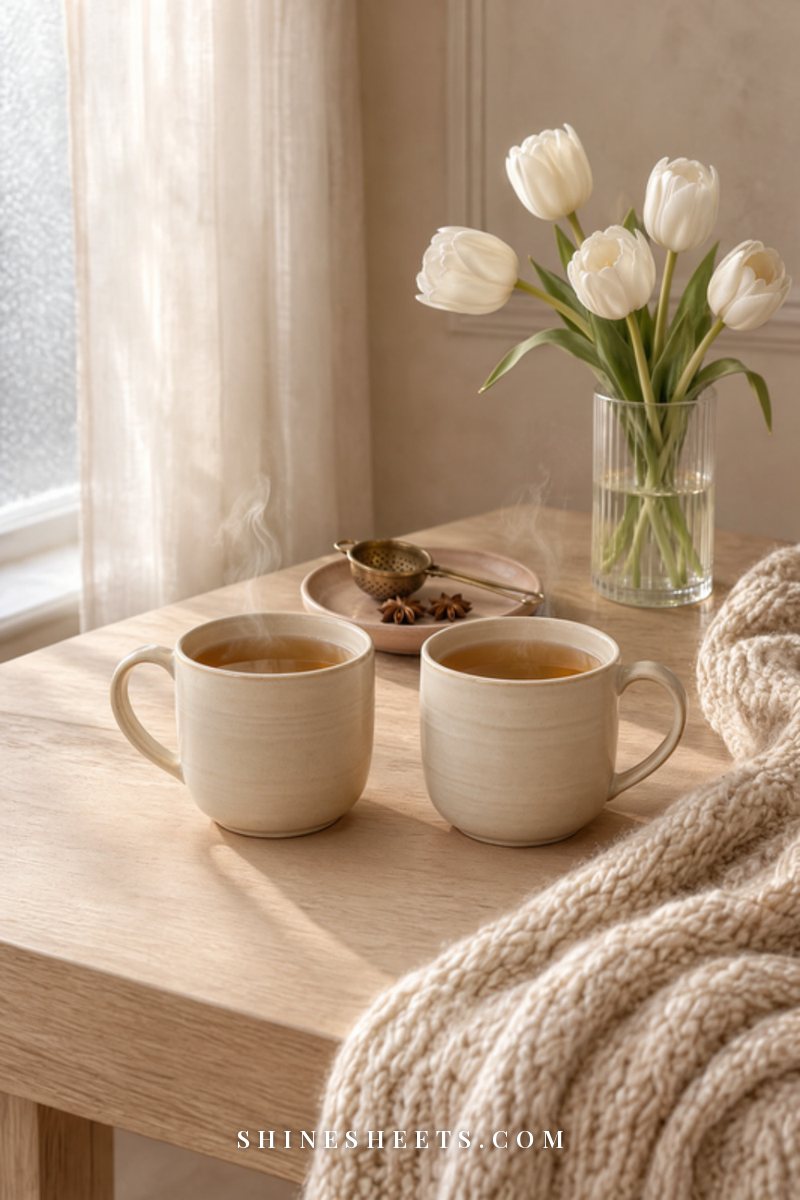
Long-term partners often stop asking because they assume they already know the answers. Asking anyway is a quiet way of saying, "I still want to know you." A slow evening with two pastel ceramic mugs of tea and phones in another room is the perfect setting.
With New People at Work
- Light: "How's your week going so far?"
- Middle: "What kind of projects do you enjoy most?"
- Deeper: "What's something you're hoping to learn or grow in this year?"
At work, stay on the lighter rungs until you know someone better, and keep personal topics (health, relationships, money) off the table unless they bring them up. If the very first rung still feels awkward, these ideas on how to make small talk help you get started.
With Family
- Light: "What's something good that happened recently?"
- Middle: "What was your life like when you were my age?"
- Deeper: "What's a lesson you learned the hard way that you'd want me to know?"
Family conversations can get stuck in the same old grooves. Questions about the past – first jobs, old friendships, how parents met – often open surprisingly tender, funny conversations. Some people like to jot the answers down afterwards in a cream linen notebook; I love that idea, because these stories are easy to forget.
5 Mistakes That Make Questions Fall Flat

Even kind, curious people slip into these. Knowing them makes them easy to catch.
1. Rapid-Fire Questions
Question, answer, new question, answer, new question. It can feel like a quiz, and the other person never gets to settle into anything. Slow down, respond to what they said, and follow up before moving on.
2. "Why" That Sounds Like Blame
"Why did you do that?" can sound like an accusation, even when you're only curious. Try "What made you decide to…?" or "How did you end up choosing…?" They ask the same thing, but softer.
3. Leading Questions
"Don't you think that was a bad idea?" or "You must be so relieved, right?" These hand the person an answer instead of asking for theirs. Keep your questions open: "How do you feel about how it turned out?"
4. Steering Back to Yourself
Someone shares something, and you immediately answer with your own bigger version of it. Sharing a little is good (principle 6), but if every answer becomes a launch pad for your story, people stop opening up. Ask one more question about their experience before you share yours.
5. Prying Into Painful Topics
Curiosity has edges. Health, grief, fertility, money, breakups, family conflict – if someone hasn't brought it up, it isn't yours to dig into. And if they do mention it, follow their lead rather than pushing for details. "That sounds really hard. I'm here if you ever want to talk about it" is often the kindest question of all, because it isn't really a question.
Go-To Questions for When Your Mind Goes Blank
Even with every principle in mind, there will be moments when your brain simply empties. It happens to everyone, especially when you're tired, nervous or meeting someone new. Having a few warm, flexible questions ready means you never have to panic in that gap.
- "What's been keeping you busy lately?" (works for almost anyone, and they choose the topic)
- "What are you looking forward to right now?"
- "How did you get into that?" (perfect after someone mentions a job, hobby or place)
- "What's the best thing you've read, watched or listened to recently?"
- "What was the highlight of your week?"
- "What would you be doing today if you had the whole day free?"
Notice that none of these are clever. They're simply open, easy to answer and gentle. Their job is to restart the conversation, and then your follow-ups take it from there. If you only memorize one, make it "How did you get into that?" It fits almost every situation and people genuinely enjoy answering it.
It also helps to remember that a short silence isn't a failure. Sometimes a comfortable pause, a sip of tea and a smile say "I'm enjoying this" better than any question could.
Reading Comfort Cues and Letting People Pass
Good questions are invitations, never demands. Part of asking well is noticing when someone would rather not go deeper.
Signs someone is comfortable: longer answers, more detail, leaning in, asking you questions back, laughing, adding "and actually…"
Signs someone would rather step back: short answers, changing the subject, looking away, crossing arms, a nervous laugh, "I don't know, it's fine."
When you see the second list, simply step down a rung on the ladder. You can make it easy for them, too: "No pressure at all, we can totally talk about something else." Letting people pass without making it awkward is what makes them feel safe enough to open up another time. This kind of reading the room is a big part of emotional intelligence, and it gets easier with practice.
One more gentle note: asking better questions is about connection, not about getting someone to say something or analyzing them. If a friend is struggling with something heavy, the best question might be whether they'd like support finding a therapist or someone qualified to help – not more questions from you.
Listening Is Half of Asking
A beautiful question followed by half-listening is still a missed connection. The question opens the door; listening is what makes the person want to walk through it.
- Put the phone away, face down or in a bag – not on the table between you. A quiet corner with a soft-neutral table lamp instead of a bright overhead light makes slow conversations at home feel easier.
- Listen to understand, not to reply. Notice if you're planning your next question while they're still talking.
- Reflect back what you heard: "So it sounds like the hardest part was not knowing."
- Remember details and bring them up later: "How did the interview go?" a week later means a lot.
- Let them finish, even if there's a pause in the middle.
For a deeper look at this half of the skill, my guide on how to be a good listener covers the habits people remember most.
If you'd like to practice, try this for one week: in each conversation, ask one open question and one follow-up, and then just listen. That's it. In the evening, a few lines in a journal after a cup from a herbal tea sampler about what you learned can make the habit stick, and you'll be surprised how much more you know about the people around you after just seven days.
Final Thoughts
Asking better questions isn't about being clever or saying the perfect thing. It's about slowing down, getting curious and giving someone the space to be fully themselves for a few minutes.
Start with one open question and one follow-up the next time you talk to someone you care about. Small questions, asked with real attention, are how the deepest conversations begin.