Feeling anxious before holiday gatherings does not mean you are bad at people or ungrateful for the invitations. It usually means your nervous system is doing a lot of work: more events than usual, rooms full of voices, relatives with opinions and a quiet pressure to look happy the whole time. Of course that can feel like a lot.
The good news is that you do not have to choose between hiding at home and white-knuckling your way through every party. With a little planning before, a few small tools during and real rest afterward, gatherings can feel much more manageable. Some of them might even feel nice.
This guide is all about holiday social anxiety and how to get through parties and gatherings gently. You will find why December gatherings feel harder, how to prepare, six in-the-moment tools, a table of anxious thoughts with calming responses, how to rest afterward without replaying everything and kind ways to say no when you need to.
A quick note: I am not a therapist, and this is not a diagnosis. These are gentle, practical ideas. If anxiety is stopping you from living the life you want, a therapist can help, and there is a short section on that near the end.
Why Holiday Gatherings Feel Harder

Even people who feel fine socially most of the year often notice their anxiety rising in December. A few reasons it happens:
- There are simply more events. Work parties, family dinners, friend get-togethers and neighborhood gatherings stack up, often with little recovery time in between.
- Relatives and old roles. Family gatherings can pull you back into the person you were at fifteen, with the same remarks and the same tension.
- Lots of small talk. Talking to people you barely know, or have not seen in a year, takes real energy.
- Crowded, loud rooms. Music, chatter, warm rooms and bright lights can overwhelm your senses before you have said a word.
- Pressure to look happy. The holidays come with an expectation of joy, and feeling nervous can make you feel like you are doing it wrong.
- Less rest overall. Late nights, travel and busy days leave your body with fewer reserves to handle stress.
I am prone to anxiety myself, and it took me a while to understand that a nervous feeling before a party is not a sign that something will go badly. It is just a signal that my body is getting ready for something big. If the dread starts days before an event, my guide on anticipatory anxiety before an event goes deeper into that part.
Before the Gathering: Set Yourself Up Gently

A lot of holiday social anxiety lives in the unknowns: how long will it last, who will be there, what will I say, how will I leave? You cannot control everything, but you can decide a few things in advance. That alone often takes the edge off.
Decide How Long You'll Stay
Before you go, pick a rough time to leave. One or two hours is a perfectly respectable amount of time at most parties. Knowing there is an end makes the middle feel much easier.
You can always stay longer if you are enjoying yourself. The plan is a safety rail, not a rule. A simple formula I like: arrive, say hello to the host, have two good conversations, then decide whether to stay or go.
Plan Your Arrival and Your Exit
Arriving is often the hardest part, so give it a little structure:
- Arrive 15 to 20 minutes after the start time. The room has some energy but is not yet packed, and you will not be the first one standing alone.
- Know your first move. Find the host, say hello, hand over your coat. Having a first task gets you through the doorway.
- Arrange your own way home. Driving yourself, booking a ride or agreeing on a time with a friend means you are never stuck.
- Prepare a short exit line. "Thank you so much for having me, this was lovely. I am heading home now." You do not need a reason.
If you are not sure about the guest side of things (what to bring, when to arrive, how to leave politely), my guide to holiday party etiquette covers all of that, so you can let that worry go.
Prepare 3 Easy Conversation Starters
Having three openers ready means you never have to search your mind for something to say. Choose ones that invite the other person to talk:
- "How do you know the host?"
- "Are you doing anything nice over the holidays?"
- "What has been the best part of your year?"
Practice them once out loud before you leave. It feels a bit funny, but it makes them come out naturally later. For more ideas, my guide on how to make small talk without feeling awkward has plenty of easy scripts.
Choose a Comfortable Outfit

Feeling physically uncomfortable adds to anxiety faster than you would think. A scratchy fabric, a tight waistband or shoes that pinch become one more thing your body is managing all evening.
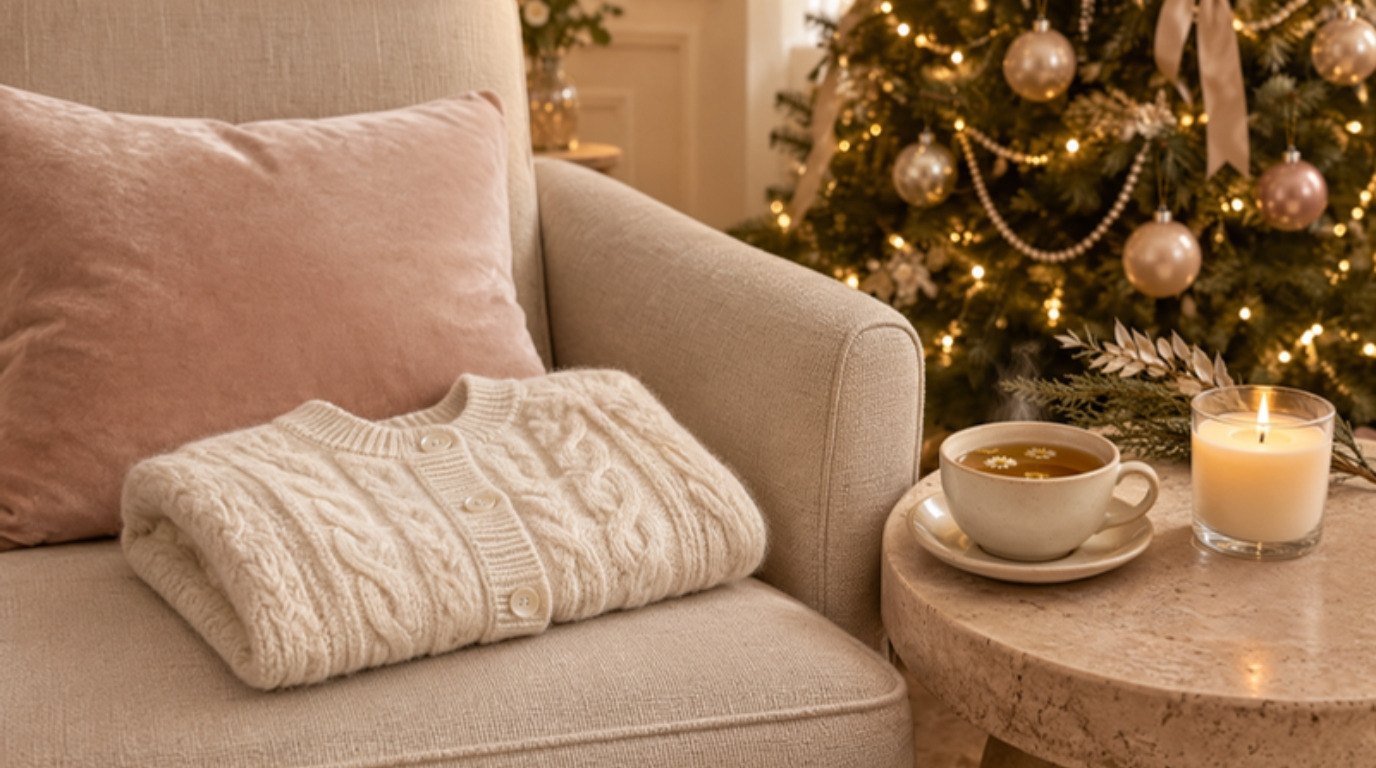
Pick something that looks festive but feels soft: trousers or a dress you have worn before, flats or low heels and a layer you can take off in a warm room. A cream knit cardigan is lovely here, because it looks polished, feels like a hug and comes off easily when the room heats up. Lay your outfit out the day before so you are not deciding at the last minute.
A Calming Routine Before You Leave

The hour before a gathering can be the most anxious part of the whole evening. Instead of rushing, give yourself a short, steady routine. Mine takes about 20 minutes:
- Eat something real an hour or two before you go, so you are not running on empty.
- Take a warm shower or wash your face slowly.
- Do three minutes of slow breathing (see the first tool below).
- Put on your outfit and one small comfort item, like a scent you love.
- Write one line in your journal: "Tonight, I only need to ___."
A lavender roll-on on your wrists is a nice part of this routine. The scent becomes a small cue to slow down, and you can bring it along in your bag. A guided anxiety journal is also a pick for anyone who likes having prompts ready instead of a blank page.
6 In-the-Moment Tools for Anxious Feelings
Even with good planning, anxious feelings can rise in the middle of a party. These six tools are quiet, quick and invisible to everyone around you. You do not need all of them. Pick two that feel natural and practice them at home first.
1. Slow Exhale Breathing

When you feel anxious, your breathing tends to get short and high in your chest. Making your exhale longer than your inhale is one of the simplest ways to signal to your body that you are safe.
Try this: breathe in through your nose for a count of four, then breathe out slowly through your mouth for a count of six. Repeat five or six times. Nobody will notice, and you can do it while standing by the snack table or listening to someone talk. My guide to breathing exercises for calm has a few more techniques to try at home first.
2. 5-4-3-2-1 Grounding
Grounding brings your attention out of your worried thoughts and back into the room. Quietly name, in your head:
- 5 things you can see (the lights on the tree, a red napkin, someone's scarf)
- 4 things you can feel (your feet in your shoes, the cardigan on your arms)
- 3 things you can hear
- 2 things you can smell
- 1 thing you can taste
It takes about a minute. If you like having something to hold, a soft gold fidget ring gives your hands a quiet way to stay busy and looks just like jewelry.
3. Give Yourself a Small Task

Having a job is one of the kindest tricks for social anxiety. It gives you somewhere to be and something to do with your hands, and conversation happens naturally around it.
Offer to help in the kitchen, refill drinks, take coats, clear a few plates or keep an eye on the music. Most hosts are grateful, and you get a break from standing in the middle of the room. Just remember to step out of the kitchen now and then, so helping does not turn into hiding all night.
4. Find Your One Person
You do not need to feel comfortable with everyone. You only need one person. That might be a friend you came with, a cousin you like or a kind face you met in the first half hour.
Check in with them now and then, stand near them in bigger groups, and let them be your anchor. If you go together, agree on a small signal in advance (touching your earring, for example) that means "I need a minute" or "I am ready to leave."
5. Take a Short Fresh-Air Break
Stepping away for five minutes is completely allowed. Go to the bathroom, step onto the porch or take a short walk to "get something from the car." Cooler air and a quieter space help your body reset.
While you are there, take five slow exhales, roll your shoulders down and remind yourself of your plan: "I am staying until nine, I have had one good conversation, I can do one more." Then go back in, or decide it is time to leave. Both are fine.
6. Focus Outward With Curious Questions
Anxiety turns your attention inward: how do I look, what do they think of me, did I just say something strange? Gently turning your focus outward takes the spotlight off yourself.
Ask open, curious questions and actually listen to the answers: "What was that trip like?" "How did you get into that?" "What are you looking forward to next year?" Most people love to talk about themselves, and listening well is one of the easiest ways to be good company.
Anxious Thoughts and Calming Responses
This table is the heart of this guide. It pairs common holiday situations with the anxious thoughts that tend to show up, a calmer way to answer them and one small action you can take. Screenshot it and look at it before you go.
| Situation | Anxious thought | Calming response | Small action |
|---|---|---|---|
| Walking into a full room | "Everyone is looking at me." | "Most people are busy thinking about themselves." | Find the host and say hello first. |
| Standing alone for a moment | "I look awkward and lonely." | "Everyone stands alone sometimes. It is just a pause." | Look at the decorations or offer to help. |
| A relative asks a personal question | "I have to explain my whole life." | "I can give a short answer and change the subject." | "Things are good, thanks. How about you?" |
| A conversation goes quiet | "It is my fault. I am boring." | "Silences are normal. Both of us share them." | Ask one curious question or excuse yourself kindly. |
| You feel your heart racing | "Something is wrong. I need to escape." | "This is anxiety. It rises and it passes." | Slow exhale breathing for one minute. |
| Time to leave | "They will think I am rude." | "Leaving warmly is polite." | Thank the host and use your exit line. |
| The drive home | "I said something embarrassing." | "Nobody remembers it the way I do." | Put on music and save reflection for tomorrow. |
The calming responses do not need to feel completely true at first. Saying them to yourself is like holding a railing on the stairs. It steadies you even when you are still a little wobbly.
After the Gathering: Rest Without Replaying

For many people with social anxiety, the hardest part is not the party. It is the hours afterward, lying in bed replaying every sentence. This is sometimes called a post-event review, and it can take more energy than the event itself.
A few gentle ways to soften it:
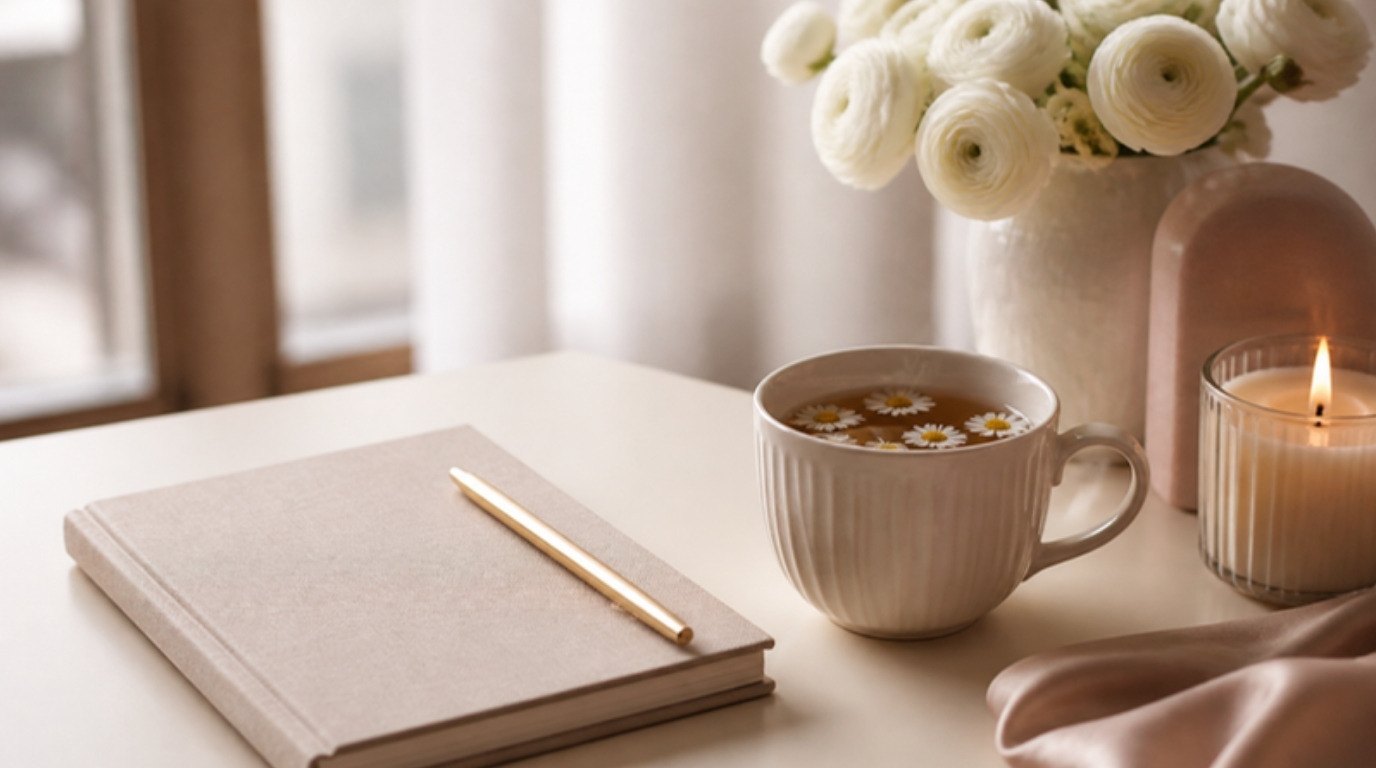
- Make a "landing" routine. Change into soft clothes, wash your face, make a cup of herbal tea and light a candle (and blow it out before bed). The routine tells your body the event is over.
- Write down three things that went fine. Not great, just fine. "I said hello to everyone. I had a nice talk about dogs. I left when I planned to."
- Set a replay limit. If your mind keeps going back, tell it: "We can think about this tomorrow at lunch for five minutes." Then actually give it those five minutes the next day. Usually it no longer feels important.
- Plan a quiet next day. After a big gathering, keep the following day light if you can.
- Protect your sleep. If you are sensitive to noise after a loud evening, noise-reducing earplugs can help your nervous system settle and make it easier to drift off.
If you feel completely drained after people time, that is not a flaw. Your energy just needs refilling, and my guide on how to recharge your social battery has lots of gentle ideas for the days in between gatherings.
Kind Ways To Decline an Invitation

You do not have to go to every gathering. Choosing a few events you genuinely want to attend, and saying a warm no to the others, is a healthy way to manage holiday social anxiety. It also makes the yes events feel better, because you arrive with more energy.
A few kind scripts:
- Simple and warm: "Thank you so much for inviting me. I cannot make it this time, but I hope you have a wonderful evening."
- With an alternative: "I will not make the party, but I would love to see you in January. Coffee after the holidays?"
- A shorter yes: "I can only stay for an hour, but I would love to stop by and say hello."
- For family: "I am keeping this year a bit quieter, so I will come for lunch but head home before the evening."
You do not owe a long explanation. One clear, kind sentence is enough. A small warning, though: if you notice you are saying no to almost everything because of fear, rather than choice, it can be a sign the anxiety is growing. Try saying yes to one small, low-pressure event and using the tools above.
When To Ask for More Support
Feeling nervous at holiday gatherings is very common. But if social anxiety is stopping you from living your life (you avoid most events, you feel panicky for days before, or it is affecting your work, friendships or family time), it is worth talking to a therapist or your doctor. Social anxiety responds well to support, and you do not have to wait until things feel unbearable to ask for help.
Asking for support is not a sign that you have failed at coping. It is a way of giving yourself more tools, and you deserve those.
Final Thoughts
Holiday social anxiety does not mean you have to miss out, and it does not mean you have to push through every event feeling miserable. A plan for arriving and leaving, a couple of quiet tools in your pocket and a soft landing afterward can make the whole season feel lighter.
Go to the gatherings that matter to you, stay as long as feels right and be proud of yourself for showing up in your own way. That is more than enough.