Being with someone who is emotionally unavailable often feels like standing at a door that opens a crack and then quietly closes again. The good moments are real, which is exactly what makes the distance so confusing. You keep wondering whether you're asking for too much, when usually you're simply asking for closeness.
Emotional unavailability isn't a diagnosis or an insult. It's a pattern: a difficulty letting someone in, sharing feelings, leaning on a partner or being leaned on. Some people stay in that pattern for years. Others soften once they feel safe and decide to do the work. Your job isn't to fix anyone. It's to see the pattern clearly and decide what you need.
This guide to the signs someone is emotionally unavailable covers what the term really means, 12 signs to notice, why people become this way, how to tell it apart from someone who is simply slow to open up, what to say (with scripts), how to decide whether to stay and how to gently check your own patterns too.
What Does Emotionally Unavailable Mean?

Someone who is emotionally unavailable has a hard time with emotional closeness. They may be warm, funny and great company, but when a relationship asks for vulnerability – talking about feelings, making plans, offering comfort, being honest about needs – they pull back, change the subject or go quiet.
It can look different from person to person. One person avoids labels and future plans. Another is lovely in person but disappears for days. Another talks a lot, but only about surface things. What ties it together is the feeling on your side: you're close to them, but not quite with them.
It's a Pattern, Not a Label
I want to be careful here, because "emotionally unavailable" gets thrown around a lot. Everyone has moments of being unavailable: a stressful month at work, grief, illness, a hard season. That doesn't make someone an emotionally unavailable person. What you're looking for is a steady pattern over time, across many situations, that doesn't change even when you gently name it.
It also helps to remember that you can't diagnose anyone, and you don't need to. You don't have to prove what's going on inside another person to know how the relationship feels to you. "I feel lonely in this relationship" is enough information to act on.
12 Signs Someone Is Emotionally Unavailable

Read these as clues, not a scorecard. One or two on their own can just be personality. Several together, for months, tell a clearer story. Notice, too, that most of these signs are about what happens over time rather than in a single evening, so give yourself permission to look at the whole picture instead of one bad weekend.
1. They Keep Things Surface Level
Conversations stay on movies, work gossip and weekend plans. When you try to go deeper – their family, their fears, what they want from life – you get a short answer and a quick turn back to lighter topics. After months together, you realize you know their coffee order better than their inner world.
2. They're Hot and Cold
One week they're attentive, texting, planning dates. The next they're distant and hard to reach, often right after a particularly close moment. That push-pull rhythm is one of the most draining parts of this pattern, and it's worth reading more about how to handle mixed signals without blaming yourself for them.
3. They Avoid Labels and Future Plans
"Let's not put a name on it." "Why plan that far ahead?" A little caution early on is normal. But if it's been many months and any talk of the relationship's direction makes them tense or vague, that avoidance is information.
4. They Deflect With Jokes
Humor is lovely, until it becomes a shield. If every serious moment gets a joke, a sarcastic remark or a playful "you're so intense," you may notice you stop bringing up important things at all.
5. They Disappear During Hard Moments
You have a terrible week, a family worry or a health scare, and they go quiet or busy. They may care, but sitting with someone else's pain feels overwhelming to them, so they step back exactly when you need them to step in.
6. They Rarely Share Their Own Feelings
Ask how they feel and you get "fine," "I don't know" or a description of what happened instead of how it felt. You might find out they were upset weeks later, or never.
7. They Keep Their Life in Separate Boxes
You haven't met their friends, or you've met them only briefly. Their family stays vague. There's a sense that you're welcome in one room of their life, but the other doors stay closed.
8. Closeness Is on Their Terms
They reach out when they want connection, and pull away when you do. Plans happen when it suits them. You may notice that the relationship's rhythm is almost entirely set by their mood.
9. They Get Defensive When You Name a Need
A simple "I'd love to talk more during the week" is heard as criticism. Instead of curiosity, you get "Why are you making this a big deal?" or a quick shutdown, and the conversation ends without anything changing.
10. They Seem to Prefer the Chase
Early on, they were intensely interested. Once things got comfortable and real, their interest cooled. For some people, the uncertain early stage feels safer than the steady, known middle.
11. They Hold On to an Ex or the Past
They still talk about a past relationship a lot, keep comparing, or say they're "not over" something. It's hard for someone to be fully present with you when part of them is still somewhere else.
12. You Feel Lonely Even When You're Together
This is the sign that matters most, because it's about you. If you often feel anxious, unsure or quietly lonely in the relationship, take that feeling seriously. It's not neediness. It's your heart telling you something is missing.
If many of these sound familiar and the distance is growing rather than shrinking, my guide to the signs he's losing interest can help you see whether this is a long-standing pattern or a more recent change.
Why People Become Emotionally Unavailable

Nobody chooses emotional distance as a hobby. It usually starts as protection. While every person's story is their own, a few common threads come up:
- Past hurt. A painful breakup, betrayal or loss can teach someone that letting people in leads to pain, so they keep a careful distance.
- Avoidant attachment patterns. Some people learned early that their feelings weren't welcome, so they learned to rely only on themselves. Closeness can feel uncomfortable, even when they want it. My guide to attachment styles explains this gently and without labels.
- Stress and overwhelm. Work pressure, money worries, grief or burnout can leave very little emotional energy for anyone, including a partner.
- Never learning the language. Some people genuinely don't know how to name their feelings. They aren't hiding them as much as they can't find them.
- Not wanting the same thing. Sometimes the simplest answer is the true one: they enjoy your company but don't want a deeper relationship right now.
Understanding where it comes from can soften your heart, and that's good. But understanding someone's reasons is not the same as accepting a relationship that leaves you lonely. You can hold compassion for them and still look after yourself.
If you'd like to understand these patterns more deeply, a best-selling book on adult attachment and relationships is one of the most helpful reads I'd suggest. It explains why some people move toward closeness and others move away, in plain, kind language.
Slow To Open Up vs Emotionally Unavailable
Some people take time. They're private, cautious or new to being vulnerable, and that's completely fine. The difference isn't speed. It's direction. Someone slow to open up is moving toward you, little by little. Someone emotionally unavailable stays in the same place, or moves away when things get close.
| Situation | Slow to open up | Emotionally unavailable |
|---|---|---|
| Over time | Shares a little more each month | Stays at the same surface level for months |
| When you share something vulnerable | Listens, even if they don't say much back yet | Changes the subject or makes a joke |
| When you name a need | Feels a bit awkward but tries | Gets defensive or shuts the talk down |
| Future plans | Careful, but includes you | Avoids the topic or stays vague |
| Hard moments | Shows up, even clumsily | Goes quiet or becomes "busy" |
| Their consistency | Steady and reliable | Hot and cold |
| How you feel | Patient and hopeful | Anxious, unsure or lonely |
Screenshot this table if it helps. When you're in the middle of a confusing relationship, it's easy to lose track of the bigger picture, and a simple comparison can bring you back to what you're actually seeing.
What To Do If You're Dating Someone Emotionally Unavailable

You don't need a big dramatic talk to start. Small, honest steps give you far more information than months of quietly guessing.
Ask Curious, Gentle Questions
Curiosity lowers defenses. Instead of "Why are you always so distant?" try questions that invite, not accuse:
- "What helps you feel close to someone?"
- "When things get serious, what goes through your mind?"
- "How do you like to be supported when you're stressed?"
- "What did relationships look like in your family growing up?"
- "What do you want this to be, a few months from now?"
Pick one, not all five, and ask it on a calm evening, not in the middle of a disagreement. A deck of couple conversation cards can make this easier, because the question comes from the card rather than from you, which feels lighter for people who tense up at "we need to talk."
For more ways to build this kind of closeness slowly, my guide on how to build emotional intimacy has small, low-pressure steps.
Say What You Need (With Scripts)
Most of us either hint (and hope they guess) or wait until we're hurt and then say everything at once. A calmer formula works better: what I've noticed + how I feel + what I'd love. Keep it short, about one specific thing.
- For distance after closeness: "I've noticed that after we have a really close weekend, things go quiet for a few days. I end up feeling unsure. I'd love a simple check-in, even a short text, so I know we're okay."
- For surface-level talks: "I love our easy conversations, and I'd also love to know you more deeply. Could we have one slower evening a week where we talk about something real?"
- For hard moments: "This week has been hard for me. I don't need you to fix anything. It would mean a lot if you'd just sit with me tonight."
- For future plans: "I'm not asking for a promise. I just want to understand where you see this going, so I can make good choices for myself."
- When they deflect with a joke: "I like that you make me laugh. Right now I'd love a serious answer, though. It matters to me."
Then watch what they do over the next few weeks. Words matter, but a small, consistent change matters more.
Give It Time, But Not Forever
Change is slow, and people who learned to keep their distance won't become wide open overnight. Give genuine effort a fair chance, often a few months. But "time" should come with movement. If you're still having the same talk six months later with no change at all, that's an answer too.
Meanwhile, keep your own life full: friends, hobbies, rest, your own plans. When a relationship takes up all your emotional space, every small withdrawal feels enormous. When your life is full, you can see things more clearly.
Deciding Whether To Stay

There's no rule that says you must leave someone who struggles with closeness. Plenty of people grow, especially with self-awareness and support. The question isn't "Are they perfect?" It's "Is this relationship giving me what I need, or moving toward it?"
A few honest questions to sit with, ideally in a quiet moment with a cup of tea:
- Do they acknowledge the pattern, even a little, or deny it completely?
- Have they taken any real step, like opening up more, asking how you feel or speaking to a therapist?
- Do I feel more secure now than I did three months ago, or less?
- Am I shrinking my needs to keep the peace?
- If nothing changed for the next year, would I be okay?
That last one tends to be the clearest. If your honest answer is no, you're allowed to choose differently. Reflecting on your dating standards can help you remember that wanting emotional presence isn't too much. It's a reasonable, healthy thing to want.
And if you decide to stay, decide actively. Agree on one or two small changes, check in after a month, and keep listening to how you feel.
Checking Your Own Patterns, Kindly

This part isn't about blame. It's about clarity. Sometimes we're drawn to emotionally unavailable people again and again, and it helps to understand why. And sometimes, honestly, we're a little unavailable ourselves.
A few gentle questions for your journal:
- Do I feel more excited by people who are hard to read than by people who are steady?
- Does consistent attention ever feel boring or uncomfortable to me?
- Do I share my own feelings, or do I expect them to go first?
- Do I choose partners who need "fixing" so I don't have to look at my own needs?
- When someone gets close, do I find reasons to pull back?
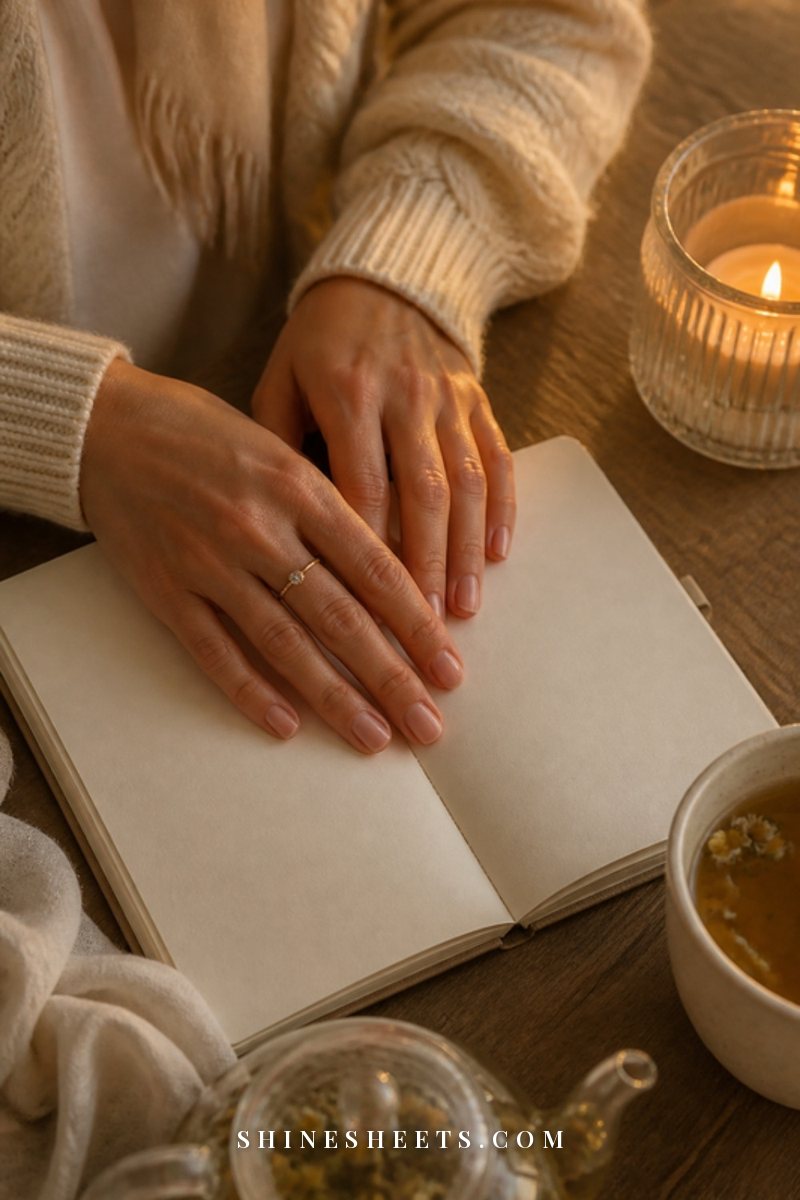
A guided self-reflection journal gives you a soft structure for this, especially on evenings when your thoughts feel tangled. I like journaling after evening tea, with a candle in a glass jar lit, because it turns a heavy topic into a calm ritual rather than a late-night spiral. A cup of chamomile lavender tea makes it feel even more like care.
If you notice your own patterns here, please don't be hard on yourself. Seeing them is the first step to choosing differently, and that's brave.
When a Therapist Can Help
A therapist can be really helpful here, for either of you. If you keep ending up in the same kind of relationship, if the anxiety of not knowing where you stand is affecting your sleep and mood, or if your partner wants to change but doesn't know how, a licensed therapist can offer tools that a blog post can't. Couples counseling can also give two people a safe place to practice closeness, with someone guiding the conversation.
It's not a sign that something is broken. It's simply support, and everyone deserves that.
If you're the one who struggles to open up, therapy can be a safe practice space. You get to try saying feelings out loud with someone who won't pull away or judge, and that slowly makes it easier to do the same with the people you love. Many people find that even a handful of sessions helps them name what they feel instead of going quiet.
And if you're the partner who's been waiting, a few sessions of your own can help you sort out what you want, separate from what they can offer. It's much easier to make a clear decision when you're not carrying it alone.
Final Thoughts
Loving someone who keeps their heart at a distance can make you doubt yourself, but wanting closeness is never too much. You can be patient, kind and understanding, and still ask for a relationship where you feel seen.
Whether they grow toward you or you gently walk toward something new, you deserve love that feels steady, warm and present.