Contentment isn't a feeling you earn once everything is finally in place. It's a quiet skill you practice in the middle of an unfinished life, with the laundry half folded and a few goals still on the list. And the lovely part is that you don't have to stop wanting things to have it.
A lot of us were taught that wanting more is what keeps us moving, and that feeling satisfied is a kind of giving up. But the "more" rarely arrives the way we picture it. We reach the next thing, enjoy it for a little while, and then the finish line quietly moves again. That isn't a personal flaw. It's a very human pattern, and once you can see it, you can soften it.
This guide is all about contentment: what it really means, how it differs from happiness, why "more" doesn't always feel like more, the signs you might be stuck in always wanting more, and eight gentle practices that help you feel enough without giving up on your hopes. There's also a little table that turns common wanting-more thoughts into something kinder.
It took me a long time to understand that feeling okay with today and wanting a better tomorrow can live in the same heart. You're allowed both.
What Contentment Really Means

Contentment is a steady sense that your life, as it is right now, is basically okay. Not perfect. Not finished. Just okay enough that you can breathe, enjoy small things and stop bracing for the next fix.
It's less about having everything and more about how you relate to what you have. Two people can live almost identical lives, and one feels quietly satisfied while the other feels like she's always running behind. The difference usually isn't the stuff. It's the inner story about the stuff.
Here's what contentment tends to look like in real life:
- You can enjoy a slow Sunday without a voice in your head listing everything you "should" be doing.
- You notice something good (a warm mug, a kind text, clean sheets) and actually let it land.
- You can want a new job, a bigger apartment or a calmer relationship without feeling that today is wasted until you get it.
- Other people's wins don't automatically feel like your losses.
- You feel a little more settled in your own skin, even on ordinary days.
Contentment doesn't mean you never feel restless or jealous. Those feelings still visit. They just don't get to run the house.
Contentment vs Happiness: What's the Difference?
We often use the two words as if they mean the same thing, but they feel quite different from the inside.
Happiness is often a high. It's the rush of good news, a lovely evening, a surprise. It's wonderful, and it's also meant to pass, the way a beautiful sunset doesn't stay in the sky all night.
Contentment is more like the ground under your feet. It's quieter and less exciting, but it's there on Tuesday afternoons and rainy mornings too. You don't chase it so much as come back to it.
A simple way to think about it:
- Happiness says, "This is amazing!"
- Contentment says, "This is enough, and I'm okay."
If you've been chasing happy feelings and wondering why they never stick, you're not doing anything wrong. Highs are supposed to fade. Building contentment gives you something steadier to stand on between them, and if you'd like the bigger picture on gentle ways to feel lighter day to day, my guide on how to be happy with less stuff pairs nicely with this one.
Why More Doesn't Always Feel Like More

Psychologists have a name for that familiar "I thought this would feel better for longer" moment: hedonic adaptation. In simple words, people tend to get used to new things, both good and bad, and drift back toward their usual mood over time. You may also hear it called the "hedonic treadmill", because it can feel like walking faster and faster while staying in the same place.
Think about the last thing you really wanted. A new sofa, a new phone, a trip, a promotion. At first it felt exciting. A few weeks later, it simply became part of your normal life. The sofa is just the sofa now. Your brain did exactly what it's built to do: it adjusted.
This adjusting is actually helpful in hard times, because it lets us cope with loss and change. But it also explains why the next purchase or the next milestone rarely delivers lasting relief. The good news is that research on happiness suggests a few things slow this fading down: appreciating what you have, savoring experiences, sharing good moments with others and noticing small, varied pleasures instead of waiting for one big one. If the science side interests you, I wrote more about it in why happiness fades and how to keep joy fresh.
In other words, contentment isn't about getting more. It's about getting better at noticing.
5 Signs You May Be Stuck in Always Wanting More
None of these make you shallow or ungrateful. They're just clues that the wanting-more loop might be running in the background. Read them gently.
- The next purchase always promises relief. When you feel tired, bored or low, your first thought is something to buy. The package arrives, the lift lasts a day or two, and the itch comes back.
- You compare constantly. You see someone's kitchen, body, vacation or career and instantly measure your own life against it, usually coming up short.
- Your goals move the moment you reach them. You hit the savings number, finish the course or land the role, and instead of celebrating, you're already onto the next target.
- Ordinary days feel hard to enjoy. Weekdays feel like waiting rooms for something better. You find yourself living for the weekend, the next trip or "when things calm down".
- You feel behind no matter what. Even when you're doing well by most measures, there's a quiet sense that everyone else is further ahead.
If two or three of these feel familiar, that's very normal. Most of us live in a world designed to keep us slightly unsatisfied, because a satisfied person buys less and refreshes feeds less. Noticing the pattern is already the first step out of it.
8 Gentle Practices for Feeling Enough

These are small, everyday practices, not a life overhaul. Pick one or two that feel easy, try them for a couple of weeks and see what shifts. Contentment grows through repetition, a little like a plant you water every day rather than once a month.
1. Notice Small Good Moments
Our brains are wired to spot problems quickly and let good things slide past. You can gently balance that by deliberately pausing on small pleasant moments.
Try this: three times a day, when something nice happens (sunlight on the floor, a good song, the first sip of coffee), stop for about 10 seconds and really take it in. Notice the colors, the warmth, the feeling in your chest. That's it. It sounds tiny, but it trains your attention toward what's already good.
For more ideas on gentle, present-moment habits, my list of calming ways to practice mindfulness every day is a good place to start.
2. Practice Gratitude in Specifics

"I'm grateful for my family" is lovely, but it can start to feel like a chore after a few days. Specific gratitude lands much deeper: "I'm grateful my sister sent me that silly photo when I was having a long day."
Try this: each evening, write down three specific good things from the day and one line about why each one mattered. Keep it to about five minutes. A simple cream gratitude journal by your bed makes the habit easier to keep, because it's right there when you get in. If you'd like more ways to make gratitude feel fresh, I shared some in how to stay positive with gratitude.
Some evenings you'll struggle to find three things. On those days, "the tea was warm" counts. Truly.
3. Pause Before You Buy
This isn't about never shopping. It's about giving yourself a moment to check what you're actually looking for.
Try this: when you want something that isn't a need, add it to a note on your phone instead of the cart, and wait 48 hours (a week for bigger things). When the time's up, ask yourself: "Do I still want this, or did I want a feeling?" Often the honest answer is rest, comfort or a bit of excitement, and there may be another way to give yourself that.
If you still want it after the wait, buy it with a clear heart. The pause is there to help you choose, not to punish you.
4. Appreciate What You Already Own
Hedonic adaptation makes the things we own fade into the background. You can bring them back into focus by actually using and noticing them.
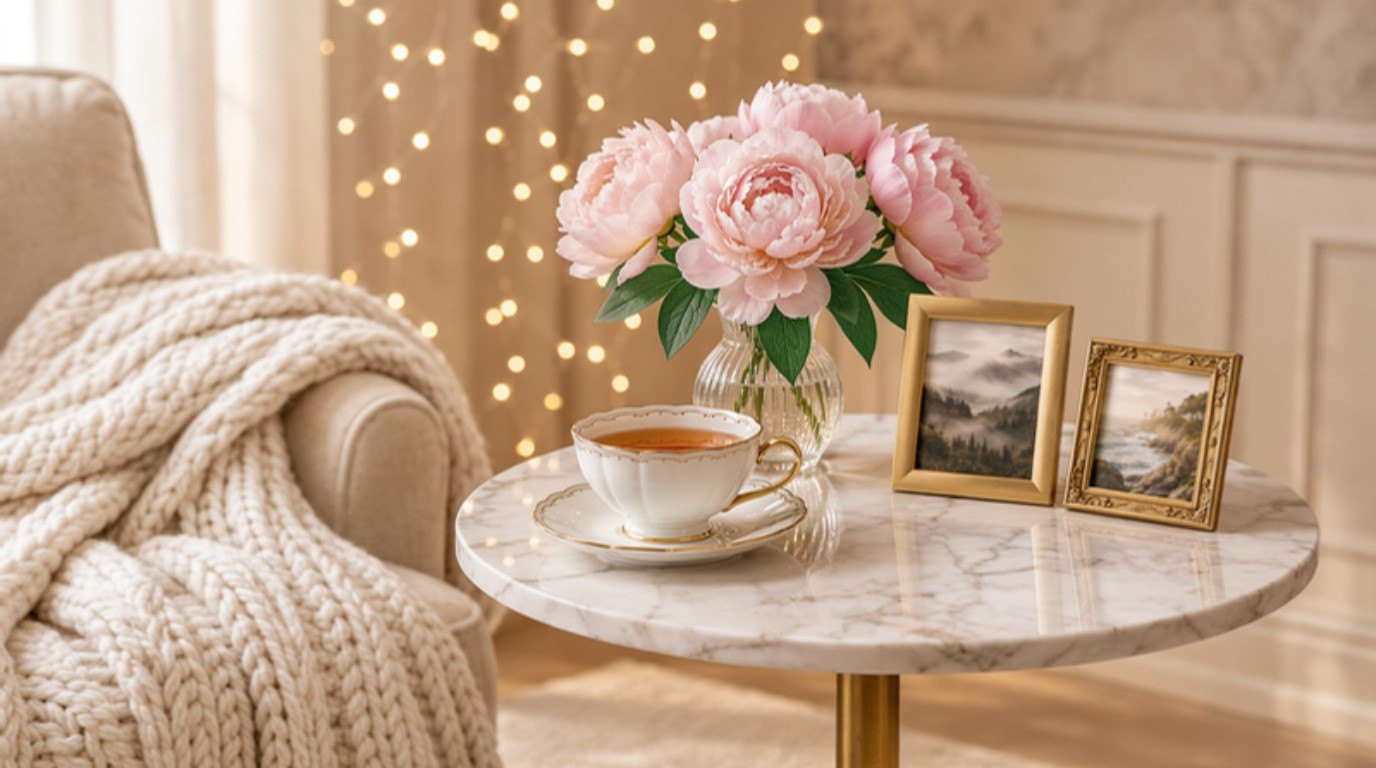
Try this: once a week, pick one thing you already have and give it a little attention. Wear the dress you've been "saving". Light the candle instead of keeping it for a special day. Make your tea in your prettiest cup, perhaps a blush ceramic mug that feels like a small treat to hold. Using what you have tends to feel surprisingly close to buying something new, without the package.
5. Savor Your Everyday Routines
Savoring means slowing down enough to fully experience something good while it's happening. Routines are perfect for it, because they happen every day anyway.
Try this: choose one daily routine (your morning coffee, your evening skincare, your walk home) and turn it into a small ritual. Do it a little slower, with fewer distractions, and notice one sensory detail each time. My own favorite moment for this is evening tea, with a glass candle lit and my phone in another room. A soft lavender candle in a glass jar can become a gentle signal that this is your slow, savoring time.
6. Limit Comparison Feeds
It's very hard to feel content while watching a highlight reel of other people's lives all day. You don't have to quit social media, but you can make it kinder to you.
Try this: spend 10 minutes going through the accounts you follow. For each one, ask: "Do I usually feel better or worse after seeing this?" Mute or unfollow anything that reliably leaves you feeling behind, and add a few accounts that make you laugh, teach you something or feel calm. Then pick one daily window, say 20 minutes in the afternoon, rather than checking first thing in the morning and last thing at night.
If comparison is a big theme for you, I wrote a whole guide on how to stop comparing yourself to others.
7. Enjoy Progress, Not Just Results
If you only allow yourself to feel good when you reach the goal, you'll spend most of your life feeling not-quite-there. Progress deserves joy too.
Try this: at the end of each week, write down one small step you took toward something that matters to you. Paid off a little more of a card. Went for two walks. Finished a chapter. Then actually acknowledge it, out loud if you like: "That's real progress." You're still working toward the goal, but now the journey isn't just a waiting room.
8. Be Kind to Yourself
A lot of wanting-more comes from a harsh inner voice that says you're not enough yet. Ironically, constant self-criticism often makes us feel more empty, not more motivated.
Try this: when you catch yourself thinking "I should be further along by now," pause and ask what you'd say to a friend who said that. Then say a version of it to yourself, something like: "You're doing a lot. It's okay to be where you are." Wrapping up in a soft sage linen throw on a hard evening is a small, physical way to offer yourself the same comfort. For more gentle tools, my guide to self-compassion basics is a kind next read.
The Wanting-More Table: What Your Thoughts Might Be Asking For
This is the heart of the guide. Wanting-more thoughts usually carry a real need underneath. When you can name the need, you can often meet it more directly. Screenshot it for the days when the itch for "more" shows up.
| Wanting-more thought | What it might be asking for | Contentment practice to try |
|---|---|---|
| "I need something new." | Novelty, excitement, a break from routine | Use something you already own in a new way, or try a free new experience: a different walk, a new playlist, a library book |
| "Everyone else has more than me." | Reassurance that you're okay and on track | Mute one comparison account and write three things your life genuinely has right now |
| "I'll be happy when…" | Hope, direction, a sense of moving forward | Write down one step you took this week toward that thing and let it count |
| "This day is so boring." | Rest, pleasure or connection | Turn one routine into a 10-minute savoring ritual, or text a friend for a short chat |
| "I deserve a treat." | Comfort after a hard day | Pause 48 hours on the purchase and offer yourself comfort now: a bath, tea, an early night |
| "I'm so behind." | Kindness and perspective | Ask what you'd tell a friend, then say it to yourself; list what you've handled this year |
| "It's still not enough." | Feeling seen and valued | Share a good moment with someone you love, or write a specific gratitude note about yourself |
You don't have to fix the thought. Just meeting the need underneath it, even a little, often takes the edge off.
Contentment Is Not Settling

This is the part I want to say clearly, because it's where many people get stuck: contentment is not giving up on your dreams. You can feel at peace with your life and still want a new job, a home of your own, a healthier relationship or a big trip one day.
In fact, contentment often makes goals feel lighter. When your sense of worth isn't riding on the outcome, you can work toward things with curiosity instead of desperation. You make clearer choices, because you're not grabbing at whatever promises the quickest relief.
Contentment also isn't ignoring real problems. If you're in a job that's harming your health, a relationship that doesn't feel safe or a money situation that keeps you up at night, it's not "ungrateful" to want change. Feeling enough inside and fixing what's genuinely wrong outside can happen at the same time.
And it definitely isn't toxic positivity. You're allowed to have bad days, to feel disappointed, to grieve what didn't work out. Contentment doesn't ask you to pretend. It just gently reminds you that the hard parts aren't the whole story.
A Simple Weekly Contentment Rhythm
If eight practices feel like a lot, here's an easy way to fold a few of them into a normal week. Think of it as a gentle rhythm rather than a strict plan.
- Every day: pause on one small good moment for 10 seconds, and write three specific gratitudes in the evening (about five minutes, ideally with tea).
- Twice a week: turn one ordinary routine into a slow savoring ritual.
- Once a week: use or wear one thing you already own and love, and write down one small step of progress.
- Once a month: do a 10-minute tidy of your social feeds and look back over your gratitude notes.
- Whenever the itch strikes: pause before buying and check the table above for what you might really need.
A gold-tipped pen kept with your journal is a tiny, pretty nudge to actually do the writing part. Little cues like that make habits much easier to keep.
When To Ask for More Support
Sometimes the feeling that nothing is ever enough is more than ordinary restlessness. If you notice a low mood that lingers for weeks, a sense of emptiness that doesn't lift, trouble enjoying things you used to love, or changes in sleep and appetite, please be gentle with yourself and reach out. Talking to a therapist or your doctor can help you understand what's going on and find support that fits you. That isn't a failure of gratitude. It's a kind, brave way to look after yourself.
These practices are meant for everyday wellbeing and are not a replacement for professional care.
Final Thoughts
Contentment isn't a finish line you cross once your life looks a certain way. It's a soft, steady place you return to, again and again, in the middle of ordinary days.
You can keep dreaming, planning and growing. You can want beautiful things. And you can also look around at your life right now, the warm mug, the people who love you, the small progress you've made, and let yourself feel that it's enough for today. That's not settling. That's coming home to yourself.