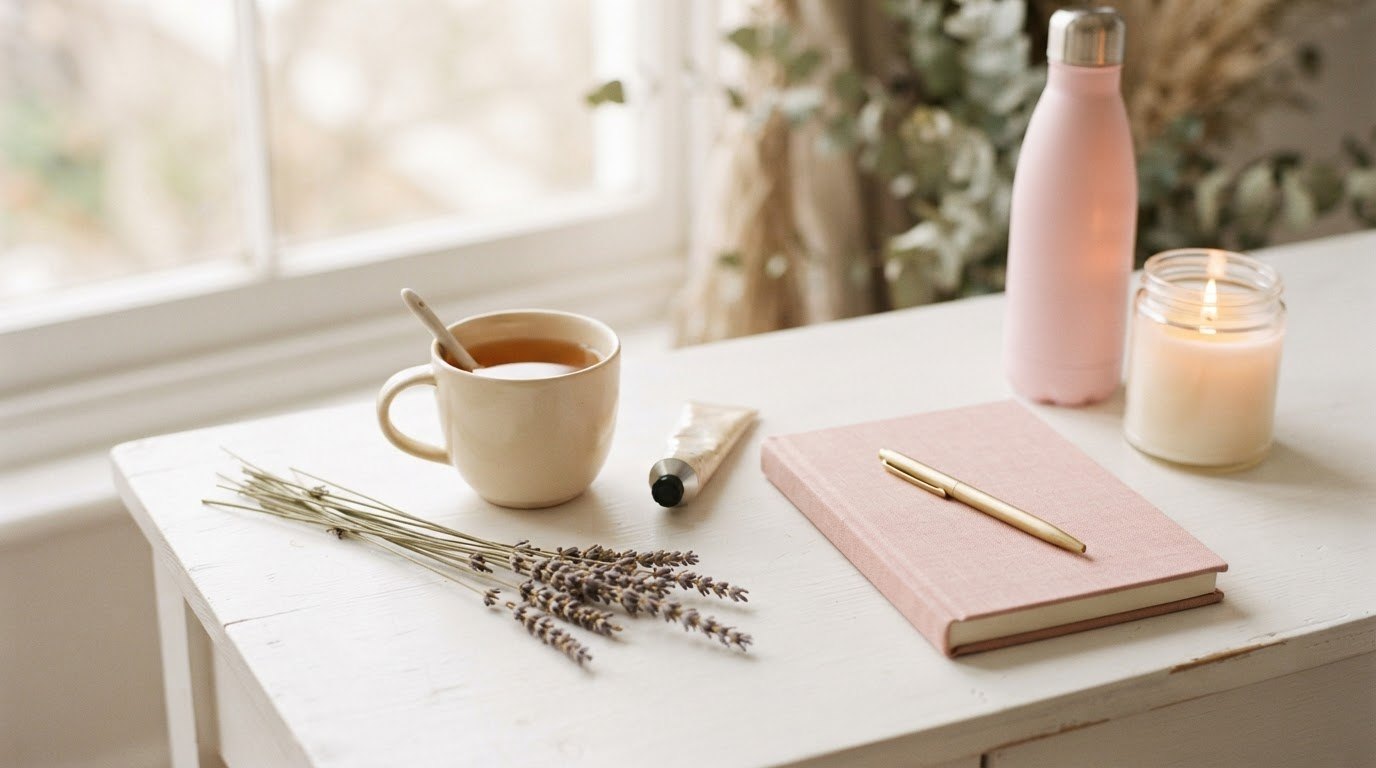
Work stress rarely comes from one huge thing. It builds from small ones: an inbox that never empties, a meeting that runs over, a message that lands just as you were about to breathe. By the afternoon your shoulders are up near your ears and you can't remember the last time you drank water. Relief, then, doesn't have to be big either. It works best as a set of small, quick resets you can reach for in the middle of a real day.
I'm prone to anxiety, and one thing I've learned is that stress is much easier to soften early than to fight once it has taken over. A two-minute pause at eleven in the morning can save you from a full-body crash at five.
This guide gathers practical work stress relief tips for real days: resets that take less than two minutes, desk-side habits, ways to handle a heavy workload (with short "not now" scripts), boundaries with after-hours messages, a transition ritual for the end of the day, weekend recovery and a stress relief menu you can screenshot. There's also a gentle note on when stress might be something bigger.
Take what helps, leave what doesn't, and be kind to yourself while you figure out your own mix.
Why Work Stress Feels So Physical
Stress isn't only in your head. When your brain senses pressure (a deadline, a tense email, a long to-do list), your body responds as if there were a real threat: your heart beats faster, your breathing gets shallow, your muscles tighten and your focus narrows. That response is useful for short bursts, but on a long workday it can stay switched on for hours.
That's why the quickest relief usually comes through the body, not through thinking your way out. Slowing your breath, moving, changing your temperature or relaxing your grip sends a signal back to your nervous system that you're safe enough to settle down. Once your body calms a little, your thinking clears too.
Keep that in mind as you read: many of these tips look almost too simple. They work precisely because they're simple enough to do while stressed.
Quick Resets for the Middle of a Hard Day
These five resets take two minutes or less and can be done at a desk, in a hallway or in a bathroom stall if that's the only quiet place you have.
1. Make Your Exhale Longer Than Your Inhale
Breathe in through your nose for a count of four, then breathe out slowly through your mouth for a count of six to eight, as if you were blowing through a straw. Repeat five times. A longer exhale is one of the fastest ways to tell your body it can slow down.
You don't need to close your eyes or sit in any special way. Nobody will notice you doing it in a meeting. If you'd like more techniques to try, my guide to breathing exercises for calm has several more patterns with step-by-step counts.
2. Run Cold Water Over Your Wrists
When you feel heat rising in your face or chest, go to the sink and run cool water over the insides of your wrists for 30 seconds. Pat a little on the back of your neck too. The sudden change in temperature interrupts the stress spiral and gives your mind something else to focus on for a moment.
Keeping a full water bottle at your desk helps as well. Dehydration can make you feel more tired, foggy and irritable, and a sip of cold water does a gentler version of the same reset.
3. Take a 90-Second Walk
Stand up and walk somewhere, anywhere: to the window, to refill your water, around the block of desks, down one flight of stairs and back up. Ninety seconds of movement lets some of the stress energy leave your body instead of sitting in your shoulders.
If you work from home, walk to the door, step outside for a few breaths of fresh air and come back. It counts.
4. Ground Yourself With Your Senses
When your thoughts are racing about everything that could go wrong, bring your attention back to the room. Quietly name:
- Three things you can see
- Two things you can hear
- One thing you can feel (your feet on the floor, the chair under you, the mug in your hand)
It sounds small, but it pulls your mind from "what if" back to "what is," which is where you can actually do something.
5. Squeeze and Release
Clench your fists tightly for five seconds, then release and let your hands go loose. Do the same with your shoulders: lift them toward your ears, hold, and drop them. Notice the difference between tense and relaxed.
A soft pastel stress ball kept in a drawer makes this even easier during long calls. Look for a slow-rising foam or a squishy gel ball that feels satisfying to press, in a calm color you don't mind seeing on your desk.
Desk-Side Habits That Lower Stress All Day
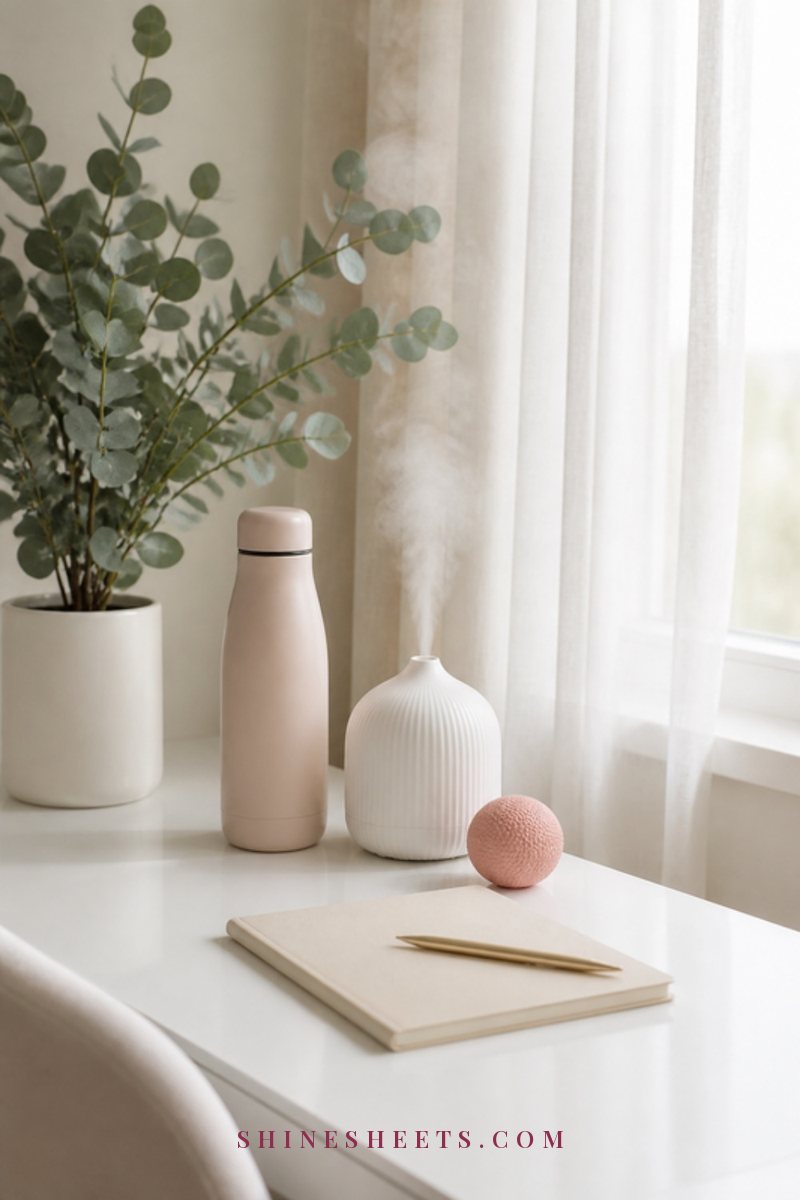
Your workspace either adds to your stress or quietly helps you carry it. A few small changes make a surprising difference over a whole week:
- Add something green. A faux plant in a white ceramic pot softens a desk and needs zero care, which matters on busy weeks. Look for a realistic eucalyptus or olive branch style that doesn't collect too much dust.
- Keep water within reach. An insulated water bottle keeps water cold for hours, so you're more likely to keep sipping. Choose one that fits your cup holder or bag and is easy to clean.
- Use a gentle scent cue. A small lavender rollerball on your wrists can become a signal to pause and breathe. Look for one diluted in a carrier oil and made for skin, and patch test first if your skin is sensitive. At home, a small white aromatherapy diffuser does the same for the whole room (only where others don't mind the scent).
- Clear one surface. Visual clutter keeps your brain half-busy. Clearing just the area right in front of your keyboard helps.
- Move your phone out of sight for focused blocks of time, ideally into a drawer.
- Adjust your light. Sit near a window if you can, or add a warm desk lamp instead of relying only on harsh overhead lighting.
For noisy spaces, noise-canceling earbuds can be a lifesaver. Look for a comfortable fit for long wear and a transparency mode so you can still hear someone saying your name.
Coffee deserves a small mention here too. For me, a cup sometimes helps me focus and sometimes makes my heart race when I'm already stressed. On high-pressure days, notice how it affects you and consider switching your second cup to tea or water.
How To Handle a Heavy Workload Without Panicking
Breathing helps in the moment, but if the stress comes from too much work, you also need ways to shrink the pile in your head.
Do a Five-Minute Brain Dump
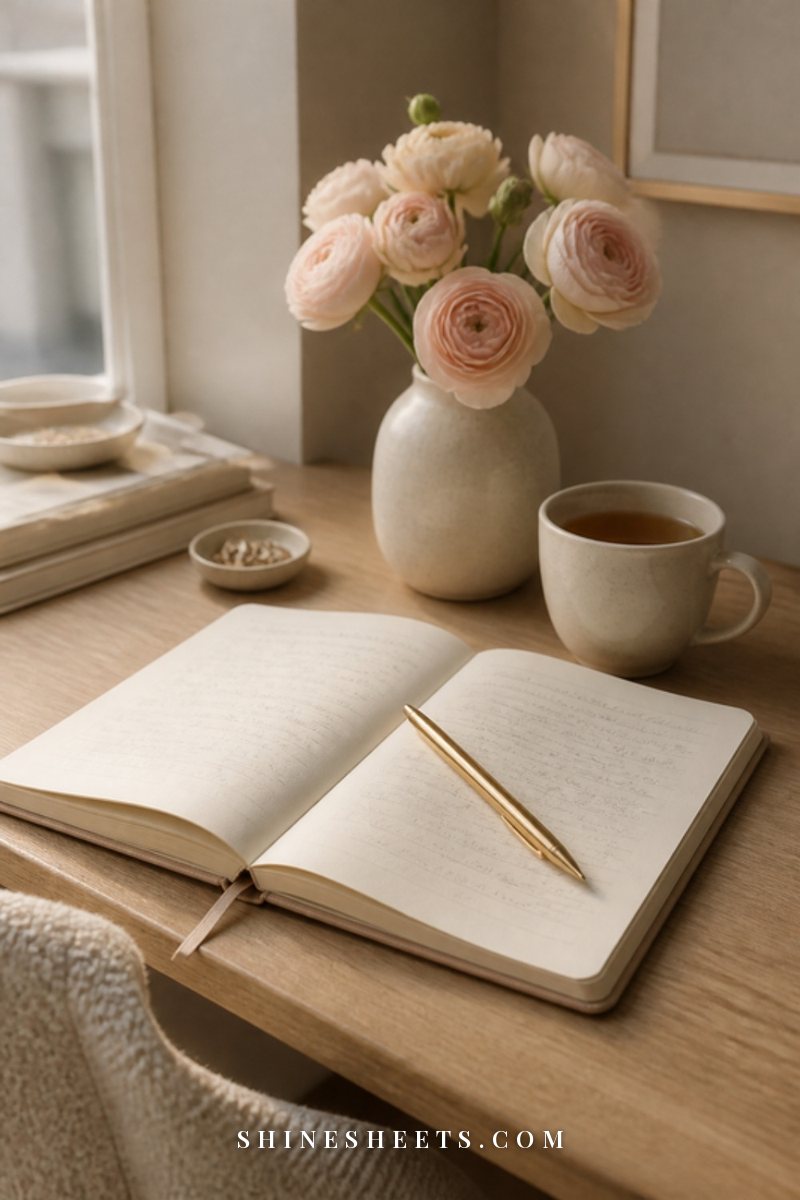
When everything feels urgent, write it all down: every task, worry and half-finished thought. Don't organize, just empty your head onto paper for five minutes. Seeing it outside of you makes it look smaller and more manageable, and it frees up the part of your brain that was busy trying to remember everything.
Then circle the three tasks that would make the biggest difference today. Only three. Everything else can wait in the list, safely written down.
Sort by What Truly Matters
Not all tasks are equal, even if they all feel urgent. For each item on your list, ask:
- Does this have a real deadline today?
- Will someone be blocked if I don't do it?
- Can it be done in under five minutes? (If yes, do it now and cross it off.)
- Can it be delegated, shortened or moved to later this week?
Usually, only a handful of things truly need you today. My guide on how to be more organized at work goes deeper into planning your day so the pile doesn't build up again, and if you're feeling buried right now, my post on dealing with work overload has more on sorting through it.
Say "Not Now" Kindly: Short Scripts
Many of us take on more because saying no feels impossible. You don't have to say no to everything. Often, "not now" or "not like this" is enough. A few scripts to borrow:
- When a new task lands: "I'd like to help with this. Right now I'm focused on X until Thursday. Could this wait until Friday, or should I move X?"
- When you're asked for a quick favor: "I can't today, but I could take a look tomorrow morning."
- When priorities clash: "I have A, B and C on my plate. Which one is most important to you so I can do that first?"
- When a meeting isn't necessary: "Could you send me a quick summary afterward? I'm trying to protect a focus block today."
- When you need time to think: "Let me check my week and get back to you this afternoon."
Short, calm and honest works far better than a long apology. People usually respect a clear answer more than a stressed yes.
Boundaries With Messages After Hours
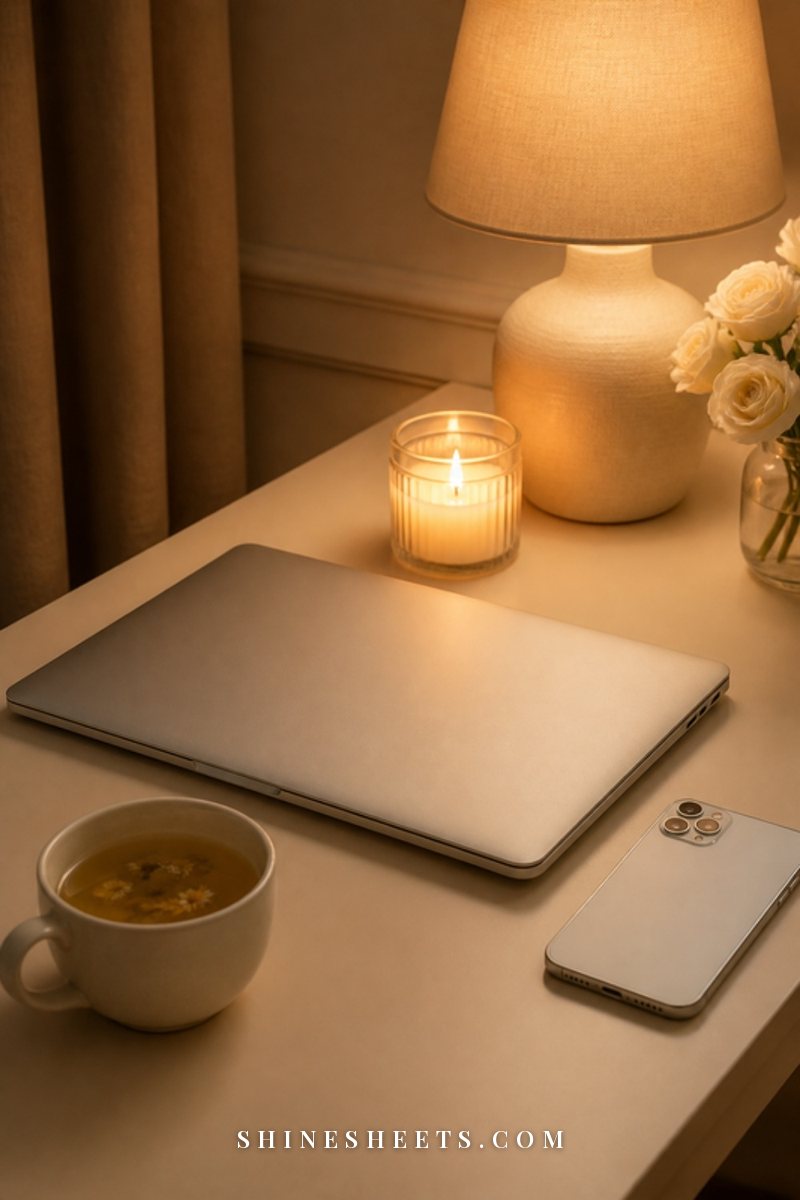
It's hard to recover from work stress if work follows you home in your pocket. Constant notifications keep your body on alert, even when you're on the couch. A few boundaries can help, adjusted to what your role realistically allows:
- Turn off work notifications after a set time, or use your phone's focus mode to silence work apps in the evening.
- Remove work email from your phone's home screen, so checking it becomes a choice instead of a reflex.
- Set expectations early: "I check messages until 6 and first thing in the morning. If something is truly urgent, please call."
- Schedule emails you write late to send the next morning, so you don't train others to expect evening replies.
- Keep work devices out of the bedroom if you can.
Boundaries take practice and they won't be perfect every week. If this feels hard, my guide on how to set boundaries walks through it gently, with more scripts for different situations.
A Transition Ritual for the End of the Workday

When you work from home, or even when you commute, it's easy for the workday to blur into the evening. A short ritual tells your brain that work is over, so it can stop scanning for problems. Here's a simple one that takes about ten minutes:
- Close the loops. Write tomorrow's top three tasks on a sticky note, so your mind doesn't try to hold them all night.
- Tidy your workspace for two minutes. A clear desk is a nicer thing to come back to in the morning.
- Shut down physically. Close the laptop, log out, and if you work at home, put it out of sight.
- Change something about your body. Swap into comfy clothes, wash your face or take a short walk.
- Mark the start of your evening. I love lighting a glass candle and making a cup of tea. Choose any small cue that feels like "mine."
Do the same steps in the same order most days. After a couple of weeks, your body starts to relax as soon as you begin the ritual.
Weekend Recovery That Actually Restores You

Weekends often get filled with chores and errands, and then Monday arrives without any real rest. Recovery is not laziness. It's how you refill the energy that work uses up. A few ideas:
- Protect one slow morning. No alarm, no plans before ten, breakfast without a screen.
- Move your body in a way that feels good, like a long walk, gentle yoga or dancing in the kitchen.
- Spend time outside, even for twenty minutes. Daylight and fresh air do a lot for a tired mind.
- Do something absorbing that has nothing to do with work: reading, baking, a puzzle, painting, gardening.
- See people who make you feel lighter, and give yourself permission to skip plans that feel draining.
- Keep work out of Saturday completely if you can, and save a short planning session for Sunday afternoon so Monday feels less scary.
If Sunday evenings bring a wave of dread, my guide to the Sunday scaries has gentle ways to soften that transition.
Your Stress Relief Menu
When you're stressed, deciding what to do is one more task. A menu takes the choosing out of it. Screenshot this table and pick one item that matches the time you have.
| Time you have | Try this | Why it helps |
|---|---|---|
| 1 minute | Five long exhales (in for 4, out for 6–8) | Slows your heart rate and calms your body quickly |
| 1 minute | Cold water on your wrists and neck | Interrupts the stress spiral with a physical change |
| 1 minute | Squeeze and release your fists and shoulders | Releases tension you didn't notice you were holding |
| 1 minute | Name 3 things you see, 2 you hear, 1 you feel | Brings your mind back to the present |
| 5 minutes | A short walk outside or down the stairs and back | Uses up stress energy and clears your head |
| 5 minutes | Brain dump, then circle your top three tasks | Makes the workload look smaller and clearer |
| 5 minutes | Tea or water break away from your desk | Hydrates and gives your eyes and mind a rest |
| 5 minutes | Stretch your neck, shoulders and wrists | Loosens the spots where stress settles |
| After work | Your 10-minute transition ritual | Signals to your body that the workday is over |
| After work | A 20–30 minute walk | Processes the day and lifts your mood |
| After work | A warm shower or bath and comfy clothes | Relaxes tight muscles and changes your state |
| After work | Phone on focus mode, a book or a show you love | Protects your evening from work spillover |
When Stress Becomes Burnout
Everyday work stress comes and goes. You have a hard week, then things ease up and you feel like yourself again. Burnout is different. It tends to build over months and doesn't lift after a weekend off. Some gentle signs to watch for:
- You feel exhausted most of the time, even after rest.
- You feel detached or cynical about work you used to care about.
- Small tasks feel overwhelming, and your focus keeps slipping.
- You get headaches, stomach trouble or poor sleep more often.
- You dread work every day, not just on difficult days.
If this sounds familiar, please don't try to push through alone. Talk to your doctor or a mental health professional, and if it feels safe, to someone you trust at work about your workload. It isn't weakness to ask for help. It's taking care of the person who does all that work. My guide to gentle burnout recovery has more on the slow, kind steps back.
And if your stress ever comes with thoughts of harming yourself, reach out to a crisis line or emergency services right away.
Final Thoughts
Hard days at work will still happen, and that's not a sign you're doing something wrong. What changes is how you move through them: a longer exhale before a tense call, a short walk when your thoughts start racing, a kind "not now," and a ritual that closes the workday so your evening can be yours.
Start with one tiny reset tomorrow and notice how it feels. Small, steady care adds up, and you deserve to end your days feeling a little lighter than when they started.