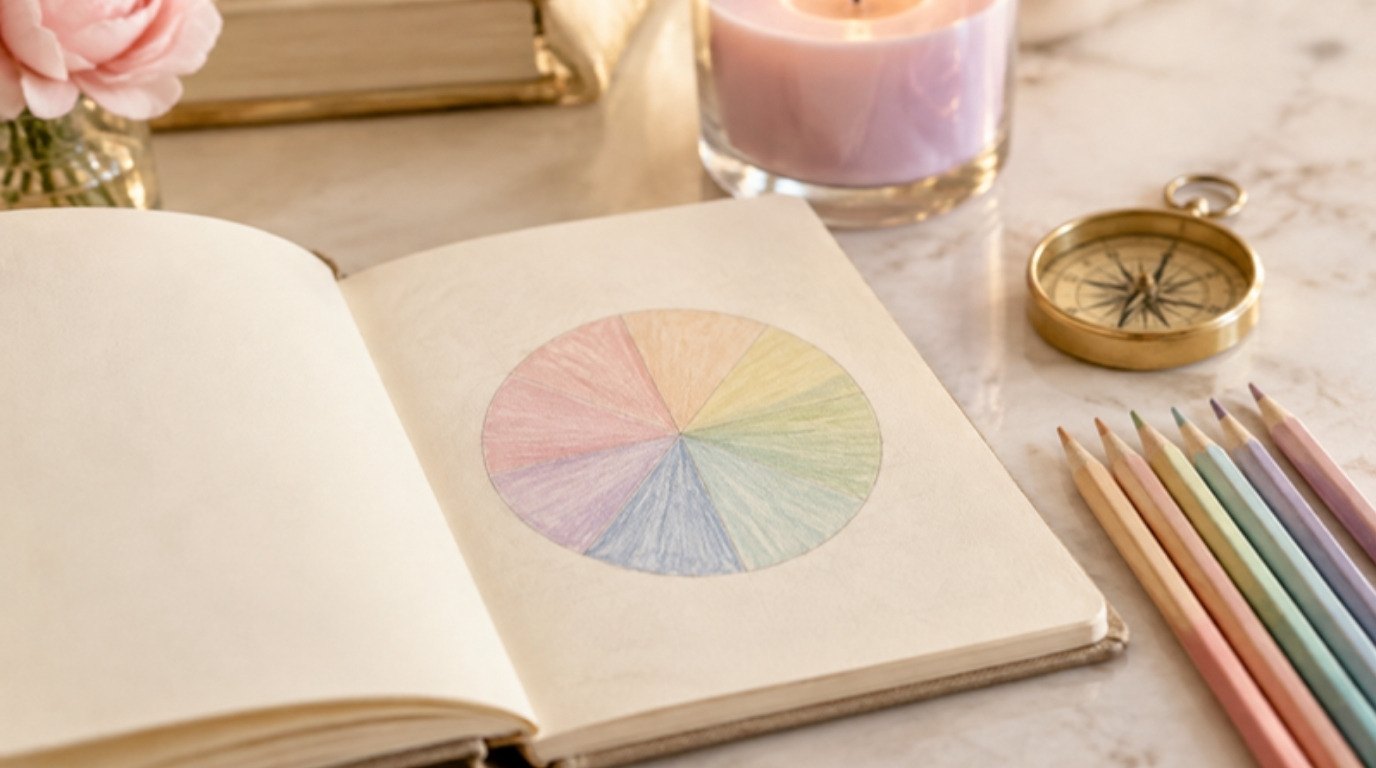
The wheel of life is one of the simplest ways to see your whole life on a single page. Instead of asking "Am I doing okay?" (a question that usually gets a vague, tired answer), it asks eight smaller questions, one for each part of your life, and then turns your answers into a shape you can actually look at.
That shape is the useful part. A list of feelings is easy to argue with. A wobbly, lopsided wheel is very hard to ignore, and it tends to point gently and clearly toward the one or two areas that would make everything else feel lighter.
In this guide, you'll learn how to use the wheel of life step by step: the eight life areas, how to sketch your wheel on paper, how to score each area truthfully, how to read your wheel shape without judging yourself, and how to turn it into one or two small goals you re-check every month. It takes about 20 minutes, and you don't need to be in a "big planning" mood to do it.
What Is the Wheel of Life?
The wheel of life is a circle divided into slices, like a pie. Each slice stands for one area of your life. You give each area a score from 1 to 10 based on how satisfied you feel with it right now, mark that score inside the slice, and connect the marks. The result is your "wheel."
If every area scored a 10, you'd have a perfect round wheel. Nobody has that, and nobody needs to. Real wheels have dents and bumps, and that's exactly what makes them useful. A dent shows you where a little care would help. A bump shows you something that's going well and worth protecting.
Coaches have used versions of this tool for decades because it does one thing beautifully: it shows balance. Not perfection, not productivity, just how evenly your attention and energy are spread right now.
The 8 Areas of the Wheel of Life
You'll see many versions online, but these eight areas cover most of what makes a life feel full. Keep them as they are for your first try; you can rename them later to fit you.
- Health – sleep, movement, energy, how your body feels day to day.
- Career – your work, studies or main daily role, and how meaningful it feels.
- Money – how secure and in control you feel with your finances.
- Relationships – your romantic life, or your relationship with being single.
- Family and friends – connection, support, time with the people who matter.
- Fun – play, hobbies, rest that actually feels restful, things you do just because you enjoy them.
- Personal growth – learning, reflection, becoming more of who you want to be.
- Home and environment – your space, your neighborhood, how your surroundings support you.
If one area doesn't apply to your life at the moment, swap it for something that does (spirituality, creativity, community). The wheel is yours.
Why a Wheel Works Better Than a List
A list puts things in order, so the first item always feels most important. A wheel puts everything side by side, which is closer to how life actually works. Your health affects your career, your money affects your fun, your home affects your mood.
The circle also makes your brain look at areas you'd normally skip. It's very easy to spend a whole year thinking about work and never once ask yourself how much fun you're having. On a wheel, that empty "fun" slice is right there, waiting.
And there's something calming about a picture. When I'm anxious, long lists of everything I should improve make me feel worse. A simple drawing feels like information, not a to-do pile.
How To Sketch Your Wheel of Life on Paper

You can find digital versions, but drawing it by hand slows you down in a good way. Here's how:
- Draw a circle. Make it big, about the size of a side plate. A gold-edge ruler and compass set makes a neat circle, but tracing around a small bowl works just as well.
- Divide it into 8 slices. Draw a vertical line, a horizontal line and two diagonals through the center.
- Label each slice on the outside edge with one life area.
- Mark a scale. The center is 0, the outer edge is 10. You don't need to draw every number; a small dot halfway (5) is enough to guide your eye.
Draw it on a fresh page of a cream linen notebook you can keep and look back at. Seeing last month's wheel next to this month's is half the fun.
For color, a set of pastel colored pencils is lovely. Give each area its own shade, or keep it simple: one color for this month, another for next month, so the two shapes overlap on the same circle.
How To Score Each Area From 1 to 10

Scoring is where people get stuck, usually because they're trying to be "right." There is no right score. There's only your honest feeling today. Give yourself about ten minutes for all eight areas.
Score How It Feels, Not How It Looks
Your score is about satisfaction, not achievement. Someone with a big job title might give career a 4. Someone in a simple role they love might give it a 9. Both are correct. Ask: "How content am I with this area right now?" and go with your first answer.
Use a Simple Scoring Scale
If numbers feel slippery, use this scale as a guide:
- 1–3: This area feels heavy, neglected or painful.
- 4–6: It's okay. Some good parts, some things I'd change.
- 7–8: It feels good. A few small wishes.
- 9–10: I wouldn't change much at all.
Score the last month, not your whole life. "How has money felt this past month?" is far easier to answer than "How is my financial life?" Mark each score as a dot inside its slice.
The Wheel of Life Scoring Table
This is the heart of the guide. For each area, there's a sample question to help you score it, a small goal idea if that area comes out low, and a quick monthly check to see whether it's moving. Screenshot it and keep it next to your wheel.
| Life area | Sample question to score it | Small goal idea | Monthly check |
|---|---|---|---|
| Health | How rested and energetic have I felt most days? | Lights out by the same time on five nights a week | How many nights did I keep it? |
| Career | Does my work feel meaningful or at least manageable? | Ask for one piece of feedback or learn one new skill | Did I take one step that made work feel better? |
| Money | Do I know where my money goes, and do I feel calm about it? | Review spending for 15 minutes every Sunday | Did I check in at least three times? |
| Relationships | Do I feel loved, seen and at peace in my love life (or single life)? | Plan one unhurried evening of connection or solo self-care each week | Did those evenings actually happen? |
| Family and friends | Do I feel connected and supported? | Message or call one person I miss every week | Who did I reach out to this month? |
| Fun | When did I last do something just because I enjoy it? | Book one hour of pure play or a hobby every weekend | Did I protect that hour? |
| Personal growth | Am I learning or growing in a way that excites me? | Read ten pages or journal for ten minutes three times a week | What did I learn or notice about myself? |
| Home and environment | Does my space help me relax and feel like myself? | Reset one small corner for ten minutes each evening | Does my space feel calmer than last month? |
The goals here are deliberately small. A small goal you keep beats a big goal you abandon in week two, every single time.
Join the Dots and Look at Your Wheel Shape

Now connect your eight dots with a line, going around the circle. Shade the area inside if you like. What you see is your wheel shape.
Take a minute to just look before you analyze. A few common shapes and what they often mean:
- Small and round: everything is low but even. Often a sign of tiredness or a hard season rather than one specific problem. Start with health or fun.
- Big and round: life feels balanced and good. Your goal is protecting what works.
- Spiky: some areas are thriving while others are close to empty. Very common when work or caregiving takes up most of your energy.
- One deep dent: a single area is pulling everything down. That's usually the clearest place to begin.
Imagine your wheel actually rolling. A spiky wheel gives a bumpy ride. That's often exactly how life feels when the shape looks like that, which is oddly reassuring: the tiredness has a reason.
How To Read Your Results Without Judging Yourself
This is the part that matters most, and also the part where it's easiest to be hard on yourself. Here's how to read your wheel kindly and usefully.
Low Scores Are Not Failures
A 3 in money doesn't mean you're bad with money. A 2 in fun doesn't mean you're boring. A low score is simply a signal: "this area hasn't had much care lately." Often there's a very good reason, like a demanding job, a move, looking after someone else or a long stretch of low energy.
If you notice a sting when you see a low number, try saying it as a fact: "Fun is at a 3 right now." Right now is the key phrase. Scores change, sometimes within weeks.
Find the Area That Lifts the Others

Here's the question that turns a wheel into a plan: "Which one area, if it went up by two points, would lift several others with it?"
Health is a classic example. Better sleep often lifts career (more focus), relationships (more patience) and fun (more energy to enjoy things). Money is another: feeling calmer about spending can lift home, relationships and personal growth. Look at your lowest two or three areas and ask which one is a "lever."
Very often, the area that lifts the others isn't your lowest score. It's the one that quietly feeds everything else.
Compare It With What You Value Most
A low score only matters if the area matters to you. If you score career a 5 but your heart is set on family right now, that 5 might be perfectly fine. If you score personal growth a 4 and learning is one of your deepest values, that dent deserves attention.
Pick your top three values and write them next to your wheel. If you're not sure what they are, this core values list helps you narrow 100 values down to your top five. Then look for areas that score low and connect to a value. That's your sweet spot.
If your wheel shows work taking over every other slice, my guide on achieving a healthy work-life balance has practical ways to win some of that space back.
From Wheel to Goals in 3 Steps
Here's where the wheel of life becomes a goal-setting tool. Three small steps, and the most important rule is in the first one.
1. Pick One or Two Areas Only

It's tempting to fix all eight at once. Please don't. Spreading your energy across every dent means none of them actually changes. Choose one area (two at most) for the next month, ideally the "lever" area you found above.
Write it in your planner as a monthly focus. An undated monthly planner works well for this, because you can start any month and the pages don't go to waste if you take a break.
2. Set One Small Goal for Each
For each chosen area, set one goal small enough to start this week. Use the table above for ideas, or write your own with this simple formula:
"This month, I will [small action] [how often] so that [area] feels [how you want it to feel]."
For example: "This month, I will put my phone in the kitchen by 10 p.m. on weeknights so that my health feels more rested."
If you'd like to make it more precise, the SMART goals formula pairs really well with the wheel. And if you need more ideas sized for a single month, this list of monthly goals ideas has 60 of them.
3. Re-Score Once a Month
At the end of each month, draw a fresh wheel (or use a new color on the same circle) and score all eight areas again. It takes ten minutes. Then ask three quick questions:
- Did my focus area move, even by one point?
- Did any other area move with it?
- Do I keep the same focus next month or choose a new one?
A one-point rise is real progress. Celebrate it. If nothing moved, make your goal smaller, not bigger. That's not failure; it's adjusting the size until it fits your actual life.
Wheel of Life vs a Full Life Audit

People often mix these two up, so here's the difference.
The wheel of life is a quick visual check. It takes about 20 minutes, shows you where your life feels balanced or lopsided right now, and helps you pick one or two small monthly goals. You can repeat it every month.
A life audit is a deeper review. It looks at your whole life, your habits, commitments and big decisions, often over a weekend or several evenings. It's the right tool when you're facing a bigger turning point. My guide to doing a life audit walks you through that longer process.
They work beautifully together. Do a life audit once or twice a year, and use the wheel of life every month in between to stay on track. And if your wheel points to one area where a big decision is waiting (a career move, for example), a personal SWOT analysis is a good next step for thinking it through.
Make Your Wheel a Monthly Ritual

The wheel works best when it becomes a small, pleasant habit rather than a test. A few ideas to make it something you look forward to:
- Pick a fixed day. The last Sunday of the month or the first evening of a new month both work well.
- Make it cozy. Evening tea, soft music and a lavender desk candle turn twenty minutes of reflection into something calming.
- Keep every wheel. Date each one and keep them in the same notebook, so you can flip back and watch your shape change over the seasons.
- Write one line underneath. "What I'm proud of this month" or "What I want more of next month." One sentence is enough.
- Be flexible. Skipped a month? Just do it next month. The wheel is still there.
I like doing mine after tea, when the house is quiet and I can journal for a few minutes afterward. It's become one of those small rituals that makes a busy month feel a little more mine.
One gentle note: if several areas stay very low for a long time and life feels heavy most days, please be kind to yourself and consider talking to a therapist or doctor. A wheel can show you where it hurts, but you don't have to fix it alone.
Final Thoughts
The wheel of life isn't about making every slice perfect. It's about seeing your life clearly, giving a little care to the area that needs it most and noticing how one small change can make the whole ride smoother.
Draw your circle, score it honestly and choose one small goal. Next month, your wheel will show you exactly how far you've come.